|
TRANSLATE THIS ARTICLE
Integral World: Exploring Theories of Everything
An independent forum for a critical discussion of the integral philosophy of Ken Wilber
  Frank Visser, graduated as a psychologist of culture and religion, founded IntegralWorld in 1997. He worked as production manager for various publishing houses and as service manager for various internet companies and lives in Amsterdam. Books: Ken Wilber: Thought as Passion (SUNY, 2003), and The Corona Conspiracy: Combatting Disinformation about the Coronavirus (Kindle, 2020). Frank Visser, graduated as a psychologist of culture and religion, founded IntegralWorld in 1997. He worked as production manager for various publishing houses and as service manager for various internet companies and lives in Amsterdam. Books: Ken Wilber: Thought as Passion (SUNY, 2003), and The Corona Conspiracy: Combatting Disinformation about the Coronavirus (Kindle, 2020).
Check out my other conversations with ChatGPT
Deep Dive Wilber Books: The Four Faces of Truth Integral Semiotics Revolutionary Social Transformation Integral Politics The Many Ways We Touch An Integral Age at the Leading Edge The Deconstruction of the World Trade Center Who Ate Captain Cook? Toward a Comprehensive Theory of Subtle Energies When 9/11 Became a MemeA Critical Review of Ken Wilber's 'The Deconstruction of the World Trade Center'Frank Visser / ChatGPT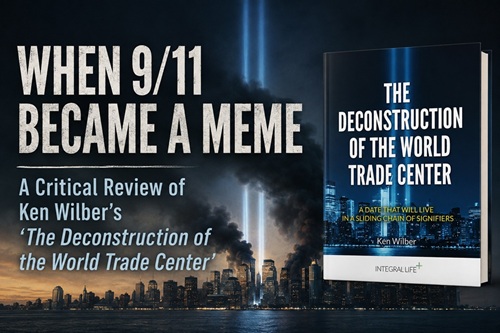 Ken Wilber's The Deconstruction of the World Trade Center—A Date That Will Live in a Sliding Chain of Signifiers is one of the strangest documents in his oeuvre. Written in the immediate aftermath of September 11, 2001, and subsequently presented as an extended endnote to his novel Boomeritis, it attempts to do something extraordinarily ambitious: interpret the terrorist attacks through the entire developmental spectrum of Spiral Dynamics, integrate political analysis with AQAL theory, and finally place the event within a mystical vision of Spirit, nonduality, and the “basic All Rightness” of the Kosmos. The result is simultaneously revealing, entertaining, intellectually provocative—and deeply problematic. The booklet is particularly interesting today because it captures Wilber at a crucial moment. He is moving from the developmental and cultural criticism of his earlier work toward the more explicitly political and spiritual formulations that would characterize Integral Institute and later Integral Theory. The September 11 attacks provide him with an almost perfect test case for his emerging framework: a world-shattering event that evokes radically different moral, political, cultural, psychological, and spiritual responses. Wilber's central claim is that these responses are not simply competing opinions. They are expressions of different developmental levels of consciousness. Red responds with rage and revenge; blue with good versus evil; orange with an assault on civilization and freedom; green with compassion, relativism and self-criticism; yellow and turquoise supposedly transcend and include all of these perspectives. The ultimate integral response, meanwhile, is grounded in the Prime Directive: “protect and promote the greatest depth for the greatest span.” This is an ingenious framework for describing differences in perspective. But as an explanation of September 11—and especially as an explanation of terrorism, political conflict and postmodernism—it repeatedly crosses the boundary between interpretation and ideological classification. The event becomes less an occasion for investigating history than a gigantic illustration of Wilber's developmental theory. And that is both the strength and the fundamental weakness of the booklet. An event reduced to a developmental dramaWilber begins with an important insight: people did not respond to September 11 in the same way. Some wanted revenge. Others interpreted it as an attack on America, on civilization, on capitalism, on Western imperialism, or on humanity itself. His spectrum model provides a useful vocabulary for understanding why the same event can activate very different moral intuitions. There is something genuinely valuable here. Political disagreement is often not simply disagreement about facts. It can involve different assumptions about what counts as relevant, what constitutes responsibility, and what kinds of values deserve priority. Wilber's insistence that we should examine these underlying structures is one of the booklet's strongest contributions. The problem begins when the developmental map is treated as an explanatory hierarchy rather than as a heuristic. The red response is presented as “rage and revenge”; blue as authoritarian moral absolutism; orange as individual freedom, capitalism and civilization; green as pluralism and compassion; yellow as systemic integration. This is rhetorically effective because it turns political differences into a developmental drama. But it also risks explaining away substantive disagreements by assigning them to levels of consciousness. A person who supports military retaliation can thereby be described as “red” or “blue.” A critic of American foreign policy can be classified as “green.” The integral theorist, by contrast, occupies the privileged position from which all these partial perspectives can supposedly be understood. This creates a structural problem: the theory appears to validate itself. If someone disagrees with the integral interpretation, the disagreement can itself be interpreted as evidence that the person is operating from a lower developmental level. That is a very difficult epistemological position to escape. The attack on “boomeritis”The most controversial part of the booklet is undoubtedly Wilber's attack on postmodernism. The terrorist attacks, he argues, exposed the contradictions of what he calls “boomeritis”: green pluralism contaminated by red narcissism. The argument is strikingly simple. Extreme postmodern pluralism allegedly denies universal standards and regards all cultures as equally valid. It therefore cannot adequately condemn terrorism when terrorism is committed by members of a supposedly oppressed “Other.” Postmodernism's celebration of cultural difference consequently becomes, in pathological form, an intellectual environment in which terrorism can be rationalized. Wilber goes so far as to claim that “boomeritis became the language of deconstruction, of tearing down, of terrorism everywhere.” This is the weakest major argument in the booklet. There is a legitimate criticism buried inside it. Some forms of cultural relativism can indeed make moral judgment difficult. And there certainly were postmodern writers who were hostile to universalist claims and suspicious of Western power. Wilber is also right that an adequate critique of Western imperialism does not require romanticizing every non-Western political movement. But the leap from these observations to “boomeritis” as a significant intellectual precursor or accomplice of terrorism is much too large. The booklet repeatedly blurs several very different things: postmodern philosophy, cultural relativism, left-wing politics, identity politics, academic radicalism, anti-Westernism, New Age spirituality, and narcissistic psychology. Wilber places them on the same developmental continuum and then treats their alleged common structure as an explanation of their political consequences. The result is a sweeping caricature. Indeed, the list of supposed intellectual accomplices is extraordinary: Heidegger, Foucault, Derrida, Wittgenstein, Rorty, Edward Said, Lyotard, Baudrillard, Laclau, Mouffe, Žižek, Negri, Hardt, Stanley Fish, Susan Sontag and others. This is less an argument than an indictment. The problem is not merely that these thinkers differ enormously from one another. It is that Wilber rarely demonstrates a causal chain connecting their philosophical positions to the motivations of al-Qaeda. “Complicity” becomes a remarkably elastic category. He explicitly concedes that extreme postmodernists were not the actual cause of the terrorist attacks, but then maintains that they created an intellectual atmosphere in which terrorism could be justified. That claim requires considerably more evidence than the booklet provides. The pre/post fallacy becomes a universal solventWilber's concept of the “pre/post fallacy” is central to his criticism. He believes that postmodern pluralism frequently confuses preconventional and postconventional phenomena because both can appear anti-authoritarian. Thus a terrorist organization rejecting Western authority can be mistaken for a genuinely postconventional movement. A tribal culture can be romanticized because it is not modern. A violent rejection of conventional structures can masquerade as progressive liberation. There is a real philosophical issue here. Opposition to an existing order does not automatically make a movement progressive. A reactionary movement can be revolutionary in method while being deeply regressive in values. But Wilber's developmental scheme makes the analysis dangerously easy. Once “red,” “blue,” “orange,” and “green” become explanatory categories, almost every political phenomenon can be sorted into them. The Taliban becomes “red-blue.” Western liberalism becomes “orange-green.” Extreme postmodernism becomes “green infected with red.” Integral Theory becomes “yellow/turquoise.” This can illuminate patterns, but it can also flatten history. The actual causes of political violence are typically contingent and multilevel: political institutions, colonial histories, wars, economic interests, state repression, ideology, social networks, organizational structures, leadership, individual psychology and geopolitical circumstances. Wilber acknowledges this complexity rhetorically. He repeatedly insists that the causes of terrorism are “AQAL”—all quadrants, all levels, all lines. Yet the actual analysis remains surprisingly schematic. A more balanced Wilber emerges in the discussion of AmericaOne of the booklet's virtues is that Wilber does not simply produce a conventional post-9/11 defense of American power. He explicitly acknowledges American responsibility for contributing to global conditions that can foster terrorism. He recognizes the role of economic globalization and even discusses America's earlier support for militant forces in Afghanistan. Most importantly, he rejects the simplistic proposition that terrorism can be solved merely by military retaliation. His formulation is actually quite sensible at this point: military action may sometimes be necessary, but bombing or financial sanctions alone cannot address the larger cultural and developmental conditions that reproduce political violence. He also makes a valuable distinction between explaining terrorism and excusing it. The booklet argues that Western policies can contribute to the conditions in which terrorism emerges without thereby removing responsibility from the terrorists themselves. This is considerably more nuanced than either a simplistic “America caused it” argument or a simplistic “they hate our freedom” argument. Indeed, Wilber's criticism of both sides is sometimes genuinely insightful. Conservatives, he argues, tend to emphasize interior causes—character, values, religion, responsibility—while liberals tend to emphasize exterior causes—economic conditions, political structures and oppression. His proposed integral position would combine both. This is probably the booklet's most durable political insight. But the conservative/liberal binary is itself too schematicUnfortunately, Wilber immediately turns this insight into another developmental simplification. Conservatives supposedly focus on the Left-Hand quadrants and liberals on the Right-Hand quadrants. Conservatives emphasize interior development; liberals emphasize exterior reform. The integral position combines both. This is elegant. It is also far too neat. Real conservative and liberal traditions have never divided so cleanly. Conservatism contains economic liberalism, nationalism, traditional religion, institutionalism, communitarianism and various forms of state intervention. Liberalism contains classical liberalism, social democracy, egalitarianism, civil libertarianism and many competing views of individual responsibility. Wilber himself acknowledges that “liberal” and “conservative” have multiple meanings, but the subsequent analysis nevertheless depends heavily on the binary he has just constructed. More importantly, his developmental interpretation subtly privileges his own position. Liberalism is portrayed as an historically progressive movement from blue to orange and eventually green, but green then becomes trapped in “flatland.” Integral Theory arrives as the developmental solution that preserves the achievements of liberalism while transcending its limitations. The argument is elegant because the theory gets to define the terms of its own victory. “Integral politics” and the problem of enlightened elitismWilber's proposed alternative is “postliberal” and “postconservative” politics. It would integrate the entire developmental spectrum while also integrating the four quadrants. Such a political system would preserve the legitimate contributions of each level rather than privileging one. This is arguably the most interesting theoretical proposal in the booklet. Wilber describes it as both “vertical integration” across developmental levels and “horizontal integration” across interior and exterior dimensions. But here a serious political problem appears. Who decides what belongs where? Who determines that one value system is developmentally superior to another? Who identifies the “integral” leaders? And who prevents the claim to higher consciousness from becoming a justification for technocratic or spiritual elitism? Wilber openly acknowledges the problem. Integral politics, he says, is indeed a kind of managerial elitism—but supposedly an elitism to which everyone is invited. That answer is not sufficient. A hereditary aristocracy can be criticized because membership is closed. But a developmental aristocracy presents a subtler problem: its members can claim authority precisely because they allegedly possess a higher level of consciousness. Democratic disagreement can then be reinterpreted as developmental deficiency. The booklet itself admits that second-tier consciousness supposedly encompasses less than two percent of the population. That should have triggered much greater political caution. Instead, it becomes part of the mythology of the emerging “Integral Millennium.” The 2-percent problemThis passage is perhaps the most revealing in the entire document. Wilber's characters estimate that approximately 40 percent of Americans are blue, 30 percent orange, 20 percent green, and less than 2 percent second tier. They then recognize that an integral political program cannot simply be imposed on a democratic population that supposedly does not understand it. This is a genuine problem for Integral Theory, and Wilber deserves credit for seeing it. But he never solves it. The Constitution is invoked as the historical model: an allegedly developmentally advanced legal framework was imposed upon a population that had not yet fully internalized its values. The implication is that an “Integral Constitution” might someday do something similar for second-tier values. This is where developmental theory begins to acquire a potentially troubling political logic. The constitutional order can indeed embody principles that exceed the moral development of some citizens. But that does not establish that Integral Theory has identified objectively higher political principles in the same way that constitutional rights can be publicly justified. The analogy therefore conceals the central democratic question: developmental ranking is not the same thing as political legitimacy. The most problematic sentence in the booklet: “all is right”The final third of the booklet moves from political theory into mystical theology. Here the prose becomes increasingly ecstatic. The terrorist attacks are incorporated into a vision of the “World Soul,” the “basic All Rightness” of the Kosmos, the divine Ground, the Witness and finally nondual consciousness. At first, this produces something genuinely moving. Wilber insists that spiritual realization should not produce emotional indifference. On the contrary, the mystic can experience immense compassion and grief while simultaneously recognizing the unity of existence. That is a serious spiritual insight, and it prevents the usual caricature of nonduality as emotional detachment. But Wilber's language repeatedly approaches a dangerous metaphysical ambiguity. If everything is ultimately “All Right,” what happens to moral evil? Wilber tries to preserve ordinary moral distinctions. The opposites are united but not obliterated; one should still “do good, avoid evil,” right injustice and eradicate terrorism. Yet the later nondual passages push much further. The Witness is described as untouched by events; “nothing ever happens”; the terrorist and the victim are both expressions of the same ultimate Self; and in the language of “One Taste,” even good and evil are ultimately dissolved into a nondual identity. This creates a tension the text never satisfactorily resolves. At the relative level, Wilber wants to make moral judgments. At the ultimate level, he wants to dissolve the very distinctions on which moral judgment depends. The traditional mystical solution is not necessarily incoherent, but it requires careful differentiation between ontological nonduality and ethical duality. Wilber's rhetoric sometimes moves too quickly between the two. The Auschwitz problemThe booklet itself seems aware of this danger, but its solution is inadequate. Wilber repeatedly insists that nonduality does not mean passivity. One must still act to reduce suffering. Indeed, the Prime Directive is supposed to reconcile the paradox: promote the greatest depth for the greatest span. This is an attractive ethical formula. But it does not follow from nondual realization alone. There is no logical bridge demonstrated between “all phenomena arise within one ultimate Ground” and “therefore we should promote developmental flourishing.” The latter is a normative commitment. Wilber can certainly adopt it, but he cannot simply derive it from metaphysical nonduality without further argument. This is one of the recurring problems in Wilber's philosophy: metaphysical claims, developmental psychology and ethical prescriptions are woven together so tightly that the transitions between them become almost invisible. The failure of predictionThere is another reason this booklet is especially interesting today. Wilber makes several confident historical predictions. Most notably, he announces that September 11 has effectively killed extreme postmodernism. Deconstruction has supposedly been “felled at the knees,” pluralistic relativism has suffered a fatal blow, and the era of boomeritis is coming to an end. This prediction has not aged well. Postmodern and poststructuralist ideas did not disappear after 9/11. Nor did relativism, identity politics, discourse theory or academic suspicion toward universalist narratives. They continued to evolve, mutate and influence intellectual and political culture. The prediction therefore illustrates a larger weakness in Wilber's developmental historiography: it tends to interpret history teleologically. Events become evidence that consciousness is moving from one stage toward another. But history is not obliged to follow the Spiral. September 11 did not announce the death of postmodernism. Nor did it inaugurate an Integral Millennium. It inaugurated a period of war, securitization, geopolitical instability, surveillance, polarization and eventually a series of conflicts whose consequences were far more complicated than Wilber's developmental narrative anticipated. The booklet's historical confidence is therefore one of its least convincing features. The strange case of IslamWilber's discussion of Islam is particularly revealing of the limitations of his framework. He describes Islam as perhaps the most “recalcitrant” surviving blue-meme structure and argues that it requires a self-critical hermeneutic comparable to developments within Christianity and Judaism. At the same time, he appeals positively to Sufi and Neoplatonic strands within Islam as possible resources for further development. There is something constructive here: Wilber is not simply treating Islam as intrinsically violent. He explicitly recognizes “wonderful exceptions” and points toward Rumi and al-Hallaj as resources for spiritual development. But the analysis remains deeply Eurocentric. Islam is primarily evaluated according to how closely it approximates a developmental sequence whose normative endpoint has already been defined by Wilber. The implicit trajectory runs from mythic religion through modern rationality to postmodern pluralism and finally Integral spirituality. That makes the framework less genuinely intercultural than it initially appears. Instead of allowing Islamic intellectual history to challenge the developmental model, Wilber tends to ask where Islamic traditions fit within it. The booklet's literary form is part of the problem—and part of the funIt is important not to overlook the peculiar literary structure. Wilber explicitly warns readers that the text is an endnote to Boomeritis, not a conventional essay. He acknowledges that the characters are intentionally flat and that the dialogue is partly a parody of postmodern fiction. This explains much of what might otherwise appear simply embarrassing. The characters are essentially developmental voices wearing human costumes. Derek Van Cleef is rage and sarcasm. Margaret is compassion. Lesa is analytical integralism. Joan is mystical consciousness. The dialogue therefore functions less like genuine conversation than like a theatrical presentation of Wilber's internal system. Once understood this way, the literary device becomes more interesting. The entire dinner conversation is essentially an Integral Theory psychodrama. But it also removes an important test. Because every character ultimately operates inside Wilber's conceptual universe, the theory is rarely forced to encounter a genuinely autonomous opposing argument. The characters disagree, but they disagree within the architecture of the system. That makes the text lively but intellectually closed. The genuinely valuable coreDespite these criticisms, it would be unfair to dismiss the booklet. Its best idea is remarkably simple: catastrophic events should not be interpreted through a single explanatory lens. Wilber is right to resist both the conservative reduction of terrorism to evil individuals and the liberal reduction of terrorism to Western oppression. He is right that economic structures, cultural values, psychology, political institutions and historical circumstances can all matter simultaneously. His AQAL language is unnecessarily elaborate, but the underlying intuition is sound. He is also right that compassion and moral judgment need not be enemies. A mature response can recognize the humanity of perpetrators without excusing their actions. It can recognize Western responsibility without denying terrorist responsibility. It can oppose violence while recognizing that force may sometimes be necessary. His proposed formula—“greatest depth for the greatest span”—is similarly useful as a heuristic for policy thinking, provided it is treated as a principle to be debated rather than as a metaphysical commandment. The problem is that Wilber does not leave it at that. He embeds these useful insights in a much larger developmental-metaphysical system whose empirical and philosophical foundations remain insufficiently established. What the booklet reveals about Wilber himselfPerhaps the most interesting feature of The Deconstruction of the World Trade Center is not what it says about September 11. It is what it reveals about Ken Wilber. The terrorist attacks became the occasion for him to consolidate virtually every major component of his emerging worldview: Spiral Dynamics, developmental hierarchy, AQAL, the four quadrants, integral politics, boomeritis, the pre/post fallacy, Eros, the Prime Directive, the Big Three, transpersonal development, the Witness, nonduality and the ultimate identity of Spirit and Kosmos. In that sense, September 11 becomes almost secondary. The event is absorbed into Wilber's theory. That is precisely where the booklet becomes most questionable. A theory of everything is always in danger of becoming a theory that explains everything in its own terms. When a historical event can be interpreted at every developmental level, across every quadrant, and ultimately as another manifestation of Spirit, the framework becomes extraordinarily difficult to falsify. Its comprehensiveness becomes its weakness. Twenty-five years later: what remains?Read today, the booklet is neither prophetic masterpiece nor worthless historical curiosity. It is a revealing document from an important transitional moment in Integral Theory. Its critique of simplistic political binaries remains valuable. Its insistence that causes and solutions must be multidimensional remains relevant. Its distinction between explaining violence and excusing violence remains sound. Its attempt to reconcile compassion with effective action is worth taking seriously. But its diagnosis of postmodernism is vastly overstated. Its “boomeritis” thesis substitutes psychological and developmental labeling for historical explanation. Its developmental hierarchy is treated with far more confidence than its empirical foundation warrants. Its conception of integral political leadership raises unresolved questions about democratic legitimacy and epistemic elitism. And its mystical conclusion illustrates the perennial danger of allowing metaphysical nonduality to blur the ethical distinction between victim and perpetrator. Most revealingly, its confident prediction that 9/11 had effectively killed postmodernism has been falsified by subsequent intellectual history. The enduring lesson of the booklet may therefore be almost the opposite of the lesson Wilber intended. September 11 does indeed demand an integral response—but an integral response should include the possibility that Wilber's own categories are partial, historically situated and fallible. The real test of an integral theory is not whether it can find a place for every perspective inside its developmental map. It is whether the map itself can be subjected to the same critical scrutiny that it applies to everyone else. Wilber's booklet does not quite pass that test. And that is why The Deconstruction of the World Trade Center remains worth reading: not as the definitive integral interpretation of 9/11, but as an unusually concentrated demonstration of both the extraordinary reach and the characteristic blind spots of Wilber's Integral Theory.
Widget is loading comments...
|