|
TRANSLATE THIS ARTICLE
Integral World: Exploring Theories of Everything
An independent forum for a critical discussion of the integral philosophy of Ken Wilber
  Frank Visser, graduated as a psychologist of culture and religion, founded IntegralWorld in 1997. He worked as production manager for various publishing houses and as service manager for various internet companies and lives in Amsterdam. Books: Ken Wilber: Thought as Passion (SUNY, 2003), and The Corona Conspiracy: Combatting Disinformation about the Coronavirus (Kindle, 2020). Frank Visser, graduated as a psychologist of culture and religion, founded IntegralWorld in 1997. He worked as production manager for various publishing houses and as service manager for various internet companies and lives in Amsterdam. Books: Ken Wilber: Thought as Passion (SUNY, 2003), and The Corona Conspiracy: Combatting Disinformation about the Coronavirus (Kindle, 2020).
Check out my other conversations with ChatGPT
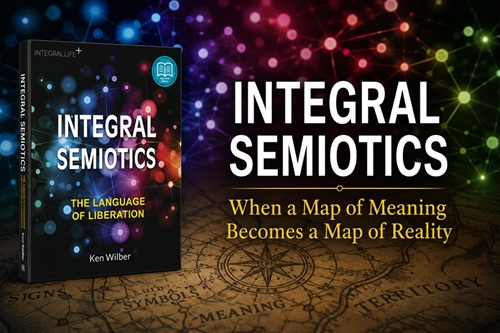
Deep Dive Wilber Books: The Four Faces of Truth Integral Semiotics Revolutionary Social Transformation Integral Politics The Many Ways We Touch An Integral Age at the Leading Edge The Deconstruction of the World Trade Center Who Ate Captain Cook? Toward a Comprehensive Theory of Subtle Energies Integral SemioticsWhen a Map of Meaning Becomes a Map of RealityFrank Visser / ChatGPT
Ken Wilber's Integral Semiotics is one of the more ambitious—and revealing—documents in his later body of work. Originally presented as an excerpt from the projected second volume of his Kosmos Trilogy, the booklet attempts to extend the AQAL framework into the domain of language, meaning, signs, symbols, interpretation, and ultimately spirituality. Its central claim is deceptively simple: words do not all refer to objects located in the same kind of reality. A word such as “dog” refers to something available in the sensorimotor world, while words such as “God,” “Buddha-nature,” “Spirit,” or “Emptiness” refer to phenomena disclosed in other “worldspaces.” To understand such a referent, Wilber argues, one must occupy the appropriate worldspace oneself. There is a genuinely interesting insight here. Human beings plainly do inhabit multiple domains of meaning, and many things that matter to us—mathematical objects, moral values, emotions, cultural norms, fictional entities, aesthetic experiences and religious experiences—cannot simply be pointed to in the same way as a chair or a tree. Wilber is therefore right to resist the crude equation of reality with physical location. His attempt to broaden the philosophical discussion beyond a narrowly physicalist conception of reference is worthwhile. But the booklet also illustrates a recurring problem in Wilber's work: a useful philosophical distinction is rapidly transformed into an elaborate metaphysical architecture, and the architecture is then presented as if it had established the truth of the metaphysics. Integral Semiotics begins as a theory about how signs acquire meaning and ends by offering a “Kosmic Address” for God. In between, semiotics becomes developmental psychology, developmental psychology becomes ontology, and ontology quietly becomes Wilber's preferred spiritual cosmology. The result is not really an integral theory of semiotics. It is, more accurately, an AQAL theory of spiritual interpretation that appropriates the vocabulary of semiotics to defend a pre-existing integral metaphysics. From Semiotics to AQALWilber begins with a useful survey of the semiotic tradition. He invokes Ferdinand de Saussure's distinction between signifier and signified, Charles Sanders Peirce's triadic conception of sign, object and interpretant, speech-act theory, Habermas, developmental structuralism and hermeneutics. This is an impressive list, and it reflects Wilber's longstanding talent for identifying intellectual traditions that can be incorporated into his larger synthesis. His decisive move, however, is to map the basic elements of semiotics onto the four AQAL quadrants. The signifier becomes Upper Right: the observable material word or symbol. The signified becomes Upper Left: the interior concept or apprehension. Syntax becomes Lower Right: the objective structure or system governing signs. Semantics becomes Lower Left: the shared cultural meaning in which signs are embedded. As an organizing metaphor, this is attractive. As a theory of semiotics, however, it is much less convincing. The problem is that Wilber treats conceptual correspondences as though they were discoveries of structural identity. That something can be described in four different ways does not establish that those four descriptions are ontologically equivalent to the four quadrants. AQAL has a powerful classificatory capacity precisely because almost anything can be redescribed in its vocabulary. But this flexibility is also its weakness. The quadrants can function as a useful heuristic without thereby becoming the underlying structure of the phenomena being classified. This distinction is crucial. A theory can say, “Here are four useful perspectives from which we might study language.” That would be methodological pluralism. Wilber repeatedly moves beyond this modest claim and suggests that the four dimensions are actually the constituent dimensions of the sign itself. He describes the signifier, signified, syntax and semantics as the “four ingredients” of meaning and proposes that adding developmental levels to the quadrants will yield the beginnings of a comprehensive Integral Semiotics. But this is not demonstrated. It is stipulated. The difference matters because genuine semiotic theories are concerned not merely with locating components in a fourfold matrix but with explaining semiosis: how signs function, how meaning is generated, how interpretation proceeds, how signs refer, how contexts alter meaning, how sign systems evolve, and how interpreters participate in an ongoing process of signification. Wilber's framework is much stronger at classifying these dimensions than at explaining their actual dynamics. This point has subsequently been made by scholars attempting to develop an Integral Semiotics of their own. Giorgi S. Giorgi, for example, acknowledges Wilber as having taken an important first step but observes that Wilber focuses primarily on the relationship between signs, referents and their “worldspaces,” whereas semiotics properly concerns the more complex process of semiosis—the production and interpretation of meaning. Giorgi also notes that Wilber sometimes appears to blur the distinction between referent and object. That is a serious criticism. The booklet is called Integral Semiotics, but its central concern is not really semiosis. It is ontology. The “Kosmic Address” of EverythingThe centerpiece of Wilber's proposal is the concept of the “Kosmic Address.” Every legitimate referent, he argues, has a location in the AQAL matrix. A dog can be located in the sensorimotor world; the square root of minus one belongs to a rational worldspace; Buddha-nature belongs to the causal worldspace. A full address can include quadrant, level, state, line, type, methodology and even the developmental position of the perceiving subject. The idea is ingenious. It attempts to solve a real philosophical problem: how can we distinguish between different kinds of reference without reducing everything to physical objects? Yet the “Kosmic Address” is also where the argument becomes increasingly circular. The reasoning runs roughly as follows: different kinds of phenomena are disclosed in different worldspaces; the AQAL system maps those worldspaces; therefore, if we know the AQAL location of a phenomenon, we know where to look for it. But the AQAL location is itself assigned by Wilber's theoretical model. The model therefore becomes both the map and the evidence that the mapped territory exists. Consider the square root of minus one. There is no serious problem in saying that mathematical entities belong to a conceptual or formal domain rather than occupying physical space. But Wilber's example does not establish that all nonphysical referents are therefore ontologically comparable. The ontological status of a mathematical object, a moral value, a fictional unicorn, a cultural norm, an altered state of consciousness and Buddha-nature cannot simply be placed on the same continuum because none of them has “simple location.” Indeed, Wilber explicitly says that unicorns, Santa Claus and the tooth fairy are “real” in the mythic worldspace, while acknowledging that they cannot be found in the sensorimotor or rational world. This is an important warning sign. Phenomenological reality, cultural reality, fictional existence and mind-independent existence are different philosophical categories. To call all of them “real” may be defensible under a carefully specified pluralist ontology. But merely assigning each a different quadrant and level does not provide that specification. The AQAL matrix risks becoming a universal filing cabinet in which every conceivable entity receives an address. And a filing system is not an ontology. The Crucial Confusion Between Access and RealityThe deepest problem in Integral Semiotics concerns the relationship between epistemology and ontology. Wilber repeatedly argues that a referent can only be encountered if the subject has developed the appropriate capacity to perceive it. A person who has not reached a certain developmental level cannot properly apprehend what someone at that level experiences. Hence a higher-level referent can be “over the head” of a lower-level subject. There is an obvious truth in this. A child cannot understand differential calculus merely because the relevant symbols are placed before her. A person unfamiliar with a musical tradition may fail to hear distinctions that an expert musician hears immediately. Someone who has never experienced grief may have a very different understanding of what grief means. Training, development, cultural participation and first-person experience clearly affect what humans can discriminate and understand. But Wilber repeatedly slides from the epistemological claim that “you need certain capacities to experience or understand X” to the ontological claim that “X exists as a particular phenomenon in the worldspace associated with those capacities.” That is precisely the move that requires argument rather than assertion. A phenomenon can be dependent on a mode of access without existing in the strong ontological sense Wilber sometimes implies. The fact that a person must undergo a certain practice before reporting an experience does not by itself establish that the experience corresponds to an independently existing metaphysical referent. Meditation can produce highly reproducible phenomenology without establishing that the metaphysical interpretation attached to that phenomenology is correct. This is especially important in Wilber's treatment of spirituality. From “God” to a Kosmic AddressThe booklet's real purpose becomes apparent when Wilber turns from ordinary signs to religious ones. He argues that the apparent problem with claims about God, Spirit or Buddha-nature is that modern empiricism searches for their referents in the wrong place. Since these referents do not have simple physical location, materialist methodologies allegedly dismiss them as unreal. The solution is to identify their appropriate Kosmic Address and undertake the necessary spiritual practice. Wilber therefore presents meditation and contemplation as injunctions that can move consciousness into the relevant worldspace, where the referent can supposedly be directly apprehended. This is an ingenious reformulation of Wilber's earlier “three strands” or “injunction, data, confirmation” approach to spiritual knowledge. It also contains something important: spiritual claims should not automatically be dismissed merely because they concern subjective experience. But the argument does not achieve what Wilber wants it to achieve. The fact that a contemplative practice reliably generates a particular experience establishes, at most, that the practice has particular phenomenological effects. It does not establish the metaphysical interpretation of those effects. Meditation may disclose experiences of unity, timelessness, boundlessness, luminosity or self-transcendence. Different religious traditions can then interpret those experiences as Brahman, emptiness, God, Buddha-nature, pure consciousness, divine union or something else entirely. The experience does not uniquely determine the ontology. This is where Wilber's semiotic apparatus becomes an epistemological shortcut. Instead of asking whether the metaphysical interpretation of a mystical experience is warranted, he assigns the experience a place in the AQAL matrix. Once “causal God” has been given the address “Q/1, S/c,” the appearance of precision can obscure the absence of independent validation. A coordinate system does not make its coordinates empirically real. The analogy with geography is misleading. If I give the latitude and longitude of Amsterdam, another person can independently travel there and confirm the location. But if I give “causal God” a Kosmic Address, there is no comparable procedure for establishing that the address identifies an ontologically independent entity rather than a particular class of human experience and interpretation. The proposed “address” therefore risks becoming a sophisticated restatement of the claim it was supposed to prove. The Apple and GodWilber's comparison between an apple and God makes the problem especially clear. He observes that when someone sees an apple, brain activity associated with seeing the apple is not normally taken to prove that the apple is imaginary. Yet when someone reports experiencing God, similar brain activity is sometimes interpreted as evidence that God is merely a construction of the brain. Wilber rightly points out that this asymmetry deserves examination. But the conclusion he draws is too strong. The fact that neural correlates do not logically entail that the experienced object is unreal does not establish that the object is metaphysically real. It merely establishes that neural correlation underdetermines the ontological interpretation. There is a perfectly reasonable middle position between “God is nothing but a brain state” and “God is a metaphysically real referent in the causal worldspace.” A naturalistic philosopher can say that religious experiences are genuine experiences generated by human brains and shaped by cultural expectations, while remaining agnostic about whether anything metaphysically transcendent corresponds to them. Conversely, a theist can argue that religious experience provides evidence for a transcendent reality. The philosophical work lies in evaluating those competing explanations. Wilber too quickly treats the inadequacy of reductive materialism as evidence for his own spiritual ontology. This is a recurring pattern in his writings: defeating a reductionist alternative is treated as if it established the integral alternative. It does not. The Problem with Developmental PerceptionThe developmental component introduces another difficulty. Wilber argues that higher developmental levels disclose phenomena unavailable to lower levels. Thus someone at a mythic stage may be incapable of apprehending a rational referent, while someone below the causal level cannot properly perceive Buddha-nature. Again, the modest version is unobjectionable. Human cognitive and cultural development clearly changes what people can understand. The stronger version, however, makes developmental hierarchy into an epistemic authority. If a critic says, “I do not see the causal referent you claim exists,” the integral response can become: “You cannot see it because you have not developed far enough.” This creates a potentially self-sealing system. The absence of evidence becomes evidence of insufficient development. That is methodologically dangerous. A scientific theory can certainly contain concepts that require training before they become intelligible. But the theory must ultimately provide criteria independent of the mere status of the person making the claim. Otherwise, “higher development” becomes an epistemic trump card. The person who occupies the allegedly higher level acquires privileged access to reality, while disagreement can be explained away as developmental deficiency. The danger becomes even greater because Wilber's own developmental hierarchy is not itself established by the semiotic argument. The levels are imported from his broader Integral Theory. They are then used to determine which referents are accessible at which levels. The model therefore validates itself. A Giga Glossary of the KosmosWilber eventually describes Integral Semiotics as an “Integral Giga Glossary” of possible referents, in which knowing a referent requires undertaking the injunctions necessary to bring its corresponding phenomenon forth. This is perhaps the most revealing formulation in the entire booklet. Wilber is proposing not merely a theory of language but a universal ontology of meaningful phenomena. Every important human experience is to receive its appropriate coordinate in AQAL space. The aspiration is encyclopedic: a complete map of the phenomena disclosed across quadrants, levels, lines, states and types. There is something admirable about the ambition. Wilber wants to prevent the systematic exclusion of dimensions of human experience merely because they do not fit a narrow scientific ontology. But the Giga Glossary also exposes the fundamental weakness of the project. The more dimensions Wilber adds, the greater the apparent precision becomes, but the greater the distance from ordinary empirical validation. “Kosmic Address” begins to resemble scientific notation without the corresponding measurement procedures. The terminology produces an impression of exactitude that the underlying epistemology cannot support. This is particularly visible in the increasingly elaborate formulas for the subject and object. Wilber proposes expressions such as a subject's quadrant and level multiplied by the object's quadrant and level, with further dimensions added for methodology, states and types. Such notation is rhetorically powerful because it makes the theory look almost mathematical. But notation is not quantification. Writing a phenomenon as (Q/1, L/12)o does not measure anything. It simply encodes Wilber's classification of that phenomenon. The notation is therefore a shorthand for theoretical assumptions rather than an independent method of discovering facts. The danger is what might be called pseudo-formalization: a conceptual system acquires increasingly formal symbols without acquiring the empirical or logical constraints that make formal systems powerful. Culture Wars and the Developmental HierarchyWilber also uses Kosmic Addressing to explain political and cultural conflict. The culture wars, he suggests, largely represent clashes between amber traditionalism, orange modernism and green postmodernism, with each level unable to understand the others properly. There is some explanatory value here. Developmental psychology can indeed illuminate why people operating with different moral frameworks, epistemic assumptions and cultural identities often talk past one another. But Wilber's explanation is again too neat. Political disagreement is not reducible to developmental altitude. People can share the same cognitive level while having radically different interests, information, identities, historical experiences and political commitments. A scientist and a religious fundamentalist may disagree because of epistemic commitments; two scientists can disagree because of different evidence; two postmodernists can disagree because of different political interests; and people at apparently similar developmental stages can hold incompatible moral judgments. Calling these disputes “cross-level miscommunication” risks turning a complex sociology of conflict into a developmental hierarchy. Worse, the hierarchy can function politically as a mechanism of intellectual self-validation. Those who agree with Wilber's integral interpretation can be classified as more advanced, while their critics can be located at lower stages. The theory then explains disagreement by ranking the disagreeing parties. That is precisely the kind of circularity a genuinely critical theory should avoid. The Interesting Idea Wilber Almost HasDespite these objections, it would be unfair to dismiss Integral Semiotics altogether. Its strongest contribution is the insistence that meaning is perspectival without being arbitrary. Human beings do not encounter a single undifferentiated “world” independently of their perceptual, linguistic, cultural and developmental capacities. What counts as salient, intelligible or meaningful depends heavily upon the form of life in which the observer participates. This insight has substantial precedents outside Integral Theory. Developmental psychology, phenomenology, hermeneutics, sociology of knowledge, pragmatism, cultural anthropology and contemporary cognitive science all provide sophisticated accounts of how perception and meaning are structured. Wilber's contribution is to attempt to place these insights inside a single framework. The problem is that he does not stop there. He converts “different modes of access disclose different aspects of experience” into “different worldspaces contain different kinds of referents.” He then converts those worldspaces into AQAL coordinates, and finally uses those coordinates to validate the spiritual ontology with which he began. The conceptual trajectory is therefore: experience → interpretation → worldspace → ontology → Kosmic Address. Each transition requires justification, but Wilber tends to treat the transitions as self-evident. What a Genuine Integral Semiotics Would RequireA genuinely Integral Semiotics could be much more modest—and ultimately much more powerful. It could begin with the insight that signs operate simultaneously at several levels: material, psychological, social, cultural, embodied and pragmatic. It could investigate how linguistic meaning depends on biological capacities, individual cognition, interpersonal interaction, social institutions and cultural histories. It could integrate Saussurean structuralism, Peircean semiosis, pragmatics, hermeneutics, cognitive linguistics, developmental psychology and social semiotics without assuming in advance that AQAL provides the final ontology. Most importantly, it would distinguish between three questions that Wilber tends to merge. First: what does a sign mean? Second: what experience or phenomenon does a sign successfully refer to? Third: what is the ontological status of that phenomenon? These questions are related, but they are not identical. The word “God” has a meaning. People have experiences to which they apply the word “God.” Cultures have elaborate symbolic systems surrounding the concept. Mystics report distinctive experiences associated with it. None of these facts, individually or collectively, automatically settles the question of whether God exists as an independently existing metaphysical reality. That final question requires another argument. Wilber's Integral Semiotics is most persuasive when it addresses the first two questions. It becomes much less convincing when it presents its semiotic machinery as an answer to the third. The Ultimate ReferentThe final irony is that Wilber himself recognizes a limit to his semiotic approach. When discussing ultimate nonduality, he admits that the Ultimate cannot be captured by ordinary signification because concepts depend upon oppositions, whereas nonduality has no opposite. This is arguably the most philosophically defensible part of the later booklet. If ultimate reality is genuinely nondual, then attempting to give it a precise coordinate in an AQAL matrix is already problematic. A coordinate presupposes differentiation: here rather than there, this level rather than that level, this quadrant rather than another. Yet the Ultimate, as Wilber himself describes it, is not another object alongside other objects. Here the semiotic critique turns back upon the integral system itself. If the Ultimate cannot be reduced to a referent, then it cannot straightforwardly receive a Kosmic Address. If it can receive a Kosmic Address, then it has become one more item within the classificatory universe of AQAL. Wilber wants both claims simultaneously: the Ultimate is beyond all distinctions, yet the integral map can tell us exactly where particular manifestations of Spirit belong. That tension is never completely resolved. Conclusion: A Brilliant Extension of the Map, Not a Validation of the TerritoryIntegral Semiotics is an intellectually ambitious and occasionally illuminating extension of Wilber's AQAL framework. Its strongest insight is that meaning cannot be reduced to physical reference and that different human capacities, cultural contexts and modes of experience disclose different dimensions of significance. Its emphasis on methodological pluralism and on taking first-person experience seriously remains valuable. But the booklet overreaches dramatically. Wilber takes the legitimate observation that different experiences require different interpretive and experiential frameworks and turns it into a theory of multiple ontological worldspaces. He then assigns those worldspaces developmental levels and AQAL coordinates. Finally, he uses those coordinates to place spiritual entities such as God and Buddha-nature on apparently equal ontological footing with ordinary physical objects. That final move is not established by semiotics. The “Kosmic Address” is a clever metaphor, but it is not a demonstrated ontology. The AQAL coordinates classify phenomena according to Wilber's own theoretical assumptions; they do not independently establish those phenomena. Developmental access can explain why people perceive and interpret things differently, but it cannot by itself establish that higher-level experiences disclose metaphysically higher realities. And spiritual practice can establish the reproducibility and richness of certain experiences without automatically validating the metaphysical interpretation attached to them. The most serious problem, therefore, is not that Wilber takes spirituality seriously. It is that he attempts to smuggle a particular spiritual metaphysics into semiotics under the cover of methodological sophistication. The booklet begins by asking a legitimate question: where do the things we talk about actually exist? Its answer is: wherever AQAL says they exist. That is the point at which a theory of signs becomes a theory of everything. And once that happens, the “Kosmic Address” ceases to be a method for discovering reality. It becomes an address book for a reality that Wilber has already decided is there.
Widget is loading comments...
|