|
TRANSLATE THIS ARTICLE
Integral World: Exploring Theories of Everything
An independent forum for a critical discussion of the integral philosophy of Ken Wilber
  Frank Visser, graduated as a psychologist of culture and religion, founded IntegralWorld in 1997. He worked as production manager for various publishing houses and as service manager for various internet companies and lives in Amsterdam. Books: Ken Wilber: Thought as Passion (SUNY, 2003), and The Corona Conspiracy: Combatting Disinformation about the Coronavirus (Kindle, 2020). Frank Visser, graduated as a psychologist of culture and religion, founded IntegralWorld in 1997. He worked as production manager for various publishing houses and as service manager for various internet companies and lives in Amsterdam. Books: Ken Wilber: Thought as Passion (SUNY, 2003), and The Corona Conspiracy: Combatting Disinformation about the Coronavirus (Kindle, 2020).
Check out my other conversations with ChatGPT
A FRESH LOOK AT OLD CONCEPTS: The Holon Four Quadrants The Kosmos Pre/Trans Fallacy Involution and Evolution Science and Religion The Twenty Tenets The Limits of HolismA Critical Essay on Ken Wilber's Twenty TenetsFrank Visser / ChatGPT
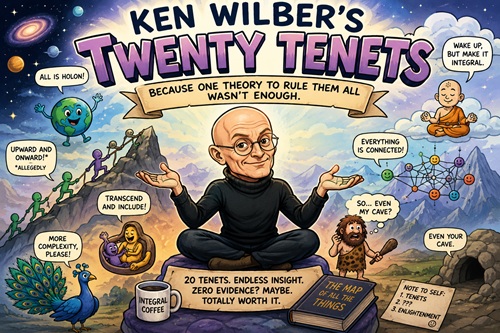 The following commentary examines each of Wilber's first twelve tenets individually. Rather than dismissing them outright, it evaluates their philosophical strengths, scientific plausibility, and conceptual weaknesses. 1. Reality as a whole is not composed of things, or processes, but of holons.This is Wilber's foundational proposition. Everything is simultaneously a whole in itself and part of a larger whole. As a philosophical metaphor, the concept is remarkably powerful. Molecules are part of cells; cells are part of organs; people belong to families, societies, and ecosystems. The idea captures the nested nature of much of reality. The problem is its claim to universality. Many complex systems are not neatly nested but networked. The internet, ecosystems, financial markets, language, and social media exhibit overlapping relationships rather than clean hierarchies. Network science increasingly emphasizes distributed interactions instead of hierarchical nesting. Moreover, declaring that reality is composed of holons is a metaphysical assertion rather than an empirical discovery. It cannot be experimentally verified. Assessment: A useful organizing concept, but too broad to function as a universal ontology. 2. Holons display four fundamental capacitiesa. Self-preservationEvery holon attempts to maintain its own integrity. This clearly applies to organisms and many living systems. Cells repair themselves, animals seek survival, and organizations attempt continuity. However, extending this principle to atoms, galaxies, or abstract systems is largely metaphorical. Atoms do not "preserve" themselves in any intentional sense. Assessment: Strong for biology; questionable when generalized to all levels of reality. b. Self-adaptationHolons adapt to changing environments. Again, this accurately describes biological evolution and many social systems. Yet physical objects simply obey physical laws rather than adapting in any meaningful sense. Rocks do not adapt to erosion. Wilber often blurs adaptive biological systems with non-living physical systems. Assessment: Scientifically robust within biology, less convincing as a universal principle. c. Self-transcendenceHolons generate new forms beyond themselves. This refers to emergence. Complexity science certainly recognizes emergence. Molecules produce life; neurons produce consciousness; individuals produce societies. The difficulty lies in treating emergence as an intrinsic drive rather than an occasional consequence of interacting systems. Nature also exhibits extinction, collapse, simplification, and equilibrium. Assessment: Emergence exists, but "self-transcendence" may anthropomorphize natural processes. d. Self-dissolutionHolons eventually disintegrate. This is perhaps the least controversial of the four capacities. Stars die. Species go extinct. Cells undergo apoptosis. Organizations collapse. Individuals perish. Everything appears temporary. However, whether dissolution is an active capacity of holons or simply a consequence of entropy is debatable. Assessment: Generally compatible with modern science. 3. Holons emerge.Emergence is one of the strongest concepts in Integral Theory. Modern science widely accepts that new properties arise from complex interactions. Water possesses properties absent in hydrogen or oxygen individually. Brains exhibit cognition absent in individual neurons. Economies display behavior impossible to predict from individual transactions alone. Wilber is on firm ground here. His weakness lies in extending emergence into metaphysical evolution toward higher consciousness. Assessment: Strong scientific support for emergence; weaker support for metaphysical interpretations. 4. Holons emerge holarchically.Wilber argues emergence occurs through nested hierarchies. This often happens. Cells become tissues. Tissues become organs. Organs become organisms. However, many complex systems emerge through networks rather than hierarchical assembly. Ant colonies. Internet architecture. Climate systems. Financial markets. Modern complexity science often emphasizes decentralized emergence rather than hierarchical construction. Assessment: Sometimes true, but not universally. 5. Each emergent holon transcends but includes its predecessor.This is perhaps Wilber's most famous phrase. It suggests that higher levels preserve lower levels while adding new capacities. Living cells contain chemistry. Psychology includes biology. Culture includes individuals. This often works well. However, evolution frequently discards earlier structures. Whales lost hind limbs. Snakes lost legs. Parasites lose organs. Digital technology replaces rather than merely includes older technologies. Evolution regularly simplifies as well as complexifies. Assessment: A valuable developmental metaphor, but not a universal evolutionary law. 6. The lower sets the possibilities of the higher; the higher sets the probabilities of the lower.This describes downward and upward causation. Genes constrain organisms. Organisms influence gene expression. Individuals create institutions. Institutions shape individuals. Modern systems theory increasingly accepts reciprocal causation. However, Wilber expresses this principle in highly generalized language that lacks measurable criteria. Exactly how "possibility" differs from "probability" remains unclear. Assessment: Philosophically interesting but conceptually vague. 7. "The number of levels which a hierarchy comprises determines whether it is 'shallow' or 'deep'; and the number of holons on any given level we shall call its 'span.'"This tenet borrows directly from Arthur Koestler. It serves primarily as a definition rather than an empirical claim. The distinction between depth and span can illuminate organizational analysis and systems thinking. Yet it assumes reality possesses objectively identifiable levels. Many scientific fields increasingly reject fixed levels in favor of continuous interactions. Assessment: Useful terminology, not a demonstrated law. 8. Each successive level of evolution produces greater depth and less span.Wilber argues that evolution creates fewer entities of increasing complexity. Certainly there are vastly more atoms than organisms and more bacteria than mammals. Yet this pattern is not universal. Many highly complex systems proliferate enormously. Moreover, defining "depth" independently of value judgments proves difficult. Does greater complexity necessarily imply greater significance? Modern biology generally avoids such conclusions. Assessment: Sometimes descriptively accurate, but overly generalized and susceptible to hierarchical bias. 9. Destroy any type of holon, and you will destroy all of the holons above it and none of the holons below it.This is largely true in nested biological hierarchies. Destroy cells. The organism dies. Destroy organisms. Societies collapse. Yet exceptions abound. Artificial organs replace tissues. Synthetic biology reconstructs functions. Digital systems replicate information independently of original physical structures. Ecological redundancy allows many higher systems to survive local losses. Reality proves more resilient than the tenet suggests. Assessment: Generally useful but considerably overstated. 10. Holarchies coevolve.Evolution rarely occurs in isolation. Predators and prey coevolve. Technology and culture coevolve. Brains and language coevolve. Economies and institutions coevolve. Modern evolutionary biology strongly supports coevolution. Wilber's formulation aligns well with current systems thinking. Its weakness lies mainly in its breadth rather than its substance. Assessment: One of the strongest and most scientifically defensible tenets. 11. The micro is in relational exchange with the macro at all levels of its depth.This principle resembles modern theories of complex adaptive systems. Individuals shape societies. Societies shape individuals. Cells influence organisms. Organisms influence cells. Reciprocal interaction is widely recognized. However, Wilber again presents an intuitively plausible systems principle as though it were a universal law applying equally across every domain. Different systems display different forms of interaction. Some relationships are reciprocal; others are largely one-way. Assessment: Strong systems insight, but insufficiently specified. 12. Evolution has directionalityThis tenet is the most controversial. Wilber argues evolution possesses identifiable trends. a. Increasing complexityMany lineages become more complex. Others become simpler. Evolution has no obligation toward complexity. Bacteria remain among Earth's dominant life forms. Assessment: Complexity often increases, but not universally. b. Increasing differentiation/integrationDevelopmental systems frequently become more differentiated while maintaining integration. Embryonic development illustrates this beautifully. However, evolutionary history contains countless examples of reduced differentiation. Assessment: A genuine tendency in many developmental systems, not a universal law. c. Increasing organisation/structurationOrganization frequently increases in local systems. Yet the Second Law of Thermodynamics reminds us that global entropy also increases. Local order requires energy input. Wilber sometimes underplays this balance. Assessment: Reasonable under specific conditions, not universally directional. d. Increasing relative autonomyMore complex organisms often possess greater behavioral flexibility. Humans enjoy greater adaptive freedom than bacteria. However, complexity also increases dependence. Modern humans rely upon technology, agriculture, institutions, and infrastructure far more than simpler organisms. Autonomy and dependence frequently increase together. Assessment: Partially correct but oversimplified. e. Increasing telosThis is the most explicitly metaphysical claim. Wilber suggests evolution possesses intrinsic purpose or direction. Modern evolutionary biology rejects teleology. Natural selection explains adaptation without invoking purpose. Philosophers remain divided on whether teleology has any place in nature. Consequently, this tenet depends almost entirely upon Wilber's broader spiritual worldview rather than empirical science. Assessment: Philosophically interesting but scientifically unsupported. Overall AssessmentTaken together, the Twenty Tenets are best understood not as scientific laws but as a philosophical framework for interpreting complexity, development, and consciousness. Their greatest strengths lie in emphasizing emergence, systems thinking, reciprocal causation, and the nested organization found in many natural and social phenomena. At their best, they encourage interdisciplinary reflection and provide a vocabulary for discussing relationships between parts and wholes. Their principal weakness is overgeneralization. Patterns that hold in particular domains—especially biology and developmental psychology—are elevated into universal principles governing all reality. In doing so, the tenets often blur the boundaries between empirical observation, conceptual metaphor, and metaphysical speculation. As the framework progresses, especially in its treatment of evolutionary directionality and telos, it moves further from testable science and deeper into philosophical and spiritual interpretation. For these reasons, the Twenty Tenets are most valuable when treated as a heuristic map rather than a literal map of reality: they stimulate integrative thinking but should be engaged critically, with careful attention to where evidence ends and metaphysical commitment begins.
Widget is loading comments...
|