|
TRANSLATE THIS ARTICLE
Integral World: Exploring Theories of Everything
An independent forum for a critical discussion of the integral philosophy of Ken Wilber
  Frank Visser, graduated as a psychologist of culture and religion, founded IntegralWorld in 1997. He worked as production manager for various publishing houses and as service manager for various internet companies and lives in Amsterdam. Books: Ken Wilber: Thought as Passion (SUNY, 2003), and The Corona Conspiracy: Combatting Disinformation about the Coronavirus (Kindle, 2020). Frank Visser, graduated as a psychologist of culture and religion, founded IntegralWorld in 1997. He worked as production manager for various publishing houses and as service manager for various internet companies and lives in Amsterdam. Books: Ken Wilber: Thought as Passion (SUNY, 2003), and The Corona Conspiracy: Combatting Disinformation about the Coronavirus (Kindle, 2020).
Check out my other conversations with ChatGPT
A FRESH LOOK AT OLD CONCEPTS: The Holon Four Quadrants The Kosmos Pre/Trans Fallacy Involution and Evolution Science and Religion The Twenty Tenets The Pre/Trans FallacyKen Wilber's Powerful Distinction and Its Troubled LegacyFrank Visser / ChatGPT
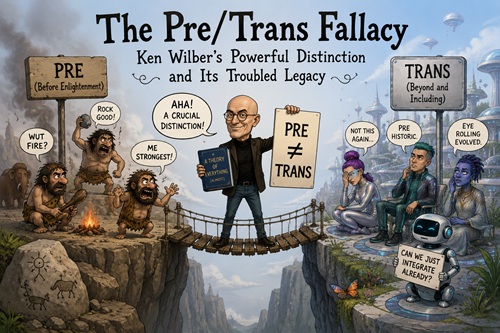
Introduction: A Brilliant Insight with a Double EdgeAmong Ken Wilber's many conceptual innovations, few have been as influential—or as controversial—as the pre/trans fallacy. Introduced in his early works, especially The Atman Project (1980), the concept was designed to solve a major problem in the interpretation of human development: the tendency to confuse pre-rational states with trans-rational states. Wilber argued that because both pre-rational and trans-rational experiences lie outside ordinary rational consciousness, they are often mistakenly grouped together. A child's magical thinking, a psychotic episode, a mythological worldview, and a mystical realization might all appear “non-rational,” but according to Wilber they represent radically different levels of development. One is a regression below reason; the other is a transcendence beyond reason. The distinction was a genuine contribution to developmental psychology and spiritual studies. It challenged both naïve romanticism (“all non-rational states are higher”) and reductionist skepticism (“all mystical states are merely primitive remnants”). Yet the concept also contains some of the recurring problems of Wilber's larger project: an overly rigid developmental hierarchy, insufficient empirical grounding, and a tendency to classify disagreements as failures of understanding rather than legitimate critiques. The Original Insight: Not Everything Beyond Reason Is TranscendentWilber's basic argument was straightforward. Modern Western culture, influenced by the Enlightenment, often reduces spirituality to pathology. Mystical experiences are interpreted as regression, wish fulfillment, or psychological disturbance. Thinkers such as Freud were especially suspicious of religion and mystical states, viewing them as expressions of infantile needs. On the other hand, some romantic and spiritual traditions make the opposite mistake. They idealize pre-modern consciousness, assuming that ancient myths, childhood imagination, altered states, and mystical realization all belong to a higher mode of awareness. Wilber proposed a third position: • Pre-rational states come before the development of rational egoic consciousness. • Rational states involve logical thought, scientific reasoning, and individual autonomy. • Trans-rational states emerge after rationality and include contemplative awareness, mystical insight, and nondual realization. The key point was that the prefix matters. “Pre” and “trans” both mean “beyond” in some sense, but they move in opposite directions. A child who believes that thoughts directly control reality and a mystic who experiences unity consciousness may both appear to have moved beyond ordinary rational categories. But one reflects an incomplete developmental stage, while the other supposedly represents a higher integration. This was an elegant psychological distinction. The Influence of Developmental PsychologyWilber borrowed heavily from developmental theorists such as Jean Piaget, Lawrence Kohlberg, and Abraham Maslow. These thinkers had already shown that human cognition develops through recognizable stages. Piaget demonstrated that children do not simply know less than adults; they reason differently. Kohlberg described moral development as progressing from self-interest toward increasingly universal principles. Maslow proposed a hierarchy culminating in self-actualization. Wilber extended these insights into the spiritual domain. His argument was that spiritual consciousness should not be separated from human development as a whole. Mysticism was not a return to infancy but a possible later achievement. This move helped create what became known as integral psychology: an attempt to combine developmental science, psychology, philosophy, and contemplative traditions. The Problem of the Developmental LadderThe difficulty begins when Wilber moves from a useful distinction to a comprehensive map of consciousness. The pre/trans distinction assumes that consciousness develops in a relatively linear sequence: • archaic consciousness • magical consciousness • mythic consciousness • rational consciousness • pluralistic/postmodern consciousness • integral consciousness • transpersonal consciousness This creates a powerful explanatory framework, but it also risks turning complex human experiences into a single ladder of advancement. Human beings do not simply climb stages like a staircase. Different capacities develop at different rates. Someone may be highly rational in science while retaining mythological beliefs in religion or politics. Someone may have profound mystical experiences while lacking emotional maturity or ethical development. Developmental psychology itself has become far more cautious about universal stage models than many of Wilber's formulations suggest. The Difficulty of Distinguishing “Pre” from “Trans”The central challenge is epistemological: how do we know whether an unusual state is pre-rational or trans-rational? Wilber often proposed criteria: • Does the experience integrate rational capacities? • Does it produce greater compassion and psychological maturity? • Does it function within a stable personality structure? These are reasonable questions. But they are not always easy to apply. A visionary experience, for example, might be interpreted in multiple ways: • a religious believer may see it as spiritual revelation; • a psychologist may interpret it as unconscious material; • a neuroscientist may study its brain correlates; • a skeptic may see it as a cognitive construction. The pre/trans framework sometimes appears to solve this ambiguity by placing experiences on a developmental map. But critics argue that it risks becoming circular: A spiritual experience is “trans” because it comes from a higher stage; the stage is higher because it produces trans experiences. Without independent criteria, the distinction can become difficult to test. The “Romantic Reduction” ProblemWilber's criticism of romantic thinkers was often insightful. He argued that figures such as Jean-Jacques Rousseau and certain New Age movements confused natural innocence with spiritual realization. However, critics have argued that Wilber sometimes exaggerated this opposition. Many romantic traditions did not simply equate primitive consciousness with enlightenment. They often criticized modern alienation while still valuing rational development. The history of spirituality is more complicated than a simple movement from magical childhood, through rational adulthood, toward mystical maturity. Some traditions emphasize transformation rather than progression. Others reject the idea that consciousness can be ranked at all. The “Hierarchy” ControversyThe pre/trans fallacy became controversial because it placed spiritual experiences within a hierarchy. Wilber argued that hierarchies are unavoidable: some states genuinely include and transcend others. A mature adult includes capacities that a child does not possess. But critics responded that Wilber sometimes confused developmental complexity with human worth. A person at a so-called lower stage is not necessarily a lesser human being. Cultures that emphasize myth, ritual, or communal identity are not simply immature versions of modern societies. The danger is that developmental language can become a subtle form of elitism: “My worldview is more evolved than yours.” This criticism has been especially prominent among scholars of religion and anthropology, who emphasize cultural diversity rather than universal ranking. A Scientific Problem: The Limited Evidence BaseAnother weakness is the empirical status of Wilber's model. The pre/trans fallacy is a theoretical proposal, not a strongly validated scientific theory. Developmental psychology has produced evidence for certain cognitive and moral developments, but the extension from those domains to higher states of consciousness remains debated. Meditation research has shown measurable effects on attention, emotion regulation, and brain activity. However, neuroscience does not currently provide evidence for Wilber's full developmental hierarchy of consciousness. The concept remains primarily philosophical and interpretive. A Valuable Warning That Became a Total TheoryThe enduring value of the pre/trans fallacy is that it warns against two genuine mistakes: • dismissing all spirituality as regression; • romanticizing all nonordinary states as enlightenment. That insight remains important. However, Wilber transformed this modest warning into a grand theory of consciousness evolution. The problem is not the distinction itself; it is the confidence with which it was expanded into a universal map of human development. The pre/trans fallacy is at its best as a question: Is this experience a regression beneath rationality, or a transformation beyond it? It becomes problematic when the answer is predetermined by an elaborate hierarchy of consciousness. Conclusion: Between Reductionism and RomanticismKen Wilber's pre/trans fallacy remains one of his most memorable contributions. It identified a real interpretive error and provided a vocabulary for discussing the relationship between psychology and spirituality. But the concept also reveals the broader tension within integral theory. Wilber wanted to defend spirituality from reductionism while preserving the achievements of modern science and rationality. That ambition was admirable. The difficulty is that his solution often relied on a highly structured developmental worldview that is more philosophical than scientifically established. The pre/trans distinction may be useful as a conceptual tool. It is far less convincing as a final map of consciousness. The challenge remains: to recognize genuine transformation without assuming that every extraordinary experience fits neatly into a hierarchy invented to explain it. Appendix: Is Wilber's Eros Concept Pre-Rational or Trans-Rational?Ken Wilber's concept of Eros creates an interesting challenge for his own pre/trans framework. If the pre/trans fallacy warns us not to confuse primitive impulses with higher spiritual development, where should we place Wilber's own idea that evolution is driven by an inherent upward pull toward greater complexity, consciousness, and Spirit? Is cosmic Eros a genuinely trans-rational insight, or does it represent a return to a more pre-rational mythological worldview? The answer depends largely on what criteria one applies. The Case for Eros as Trans-RationalWilber would certainly classify Eros as trans-rational. In his view, Eros is not a personal desire or biological instinct but the manifestation of Spirit-in-action within the cosmos. Evolution, according to Wilber, is not merely a blind process governed by variation and selection. Rather, it displays an inherent tendency toward greater complexity and interiority: • atoms organize into molecules; • molecules into living cells; • cells into organisms; • organisms into minds; • minds into spiritual awareness. This developmental arc, Wilber argues, points toward an underlying principle of self-transcendence. Eros is therefore not a supernatural force imposed from outside evolution but the "drive" of the Kosmos toward increasing depth. From within Wilber's framework, Eros belongs beyond ordinary rational thought because it is an intuition of the ultimate nature of reality—a contemplative insight comparable to mystical experiences of unity and interconnectedness. The Problem: A Scientific Principle or a Mythic Narrative?The difficulty is that Wilber's Eros often resembles concepts that historically belong to the mythic or metaphysical realm. The idea that nature contains an intrinsic upward striving has a long history: • Aristotle's movement toward the "unmoved mover"; • Hegel's unfolding of Absolute Spirit; • Bergson's élan vital; • Teilhard de Chardin's Omega Point. Wilber inherits much from these traditions. But the problem is that these ideas are not easily distinguishable from what developmental psychology would call mythic consciousness: a narrative in which the universe has intention, direction, and purpose. The crucial question becomes: Does calling this intuition "trans-rational" make it more than a mythic interpretation? A mythic worldview says: The universe is moving toward a divine goal because a cosmic intelligence intends it. A trans-rational worldview, in Wilber's sense, says: Through direct realization, one perceives an underlying evolutionary impulse toward greater unity and consciousness. The difference may be profound from a first-person spiritual perspective. But from a third-person scientific perspective, the distinction is difficult to establish. The Pre/Trans Trap Applied to Wilber HimselfIronically, critics have suggested that Wilber occasionally commits a version of the very error he warns others against. The pre/trans fallacy warns against mistaking earlier symbolic interpretations of reality for higher insight. But one could argue that cosmic Eros risks reviving a pre-modern idea of a meaningful, purposive universe and simply relabeling it as trans-rational. A medieval theologian might say: Creation unfolds according to God's plan. Wilber says: The Kosmos unfolds through Eros toward Spirit. Are these fundamentally different statements, or are they different philosophical languages expressing a similar intuition? Wilber would answer that his view is more sophisticated because it incorporates modern science and developmental theory. His critics would respond that adding evolutionary terminology does not automatically transform teleology into an empirically supported principle. Evolutionary Biology and the Missing EvidenceFrom the perspective of contemporary evolutionary biology, complexity does not require an inner cosmic drive. Evolutionary theory explains increasing complexity through mechanisms such as: • mutation; • natural selection; • genetic drift; • developmental constraints; • ecological interactions; • self-organization. Complexity can emerge without a predetermined direction. Evolution has produced remarkable increases in complexity, but it has also produced enormous simplicity, extinction, and biological dead ends. The history of life is not a staircase leading inevitably toward consciousness. It is a branching tree. The emergence of humans appears to be a contingent outcome of evolutionary history, not the guaranteed destination of an intrinsic cosmic tendency. Thus, from a scientific standpoint, Eros is not a discovery about evolution but an interpretation imposed upon evolutionary patterns. A More Modest Interpretation: Eros as a Human ValueThere may nevertheless be a valuable way to preserve something like Wilber's Eros without turning it into a cosmic force. Humans undeniably possess tendencies toward: • creativity; • cooperation; • knowledge; • moral expansion; • self-transcendence. One could call this an "erosic" impulse—not as a property of the universe itself, but as a feature of certain living systems, especially human cultures. This interpretation would place Eros closer to: • emergent complexity theory; • cultural evolution; • developmental psychology; • humanistic psychology. It would remain meaningful without requiring a hidden metaphysical mechanism. Conclusion: Transcendence or Repackaged Myth?Wilber's Eros concept occupies an uncomfortable position within his own framework. He intends it to be the highest expression of trans-rational insight: a direct recognition of Spirit's evolutionary creativity. But critics may argue that, judged by Wilber's own criteria, it contains elements characteristic of pre-rational myth-making: • cosmic intention; • universal purpose; • a predetermined direction of development. The central question is therefore not whether Eros is inspiring. It clearly is. The question is whether inspiration should be confused with explanation. Perhaps the most interesting irony is this: The pre/trans fallacy was designed to prevent us from confusing myth with mystical insight. Yet Wilber's Eros theory raises the possibility that mythic patterns can reappear at the highest levels of a supposedly post-metaphysical worldview. The challenge for integral thought is to distinguish genuine transcendence from the ancient human tendency to see our own longing for meaning reflected in the structure of the cosmos.
Widget is loading comments...
|