|
TRANSLATE THIS ARTICLE
Integral World: Exploring Theories of Everything
An independent forum for a critical discussion of the integral philosophy of Ken Wilber
  Frank Visser, graduated as a psychologist of culture and religion, founded IntegralWorld in 1997. He worked as production manager for various publishing houses and as service manager for various internet companies and lives in Amsterdam. Books: Ken Wilber: Thought as Passion (SUNY, 2003), and The Corona Conspiracy: Combatting Disinformation about the Coronavirus (Kindle, 2020). Frank Visser, graduated as a psychologist of culture and religion, founded IntegralWorld in 1997. He worked as production manager for various publishing houses and as service manager for various internet companies and lives in Amsterdam. Books: Ken Wilber: Thought as Passion (SUNY, 2003), and The Corona Conspiracy: Combatting Disinformation about the Coronavirus (Kindle, 2020).
Check out my other conversations with ChatGPT
A FRESH LOOK AT OLD CONCEPTS: The Holon Four Quadrants The Kosmos Pre/Trans Fallacy Involution and Evolution Science and Religion The Twenty Tenets From Spirit Down to Matter and Back AgainA Critical Examination of Ken Wilber's Dubious Doctrine of Involution and EvolutionFrank Visser / ChatGPT
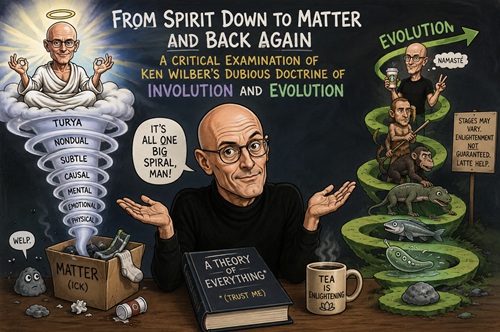 Introduction: The Cosmic Drama Behind Integral TheoryFew ideas are more central to Ken Wilber's worldview than the paired concepts of involution and evolution. They provide the metaphysical backbone for his understanding of the universe as a purposeful unfolding of consciousness. According to Wilber, evolution is not merely the biological process described by modern science, but the second half of a much larger cosmic movement: Spirit first descends into manifestation through involution, and then gradually reawakens through evolution until it recognizes itself as Spirit. This vision gives Wilber's Integral Theory its grand narrative structure. The universe becomes a spiritual adventure story: the One becomes the many, forgets itself, and then struggles back toward unity. Yet precisely because this story attempts to reinterpret the entire history of matter, life, mind, and culture, it also raises profound philosophical and scientific problems. The central criticism is not that Wilber's vision lacks poetic or existential appeal. Many religious and philosophical traditions have imagined reality as a process of descent and return. The problem is that Wilber frequently presents this metaphysical narrative as if it provides a superior explanatory framework for evolution itself. When judged by the standards of science, the concepts of involution and Spirit-driven evolution remain speculative assumptions rather than demonstrated insights. 1. The Ancient Roots of Involution: A Descending CosmosWilber did not invent the idea of involution. It has deep roots in various forms of Neoplatonism, Vedanta, Theosophy, and esoteric cosmology. The basic pattern is familiar: • Ultimate reality exists as pure consciousness or Spirit. • Spirit manifests itself as increasingly dense levels of reality. • Matter represents the furthest point of descent or concealment. • Evolution is the reversal of this process: consciousness gradually awakens to its own nature. In this framework, the universe is not fundamentally a history of increasing complexity emerging from simple beginnings. Rather, complexity was somehow already implicit in Spirit and is gradually being revealed. Wilber adopts this structure most explicitly in works such as The Atman Project (1980) and Up from Eden (1981), where he describes human development as a continuation of a cosmic process. Individual psychological growth mirrors the evolution of the universe itself. The attraction is obvious: human consciousness gains cosmic significance. The human journey becomes not an accidental biological event on a small planet, but the universe becoming aware of itself. But the explanatory price is high. 2. The Central Problem: What Exactly Is Involving?The first difficulty with involution is conceptual. If Spirit is absolute, perfect, and fully aware, why does it need to descend into limitation at all? A traditional theological answer might be that creation is an expression of divine creativity or play (lila in some Hindu traditions). But such answers do not explain a mechanism. They provide meaning, not empirical explanation. Wilber's formulation creates a paradox: • Spirit is already everything. • Spirit becomes apparently less than itself. • Spirit then evolves back into what it always was. The cosmic journey begins and ends at the same point. This resembles the philosophical problem of divine forgetfulness: why would an ultimate consciousness intentionally create a condition in which it no longer recognizes itself? The answer is often aesthetic rather than explanatory: the drama of rediscovery requires temporary concealment. But this turns the process into a narrative metaphor rather than a scientific theory. 3. Evolution According to Biology: No Hidden Destination RequiredModern evolutionary biology presents a radically different picture. Evolution does not describe a cosmic return of consciousness. It describes changes in populations over generations through mechanisms such as: • mutation, • natural selection, • genetic drift, • recombination, • developmental constraints, • ecological interactions. There is no evidence that evolution contains an intrinsic drive toward greater consciousness. Complexity has increased in some lineages, but evolution also produces: • parasites, • viruses, • simple organisms, • evolutionary dead ends, • massive extinctions. The overwhelming majority of species that ever existed have disappeared. Evolution is not a ladder. It is a branching tree. Wilber frequently objects that Darwinian evolution is incomplete because it allegedly cannot explain the emergence of consciousness, values, or spirituality. But this criticism often confuses two different questions: How did consciousness emerge biologically? versus Why does consciousness exist at all? The first is a scientific question. The second is a philosophical one. Science may not yet have a complete theory of consciousness, but adding Spirit as an invisible evolutionary force does not solve the explanatory problem. It merely relocates it. 4. The Problem of Teleology: Evolution Without a GoalWilber's evolutionary model is fundamentally teleological: it assumes evolution has an inherent direction. • Matter evolves into life. • Life evolves into mind. • Mind evolves into Spirit. This sequence is central to Integral Theory's “Kosmic” worldview. The difficulty is that biological evolution does not work this way. It has no predetermined endpoint. Humans are not the inevitable destination of evolution; they are one highly contingent outcome among countless possibilities. If the asteroid impact 66 million years ago had not occurred, mammals might never have dominated terrestrial ecosystems. If certain mutations had not occurred, human cognition might never have emerged. Evolutionary history is full of contingency. The appearance of intelligence is remarkable, but rarity does not imply destiny. 5. Is Wilber Smuggling Religion into Science?A recurring issue in Wilber's writings is the movement between different explanatory domains. When discussing spirituality, Wilber often speaks in terms of mystical insight, contemplative experience, and philosophical interpretation. When discussing evolution, however, he sometimes presents spiritual concepts as if they describe objective cosmic processes. This creates a category confusion. A person may reasonably believe: “My experience of meditation reveals a profound unity underlying existence.” That is a statement about experience. It is a very different claim to say: “The universe itself evolves through an underlying force called Spirit.” That is a claim about external reality. The first belongs to phenomenology or spirituality. The second requires evidence. Wilber's critics argue that he frequently moves from legitimate observations about human consciousness to unsupported conclusions about cosmic history. 6. The Eros Problem: Does the Universe Have an Inner Drive?One of Wilber's most controversial ideas is his use of Eros as the evolutionary principle of increasing complexity and consciousness. For Wilber, Eros is not merely biological reproduction or human desire. It is a cosmic tendency toward greater depth and emergence. Here the criticism becomes especially sharp. Complexity can emerge through natural processes without requiring a hidden evolutionary impulse. Examples include: • stars forming through gravity, • chemical self-organization, • biological complexity through selection, • cultural evolution through learning and competition. These processes do not require an additional metaphysical principle. The introduction of Eros risks becoming a placeholder word: “Why does complexity emerge?” “Because Eros drives complexity.” But then the question becomes: “What explains Eros?” The explanation has simply been moved one level upward. 7. Involution as a Philosophical Metaphor: A More Defensible ReadingThe strongest defense of Wilber is to interpret involution and evolution symbolically rather than literally. As a mythological framework, the idea has considerable value. Many traditions contain a similar pattern: • descent into limitation, • fragmentation, • suffering, • awakening, • return to unity. As a psychological metaphor, it can illuminate human development. People often experience life as a movement from unconsciousness toward greater awareness. But metaphors become problematic when mistaken for mechanisms. A map of inner transformation is not automatically a map of cosmic history. 8. The Irony: Wilber's Evolutionary Vision Requires the Very Science It CritiquesThere is an interesting tension within Integral Theory. Wilber often criticizes reductionistic interpretations of evolution, yet his entire developmental hierarchy depends upon scientific discoveries: • cosmic evolution, • stellar evolution, • planetary history, • biological evolution, • neuroscience. Without modern science, the Integral story would have no temporal structure. The problem is not that Wilber incorporates science. That is a strength. The problem is that he sometimes adds metaphysical layers while implying that science itself is insufficient without them. A more modest approach would acknowledge: Science explains many aspects of evolutionary development. Philosophy explores its meaning. Spiritual traditions interpret human experience. These domains can enrich one another without one pretending to replace the others. 9. The Legacy of Involution and Evolution: Myth, Philosophy, or Science?Wilber's involution/evolution model remains one of the most ambitious attempts to create a unified worldview. It tries to connect cosmology, biology, psychology, spirituality, and culture into a single developmental narrative. Its strength lies in its integrative imagination. Its weakness lies in its explanatory ambition. The concept of involution cannot currently be supported by empirical evidence. The concept of Spirit-driven evolution conflicts with the non-directional character of evolutionary biology. And the notion of Eros risks transforming unanswered questions into metaphysical answers. The most productive way to approach these ideas is not to dismiss them as meaningless, but to place them in the proper category. They belong primarily to philosophy, mythology, and spiritual interpretation, not evolutionary science. Conclusion: The Universe Does Not Need to Remember ItselfWilber's great cosmic story portrays evolution as Spirit awakening from its own self-created sleep. It is an elegant and powerful myth of return. But myths explain meaning, not mechanisms. The universe does not appear to be climbing a hidden ladder toward consciousness. Life does not seem to be the inevitable unfolding of a cosmic intention. Human awareness appears instead as a rare and remarkable outcome of billions of years of contingent evolutionary history. The real wonder of evolution is not that Spirit was secretly present all along. The real wonder is that from simple beginnings, without a predetermined script, matter organized itself into living systems, nervous systems, minds, cultures, and beings capable of asking why they exist. That story requires no cosmic involution. It may be stranger, more beautiful, and more humbling precisely because it does not.
Widget is loading comments...
|