|
TRANSLATE THIS ARTICLE
Integral World: Exploring Theories of Everything
An independent forum for a critical discussion of the integral philosophy of Ken Wilber
  Frank Visser, graduated as a psychologist of culture and religion, founded IntegralWorld in 1997. He worked as production manager for various publishing houses and as service manager for various internet companies and lives in Amsterdam. Books: Ken Wilber: Thought as Passion (SUNY, 2003), and The Corona Conspiracy: Combatting Disinformation about the Coronavirus (Kindle, 2020). Frank Visser, graduated as a psychologist of culture and religion, founded IntegralWorld in 1997. He worked as production manager for various publishing houses and as service manager for various internet companies and lives in Amsterdam. Books: Ken Wilber: Thought as Passion (SUNY, 2003), and The Corona Conspiracy: Combatting Disinformation about the Coronavirus (Kindle, 2020).
Check out my other conversations with ChatGPT
A FRESH LOOK AT OLD CONCEPTS: The Holon Four Quadrants The Kosmos Pre/Trans Fallacy Involution and Evolution Science and Religion The Twenty Tenets Ken Wilber Between Science and ReligionThe Ambiguous Status of an Integral ReconciliationFrank Visser / ChatGPT
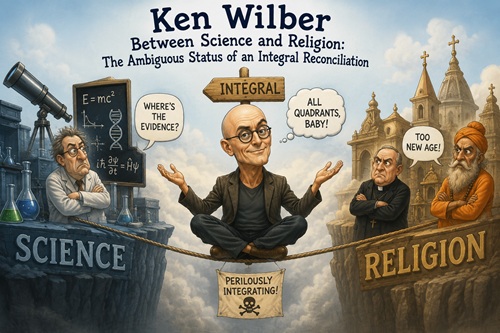 Introduction: The Man Who Wanted to Heal the Science-Spirit DivideFew contemporary spiritual thinkers have devoted as much effort to reconciling science and religion as Ken Wilber. From his early works such as The Spectrum of Consciousness (1977) to his later “Integral” philosophy, Wilber presented himself as a mediator between two seemingly opposed worlds: the empirical authority of modern science and the perennial wisdom of the world's spiritual traditions. His ambition was enormous. He argued that modernity had committed a “flatland” error by reducing reality to objective facts alone, while premodern cultures had possessed profound insights into consciousness, meaning, and spirituality. The task of the integral philosopher, according to Wilber, was to preserve the discoveries of science while recovering the interior dimensions of existence that modernity had allegedly discarded. Yet Wilber's position in the science-versus-religion debate remains deeply ambiguous. He frequently defended science against fundamentalist religion, creationism, and pseudoscience. At the same time, he introduced metaphysical concepts—Spirit, Eros, involution, higher stages of consciousness—that appear to exceed what science can establish. His project therefore oscillates between a sophisticated critique of scientism and a speculative spiritual cosmology that risks becoming a form of disguised metaphysics. The central question is not whether Wilber respects science. He clearly does. The deeper question is: Does Wilber ultimately place spirituality within the domain of legitimate knowledge, or does he attempt to smuggle metaphysical commitments into a scientific worldview? 1. Wilber's Basic Diagnosis: Science Won the Battle but Lost the MeaningWilber's starting point is a familiar one: the conflict between modern science and traditional religion. He accepts the scientific revolution as one of humanity's great achievements. Science has transformed our understanding of nature, eliminated countless superstitions, and provided reliable methods for investigating the physical world. Wilber has consistently rejected literalist creationism and emphasized evolutionary biology, neuroscience, and developmental psychology. But he argues that modernity made a crucial mistake: it elevated the “objective” dimension of reality above all others. According to Wilber, the modern worldview reduced reality to what can be measured externally. Consciousness became merely brain activity, values became subjective preferences, and spirituality became a psychological illusion. This reductionism produced what he calls “flatland”: a world of surfaces without depth. Wilber's solution is not a return to premodern religion. He does not want to replace Darwin with Genesis or neuroscience with revelation. Instead, he proposes an integral framework in which science studies the exterior dimensions of reality while spirituality explores interior experience. This is an important distinction. Wilber is not a traditional religious apologist. He is closer to a transpersonal philosopher attempting to expand science rather than reject it. 2. Wilber's Strongest Contribution: The Critique of ScientismWilber's most persuasive arguments concern scientism: the philosophical claim that scientific methods are the only valid means of acquiring knowledge. Here Wilber makes a legitimate point. Science is extraordinarily successful at explaining physical processes, but it does not by itself answer every human question. Science can explain how neurons fire, but it does not fully explain why subjective experience exists. It can analyze brain states during meditation, but it cannot simply replace the first-person experience of meditation itself. It can describe the evolutionary origins of morality, but it does not automatically determine what humans ought to value. Wilber argues that reality contains multiple domains of inquiry: • objective facts investigated through science; • subjective experience investigated through introspection and phenomenology; • intersubjective meaning investigated through cultural studies; • social systems investigated through sociology and systems theory. This insight eventually became his famous four-quadrant model. At its best, Integral Theory functions as a warning against simplistic reductionism. A complete understanding of human beings requires biology, psychology, culture, and social structures. However, the problems begin when Wilber moves from this methodological pluralism to claims about the ultimate structure of reality. 3. The Four Quadrants: A Map of Inquiry, Not a Proof of MetaphysicsWilber's four quadrants are often presented as his greatest conceptual contribution:
This framework provides a useful reminder that humans cannot be understood from one perspective alone. A neuroscientist studying the brain is examining something real. A psychologist studying subjective experience is also examining something real. An anthropologist studying culture is not merely studying illusions. The mistake, however, is to move from the reasonable claim that these perspectives are irreducible methods of inquiry to the stronger claim that they reveal fundamental “dimensions” of reality itself. The quadrants are best understood as a conceptual framework. They are not discoveries comparable to the laws of physics or evolutionary mechanisms. Wilber sometimes blurs this distinction. His models frequently move between: • useful interpretive schemes; • claims about human development; • claims about cosmic evolution. Those are very different levels of argument. 4. Wilber Against Religion: Why He Rejects Traditional SupernaturalismWilber's relationship with religion is complicated. He is critical of conventional religious belief when it conflicts with scientific understanding. He rejects: • biblical literalism; • creationist interpretations of evolution; • supernatural interventions in nature; • authoritarian religious claims. In this respect, Wilber aligns more closely with thinkers such as John Hick, Aldous Huxley, and transpersonal psychologists than with traditional theologians. For Wilber, religious traditions are cultural containers preserving genuine experiences of expanded consciousness. The myths may be historically limited, but the underlying experiences may represent authentic states of awareness. This distinction allows Wilber to preserve spirituality without accepting traditional dogma. But it creates a new problem: How do we distinguish authentic spiritual insight from human interpretation? 5. The Problem of Spiritual Epistemology: Who Verifies the Mystics?Wilber often argues that spiritual knowledge follows a methodology comparable to science. A meditator follows a contemplative practice, has certain experiences, and these experiences can supposedly be verified by others who undertake the same practice. Wilber calls this “injunction, experience, confirmation.” There is some validity here. Disciplines such as meditation do produce recurring psychological experiences across cultures. Researchers can study these states scientifically. But the analogy with science has limits. Scientific claims are publicly testable because they involve measurements independent of the observer. Spiritual experiences are not independent observations in the same way. A group of meditators may agree about certain experiences, but agreement does not automatically establish their metaphysical interpretation. For example: • A Christian mystic may interpret an experience as communion with God. • A Buddhist may interpret the same experience as realization of emptiness. • A neuroscientist may interpret it as a particular brain state. The experience may be real. The interpretation remains contested. Wilber sometimes moves too quickly from: “People have profound spiritual experiences” to: “These experiences reveal the ultimate structure of reality.” That second step requires additional philosophical argument. 6. The Return of Metaphysics: Spirit, Eros, and InvolutionThe greatest tension in Wilber's thought appears in his cosmic claims. Wilber repeatedly insists that his approach is post-metaphysical. Yet his worldview contains unmistakably metaphysical elements: • Spirit as the ultimate ground of reality; • involution as the descent of Spirit into manifestation; • evolution as Spirit's return to itself; • Eros as the evolutionary drive toward greater complexity and consciousness. These concepts are not scientific hypotheses. They cannot be tested, falsified, or compared with competing biological explanations. This creates a fundamental contradiction. Wilber criticizes premodern mythology for confusing symbolic narratives with reality. Yet his own cosmological language sometimes risks functioning in a similar way. The modern evolutionary sciences explain complexity through mechanisms such as: • mutation; • natural selection; • genetic drift; • developmental constraints; • ecological interactions; • self-organizing processes. Wilber adds a spiritual directionality to evolution. But directionality requires evidence, not merely philosophical preference. 7. Evolution: Where Wilber Most Clearly Crosses the Scientific BoundaryWilber's treatment of evolution is perhaps the most controversial aspect of his work. He accepts evolutionary biology but argues that standard neo-Darwinism is incomplete because it lacks an account of consciousness, meaning, and developmental emergence. There is a legitimate philosophical question here: why does matter produce subjective experience? However, Wilber often moves beyond this philosophical puzzle by suggesting that evolution itself has an intrinsic spiritual trajectory. The problem is that biological evolution does not appear to move toward inevitable higher consciousness. Evolution produces: • bacteria that dominate Earth's biomass; • parasites; • viruses; • extinct lineages; • organisms adapted to very specific niches. Human intelligence is one evolutionary outcome, not necessarily evolution's destination. To interpret evolution as a cosmic ascent toward Spirit is a philosophical interpretation imposed upon evolutionary history, not a conclusion derived from evolutionary science. 8. Is Wilber a Scientist, a Mystic, or a Philosopher?The confusion surrounding Wilber partly comes from the fact that he occupies several roles simultaneously. As a philosopher, he offers ambitious integrative frameworks. As a psychologist, he synthesizes developmental theories and contemplative traditions. As a spiritual teacher, he interprets mystical experiences as expressions of deeper reality. But he is not a scientist in the strict sense. His major claims about consciousness and cosmic evolution are not scientific theories because they do not generate testable predictions. This does not make them meaningless. Philosophy and spirituality have legitimate domains. The mistake is presenting philosophical speculation as if it carries the authority of science. 9. Wilber's Unresolved Double MovementWilber's entire project contains a fascinating tension. One movement pushes toward science: • rejection of superstition; • respect for evolutionary biology; • acceptance of empirical research; • criticism of religious literalism. The other movement pushes toward metaphysics: • cosmic purpose; • Spirit as ultimate reality; • evolution as awakening; • mystical states as revelations of ontology. Wilber wants the authority of science without surrendering the traditional religious intuition that reality has depth and purpose. The result is an unstable compromise. He successfully demonstrates that science does not answer every human question. But he does not demonstrate that spiritual interpretations of those unanswered questions are scientifically justified. Conclusion: Wilber's Place in the Science-Religion DebateKen Wilber is neither a defender of traditional religion nor a materialist reductionist. He occupies a middle position: a spiritual philosopher who accepts science but argues that science alone gives an incomplete picture of reality. His strongest contribution is his critique of scientism and his insistence that human existence includes subjective, cultural, and ethical dimensions that cannot be reduced to physical descriptions. His weakest point is the transition from this reasonable pluralism to a cosmic metaphysics of Spirit, Eros, and involution. Here Wilber moves beyond what science can establish and enters the territory of philosophical speculation. The most defensible version of Wilber is therefore not as a scientist of consciousness or a revealer of cosmic evolution, but as a synthesizing philosopher of human meaning. His enduring question is valuable: How can we preserve the achievements of science while acknowledging the depth of human experience? His problematic answer is the claim that this depth reveals a scientifically meaningful cosmic trajectory. Between those two positions lies the unresolved tension at the heart of Integral Theory.
Widget is loading comments...
|