|
TRANSLATE THIS ARTICLE
Integral World: Exploring Theories of Everything
An independent forum for a critical discussion of the integral philosophy of Ken Wilber
  Frank Visser, graduated as a psychologist of culture and religion, founded IntegralWorld in 1997. He worked as production manager for various publishing houses and as service manager for various internet companies and lives in Amsterdam. Books: Ken Wilber: Thought as Passion (SUNY, 2003), and The Corona Conspiracy: Combatting Disinformation about the Coronavirus (Kindle, 2020). Frank Visser, graduated as a psychologist of culture and religion, founded IntegralWorld in 1997. He worked as production manager for various publishing houses and as service manager for various internet companies and lives in Amsterdam. Books: Ken Wilber: Thought as Passion (SUNY, 2003), and The Corona Conspiracy: Combatting Disinformation about the Coronavirus (Kindle, 2020).
Check out my other conversations with ChatGPT
A FRESH LOOK AT OLD CONCEPTS: The Holon Four Quadrants The Kosmos Pre/Trans Fallacy Involution and Evolution Science and Religion The Twenty Tenets The HolonKen Wilber's Most Elegant Idea - and One of His Most ProblematicFrank Visser / ChatGPT
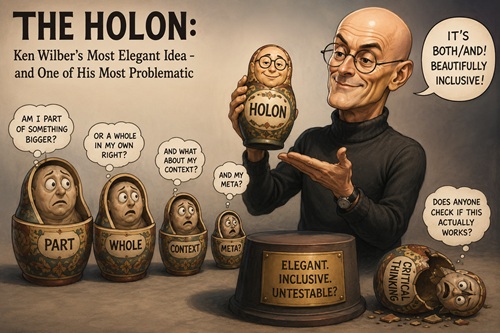 IntroductionAmong Ken Wilber's many conceptual innovations, none has been more influential than the holon. Borrowed from Arthur Koestler's The Ghost in the Machine (1967), the holon serves as the fundamental building block of Wilber's Integral Theory. According to Wilber, everything in existence—from atoms to organisms, from thoughts to societies—is a holon: simultaneously a whole in itself and a part of a larger whole. It is an undeniably attractive concept. It captures an important truth about nested organization in nature and society, avoids simplistic reductionism, and provides a common vocabulary across many disciplines. Yet Wilber transformed Koestler's relatively modest systems concept into something far more ambitious: a universal metaphysical principle governing evolution itself. The result is both ingenious and deeply problematic. Koestler's Original InsightArthur Koestler introduced the term holon to overcome the misleading opposition between "parts" and "wholes." An organ, for example, is a whole composed of cells, yet simultaneously part of an organism. Likewise: • atoms are parts of molecules; • molecules are parts of cells; • cells are parts of organisms; • organisms are parts of ecosystems. Koestler emphasized hierarchical organization without implying superiority. Each level possesses relative autonomy while remaining dependent upon larger systems. His holon was primarily an organizational concept. Wilber turned it into an ontological one. Wilber's Twenty TenetsIn Sex, Ecology, Spirituality (1995), Wilber formulated his famous Twenty Tenets, supposedly describing the universal behavior of all holons. According to these principles, every holon: • preserves its own identity ("agency"); • participates in larger wholes ("communion"); • transcends and includes previous stages; • seeks greater depth; • possesses four irreducible dimensions (interior/exterior, individual/collective); • evolves toward increasing complexity. These are presented not merely as observations but as universal laws of reality. This is where the problems begin. Is Everything Really a Holon?Wilber frequently writes that everything is a holon. This universalization immediately raises awkward questions. • Are hurricanes holons? • Is a traffic jam a holon? • Is an economic recession a holon? • What about clouds, galaxies, rivers, forest fires, or radioactive decay? Many natural phenomena are dynamic processes rather than stable nested entities. Others resist clear boundaries altogether. Calling all of them holons often adds little explanatory value. The concept becomes so broad that it risks meaning almost nothing. If everything qualifies, the concept loses discriminating power. The Problem of Natural HierarchiesWilber distinguishes between "natural" hierarchies (which he celebrates) and "dominator" hierarchies (which he rejects). Natural hierarchies supposedly arise because higher holons include lower ones. But this language easily slips into value judgments. Cells become "higher" than molecules. Humans become "higher" than animals. Mystics become "higher" than ordinary people. Although Wilber insists "higher" merely means "greater complexity," readers often interpret it normatively. Complexity becomes confused with superiority. Evolution becomes moral progress. Nature offers no evidence that increasing complexity is inherently better. Bacteria remain the most successful life forms on Earth. "Transcend and Include"Perhaps Wilber's most famous slogan is: Every higher stage transcends and includes the previous one. Sometimes this works beautifully. • An organism indeed includes cells. • Cells include molecules. • Languages include words. Yet the formula often becomes overstretched. • Does modern physics simply "include" Aristotelian physics? • Does democracy merely "include" monarchy? • Does science simply "include" mythology? Historical development is often discontinuous, messy, and revolutionary. New systems frequently replace earlier explanatory frameworks rather than gently embracing them. Thomas Kuhn's scientific revolutions illustrate precisely this discontinuity. Evolution as an Ascending HolarchyWilber interprets biological evolution as the construction of increasingly deep holarchies. • Atoms become molecules. • Molecules become cells. • Cells become organisms. • Organisms become minds. • Minds become Spirit. This resembles the classic "Great Chain of Being" more than modern evolutionary biology. Biological evolution has no predetermined destination. • Species emerge. • Species disappear. • Complexity sometimes increases. • Often it decreases. • Parasites simplify. • Cave organisms lose eyes. • Viruses evolve extraordinary efficiency through reduction rather than expansion. Evolution resembles a branching bush far more than a ladder. Stephen Jay Gould repeatedly emphasized this point. Wilber largely ignores it. The Missing Role of ContingencyOne striking omission from Wilber's holarchy is historical contingency. Evolutionary biology since Gould has stressed that chance events profoundly shape life's history. • Mass extinctions. • Asteroid impacts. • Continental drift. • Random mutations. • Population bottlenecks. None follows the neat upward trajectory suggested by Wilber's developmental diagrams. Replay the tape of life, Gould argued, and intelligent humans probably never appear. Wilber instead sees an intrinsic drive toward greater depth. This introduces purpose where biology sees contingency. Agency Everywhere?Another universal tenet claims every holon possesses agency. For organisms this makes sense. • Animals pursue goals. • Humans make decisions. But does an electron possess agency? Does a crystal? Does a virus? Wilber often stretches agency into an extremely abstract notion of "self-preservation." Yet at this level the concept risks becoming metaphorical. Physical systems follow natural laws. Calling this "agency" imports psychological language into domains where it may not belong. The Four QuadrantsWilber's holons always possess four aspects: • interior individual; • exterior individual; • interior collective; • exterior collective. This elegant symmetry has undeniable heuristic value. It reminds researchers not to reduce everything to physical mechanisms or subjective experience. However, must every phenomenon always fit all four quadrants? Many examples appear forced. • A proton hardly possesses an obvious "interior." • A rock lacks culture. • A galaxy has no shared worldview. The quadrants increasingly rely on speculative extrapolation the further down one goes into physics. Holons and Spiritual EvolutionUltimately the holon concept supports Wilber's spiritual cosmology. Since every stage transcends the previous one, evolution appears naturally directed toward higher consciousness. Spirit is not added from outside. It supposedly reveals itself through the intrinsic architecture of holons. This is philosophically elegant. But scientifically unsupported. Nothing in evolutionary biology demonstrates an inherent drive toward enlightenment. Natural selection explains adaptation, not spiritual ascent. Complexity emerges where advantageous. It also disappears where advantageous. Nature exhibits no consistent preference. A Powerful Metaphor Mistaken for a TheoryPerhaps the greatest strength of the holon lies precisely where Wilber first found it. It is an excellent metaphor for nested systems. Organizations contain departments. • Departments contain teams. • Organisms contain organs. • Languages contain sentences. • Ecosystems contain species. The concept encourages systems thinking while avoiding simplistic reductionism. Problems arise when this metaphor becomes a universal explanatory principle governing every aspect of reality. Holons then cease being descriptive tools and become metaphysical entities. The boundary between science and philosophy quietly disappears. ConclusionThe holon is arguably Ken Wilber's most enduring contribution. It elegantly captures the nested organization found throughout nature, society, and cognition, and it remains a valuable heuristic for thinking about complex systems. Few concepts in Integral Theory have proved so adaptable across disciplines. Yet Wilber asks the concept to carry far more weight than it can bear. By elevating the holon into a universal law of existence, he turns an insightful systems concept into the cornerstone of a grand metaphysical architecture. The transition from observation to ontology is rarely acknowledged, and even more rarely justified. The irony is that the holon works best when treated modestly. As a way of describing hierarchical organization, it is illuminating. As a theory of evolution, consciousness, and cosmic purpose, it becomes increasingly speculative. The elegance of the idea should not obscure the distinction between empirical patterns and philosophical interpretation. Like much of Wilber's work, the holon begins as a useful insight—but ends as a worldview. Appendix: Individual and Social Holons, Heaps and Artifacts—Did That Help?One of the recurring criticisms of Wilber's holon concept was that it seemed to classify everything as a holon. In response, Wilber introduced a series of distinctions designed to clarify the concept. The most important was the differentiation between individual holons and social holons, accompanied by the exclusion of heaps and artifacts from the category of "true" holons. Did this solve the conceptual problems? Only partially. Individual HolonsIndividual holons are relatively straightforward. An atom, a cell, an organism, or a human being possesses a degree of autonomous organization. Such entities maintain themselves, regulate their internal processes, and exhibit a recognizable identity over time. This closely resembles the concept of an organism or self-organizing system in biology. Few critics object to this usage. Social HolonsThe real controversy begins with social holons. Wilber argues that groups—families, tribes, corporations, nations, ecosystems—also qualify as genuine holons. They possess what he calls communion rather than agency and exhibit patterns that transcend the behavior of individual members. Certainly, social systems display emergent properties. Economies fluctuate independently of any single individual. Ant colonies coordinate remarkably complex behavior. Human cultures shape beliefs and institutions. But are these truly holons in the same sense as organisms? Many systems theorists would hesitate. A multicellular organism has a central metabolism, coordinated development, and clear physical boundaries. A nation does not. Its borders shift. Its members come and go. Its identity depends largely on legal, cultural, and symbolic conventions. Calling both "holons" stretches the concept across radically different kinds of organization. HeapsWilber excludes mere aggregates—or heaps—from his hierarchy. • A pile of sand. • A collection of rocks. • A bucket of marbles. These lack intrinsic organization and therefore fail to qualify as holons. This distinction makes intuitive sense. Yet the boundary quickly becomes fuzzy. When exactly does a heap become an organized system? • A snowflake? • A crystal? • A hurricane? • A galaxy? Nature offers countless intermediate cases. The line separating organized wholes from aggregates is often one of degree rather than kind. ArtifactsEven more curious is Wilber's treatment of artifacts. • A chair. • A bicycle. • A computer. • An airplane. These are not considered true holons because they are externally assembled rather than internally self-organized. Again, the distinction appears reasonable at first glance. But modern technology complicates matters considerably. • Is a self-driving robot merely an artifact? • What about autonomous software agents? • Artificial life simulations? • Self-repairing machines? As technology increasingly incorporates self-maintenance, adaptation, and learning, the sharp divide between organism and artifact becomes harder to sustain. An Ad Hoc Rescue?Critics have suggested that these additional categories function less as discoveries than as repairs to an increasingly strained conceptual framework. Initially, everything appeared to be a holon. Then exceptions accumulated. So new categories were introduced: • Individual holons • Social holons • Heaps • Artifacts Each distinction solves one problem while creating another. The classification becomes increasingly elaborate without offering objective criteria for difficult cases. Why is an ant colony a social holon while a traffic jam is merely a heap? Why is an ecosystem a holon but not the atmosphere? Where exactly is the boundary? Wilber rarely provides operational definitions that independent researchers could consistently apply. Categories in Search of CriteriaThe deeper issue is methodological. Scientific classifications succeed when they allow different observers to classify phenomena consistently. Biology can usually distinguish mammals from reptiles using shared criteria. Chemistry can distinguish compounds from mixtures. Wilber's categories are far less precise. They often rely on intuitive judgments about whether something possesses sufficient "agency," "communion," or "self-organization." As a result, borderline cases proliferate, and different readers may reach different conclusions. ConclusionWilber's distinctions between individual holons, social holons, heaps, and artifacts undoubtedly make the theory more nuanced. They acknowledge that not every collection of objects is an organized whole and that different forms of organization exist. But they do not fully resolve the underlying problem. The central question remains: What objective criterion determines whether something is a holon? Without clear, independently applicable criteria, the concept remains flexible enough to accommodate almost any example—and almost any exception. The refinements reduce some ambiguities, but they do not transform the holon into the kind of rigorously defined scientific category that Wilber often implies it to be.
Widget is loading comments...
|