|
TRANSLATE THIS ARTICLE
Integral World: Exploring Theories of Everything
An independent forum for a critical discussion of the integral philosophy of Ken Wilber
  Frank Visser, graduated as a psychologist of culture and religion, founded IntegralWorld in 1997. He worked as production manager for various publishing houses and as service manager for various internet companies and lives in Amsterdam. Books: Ken Wilber: Thought as Passion (SUNY, 2003), and The Corona Conspiracy: Combatting Disinformation about the Coronavirus (Kindle, 2020). Frank Visser, graduated as a psychologist of culture and religion, founded IntegralWorld in 1997. He worked as production manager for various publishing houses and as service manager for various internet companies and lives in Amsterdam. Books: Ken Wilber: Thought as Passion (SUNY, 2003), and The Corona Conspiracy: Combatting Disinformation about the Coronavirus (Kindle, 2020).
Check out my other conversations with ChatGPT
A FRESH LOOK AT OLD CONCEPTS: The Holon Four Quadrants The Kosmos Pre/Trans Fallacy Involution and Evolution Science and Religion The Twenty Tenets The Four QuadrantsKen Wilber's Elegant Map and Its Elusive TerritoryFrank Visser / ChatGPT
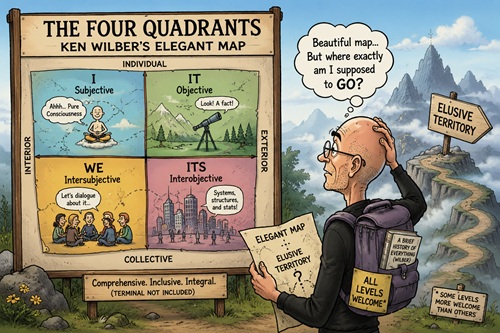
Introduction: The Diagram That Made Integral Theory FamousIf one image has come to symbolize Ken Wilber's Integral Theory, it is the famous four-quadrant diagram. Simple enough to fit on a napkin yet ambitious enough to claim universal scope, it divides reality into four irreducible perspectives: the interior and exterior of individuals, and the interior and exterior of collectives. The quadrants have become Wilber's trademark. They appear in books, workshops, consulting models, educational programs, organizational development, coaching, psychology, and even military strategy. For many admirers, the AQAL ("All Quadrants, All Levels") framework represents one of the most important conceptual advances in contemporary philosophy. Unlike Wilber's more speculative ideas—such as Eros, Spirit-in-action, or involution—the four quadrants seem refreshingly modest. They merely remind us that every phenomenon can be viewed from multiple perspectives. Surely that cannot be controversial. Yet beneath their apparent simplicity lie a number of philosophical and practical problems. The question is not whether multiple perspectives matter—they certainly do—but whether Wilber's quadrants describe the structure of reality itself or merely provide a convenient classification scheme. The Four PerspectivesWilber distinguishes four fundamental dimensions.
Thus: • subjective experience belongs to the Upper Left, • observable behavior to the Upper Right, • culture to the Lower Left, • social systems to the Lower Right. A human conversation, for example, involves all four: • personal thoughts, • vocal behavior, • shared language, • social institutions enabling communication. At this level the model seems almost self-evident. A Useful Reminder Against ReductionismThe quadrants perform an important service. Modern disciplines often reduce complex phenomena to one explanatory domain. • Psychologists may focus exclusively on subjective experience. • Neuroscientists emphasize the brain. • Sociologists privilege institutions. • Anthropologists stress culture. Wilber's framework reminds us that human life simultaneously involves minds, brains, societies, and meanings. This pluralistic instinct deserves praise. The quadrants function as a useful checklist: Have we forgotten an important dimension? In this practical sense, AQAL can improve interdisciplinary thinking. From Heuristic to MetaphysicsThe problems begin when Wilber elevates this practical checklist into an ontological principle. He often writes as though the four quadrants are not merely four useful viewpoints but the very architecture of reality. Reality itself supposedly possesses four inseparable dimensions. This raises difficult questions. • Are these really properties of nature? • Or are they categories humans use to organize information? The distinction matters. Maps organize reality. Reality does not necessarily come pre-divided into maps. Perspectives or Pieces?Consider a tree. Does the tree literally possess four quadrants? Or can humans examine it from four different perspectives? Its molecular structure is objective. Its ecological relationships are systemic. Its cultural symbolism exists only because humans assign meanings to it. Its "interior" is even more problematic. Does a tree possess subjective experience? Wilber increasingly answers yes. Many biologists remain unconvinced. The quadrants begin to blur once applied outside human psychology. The Problem of Collective InteriorsPerhaps the most controversial quadrant is the Lower Left: collective interiors. Cultures certainly exist. Shared meanings certainly exist. But where exactly do they exist? Individuals possess minds. Groups do not literally possess brains. A culture consists of many interacting individuals exchanging symbols, habits, languages, and institutions. Calling this a collective interior may be a convenient metaphor. Treating it as an independent ontological domain risks reifying abstractions. Does "society" think? Or do individuals think socially? The distinction is subtle but important. Are the Quadrants Truly Irreducible?Wilber repeatedly insists that no quadrant can be reduced to another. Each is equally fundamental. Yet science often reveals genuine explanatory asymmetries. • Brain injury alters consciousness. • Cultural norms influence personal beliefs. • Economic systems shape institutions. • Genes constrain development. These influences are not symmetrical. The claim of complete irreducibility may oversimplify complex causal relationships. Interdependence need not imply equal explanatory status. Everything Has Four Quadrants?Wilber eventually extends the model to every holon in existence. • Atoms. • Cells. • Dogs. • Planets. • Galaxies. • Even subatomic particles. Everything supposedly possesses four dimensions. Here the theory becomes increasingly speculative. • Does a hydrogen atom have an interior? • Does an ecosystem possess shared meanings? • Does a molecule participate in culture? Wilber often answers these questions affirmatively by greatly expanding the notion of "interiority." But the broader the definition becomes, the less empirically meaningful it appears. The Missing Evolutionary StoryIronically, Wilber presents the quadrants as timeless features of reality. Yet human knowledge evolved. Disciplines evolved. Scientific methods evolved. The distinction between subjective and objective investigation emerged historically. One could argue that the quadrants reflect the organization of modern academic knowledge more than the deep structure of the cosmos. The model may describe how humans categorize reality rather than how reality itself is constituted. The Problem of BoundariesMany real-world phenomena resist neat placement. Consider language. Is it: • subjective? • behavioral? • cultural? • systemic? The answer is all four. Likewise: • money, • law, • technology, • artificial intelligence, • religion, • science. Each spans multiple quadrants simultaneously. Instead of clarifying reality, the framework sometimes merely restates that complex phenomena have many aspects. This insight is useful but hardly revolutionary. Quadrants as Educational ToolWhere the model works best is pedagogy. Students quickly learn that psychology alone cannot explain society. Biology alone cannot explain culture. Economics alone cannot explain consciousness. Medicine benefits from considering subjective experience alongside physiology. Organizations benefit from examining culture alongside formal structures. The quadrants encourage broader thinking. As an educational device they remain valuable. The False Promise of CompletenessWilber frequently presents AQAL as the most comprehensive framework ever developed. This is a much stronger claim. No four-box diagram can capture all dimensions of reality. History, geography, networks, probability, emergence, evolution, complexity, information flow, and ecological interactions often cut across quadrant boundaries. Modern systems theory increasingly emphasizes dynamic networks rather than static boxes. Reality appears less like a four-pane window than a constantly evolving web. Scientific Modesty Versus Philosophical AmbitionThe quadrants illustrate a recurring pattern in Wilber's work. A modest observation becomes an ambitious metaphysical claim. The modest observation: Human phenomena can be studied from multiple perspectives. Few would disagree. The ambitious claim: Reality itself is fundamentally organized into four irreducible ontological dimensions. This requires far stronger evidence. Wilber largely relies on philosophical argument rather than empirical demonstration. As with many aspects of Integral Theory, conceptual elegance substitutes for experimental validation. Conclusion: An Excellent Map—But Not the TerritoryThe four quadrants remain Wilber's most successful contribution. They provide a memorable antidote to one-sided explanations and encourage interdisciplinary dialogue. As a heuristic, they have genuine value and continue to help practitioners avoid simplistic reductionism. Yet their usefulness should not be mistaken for proof of their metaphysical status. The quadrants are best understood as a conceptual framework for organizing inquiry, not as a discovery about the fundamental architecture of the universe. Their apparent universality stems partly from the fact that almost any phenomenon can be described from several perspectives—a flexibility that makes the model broadly applicable, but also difficult to falsify. Like many elegant diagrams, the four quadrants simplify a world that is messier than the boxes suggest. They invite us to ask important questions, but they do not settle them. Their enduring appeal lies less in revealing the hidden structure of reality than in reminding us that reality almost always looks different depending on where we stand.
Widget is loading comments...
|