|
TRANSLATE THIS ARTICLE
Integral World: Exploring Theories of Everything
An independent forum for a critical discussion of the integral philosophy of Ken Wilber
  Frank Visser, graduated as a psychologist of culture and religion, founded IntegralWorld in 1997. He worked as production manager for various publishing houses and as service manager for various internet companies and lives in Amsterdam. Books: Ken Wilber: Thought as Passion (SUNY, 2003), and The Corona Conspiracy: Combatting Disinformation about the Coronavirus (Kindle, 2020). Frank Visser, graduated as a psychologist of culture and religion, founded IntegralWorld in 1997. He worked as production manager for various publishing houses and as service manager for various internet companies and lives in Amsterdam. Books: Ken Wilber: Thought as Passion (SUNY, 2003), and The Corona Conspiracy: Combatting Disinformation about the Coronavirus (Kindle, 2020).
Check out my other conversations with ChatGPT
A FRESH LOOK AT OLD CONCEPTS: The Holon Four Quadrants The Kosmos Pre/Trans Fallacy Involution and Evolution Science and Religion The Twenty Tenets The Kosmos of Ken WilberFrom Cosmic Meaning to Metaphysical OverreachFrank Visser / ChatGPT
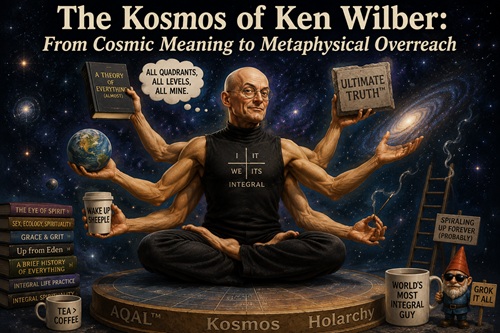
Introduction: When “Cosmos” Becomes “Kosmos”Among Ken Wilber's most influential concepts is his deliberate re-spelling of cosmos as Kosmos. The distinction is central to his integral philosophy. A cosmos, in ordinary scientific usage, refers to the physical universe: galaxies, stars, planets, matter, energy, space, and time. A Kosmos, according to Wilber, is something far greater: the entire spectrum of reality, including matter, life, mind, soul, and Spirit. Wilber introduced the term to challenge what he regarded as the narrow materialism of modern science. The modern worldview, he argued, had reduced the universe to a meaningless collection of atoms governed by blind forces. Against this “flatland” reduction, he proposed a hierarchical and developmental universe in which consciousness is not an accidental byproduct of matter but a fundamental dimension of reality itself. The ambition is enormous. Wilber's Kosmos attempts to provide a grand synthesis of science, psychology, spirituality, and metaphysics. Yet precisely because the concept tries to encompass everything, it also raises fundamental philosophical questions. Does the Kosmos reveal a deeper structure of reality, or does it project human meaning onto an indifferent universe? From Greek Cosmos to Wilber's KosmosWilber's use of Kosmos draws on the ancient Greek meaning of kosmos as an ordered whole. For the Greeks, the universe was not merely a physical arrangement of objects but a meaningful and harmonious order. This older conception contrasts with the modern scientific picture of a universe described through mathematical laws without intrinsic purpose. Wilber argues that modernity committed a historical error by stripping the cosmos of interiority and value. Scientific materialism, in his view, retained only the exterior dimensions of reality—the measurable “its”—while ignoring the interior dimensions of experience, consciousness, and meaning. His Kosmos therefore restores what he sees as a lost dimension. Reality is not merely a collection of objects; it is a nested hierarchy of holons, moving from atoms to molecules, cells, organisms, minds, cultures, and ultimately Spirit. The question, however, is whether recovering an ancient sense of cosmic meaning requires accepting Wilber's specific metaphysical interpretation. The Kosmos as an Evolutionary HierarchyA central feature of Wilber's Kosmos is evolutionary development. Evolution is not merely biological change through natural selection but a universal process of increasing complexity and consciousness. Wilber frequently describes evolution as a movement from: • matter (physiosphere) • to life (biosphere) • to mind (noosphere) • to Spirit (theosphere) This developmental ladder forms the backbone of his integral worldview. Evolution becomes a story of increasing interiority: the universe awakens to itself through increasingly complex forms. This vision has undeniable philosophical appeal. Many thinkers have been fascinated by the emergence of consciousness, intelligence, and self-reflection from simpler forms of matter. The appearance of life and mind does indeed represent a remarkable increase in complexity. However, Wilber often moves beyond what evolutionary science itself establishes. Biological evolution explains how variation and selection can produce adaptation and complexity. It does not, by itself, demonstrate that evolution has an inherent direction toward consciousness or Spirit. The difference between “evolution has produced consciousness” and “evolution is oriented toward consciousness” is enormous. The first is an empirical observation. The second is a metaphysical claim. The Problem of Cosmic TeleologyThe most controversial aspect of Wilber's Kosmos is its apparent teleology: the idea that the universe has an inherent drive or purpose. Wilber's concept of Eros is central here. He describes Eros as the force within evolution that pulls reality toward greater complexity, consciousness, and unity. Evolution is not simply blind; it is an unfolding of Spirit. This interpretation resembles older philosophical traditions, from Aristotle's entelechy to Hegel's unfolding Absolute and Teilhard de Chardin's Omega Point. It provides a meaningful narrative: the universe is not going anywhere randomly; it is becoming aware of itself. The difficulty is that modern evolutionary biology does not require such a principle. Natural selection can explain increasing complexity without invoking a cosmic urge toward higher states. Complexity can emerge through local processes, constraints, and environmental pressures without implying an ultimate destination. Furthermore, evolution also produces simplicity, extinction, stagnation, and degeneration. The vast majority of species that have ever existed are extinct. Evolution has no obvious universal trajectory toward greater consciousness. A universe that occasionally produces consciousness is not necessarily a universe designed to produce consciousness. Kosmos and the Conflict with Scientific NaturalismWilber's critique of scientific materialism is partly justified. Science does face profound philosophical questions about consciousness, values, and meaning. A purely mechanistic description of reality may leave important aspects of human experience unexplained. However, Wilber sometimes presents a false choice: either accept reductionist materialism or embrace a spiritual Kosmos. Many contemporary scientists and philosophers reject both extremes. Emergentism, for example, argues that higher-level phenomena such as life, consciousness, and culture arise from physical processes while possessing genuine properties not reducible to their components. A brain is made of neurons, but a thought is not simply equivalent to a single neuron. A society consists of individuals, but social institutions have their own causal patterns. Emergence allows for levels of reality without requiring a cosmic consciousness guiding evolution. Wilber's holarchical vision often captures this intuition, but he adds a metaphysical interpretation that does not necessarily follow. The Kosmos and the Four QuadrantsWilber's Four Quadrants provide the structural framework for his Kosmos. Every phenomenon has four dimensions: • interior-individual (intentional) • exterior-individual (behavioral) • interior-collective (cultural) • exterior-collective (social systems) The strength of this approach is that it reminds us not to reduce human beings to only one dimension. Consciousness cannot be fully understood without considering biology, subjective experience, culture, and social structures. Yet the quadrants become problematic when they are presented as fundamental features of reality itself rather than useful analytical perspectives. Critics argue that Wilber sometimes transforms a methodological framework into an ontology—a map becomes a territory. The existence of four useful perspectives does not necessarily prove that reality itself is structured into four ontological domains. The Cosmic Narrative ProblemOne reason Wilber's Kosmos remains attractive is that it answers a deep human longing: the desire for a meaningful universe. Modern science presents an extraordinary but emotionally neutral story. Stars form, planets develop, life emerges, organisms evolve, and consciousness appears. There is no guarantee that the universe has a purpose. Wilber offers a more inspiring alternative: Spirit is waking up through evolution. Human beings are not accidents but participants in a cosmic unfolding. The philosophical danger is that existential comfort can be mistaken for empirical truth. A meaningful story about the universe is not necessarily a true story about the universe. The history of ideas is filled with examples where humans projected their aspirations onto nature. The medieval universe reflected divine hierarchy; nineteenth-century evolutionists often imagined progress; contemporary thinkers sometimes see complexity as destiny. The challenge is preserving wonder without turning wonder into evidence. A Balanced Assessment: Visionary Metaphor or Metaphysical Claim?The Kosmos concept can be interpreted in two very different ways. As a philosophical metaphor, it is powerful. It reminds us that reality includes more than measurable objects. Consciousness, culture, values, and meaning are real dimensions of human existence. Wilber's insistence on integrating these domains remains intellectually valuable. As a literal cosmological claim, however, the concept faces serious difficulties. The existence of a cosmic evolutionary drive toward Spirit is not supported by scientific evidence. The transition from biological evolution to spiritual evolution requires additional assumptions. Wilber's greatest contribution may therefore not be that he discovered the hidden architecture of the universe, but that he articulated a compelling vision of how humans experience their place within it. Conclusion: Between Meaning and MysteryKen Wilber's Kosmos stands at the intersection of philosophy, spirituality, and cosmology. It is an ambitious attempt to overcome the fragmentation of modern knowledge and restore a sense of wholeness to our understanding of reality. Its strength lies in its refusal to accept a purely flattened universe devoid of consciousness, meaning, and value. Its weakness lies in moving too quickly from the undeniable fact of emergence to the much more controversial claim of cosmic purpose. The universe may indeed be deeper than our current scientific understanding reveals. But acknowledging mystery is different from filling that mystery with a predetermined metaphysical narrative. The real challenge is not choosing between a dead cosmos and a spiritually scripted Kosmos. It is learning to appreciate a universe that is already astonishing enough: one in which blind physical processes have somehow produced stars, life, minds, cultures, and beings capable of asking why there is anything at all.
Widget is loading comments...
|