|
TRANSLATE THIS ARTICLE
Integral World: Exploring Theories of Everything
An independent forum for a critical discussion of the integral philosophy of Ken Wilber
  Frank Visser, graduated as a psychologist of culture and religion, founded IntegralWorld in 1997. He worked as production manager for various publishing houses and as service manager for various internet companies and lives in Amsterdam. Books: Ken Wilber: Thought as Passion (SUNY, 2003), and The Corona Conspiracy: Combatting Disinformation about the Coronavirus (Kindle, 2020). Frank Visser, graduated as a psychologist of culture and religion, founded IntegralWorld in 1997. He worked as production manager for various publishing houses and as service manager for various internet companies and lives in Amsterdam. Books: Ken Wilber: Thought as Passion (SUNY, 2003), and The Corona Conspiracy: Combatting Disinformation about the Coronavirus (Kindle, 2020).
Check out my other conversations with ChatGPT
RUSSIA TODAY
Russia's 2026 Elections Putin's "Special Military Operation" Dugin's Metaphysics of Empire American vs. Russian Empire? Ritter as Geopolitical Crusador The Real New World Order No Clash of Civilizations? The Clash of CivilizationsA Critical Examination of Huntington's Grand TheoryFrank Visser / ChatGPT
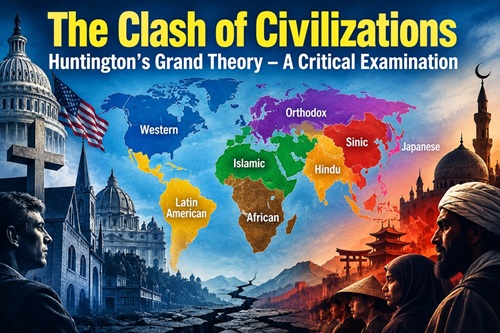
The end of ideology?Huntington's starting point was a genuinely important question. The Cold War had organized international politics around an ideological confrontation between two superpowers and their respective political-economic systems. With the Soviet Union gone, the old map no longer seemed adequate. Huntington rejected the idea that the world was simply converging on liberal democracy and Western modernity. Instead, he proposed that culture and civilization would become increasingly important sources of political identity. In his 1993 article, he argued that the “fault lines” between civilizations would become the future battle lines. His later book expanded this argument into a comprehensive model of world politics. His map divided the world into several major civilizations: Western, Orthodox, Islamic, Hindu, Sinic, Japanese, Latin American and, more ambiguously, African. Religion was particularly important in his classification. Huntington believed that modernization did not necessarily mean Westernization. Societies could become technologically and economically modern while retaining distinctive cultural identities. This was the strongest part of his argument. There really are differences in historical memory, religion, political culture, family structure, language and social norms. The assumption that modernization would automatically dissolve such differences was simplistic. Huntington was therefore right to challenge a certain triumphalist version of the “end of history.” But recognizing cultural differences is one thing. Making civilizations the principal actors of international politics is another. The problem with treating civilizations as actorsThe central weakness of the model appears when Huntington moves from culture to causation. A civilization is not an actor in the same sense as a state, government, army, political movement or terrorist organization. France can sign a treaty. China can impose sanctions. Iran can finance a militia. The United States can invade a country. “Western civilization” cannot. Huntington nevertheless frequently writes as if civilizations possess collective interests and can behave strategically. This creates an enormous analytical problem. Within Huntington's civilizations are hundreds of millions, sometimes billions, of people with radically different interests. The Islamic world is the clearest example. Indonesia, Iran, Saudi Arabia, Turkey, Pakistan, Morocco and Nigeria share important religious traditions, but their political systems, strategic interests and relationships with one another are radically different. Sunni and Shiite powers have frequently regarded one another as greater threats than distant Western powers. The same problem exists inside the “West.” The United States, France, Germany, Poland and Greece may share important cultural traditions, but they have repeatedly disagreed about wars, trade, Russia, China, migration and the distribution of power. Indeed, one of the earliest responses to Huntington pointed out precisely this difficulty. Albert Weeks argued that nation-states and their political interests remained much more important determinants of international behavior than Huntington's civilizational categories. The civilization is therefore often less an explanation of political behavior than a very large container into which political behavior is subsequently placed. Culture does not cause conflict by itselfHuntington's model also has difficulty distinguishing between a difference and a cause. Suppose two countries belong to different civilizations and go to war. Their cultural difference is then obvious. But was that difference actually responsible for the war? Countries can have profound cultural differences without fighting. Conversely, countries belonging to essentially the same cultural sphere can engage in extraordinarily destructive wars. Europe provides the devastating counterexample. The First and Second World Wars were overwhelmingly wars between European states. Germany, France, Britain, Italy, Austria and Russia belonged, in Huntington's broad terminology, to overlapping Western or European cultural traditions. Yet they produced industrialized warfare on a scale unprecedented in human history. The twentieth century also witnessed the Iran-Iraq War, the Chinese Civil War, the Soviet invasion of Afghanistan, the wars accompanying the breakup of Yugoslavia, and numerous African civil wars. Many of these conflicts make more sense through nationalism, territorial disputes, regime competition, economic interests, imperial legacies, resource struggles or internal political fragmentation than through civilizational conflict. This is not merely a philosophical objection. Quantitative studies have produced mixed—and often negative—results when Huntington's hypotheses are tested directly. Giacomo Chiozza's analysis of international conflict from 1946 to 1997 found that interactions across civilizational boundaries were not more conflict-prone, including during the early post-Cold War period when Huntington expected the effect to become particularly visible. Henderson and Tucker similarly examined interstate war over a much longer period and found no significant association between civilization membership and the onset of interstate war in the post-Cold War period examined. Their results directly challenged Huntington's central prediction. Jonathan Fox, examining ethnic conflicts, found additional problems: civilizational conflicts represented only a minority of ethnic conflicts, Huntington's classification was difficult to operationalize, and there was no statistically significant evidence that the intensity of civilizational ethnic conflicts had increased relative to other ethnic conflicts after the Cold War. These findings do not prove that culture is irrelevant. They demonstrate something more precise: cultural-civilizational difference is a poor candidate for the master variable of international conflict. The “bloody borders” problemHuntington gave particular attention to the boundary between Islam and other civilizations. He suggested that conflicts involving Muslim populations were especially likely to occur along the “bloody borders” of the Islamic world. There is certainly a historical basis for observing that many conflicts have occurred in regions where religious and cultural boundaries overlap. But there is a danger of reversing cause and effect. The Middle East, for example, cannot be understood simply as the arena of an Islamic-Western confrontation. Its modern history includes European imperialism, the collapse of the Ottoman Empire, arbitrary colonial borders, Arab nationalism, Zionism, the Israeli-Palestinian conflict, oil politics, authoritarian regimes, Iranian-Saudi rivalry, Sunni-Shia competition, Cold War intervention, American intervention, Russian intervention and local struggles for political power. To reduce this enormously complicated history to “Islam versus the West” is not merely incomplete. It can obscure the mechanisms actually producing the conflicts. It also encourages the observer to notice evidence that confirms the theory. A conflict involving Muslims and Westerners becomes a civilizational conflict. A conflict between Muslims becomes an internal dispute. A conflict between Western states becomes an exception. A theory capable of classifying almost any outcome in this manner risks becoming difficult to falsify. The internal diversity Huntington underestimatesThe word “civilization” creates an illusion of internal unity. Religion is especially problematic in this respect. Huntington sometimes treats religious traditions as though they provide relatively stable political identities. But religions themselves contain competing interpretations, institutions and political movements. Islam contains secularists, liberals, conservatives, monarchists, republicans, socialists, nationalists, Islamists, Salafists, Sufis and many other currents. Christianity contains equally dramatic political differences. Religion can therefore be a political resource without being a sufficient explanation of political behavior. The same applies to China and the “Sinic” civilization. China is certainly shaped by a distinctive historical tradition. But Chinese foreign policy is also shaped by territorial disputes, economic interests, Communist Party ideology, military strategy, nationalism, energy security and the desire to maintain regime stability. Culture matters. But culture interacts with institutions and interests. That distinction is crucial. The missing variable: political interestsA more useful model would treat civilization as one variable among several rather than as the organizing principle of world politics. States seek security. Governments seek survival. Political elites seek power. Economies seek markets and resources. Nationalists seek territorial or symbolic victories. Regimes seek legitimacy. Great powers seek spheres of influence. These motivations frequently cross civilizational boundaries. The United States and Saudi Arabia are culturally different but have been strategic partners. Russia and Iran belong to different civilizational categories but have cooperated extensively when their geopolitical interests have converged. India and Russia have maintained important strategic relations despite their very different civilizational histories. China and numerous Muslim-majority states cooperate economically despite Huntington's expectation that civilizational differences would become increasingly consequential. Conversely, countries belonging to the same broad civilization can become bitter enemies. This suggests a more parsimonious principle: states cooperate when interests converge and conflict when interests diverge, with culture influencing how those interests are understood and legitimized. That is less dramatic than a “clash of civilizations,” but it has considerably greater explanatory flexibility. Yet Huntington was not simply wrongA fair criticism should not turn Huntington into a caricature. There is an important insight beneath the overextended theory. Human beings do organize themselves around collective identities, and those identities can become politically powerful. The collapse of communism did not produce a culturally homogeneous world. Nationalism, religion and historical memory remained remarkably resilient. Moreover, a later empirical literature has produced findings more favorable to parts of Huntington's thesis. Nicholas Charron's 2010 study, for example, found stronger evidence for civilizational effects when focusing specifically on violent international conflict in the post-Cold War period, including evidence relevant to Huntington's “fault line” and Islamic-border hypotheses. A 2019 study likewise found higher conflict probabilities between countries belonging to different civilizations in some periods, while arguing that language rather than religion accounted for much of the effect. This is important because it prevents an equally simplistic dismissal of Huntington. The empirical literature does not say that cultural differences have zero relationship to conflict. Rather, it suggests that the relationship is contingent, contested and considerably more complicated than Huntington's grand narrative implies. The self-fulfilling prophecyThere is another problem with the theory: it can become politically performative. If policymakers believe that the West and Islam constitute opposing civilizations, they may begin to interpret international events through precisely that framework. A conflict becomes evidence of an underlying civilizational antagonism. Defensive measures then reinforce perceptions of hostility on the other side. The model can thus become a lens through which political actors construct the reality they claim merely to be describing. This was especially consequential after September 11, 2001. The terrorist attacks could be interpreted as evidence of a fundamental confrontation between Islam and the West. But the vast majority of Muslims did not participate in the attacks, and many Muslim-majority governments subsequently cooperated with Western governments against jihadist organizations. The distinction between “Muslims,” “Islamist movements,” “Islamist terrorist organizations,” and particular Middle Eastern governments is therefore indispensable. Civilizational thinking tends to blur those distinctions. Huntington's greatest achievement—and his greatest mistakeHuntington succeeded brilliantly as a provocateur. He forced Western intellectuals to confront an uncomfortable question: what happens when the ideological framework of the Cold War disappears? He challenged the assumption that modernization necessarily produces cultural convergence. He also recognized that collective identity would remain a powerful force in international politics. But he went too far. He transformed civilizations from background cultural structures into quasi-political actors. He treated enormous and internally divided populations as if they possessed coherent interests. He elevated cultural difference from one explanatory factor among many into the central organizing principle of post-Cold War conflict. That is where the model becomes misleading. The world does contain civilizational differences. But civilizations do not go to war. States, governments, movements, armies and individuals do. They do so for particular historical and political reasons. Culture can influence those reasons. It can provide identity, legitimacy, solidarity and an interpretation of the enemy. But it does not eliminate geography, economics, nationalism, institutions, ideology, leadership or strategic interest. The most useful revision of Huntington is therefore not to replace “clash of civilizations” with “culture doesn't matter.” It is to put culture back in its proper place. Civilizations are historical formations, not unified political actors. They shape the repertoire of ideas through which human beings understand themselves and others. Sometimes those identities become politically explosive. At other times they are remarkably permeable. The post-Cold War world has therefore not demonstrated a simple transition from ideological conflict to civilizational conflict. It has demonstrated something more interesting: the return of multiple causes of conflict after the disappearance of the bipolar Cold War structure. Huntington saw one of those causes very clearly. His mistake was making it the whole map.
Widget is loading comments...
|