|
TRANSLATE THIS ARTICLE
Integral World: Exploring Theories of Everything
An independent forum for a critical discussion of the integral philosophy of Ken Wilber
  Frank Visser, graduated as a psychologist of culture and religion, founded IntegralWorld in 1997. He worked as production manager for various publishing houses and as service manager for various internet companies and lives in Amsterdam. Books: Ken Wilber: Thought as Passion (SUNY, 2003), and The Corona Conspiracy: Combatting Disinformation about the Coronavirus (Kindle, 2020). Frank Visser, graduated as a psychologist of culture and religion, founded IntegralWorld in 1997. He worked as production manager for various publishing houses and as service manager for various internet companies and lives in Amsterdam. Books: Ken Wilber: Thought as Passion (SUNY, 2003), and The Corona Conspiracy: Combatting Disinformation about the Coronavirus (Kindle, 2020).
Check out my other conversations with ChatGPT
RUSSIA TODAY
Russia's 2026 Elections Putin's "Special Military Operation" Dugin's Metaphysics of Empire American vs. Russian Empire? Ritter as Geopolitical Crusador The Real New World Order No Clash of Civilizations? American Empire vs. Russian Empire?Frank Visser / ChatGPT
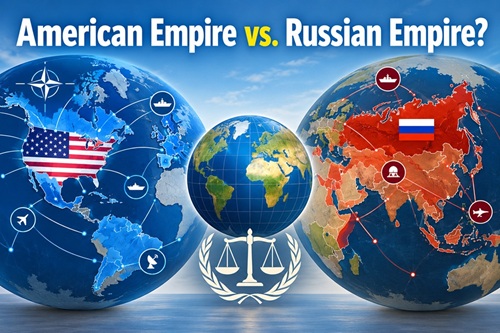
Appendix: American Empire vs. Russian Empire?A natural objection to any critique of Alexander Dugin is the following: But what about the American empire? If Dugin condemns the United States as an Atlantic hegemon, are we simply reproducing the very double standard that his worldview attacks? Has the United States not maintained military bases around the world, intervened in foreign countries, overthrown governments, fought wars far from its own territory, imposed economic sanctions and exercised enormous influence over other states? And if so, what gives Americans the right to lecture Russians about empire? This is not a trivial objection. Any serious criticism of Russian imperialism should begin by acknowledging that the United States has possessed—and continues to possess—extraordinary global power. The U.S. Department of Defense currently describes an American military presence encompassing thousands of sites in more than 160 countries, while its FY2025 budget documents list 74 overseas major installations. The exact number depends heavily on what counts as a “base” or “site,” but the global character of American military power is beyond dispute. American history also contains unmistakably imperial episodes. The nineteenth-century expansion across North America involved territorial conquest and the displacement of Indigenous peoples. The Spanish-American War of 1898 was followed by American rule in Puerto Rico and the Philippines, while Hawaii was annexed by the United States in the same period. In the twentieth century the United States repeatedly intervened in the political affairs of other countries, most notoriously in places such as Vietnam, Iraq and elsewhere in the Cold War and post-Cold War eras. So the word empire should not be reserved for Russia. But this does not establish Dugin's argument. It establishes something more modest and more important: great powers have repeatedly used military, economic and political power to shape the affairs of other societies. The United States is part of that history. Russia is part of it too. The crucial question is therefore not which great power is innocent. Neither is. The question is what kind of imperial relationship is being described. Empire is not a single thingThere is a temptation to construct a simple equation: American empire = Russian empire. That equation is too crude to be historically useful. The American global system has generally been built around a combination of military alliances, overseas bases, economic institutions, diplomatic influence, intervention and—in some periods—direct territorial control. Much of this system operates through treaties and partnerships with sovereign states. NATO, for example, is a formal alliance whose members retain their own governments and armed forces. American military deployments abroad can therefore coexist with the formal sovereignty of host countries. That does not make American power harmless or automatically legitimate. A military alliance can be unequal; a powerful state can exert enormous pressure on weaker partners; and formal sovereignty does not eliminate informal dependence. But there is a significant distinction between exercising influence over a sovereign state and claiming that the sovereign state itself belongs to one's civilization and therefore does not possess an independent geopolitical choice. This distinction becomes particularly important in the Russian case. The Russian imperial traditionRussia's imperial history is different in structure. The Russian Empire expanded continuously across Eurasia, incorporating enormous territories and peoples into a single imperial state. The Soviet Union subsequently inherited and transformed much of that geopolitical space. After the Soviet collapse, the Russian Federation lost control over many of those territories, but the idea that Russia possesses a special historical sphere of influence in the former Soviet space has remained influential in Russian strategic thought. Dugin radicalizes precisely this idea. For him, Russia is not merely one sovereign state among others. It is the core of a Eurasian civilization. This makes the political independence of neighboring states conceptually problematic whenever their choices appear to threaten that civilization. And this is where the comparison with American power reaches its limit. The United States has certainly attempted to shape the political orientation of other countries. But Dugin's theoretical framework explicitly challenges the assumption that every nation-state should ultimately be free to determine its geopolitical alignment independently. His Eurasianism replaces the universal principle of equal sovereignty with a hierarchical conception of civilizational space. That is not simply anti-Americanism. It is an alternative theory of international order. But NATO expansion mattersNone of this means that the history of NATO expansion should be ignored. Russian leaders have repeatedly objected to NATO's enlargement into Central and Eastern Europe, and Western governments have made strategic choices that Russian leaders interpreted as threatening. The post-Cold War security order therefore cannot honestly be described as a history in which one side acted and the other merely reacted. But explaining Russian perceptions is not the same as accepting the conclusion that Russia consequently possesses a right to determine the foreign policy of its neighbors. This is a distinction often lost in polemical discussions. A state can have legitimate security concerns without possessing a legitimate veto over another state's sovereignty. The United States can make strategic mistakes without thereby acquiring moral equivalence with every action of its adversaries. Russia can have genuine grievances without those grievances establishing an imperial right over Ukraine, Georgia or other neighboring states. Several propositions can be true simultaneously. Iraq is not a trump cardThe Iraq War is frequently invoked in discussions of Ukraine: America invaded Iraq illegally, so why criticize Russia for invading Ukraine? The comparison deserves serious consideration. The 2003 invasion of Iraq remains one of the most consequential examples of American military intervention in the post-Cold War era. It demonstrated how a superpower could use overwhelming military force to overthrow another government's regime on grounds that were intensely contested. But even here, historical analogy must be handled carefully. The existence of one unlawful or unjustified intervention does not logically legalize another. Otherwise international law would operate according to the principle that once one powerful country violates a rule, every other powerful country acquires permission to violate it. That is not a defense of American conduct. It is precisely the opposite. If the invasion of Iraq is regarded as a serious violation of international norms, the appropriate lesson is that such norms should apply consistently. The relevant principle should be universal: No great power should acquire a special license to invade weaker countries because another great power has previously abused its power. That principle cuts against both American exceptionalism and Russian exceptionalism. The American empire and the Russian empireThere is nevertheless an important similarity between the two systems. Both have tended to understand international politics partly through spheres of influence. Washington has historically sought a favorable international environment in which hostile powers do not dominate strategically important regions. Moscow has done something similar, often with a much stronger emphasis on territorial depth and control over neighboring space. Both have justified military power in terms of security. Both have supported friendly governments abroad. Both have intervened outside their borders. Both have attempted to shape the political choices available to other states. Both have developed narratives explaining why their own power contributes to a larger international order. The difference is that the American post-1945 order has been heavily institutionalized through alliances and international organizations, whereas Dugin's preferred order is explicitly civilizational and multipolar, with large geopolitical blocs exercising privileged authority over their surrounding spaces. The two models should therefore neither be equated nor artificially separated. They belong to the same history of great-power politics, but they represent different versions of it. The uncomfortable conclusionThis actually strengthens the critique of Dugin. If America has behaved imperially at various points in its history, that does not prove that empire is inevitable or desirable. It demonstrates how easily concentrated power can produce imperial behavior. The lesson should therefore not be: Russia is entitled to its empire because America has one. Nor should it be: America's empire does not count because it calls itself an alliance system. The more intellectually consistent position is harder. American power should be subjected to the same critical standards applied to Russian power. Russian power should be subjected to the same standards applied to American power. That means asking, in each case: Was force used? Against whom? Under what legal authority? With what objectives? Did the affected population possess meaningful political agency? Were borders changed by force? Was sovereignty respected? Were civilians protected? Were alternative diplomatic possibilities seriously pursued? And what happened after the intervention? These questions are more useful than competing accusations of hypocrisy. Dugin's missed opportunityThere is, in fact, a potentially legitimate critique of American hegemony buried inside Dugin's worldview. The United States really has possessed enormous structural power. American military installations span the globe. American alliances have helped shape the security architecture of Europe and Asia. American economic and technological power has given Washington extraordinary influence. The United States has sometimes used that power controversially and sometimes disastrously. One could construct a powerful critique of this system without embracing Russian imperialism. One could argue for a genuinely multipolar international order in which no state, including the United States, possesses a privileged right to determine the political destiny of others. But that principle must apply to Russia as well. And here Dugin's argument becomes self-defeating. He objects to American hegemony partly because it violates the autonomy of civilizations, while simultaneously imagining a Eurasian order in which Russia occupies the central position. The problem is not solved. The hegemon has simply changed. This is the fundamental weakness of many anti-imperialist arguments that become attached to great-power nationalism. They begin by saying: No country should dominate other countries. They end by saying: Except, perhaps, ours. Beyond competing empiresThe more interesting alternative is neither American empire nor Russian empire. It is an international order in which powerful states are constrained by rules that they do not control unilaterally, smaller states retain meaningful sovereignty, borders are not changed by force, and security arrangements are negotiated rather than imposed. That ideal is obviously imperfectly realized. The United States has violated it. Russia has violated it. European powers have violated it. China has violated aspects of it. Historically, virtually every major power has at some point found reasons why the rules should not apply in quite the same way to itself. But the imperfection of the principle is not an argument against the principle. Indeed, it may be the strongest argument for it. Dugin's great geopolitical mistake is therefore not simply that he criticizes America. Some of his criticisms deserve to be taken seriously. His deeper mistake is assuming that the answer to one hegemonic order must be another hegemonic order. A world divided into competing civilizational empires would not necessarily be a more peaceful or more emancipated world. It could simply produce several powerful states, each claiming a privileged sphere of influence and each explaining its expansion as defensive, historical or civilizational. The real alternative to empire is not Russian empire instead of American empire. It is the much more difficult proposition that neither should be the organizing principle of international politics.
Widget is loading comments...
|