|
TRANSLATE THIS ARTICLE
Integral World: Exploring Theories of Everything
An independent forum for a critical discussion of the integral philosophy of Ken Wilber
  Frank Visser, graduated as a psychologist of culture and religion, founded IntegralWorld in 1997. He worked as production manager for various publishing houses and as service manager for various internet companies and lives in Amsterdam. Books: Ken Wilber: Thought as Passion (SUNY, 2003), and The Corona Conspiracy: Combatting Disinformation about the Coronavirus (Kindle, 2020). Frank Visser, graduated as a psychologist of culture and religion, founded IntegralWorld in 1997. He worked as production manager for various publishing houses and as service manager for various internet companies and lives in Amsterdam. Books: Ken Wilber: Thought as Passion (SUNY, 2003), and The Corona Conspiracy: Combatting Disinformation about the Coronavirus (Kindle, 2020).
Check out my other conversations with ChatGPT
RUSSIA TODAY
Russia's 2026 Elections Putin's "Special Military Operation" Dugin's Metaphysics of Empire American vs. Russian Empire? Ritter as Geopolitical Crusador The Real New World Order No Clash of Civilizations? Putin's 'Special Military Operation'The Motives Behind the EuphemismFrank Visser / ChatGPT
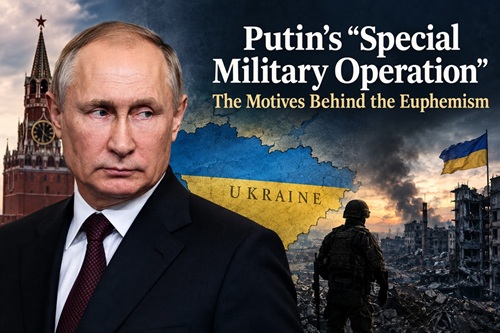 When Vladimir Putin announced the beginning of what Russia officially calls the “special military operation” on 24 February 2022, he did not describe it as a war of conquest. He presented it as a reluctant act of self-defence. Russia, he said, was protecting the people of Donbas, restoring peace, preventing a threat to Russian security, and “demilitarising and denazifying” Ukraine. The operation, in his telling, was forced upon Russia by circumstances created by Ukraine and the West. This explanation deserves to be taken seriously—not because it should simply be accepted, but because understanding what Putin says he is doing is essential to understanding the war. The interesting question is not merely whether his rhetoric is true or false. It is how several different arguments—Russian security concerns, the Donbas war, NATO expansion, Russian-Ukrainian history, and the alleged “denazification” of Ukraine—were assembled into a single justification for military action. The result is a remarkable transformation of categories. A neighbouring country's political independence becomes a threat. A domestic Ukrainian political orientation becomes “Nazism.” A civil and territorial conflict becomes genocide. And an invasion becomes a “special military operation.” Once these transformations are made, the military action can be presented not as aggression but as an almost unavoidable defensive response. The first argument: Russia was threatenedPutin's most intelligible argument concerns NATO and Russian security. This is not an argument invented in February 2022. Putin had been complaining about NATO enlargement for years. In his famous 2007 Munich speech, he described NATO's eastward expansion and the deployment of military infrastructure as a serious provocation and questioned why such infrastructure was being brought toward Russia's borders. There is therefore a genuine geopolitical issue here. Great powers have historically cared intensely about military alliances and hostile infrastructure near their borders. It would be naïve to imagine that Russia simply ceased to have security interests when the Cold War ended. But acknowledging a security interest is not the same thing as accepting the conclusion Putin drew from it. Ukraine's aspiration to determine its own foreign policy does not automatically constitute an armed attack on Russia. Nor does NATO's enlargement give Moscow a general right to determine which alliances neighbouring sovereign states may join. The distinction matters enormously. If Russia considers NATO enlargement dangerous, that is a legitimate subject for diplomacy, arms control and negotiation. It does not by itself establish a legal or moral entitlement to invade Ukraine. Indeed, Putin's argument contains an uncomfortable paradox. The more Russia treats Ukrainian independence as a security threat, the more Ukrainian leaders and citizens have reason to seek protection elsewhere. Military coercion can therefore produce precisely the geopolitical alignment that Moscow claims to fear. The second argument: DonbasThe Donbas argument is more complicated because there really was a war in eastern Ukraine beginning in 2014. Thousands of people were killed during the conflict before the 2022 full-scale invasion. The Minsk agreements attempted to establish a political settlement, but the settlement never succeeded. Putin subsequently presented the Russian intervention as an attempt to end this conflict. In later accounts he repeatedly said that Russia had acted to protect the populations of Donetsk and Luhansk and to stop what he described as Kyiv's war against them. This part of the story cannot simply be erased. There were genuine grievances, genuine casualties and a genuine political conflict in eastern Ukraine. But another distinction is necessary: recognizing that a conflict existed does not establish that Russia had the right to settle it by invading the entire country. Nor is the description of Ukraine as an undemocratic “Kyiv regime” particularly persuasive as a factual characterization. Ukraine's politics were certainly troubled by corruption, oligarchic influence, imperfect institutions and problems with media ownership and political finance. The OSCE's 2019 election observers documented many of these problems. But they also described the presidential election as competitive, with fundamental freedoms generally respected, and the parliamentary election as competitive despite significant malpractice. That matters because Putin's rhetoric requires a much darker picture: not merely a flawed democracy, but an illegitimate regime requiring external military removal or transformation. The curious word “denazification”Of all Putin's stated objectives, “denazification” is perhaps the most revealing. Ukraine certainly contains far-right groups and a history of nationalist violence. So do many European countries. Ukraine's far right, however, does not make the Ukrainian state itself a Nazi state. The country's 2019 presidential election produced a decisive victory for Volodymyr Zelensky, a Jewish Ukrainian, while the subsequent parliamentary election produced a competitive multiparty legislature. One need not idealize Ukrainian politics to see the problem. “Nazism” is being used by Putin's government not simply as a precise description of a political movement but as a delegitimizing category. Once the opponent has been classified as “Nazi,” military action against that opponent acquires an aura of moral purification. This is particularly powerful in Russia because the memory of the Second World War occupies an extraordinary place in national identity. “Nazism” is not merely a political label there. It evokes the existential struggle of 1941-45, the enormous Soviet sacrifice and the destruction of Nazi Germany. Consequently, calling the Ukrainian government “Nazi” does rhetorical work that calling it “corrupt” or “nationalist” would not. It transforms an ordinary geopolitical dispute into a continuation of the Great Patriotic War. The problem is that the analogy becomes self-sealing. If Ukraine resists Russian intervention, that resistance can itself be interpreted as evidence of “Nazism.” If Western countries support Ukraine, their support becomes evidence that the West is sponsoring Nazism. And if Russia attacks Ukrainian cities, the destruction can be presented as necessary to eliminate the supposed Nazi threat. A political category has thereby become a justification for war. The genocide argumentThe most serious version of the Donbas justification was the claim that Russia was intervening to prevent genocide. Putin repeatedly invoked this argument. In later speeches he continued to describe the Donbas population as having been subjected to “genocide” and said that Russia's military action was necessary to protect civilians. This is where the argument encounters a particularly important legal problem. Ukraine brought a case before the International Court of Justice concerning Russia's invocation of the Genocide Convention. In its March 2022 provisional-measures order, the Court did not determine the ultimate merits of the genocide allegations. But it did conclude that Ukraine possessed a plausible right under the Convention and ordered Russia to suspend the military operations it had commenced on 24 February. The distinction between war in Donbas and genocide in Donbas is therefore crucial. The existence of armed conflict and civilian suffering does not automatically constitute genocide. Genocide has a specific legal meaning involving an intent to destroy, in whole or in part, a protected national, ethnic, racial or religious group. Calling the Donbas conflict “genocide” therefore raises the evidentiary bar enormously. The Kremlin's argument did not merely say: Russian-speaking Ukrainians are suffering and deserve protection. That would have been a political argument. It said, in effect: Ukraine is committing genocide, therefore Russia is entitled to intervene militarily. The second proposition does not automatically follow from the first. The deeper argument: Ukraine is not really separatePerhaps the most important element of Putin's motivation lies underneath the immediate security arguments. Putin's conception of Ukraine has repeatedly gone beyond conventional Russian national-security thinking. He has described Russians and Ukrainians as historically connected peoples and has challenged the idea that modern Ukrainian sovereignty represents a fully independent historical development. His language increasingly treats Ukraine not simply as a neighbouring state but as part of a larger historical and civilizational space from which Russia has been artificially separated. This is why the argument cannot be reduced to NATO. If NATO were the entire issue, Ukrainian neutrality could theoretically solve the problem. But Putin's rhetoric has repeatedly addressed questions much deeper than military alignment: language, history, identity, territory and the legitimacy of Ukrainian statehood. That creates an important tension within the Russian justification. On one level, Russia says: Ukraine must be sovereign and neutral so that Russia can be secure. On another level, Putin's historical narrative questions precisely how separate Ukraine should be from Russia in the first place. These are not identical propositions. From security argument to imperial argumentThis is where the “SMO” becomes particularly revealing. A conventional security argument says: Ukraine is becoming aligned with a hostile military alliance; Russia therefore wants guarantees of neutrality. An imperial argument says: Ukraine is historically part of Russia's natural sphere and must therefore be prevented from becoming genuinely independent of Moscow. The first is a geopolitical argument familiar from great-power politics. The second is an argument about sovereignty and empire. Putin's rhetoric contains elements of both. This does not mean that every Russian security concern is invented. Nor does it mean that NATO policy is irrelevant. Western governments made strategic choices after the Cold War, and Russia interpreted some of those choices as threats. Putin's 2007 Munich speech demonstrates that these grievances predated the 2022 invasion by many years. But an explanation of Russian concerns is not necessarily a justification for Russian actions. That distinction is often lost in the argument over Ukraine. “The West forced us”Putin's narrative also places considerable responsibility on the West. NATO expansion, Western support for Ukraine, the post-2014 Ukrainian government, the failure of the Minsk process and alleged Western manipulation are woven together into a story in which Russia was progressively cornered. There is a recognizable logic here: Russia reacted because the West kept moving the geopolitical boundary closer to Russia. But this creates another problem. If Russia's security requires neighbouring states to remain within a Russian sphere of influence, then the sovereignty of those states becomes conditional upon Russian approval. That is precisely the principle that many smaller European states rejected after the collapse of the Soviet Union. The fundamental disagreement is therefore not simply about Ukraine. It concerns the political structure of Europe. Is Europe a collection of sovereign states entitled to choose their alliances, or is it a system of great-power spheres in which smaller countries must take account of the security preferences of their larger neighbours? Russia's position is much more intelligible if viewed through the second model. But the second model is precisely what post-Cold-War European security arrangements sought to move beyond. The “SMO” as political languageThe terminology itself deserves attention. Calling the invasion a “special military operation” is not a neutral description. It narrows the linguistic field. Russia did not initially present its action to its population as a conventional war between two sovereign states. The term suggests something limited, technical and purposeful. Yet the objectives subsequently attached to the operation became extraordinarily expansive: demilitarization, denazification, protection of Donbas, European security, recognition of territorial changes and, increasingly, the transformation of Ukraine's political and geopolitical orientation. The euphemism therefore performs an important political function. It separates the Russian public's conceptual image of the conflict from the much larger historical and geopolitical undertaking represented by the war. The terminology also reinforces Putin's central claim: Russia is not pursuing conquest; it is performing a necessary operation to correct an abnormal situation. But this is precisely where language and reality collide. In March 2022, the UN General Assembly described Russia's action as aggression against Ukraine and demanded the immediate and unconditional withdrawal of Russian forces. The resolution passed 141-5, with 35 abstentions. Whatever one's assessment of NATO policy, Western foreign policy or the origins of the Donbas conflict, this provides an important international-law counterpoint to the Russian description. What, then, was Putin's motivation?It would be too simple to reduce the motivation to a single explanation. Putin's stated motivations contain several layers. There was a genuine Russian fear of NATO expansion and of Ukraine's increasingly Western orientation. There was a genuine unresolved conflict in Donbas. There was a Russian perception that the post-2014 Ukrainian state had become hostile to Moscow. There was a Russian desire to preserve strategic influence over Ukraine. But these concerns were embedded within something larger: a historical conception of Russia's relationship with Ukraine in which Ukrainian sovereignty is treated as problematic when it produces a Ukraine oriented independently toward Europe and the West. The result is a kind of ideological fusion. Security, history, ethnicity, empire, anti-Nazism and geopolitics become one story. And once they become one story, almost any Russian military action can be interpreted as defensive. That is the central weakness of Putin's justification. The crucial distinctionThe most useful way to analyze Putin's stated motivation is therefore not to ask whether everything he says is “propaganda” or whether everything he says is “true.” Some of his premises describe real historical and geopolitical developments. The critical question is what conclusions he draws from them. A state can feel threatened without possessing the right to determine another state's foreign policy. A minority can suffer discrimination without that automatically constituting genocide. A country can contain far-right movements without becoming a Nazi state. A neighbouring country can have deep historical connections with Russia without ceasing to be a sovereign nation. And NATO expansion can create legitimate Russian security concerns without giving Moscow a right of veto over Ukrainian sovereignty. These distinctions are precisely what Putin's narrative tends to collapse. And that may be the deepest lesson of the “special military operation.” The war was presented as a defensive response to an intolerable external threat. But the justification increasingly reveals a different conception of international order: one in which great powers possess privileged security zones around them and smaller nations do not possess completely independent geopolitical choices. That is why the argument about Putin's motives cannot end with NATO. The fundamental question is whether Russian security requires Ukrainian subordination. If the answer is yes, then the “SMO” is ultimately about much more than Donbas, Nazism or NATO. It is about Russia's conception of its place in the post-Soviet world—and about whether Ukraine is entitled to escape that world altogether. The distinction between security and domination is therefore the key to understanding Putin's stated justification. His security concerns can be historically intelligible without making his conclusions inevitable. His grievances can be real without validating his remedies. And his motives can be partly defensive in conception while the resulting war is still an act of aggression in international law. That is perhaps the most uncomfortable conclusion of all: one does not have to believe that Putin invented every Russian grievance in order to reject the political logic by which those grievances became a justification for war.
Widget is loading comments...
|