|
TRANSLATE THIS ARTICLE
Integral World: Exploring Theories of Everything
An independent forum for a critical discussion of the integral philosophy of Ken Wilber
  Frank Visser, graduated as a psychologist of culture and religion, founded IntegralWorld in 1997. He worked as production manager for various publishing houses and as service manager for various internet companies and lives in Amsterdam. Books: Ken Wilber: Thought as Passion (SUNY, 2003), and The Corona Conspiracy: Combatting Disinformation about the Coronavirus (Kindle, 2020). Frank Visser, graduated as a psychologist of culture and religion, founded IntegralWorld in 1997. He worked as production manager for various publishing houses and as service manager for various internet companies and lives in Amsterdam. Books: Ken Wilber: Thought as Passion (SUNY, 2003), and The Corona Conspiracy: Combatting Disinformation about the Coronavirus (Kindle, 2020).
Check out my other conversations with ChatGPT Russia's 2026 ElectionsVoting Without a Genuine ChoiceFrank Visser / ChatGPT
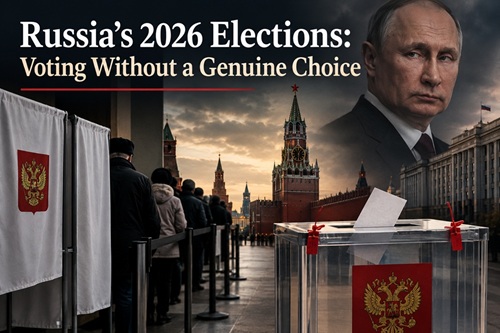 An election whose result is largely known in advanceToday, September 20, 2026, Russia concludes its first parliamentary election since Vladimir Putin launched the full-scale invasion of Ukraine in February 2022. Russians have been voting for three days to elect all 450 members of the State Duma, alongside regional governors and legislatures. On paper, this looks like the normal machinery of representative democracy: polling stations open, ballots are cast, parties compete and, at the end, votes are counted. But the more important question is not whether Russians are permitted to vote. It is whether they are permitted to make a genuinely consequential political choice. On that question, the 2026 election presents a very different picture. The Kremlin has gone to considerable lengths to ensure that the electoral process cannot become an uncontrolled expression of public dissatisfaction. United Russia already dominates the Duma, holding 310 of its 450 seats, and the political environment has been carefully structured to preserve that dominance. The other parties permitted to compete largely belong to what is commonly called Russia's "systemic opposition": parties that can criticize aspects of government policy but remain within boundaries acceptable to the Kremlin. The only registered party openly opposed to the war, Yabloko, was removed from the federal ballot before the election. That distinction is crucial. An election is not made democratic merely by placing several names or party logos on a ballot. Democracy requires uncertainty about the outcome and, more fundamentally, the possibility that those in power can actually lose. When the authorities control who may compete, what political organizations may operate, what information citizens receive, and which forms of dissent are permitted, voting can remain as a procedure while losing much of its democratic substance. The opposition that never quite gets to opposeThe most revealing feature of the 2026 election may therefore be what is absent from the ballot. Yabloko was disqualified after Russia's Supreme Court upheld a case brought against the party. Its exclusion removed the only party with an explicitly anti-war position from the federal contest. At the same time, numerous individual opposition candidates were disqualified on a variety of grounds. The Moscow Times reported that dozens of opposition candidates had been removed from the ballot, including 29 associated with Yabloko. Even candidates belonging to the Communist Party, one of the permitted "systemic opposition" parties, encountered disqualifications and pressure. This creates a peculiar political architecture. The regime does not necessarily need to abolish elections. It can instead determine the boundaries within which elections take place. The technique is more subtle. Permit competition, but regulate who may compete. Permit criticism, but exclude criticism that could threaten the political order. Permit opposition parties, but ensure that the opposition remains fragmented or institutionally dependent. Permit voters to express preferences, but narrow the available preferences beforehand. The result is something quite different from the old-fashioned one-party state. It is a managed multiparty system in which political plurality exists, but its potentially disruptive consequences are carefully contained. The war has become the referendum that never wasPutin has presented this parliamentary election as a demonstration of popular support for Russia's war in Ukraine. That is politically significant because the election is taking place after more than four years of full-scale war, with Russia experiencing continuing military costs, Ukrainian attacks increasingly reaching Russian territory, and growing economic pressures. Reuters reported today that Moscow was struck by what the city's mayor described as the largest Ukrainian drone attack on the capital since the beginning of the war, while Russians were simultaneously going to the polls. Yet an election conducted after excluding the principal anti-war political force cannot straightforwardly measure support for the war. Imagine a referendum in which one of the principal answers is removed before the ballots are printed. The resulting vote may still be numerically genuine in the narrow sense that people put marks on paper or make selections electronically. But interpreting the result as an unrestricted expression of public opinion would be a category mistake. This is the central problem with treating the Russian election as a referendum on Putin's war. A vote for a permitted party does not necessarily mean enthusiastic support for the war. A vote against United Russia does not necessarily mean support for the particular alternative chosen. Abstention can mean apathy, fear, resignation or disagreement. And a vote for the ruling party may represent genuine support, pragmatic accommodation, patriotism, conformity, fear of instability, or simple acceptance of the political status quo. The ballot itself cannot tell us which of these motivations lies behind a particular vote. The missing observerThere is another revealing feature of this election: independent international scrutiny has been significantly reduced. Russia did not invite the Organization for Security and Co-operation in Europe's election-observation bodies to monitor the parliamentary election. The OSCE said this was contrary to Russia's commitments under the 1990 Copenhagen Document and noted that the restrictions imposed on political participation and independent observation had further weakened transparency. This is the third consecutive nationwide electoral process in Russia that the OSCE has been unable to observe. That does not prove that every ballot is fraudulent. It demonstrates something more basic: independent verification has been made more difficult. This distinction matters. There is a tendency in discussions of Russian elections to jump immediately from "the election is controlled" to "therefore every vote is fabricated." That stronger claim is unnecessary. The political system can be fundamentally undemocratic without every individual ballot being falsified. Indeed, the more sophisticated form of electoral authoritarianism does not require millions of imaginary votes. It can manipulate the political environment before voting begins. If genuine opponents cannot register, independent media are constrained, election monitors are intimidated, political organizations are restricted and the electoral rules are controlled by the incumbent political establishment, then much of the decisive work has already been done before the first ballot is cast. The illusion of choiceThis is why the Russian election is best understood not simply as a question of vote counting but as a question of choice architecture. A democracy gives citizens political alternatives and allows society to determine which alternatives receive power. An authoritarian electoral system can reverse that relationship. The state determines which alternatives are institutionally viable and then asks citizens to choose among them. The distinction sounds subtle, but politically it is enormous. In a competitive democracy, the government fears the electorate because the electorate can replace it. In a managed electoral system, the government does not necessarily fear the electorate in the same way because the politically meaningful alternatives have already been filtered. The election consequently becomes less an instrument for discovering what the population wants than an instrument for demonstrating that the population has apparently chosen what the regime has already decided. That is why the anticipated victory of United Russia is less interesting than the political machinery that makes such a victory unsurprising. The important fact is not simply that the Kremlin's party is expected to win. It is that the conditions required for a genuinely uncertain contest have been progressively removed. But Russians are not the same thing as the KremlinThere is an important danger in criticizing the Russian electoral system: confusing the Russian government with the Russian people. Millions of Russians are participating in this election under circumstances they did not create. Some genuinely support Putin. Some support the war. Some oppose it. Some have become politically apathetic. Some are frightened. Some have adapted to authoritarian conditions because adaptation is safer than confrontation. Others are quietly dissatisfied. We should therefore resist the convenient Western caricature of a population consisting simply of brainwashed Putin supporters. The picture is more complicated. Russian citizens living abroad demonstrated this today by voting in what Reuters described as a symbolic act of opposition and solidarity. Many reportedly had little expectation that their ballots would alter the result inside Russia. Their participation nevertheless expressed the possibility of another Russian political future. This is perhaps the most important distinction of all: Russia is not identical to Putin's political system. A regime can control institutions without controlling every mind. It can suppress political alternatives without eliminating political disagreement. It can manufacture electoral legitimacy without manufacturing genuine unanimity. Elections as political theatreThe deeper irony is that authoritarian regimes still need elections. Why? Because modern governments seek legitimacy. Even dictatorships rarely want to announce openly: "We rule because we possess the power to rule." They prefer some institutional form suggesting popular consent. Elections provide precisely that symbolism. The Kremlin can point to turnout figures, vote percentages, parliamentary seats and images of citizens entering polling stations. Foreign governments and domestic audiences can be told that Russia has once again followed constitutional procedures. The language of democracy remains available even after much of its substance has been hollowed out. The election thus performs two functions simultaneously. Internally, it reinforces the existing political hierarchy. Externally, it supplies a vocabulary of legitimacy. This is why the spectacle matters even if the result is predetermined. The purpose is not necessarily to persuade everybody. It is enough to create a publicly usable story: Russians voted, the people spoke, United Russia won, therefore the government represents the national will. But the conclusion does not follow automatically from the premises. People voting under constrained political conditions do not thereby confer unlimited legitimacy on the system that constrained those conditions. The occupied territories make the contradiction even clearerThe election also includes voting in Crimea and in the Ukrainian territories that Russia claims to have annexed. The OSCE has explicitly stated that such elections have no validity under international law and condemned their organization in territories of Ukraine that remain internationally recognized as Ukrainian. This introduces an extraordinary contradiction. Russia presents the election as an expression of national sovereignty while simultaneously extending the Russian electoral system into territories whose annexation is not recognized internationally. The ballot therefore becomes part of the territorial claim. To vote in an occupied territory is not merely an administrative act. It is a political statement about who is entitled to govern that territory. Thus the election has a second function beyond selecting members of parliament: it helps normalize Russia's claim that territories seized during the war have become part of Russia. The electoral map becomes another instrument of territorial integration. What exactly has been demonstrated? When the votes are counted, there will inevitably be numbers. There will be turnout. There will be percentages. There will be winners and losers. There will be statements from Moscow describing the result as confirmation of the people's confidence in Putin's political course. But what, precisely, will have been demonstrated?It will demonstrate that millions of Russians participated in a state-organized electoral process. It may provide information about the degree of compliance, enthusiasm, apathy or dissatisfaction that exists within contemporary Russian society. It may also reveal regional differences and perhaps unexpected protest behavior. What it will not automatically demonstrate is that Russians were given a free and equal opportunity to replace the governing political establishment. That is the distinction between counting votes and measuring political consent. The first is arithmetic. The second requires a genuinely competitive political environment. The farce is in the mismatchCalling the election a "farce" is rhetorically satisfying, but the deeper problem is more interesting than the insult suggests. The election is not necessarily farcical because nobody votes. People do vote. It is not necessarily farcical because every vote is fabricated. That claim would require evidence ballot by ballot. The fundamental problem is the mismatch between the democratic appearance of the procedure and the political constraints surrounding it. There is a parliament, but its composition is heavily structured in advance. There are parties, but the most important anti-war party has been excluded. There are candidates, but numerous opponents have been removed. There is voting, but independent international observation has been denied. There is political choice, but the boundaries of that choice are determined by the political system itself. There is a result, but the principal political consequence is largely foreseeable before the votes are counted. In that sense, the Russian election resembles a referendum in which the question has been partially answered before it is asked. The tragedy behind the spectacleYet perhaps the greatest tragedy is not that the Kremlin stages elections. It is that elections are supposed to provide a peaceful mechanism by which societies correct themselves. A functioning democracy does not require citizens to agree. Quite the opposite. It institutionalizes disagreement. Governments make mistakes, voters punish them, opposition parties replace them, policies change, and the political system survives precisely because power can circulate without the entire state collapsing. Authoritarian systems have a different problem. Once political competition becomes threatening to the regime, disagreement itself becomes dangerous. The government therefore tries to eliminate uncertainty. But uncertainty is the essence of an election. A real election contains a politically uncomfortable possibility: the incumbent may lose. Once that possibility becomes intolerable, the election itself begins to change character. It becomes less an instrument for transferring power than an instrument for displaying power. And that may be the most revealing feature of Russia's 2026 parliamentary election. Its real message is not simply that Putin's political system expects to win. It is that the system has become organized around preventing the electorate from becoming genuinely capable of surprising it. That is why the final day of voting matters less for what Russians will decide than for what the entire electoral process tells us about the political system in which they are being asked to decide. The ballot remains. The parliament remains. The rituals remain. But democracy is not a ritual. It is the institutionalized possibility of saying no—and having that "no" actually matter.
Widget is loading comments...
|