|
TRANSLATE THIS ARTICLE
Integral World: Exploring Theories of Everything
An independent forum for a critical discussion of the integral philosophy of Ken Wilber
  Frank Visser, graduated as a psychologist of culture and religion, founded IntegralWorld in 1997. He worked as production manager for various publishing houses and as service manager for various internet companies and lives in Amsterdam. Books: Ken Wilber: Thought as Passion (SUNY, 2003), and The Corona Conspiracy: Combatting Disinformation about the Coronavirus (Kindle, 2020). Frank Visser, graduated as a psychologist of culture and religion, founded IntegralWorld in 1997. He worked as production manager for various publishing houses and as service manager for various internet companies and lives in Amsterdam. Books: Ken Wilber: Thought as Passion (SUNY, 2003), and The Corona Conspiracy: Combatting Disinformation about the Coronavirus (Kindle, 2020).
Check out my other conversations with ChatGPT
RUSSIA TODAY
Russia's 2026 Elections Putin's "Special Military Operation" Dugin's Metaphysics of Empire American vs. Russian Empire? Ritter as Geopolitical Crusador The Real New World Order No Clash of Civilizations? The New World Order and the Decline of American HegemonyFrank Visser / ChatGPT
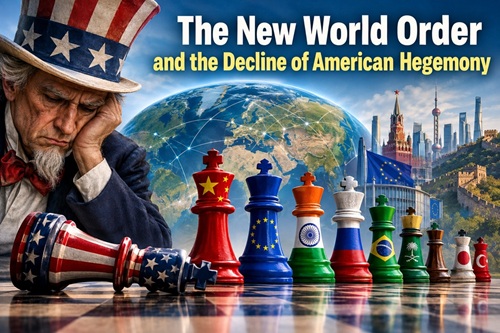 For much of the period after 1945, and especially after the collapse of the Soviet Union in 1991, the United States occupied an extraordinary position in the international system. It possessed the world's most powerful military, the dominant reserve currency, enormous economic resources, a global network of alliances, technological leadership, and considerable cultural influence. For a brief period after the Cold War, it was reasonable to speak of a unipolar world. That world is now disappearing. The important question, however, is not whether the United States is about to "collapse." Nor is it whether China has already replaced it. Both propositions are too simplistic. What is occurring is a gradual redistribution of economic, military and diplomatic power from a system overwhelmingly dominated by Washington toward a more fragmented and competitive international order. The term "New World Order" is useful here, but only if stripped of its conspiratorial baggage. There is no need to posit a secret cabal designing the transition. International orders have always changed when the underlying distribution of power changes. The present transformation is largely the consequence of that familiar mechanism. From American Century to Unipolar MomentThe American-led order emerged from the Second World War. The United States emerged from the conflict with an intact industrial base, enormous economic weight and unmatched military capabilities. Washington helped construct institutions such as the United Nations, the International Monetary Fund, the World Bank and the General Agreement on Tariffs and Trade. The dollar became the central currency of international commerce and finance. American alliances eventually extended across Europe and East Asia. NATO institutionalized the American security presence in Europe, while bilateral alliances with Japan, South Korea and others established an American security architecture in Asia. The Soviet Union provided the principal counterweight. When the Soviet Union disappeared in 1991, that counterweight disappeared with it. The United States consequently enjoyed something unusual in modern history: a period in which there was no comparably powerful peer competitor. But unipolarity contained the seeds of its own limitations. Washington increasingly treated its enormous power as an instrument for reshaping other societies. The interventions in Afghanistan and Iraq demonstrated the extraordinary reach of American military power, but also the limits of military power as a mechanism for political transformation. The United States could overthrow governments with remarkable speed. Creating stable political orders afterward proved considerably more difficult. The Rise of the RestThe most important change has been economic. China's transformation from a relatively poor country into an industrial and technological giant is perhaps the central geopolitical development of the past half-century. In 2025, according to World Bank data, US GDP at current exchange rates was about $30.8 trillion, compared with $19.5 trillion for China. China's economy therefore remains smaller in nominal dollar terms, while its growth rate was substantially higher: 5.0 percent compared with 2.2 percent for the United States. But China is only part of the story. India is becoming a major economic and demographic power. Indonesia is increasingly important. Brazil remains a major resource and agricultural power. The Gulf states have accumulated enormous financial resources. Turkey has become a significant regional actor. Russia remains a major nuclear, military and energy power despite its much smaller economy. And the European Union represents another enormous economic bloc, even though its political and military capabilities remain fragmented. The result is not simply "America versus China." It is a world in which considerably more actors possess the economic resources to pursue independent policies. The IMF itself described the contemporary international system in 2026 as moving toward "a more fragmented, multipolar world." That is probably a better description than the increasingly popular claim that America is simply being replaced by China. The Military ParadoxThe military dimension illustrates the ambiguity particularly well. The United States remains extraordinarily powerful. In 2025 it spent an estimated $954 billion on its military—approximately one-third of global military expenditure and about 2.8 times China's estimated spending. The United States also possesses something China does not: a worldwide network of formal military alliances and overseas bases, combined with decades of experience operating globally. So talk of an American military collapse is premature. But American military predominance is no longer equivalent to uncontested military dominance. China has invested heavily in naval power, missiles, nuclear weapons, cyber capabilities, satellites and anti-access/area-denial systems. Its military spending increased by 7.4 percent in 2025, according to SIPRI, reaching an estimated $336 billion. Meanwhile, other countries are rearming. Global military expenditure reached approximately $2.9 trillion in 2025. European military expenditure increased by 14 percent, while spending in Asia and Oceania increased by 8.1 percent. This produces an interesting paradox: American relative military superiority may be declining even as American military power remains historically enormous. Declining hegemony is therefore not the same thing as declining capability. The Dollar: America's Most Important AdvantagePerhaps the greatest mistake in predictions of imminent American decline is to underestimate the durability of the dollar-centered financial system. Military power can be challenged relatively quickly. Financial infrastructure is much harder to replace. The dollar is embedded in international trade, banking, debt markets, central-bank reserves and global investment. American financial markets remain exceptionally deep and liquid. China has attempted to internationalize the renminbi, while BRICS countries have periodically discussed alternatives to dollar-based settlement. Yet creating an alternative monetary system is considerably harder than criticizing the existing one. The euro is a major currency but lacks a unified European fiscal and political authority comparable to the American state. China's currency is constrained by capital controls and the structure of its financial system. Gold can serve as a reserve asset but cannot easily reproduce the functions of a gigantic international currency market. Consequently, "de-dollarization" should not be confused with the imminent disappearance of the dollar. The more plausible development is gradual diversification: more currencies, more bilateral settlement arrangements and a somewhat smaller American share of global financial activity. That is erosion of privilege, not monetary collapse. The Iraq and Afghanistan LessonsAmerican foreign policy itself contributed to the erosion of unipolarity. The invasion of Iraq in 2003 was justified partly on the premise that American power could transform the strategic environment of the Middle East. Instead, the war destabilized Iraq, strengthened Iran's regional position and eventually contributed to an enormous chain of unintended consequences. Afghanistan produced another demonstration of the limitations of military occupation and nation-building. The lesson was not that American military power was useless. Quite the opposite: American military power remained devastatingly effective against conventional opponents. The lesson was that destroying an existing political order is much easier than constructing a legitimate replacement. This distinction is fundamental to understanding the limits of hegemony. Russia and the Limits of Western PowerRussia presents a different challenge. Economically, Russia is nowhere near the United States or China. But economic size is not the only determinant of geopolitical power. Russia possesses the world's largest nuclear arsenal, enormous energy resources, a large military-industrial complex and a permanent seat on the UN Security Council. The war in Ukraine has also demonstrated something uncomfortable for Western policymakers: economic sanctions do not automatically translate into strategic capitulation. At the same time, Russia's ability to wage war at scale has come with substantial costs, and the war has produced enormous casualties, destruction and economic pressures. Its experience should therefore not be interpreted as evidence that Western power has simply become irrelevant. Instead, it illustrates the return of something that characterized international politics before the American unipolar moment: major states pursuing incompatible interests despite enormous economic interdependence. The BRICS QuestionBRICS is frequently presented as the embryo of an alternative world order. There is something real behind the claim. Countries such as China, India, Brazil and Russia represent a significant proportion of humanity and global economic production. Their governments are also increasingly interested in reducing dependence on Western institutions. But BRICS should not be mistaken for a new Soviet Union. Its members have profoundly different interests. India and China are strategic competitors. Saudi Arabia has its own priorities. Brazil's interests differ from Russia's. China is dramatically more economically important to the grouping than most of its other members. There is no unified BRICS foreign policy, military command, political ideology or economic system. The significance of BRICS therefore lies less in its ability to replace the Western order than in what it demonstrates: an increasing number of countries want greater freedom of maneuver within the international system. The Real New World OrderThe emerging order is likely to be less tidy than the Cold War system and less hierarchical than the post-1991 system. Instead of one dominant power confronting one organized adversary, there will be overlapping spheres of cooperation and competition. The United States will remain central to the Western alliance system. China will dominate much of East Asian economic activity and increasingly contest American power in the Indo-Pacific. India will attempt to maintain strategic autonomy. Europe will try to acquire greater capacity for independent defense while remaining connected to the United States. Russia will remain a disruptive nuclear and military power. Middle powers will exploit competition between the major powers to maximize their own autonomy. This is not necessarily a return to nineteenth-century geopolitics. Modern globalization, nuclear deterrence, multinational institutions and technological interdependence make the environment fundamentally different. But it does represent the end of the comfortable assumption that Washington can determine the broad direction of international affairs by itself. The American Problem Is Relative, Not AbsoluteThis distinction is essential. America can simultaneously become less dominant and remain the world's most powerful individual country. Indeed, that is probably the most plausible scenario. The United States still possesses enormous advantages: a huge economy, technological leadership in numerous sectors, sophisticated capital markets, a powerful military, favorable geography, substantial energy resources, a large internal market and an extensive alliance network. The World Bank's 2025 figures put American GDP at $30.8 trillion, with GDP per capita above $90,000. The issue is therefore not American weakness in absolute terms. It is the declining ratio between American power and everyone else's power. That distinction separates serious analysis from declinist mythology. Britain did not cease to be a powerful country when the United States overtook it. Britain simply ceased to be the dominant great power. Something similar could eventually happen to the United States. Hegemonic OverstretchThere is another problem: the costs of maintaining hegemony. A hegemon has to provide security, maintain alliances, protect trade routes, sustain military deployments, manage financial institutions and respond to crises across multiple regions. The temptation is to interpret every regional challenge as a test of American credibility. That creates a dangerous feedback loop. If Washington believes that withdrawing from any confrontation demonstrates weakness, it becomes committed to an ever-expanding definition of vital interests. The hegemon consequently accumulates obligations faster than it accumulates resources. This was one of the classic problems identified by historians of empire. Power can become a liability when maintaining the appearance of omnipotence becomes more important than distinguishing essential interests from peripheral ones. The Danger of the "Decline" NarrativeThere is an equal and opposite danger. American decline has become an ideological industry. Some commentators see every political crisis, budget deficit or military setback as proof that the American empire is collapsing. Others treat every Chinese economic problem as evidence that China will never challenge American predominance. Both approaches mistake history for a morality play. Great-power transitions are rarely clean. The British Empire did not suddenly disappear. The Soviet Union did. China may continue rising—or encounter serious demographic, economic and political constraints. The United States may experience relative decline—or renew its technological and economic advantages. The future is consequently not predetermined. From Hegemony to BalanceThe most useful interpretation of the "New World Order" is therefore not that an invisible group has constructed a new system, nor that America is about to disappear. It is that the structural conditions of American unipolarity are disappearing. The post-1991 world depended upon an unusually large concentration of power in one country. That concentration has gradually diminished as China, India, Europe, Russia and other regional powers have acquired greater capabilities. The IMF's recent assessment that the international system is becoming more fragmented and multipolar captures this transition better than the rhetoric of either American triumphalism or imminent American collapse. The emerging order will probably be messier. There will be more bargaining, more regional conflicts, more sanctions, more economic competition and more attempts by middle powers to avoid choosing sides. International institutions will remain important but will increasingly have to accommodate competing centers of power. The great geopolitical transformation of our time is therefore not necessarily the "fall of America." It is the end of the assumption that there has to be one unquestioned center. America may remain the single most capable state for decades. But being exceptionally powerful is different from being hegemonic. The first can survive the rise of other powers. The second cannot. That is the real New World Order: not an American collapse, not a Chinese takeover, but the return of geopolitical pluralism after the extraordinary—and historically brief—American unipolar moment.
Widget is loading comments...
|