|
TRANSLATE THIS ARTICLE
Integral World: Exploring Theories of Everything
An independent forum for a critical discussion of the integral philosophy of Ken Wilber
  Frank Visser, graduated as a psychologist of culture and religion, founded IntegralWorld in 1997. He worked as production manager for various publishing houses and as service manager for various internet companies and lives in Amsterdam. Books: Ken Wilber: Thought as Passion (SUNY, 2003), and The Corona Conspiracy: Combatting Disinformation about the Coronavirus (Kindle, 2020). Frank Visser, graduated as a psychologist of culture and religion, founded IntegralWorld in 1997. He worked as production manager for various publishing houses and as service manager for various internet companies and lives in Amsterdam. Books: Ken Wilber: Thought as Passion (SUNY, 2003), and The Corona Conspiracy: Combatting Disinformation about the Coronavirus (Kindle, 2020).
Check out my other conversations with ChatGPT
RUSSIA TODAY
Russia's 2026 Elections Putin's "Special Military Operation" Dugin's Metaphysics of Empire American vs. Russian Empire? Ritter as Geopolitical Crusador The Real New World Order No Clash of Civilizations? Scott RitterFrom Weapons Inspector to Geopolitical CrusaderFrank Visser / ChatGPT
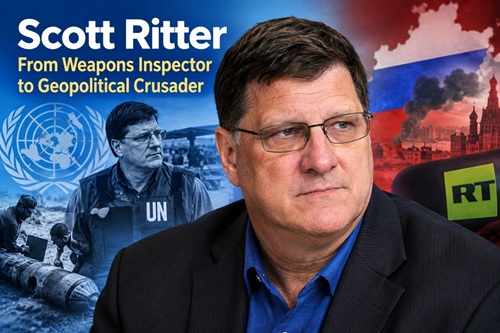 The authority of the inspectorScott Ritter acquired his public authority honestly enough. A former U.S. Marine intelligence officer, he served with the United Nations Special Commission (UNSCOM), which investigated Iraq's prohibited weapons programs after the Gulf War. From 1991 until his resignation in 1998, he became one of the commission's most prominent and aggressive inspectors. His specialty was not armchair geopolitics but the practical business of penetrating Iraq's concealment system. Contemporary reporting described him as one of UNSCOM's most effective planners of intrusive inspections. His resignation in August 1998 was also substantive rather than theatrical. Ritter believed that the Security Council was failing to enforce its own resolutions and that political considerations were progressively weakening the inspection regime. His resignation letter accused the Council and the United States of effectively surrendering the leverage necessary to complete the disarmament mission. This history matters because Ritter's later arguments about Iraq were not the inventions of an outsider who suddenly discovered geopolitics on YouTube. He really had inside experience of the Iraqi weapons programs. He also had a legitimate grievance about the political manipulation surrounding UNSCOM. There were documented tensions between U.S. intelligence operations and the inspection process, including efforts to use inspection mechanisms for intelligence collection. In other words, the Scott Ritter story begins with genuine expertise. That is precisely what makes the second half of the story so consequential. Ritter was substantially right about Iraq — but not in the way his legend suggestsRitter became one of the most prominent opponents of the 2003 invasion of Iraq. By 1999 he was publicly arguing that Iraq had been qualitatively disarmed. In a 2000 Arms Control Today article he developed the argument that the remaining uncertainty concerned accounting and verification rather than an intact, militarily significant WMD arsenal. By 2002-03 he was arguing forcefully that the Bush administration had not demonstrated that Iraq had reconstructed a significant WMD capability. The subsequent discovery that Iraq did not possess the large operational WMD stockpiles asserted by the Bush administration made Ritter look remarkably prescient. But there is an important distinction between saying, "Ritter was substantially correct about the absence of the alleged Iraqi arsenal," and saying, "Ritter's entire interpretation of Iraq was correct." The inspection record was never as simple as the retrospective mythology suggests. UNSCOM had uncovered extensive Iraqi weapons programs and had faced systematic Iraqi concealment. The inspection process could establish destruction of many weapons and capabilities, but proving a negative in a hostile state was inherently difficult. Even the later UN inspection regime encountered misleading or erroneous intelligence as well as genuine discoveries. Ritter's strongest achievement was therefore epistemic rather than prophetic: he understood better than many politicians that intelligence claims about Iraqi WMD were being presented with a confidence that the evidence did not warrant. That is an important lesson. Unfortunately, Ritter himself would later fall into a remarkably similar epistemic trap. From skepticism of American power to certainty about RussiaRitter's opposition to the Iraq War eventually developed into a much broader worldview. The United States became, in his interpretation, the principal source of geopolitical deception. NATO expansion became an explanation for Russian insecurity. Western governments became habitual manipulators of information. Western media became instruments of state propaganda. Some of these criticisms concern real phenomena and deserve discussion. Governments do manipulate intelligence. States conduct propaganda. Western governments have made disastrous foreign-policy decisions. The Iraq War itself provides an enormous historical example. But there is a dangerous logical transition from: "Governments sometimes lie" to: "Therefore the government's adversary is generally telling the truth." That transition is not skepticism. It is merely skepticism with the polarity reversed. And this is where Ritter's Ukraine commentary becomes problematic. After Russia's full-scale invasion of Ukraine in February 2022, Ritter rapidly became an extraordinarily consistent defender of the Russian interpretation of events. His public commentary went well beyond criticizing NATO policy or arguing that Western governments had contributed to the conflict. He repeatedly adopted claims that placed primary responsibility for atrocities and escalation on Ukraine while minimizing or disputing Russian responsibility. The Bucha massacre provides a particularly revealing example. Ritter publicly asserted that Ukraine was responsible for the killings. Human Rights Watch subsequently documented evidence linking the killings to Russian forces. That does not mean every Russian claim is false or every Western claim is true. It does mean that Ritter's method has become difficult to distinguish from motivated selection of evidence. The Bucha problemBucha is important because it illustrates the difference between healthy skepticism and asymmetric skepticism. A genuine skeptic asks: • What evidence supports the Russian claim? • What evidence supports the Ukrainian claim? • What evidence comes from independent investigators? • What remains uncertain? • How reliable are the sources? • What evidence would falsify my preferred interpretation? Ritter frequently seems to ask a different question: • Can I identify a weakness in the Western account? If the answer is yes, the Western account becomes suspect. But a weakness in one side's evidence does not automatically establish the opposing side's narrative. This is a classic asymmetry of conspiracy-style reasoning. The evidentiary burden imposed on one's own preferred side becomes lower than the burden imposed on its adversary. The irony is obvious. Ritter's career was built around the principle that weapons inspectors should distrust unsupported claims. Yet his later political commentary sometimes displays precisely the kind of confirmation bias that professional intelligence analysis is designed to resist. The problem of expertiseRitter's status as a former weapons inspector gives his arguments a special rhetorical power. When he discusses missile systems, military logistics, arms control or Iraqi weapons programs, listeners quite reasonably remember that he actually worked in those fields. But expertise is domain-specific. Being an experienced UNSCOM inspector does not automatically make someone an expert on the political intentions of Vladimir Putin, the internal politics of Ukraine, Russian military doctrine, Ukrainian public opinion, battlefield intelligence, or the reliability of every Western intelligence service. Nor does it make his predictions about future military events inherently more reliable. This is one of the recurring problems with celebrity experts. Their credential becomes portable: expertise acquired in one domain is gradually converted into generalized authority. Ritter's case is particularly striking because his authority derives from a period when he really was an insider. His later audience is therefore encouraged to think: "He was right about Iraq when almost everybody else was wrong, so perhaps he is right about Russia when everybody else is wrong." But that inference does not follow. Being right once is not a transferable method of truth detection. Russia and the media questionRitter's relationship with Russian state media is another important part of the story. He has written extensively for RT and has defended that relationship explicitly. In 2024 he argued that RT exercises less editorial control over him than Western media organizations did and rejected the idea that his relationship with RT made him a Russian government asset. His position should be reported fairly: Ritter says he is an independent journalist whose work reflects his own observations and analysis. He points to his continuing criticism of American policy and argues that Russian outlets provide an alternative to what he regards as an excessively compliant Western press. That is his stated position. But the relevant question is not merely whether Moscow literally dictates his articles. A much more interesting question is whether a commentator can become intellectually dependent on an information ecosystem without receiving direct instructions from that ecosystem. The answer is obviously yes. No journalist needs to receive a Kremlin phone call telling him what to believe. If the sources he trusts, the experts he interviews, the media outlets that publish him, the audiences that reward him and the political assumptions underlying his worldview all point predominantly in one direction, a powerful feedback loop can emerge. This applies to Western journalists as well. It is not a uniquely Russian phenomenon. Ritter's mistake is therefore not necessarily that he works for RT. The deeper problem is that he appears to have interpreted the existence of Western propaganda as evidence that Russian propaganda is consequently more trustworthy. It isn't. The mirror-image worldviewThe most interesting criticism of Ritter is therefore not "he is pro-Russian." That is too superficial. The deeper problem is that his skepticism has become asymmetrical. When Washington makes a claim, Ritter instinctively asks: • What is the hidden agenda? • What intelligence is being manipulated? • Who benefits? • What is the military-industrial interest? • What is being concealed? These are good questions. But when Moscow makes a claim, the same interrogation often seems substantially weaker. • What is the Kremlin's incentive? • What information might Russian intelligence conceal? • What would Russian military authorities gain by presenting events in a particular way? • Which Russian sources have been demonstrably unreliable? • Which claims have subsequently proved false? Those questions must be asked with exactly the same intensity. Otherwise skepticism becomes a political identity rather than an epistemic discipline. The danger of the "anti-imperialist" reflexThere is another intellectual problem here. Ritter's worldview can be understood partly as an inversion of American exceptionalism. American exceptionalism says, roughly, that American power is unusually benign because the United States represents liberal democracy. The opposite ideological reflex says that because the United States is an imperial power, its geopolitical adversaries are consequently resisting imperialism and therefore deserve greater credence. Neither proposition follows. Russia can oppose American hegemony and still conduct imperial warfare. Ukraine can receive Western military assistance and still be the victim of Russian aggression. NATO can have contributed to Russian insecurity without that making Russia's invasion legitimate. The United States can have lied about Iraqi WMD without that making Russian statements about Ukraine reliable. Several things can be true simultaneously. This is precisely where serious geopolitical analysis becomes difficult: reality does not organize itself into ideological teams. Ritter's Ukraine predictionsRitter has also repeatedly made highly confident assessments about the trajectory of the Ukraine war. Such predictions are especially revealing because military forecasting is extraordinarily uncertain. The Ukraine war has demonstrated the difficulty of predicting outcomes from force ratios alone. Drone warfare, electronic warfare, air defense, industrial production, ammunition supply, mobilization, intelligence, sanctions, foreign aid and political endurance interact in ways that make linear extrapolation hazardous. Recent reporting continues to describe a prolonged conflict characterized by adaptation on both sides rather than the kind of simple battlefield trajectory often implied by commentators. A commentator who repeatedly presents complex military developments as essentially inevitable should therefore be judged not by the confidence of his rhetoric but by the track record of his specific claims. This is particularly important for Ritter because his reputation rests heavily on being the man who "got Iraq right." The proper response is not to grant him permanent epistemic credit. It is to keep score. The personal dimensionThere is also an uncomfortable part of Ritter's biography that should neither be sensationalized nor ignored. In 2011 he was convicted in Pennsylvania on six counts arising from an online sex sting involving an undercover officer posing as a 15-year-old girl. He was subsequently sentenced to 18-66 months in prison. Ritter maintained at trial that he believed the person he encountered was an adult. This episode does not prove that his geopolitical analysis is false. A person's private criminal conduct is not a logical refutation of a political argument. But it does matter when considering the broader construction of public authority. Ritter's current reputation among some audiences depends heavily on an image of himself as an exceptionally courageous truth-teller who has repeatedly been persecuted by powerful institutions. That narrative becomes more complicated when the biographical record includes serious conduct that he himself has contested or defended. Again, the proper lesson is not ad hominem dismissal. It is methodological caution. What remains valuable in RitterA critical essay should not turn into a caricature. Ritter has performed an important public service in reminding Western audiences that governments can manufacture certainty from ambiguous intelligence. His criticism of the Iraq War was substantially vindicated on the central WMD question. His firsthand experience with UNSCOM gives his historical testimony considerable value. His warnings about the dangers of escalation between nuclear powers should not be dismissed merely because one disagrees with his interpretation of Russia. His criticism of Western media also occasionally raises legitimate questions about institutional incentives, editorial conformity and the relationship between journalism and national-security establishments. The problem is not that Ritter asks uncomfortable questions. The problem is that he increasingly appears to have predetermined the answers. That distinction is crucial. From skeptic to partisanThere is a revealing trajectory here. The early Ritter said: "Show me the evidence." The later Ritter increasingly says: "I know why you are showing me this evidence." The first position is methodological skepticism. The second can become ideological suspicion. The difference is enormous. A professional inspector is trained to distinguish between what is known, what is suspected and what is unverified. A political polemicist has incentives to collapse those categories because certainty is rhetorically powerful. Ritter's transformation illustrates how easily expertise can migrate from investigation into advocacy. His original rebellion against American power was understandable. His subsequent identification of the United States as the central explanatory variable in almost every geopolitical controversy is much less convincing. The world is not divided into Washington's lies and Moscow's truths. It contains American lies, Russian lies, Ukrainian propaganda, European propaganda, intelligence failures, genuine evidence, accidental misinformation, deliberate disinformation and large quantities of uncertainty. The mature skeptic must navigate all of them. The Ritter paradoxScott Ritter therefore embodies a genuine paradox. He became famous because he was willing to challenge an extremely powerful government when he believed its claims were unsupported. That is a valuable democratic function. But a critic of power must also be capable of criticizing the power he happens to sympathize with. Otherwise the dissident gradually becomes a partisan. Ritter's Iraq record should be remembered. It should not be allowed to function as a permanent credential for everything he subsequently says. His strongest contribution remains his demonstration that governments can construct an apparently overwhelming case from evidence that does not withstand scrutiny. The irony is that this lesson applies to Scott Ritter himself. His claims about Russia, Ukraine and the West should therefore be subjected to the same standard that he once demanded for Iraq: • Show the evidence. • Distinguish intelligence from inference. • Distinguish possibility from probability. • Separate what is known from what is merely asserted. • And, above all, apply the same skepticism to one's own side as to one's opponent. That is the standard by which Ritter should be read—not as a hero, not as a villain, and certainly not as an oracle, but as a highly experienced former inspector whose later career provides an unusually instructive case study in how legitimate skepticism can evolve into ideological certainty.
Widget is loading comments...
|