|
TRANSLATE THIS ARTICLE
Integral World: Exploring Theories of Everything
An independent forum for a critical discussion of the integral philosophy of Ken Wilber
  Frank Visser, graduated as a psychologist of culture and religion, founded IntegralWorld in 1997. He worked as production manager for various publishing houses and as service manager for various internet companies and lives in Amsterdam. Books: Ken Wilber: Thought as Passion (SUNY, 2003), and The Corona Conspiracy: Combatting Disinformation about the Coronavirus (Kindle, 2020). Frank Visser, graduated as a psychologist of culture and religion, founded IntegralWorld in 1997. He worked as production manager for various publishing houses and as service manager for various internet companies and lives in Amsterdam. Books: Ken Wilber: Thought as Passion (SUNY, 2003), and The Corona Conspiracy: Combatting Disinformation about the Coronavirus (Kindle, 2020).
Check out my other conversations with ChatGPT
RUSSIA TODAY
Russia's 2026 Elections Putin's "Special Military Operation" Dugin's Metaphysics of Empire American vs. Russian Empire? Ritter as Geopolitical Crusador The Real New World Order No Clash of Civilizations? Alexander Dugin and the Metaphysics of EmpireFrank Visser / ChatGPT
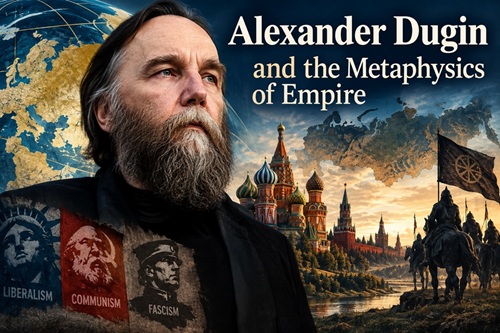 Alexander Dugin is one of those political thinkers who becomes more intelligible—and more alarming—the more seriously one reads him. It is tempting to dismiss him as a crank, a mystic in military fatigues, or simply as the eccentric “philosopher of Putinism.” That misses something important. Dugin represents a genuine intellectual current: a radical rejection of liberal modernity, individualism, universal human rights and the Western conception of political order, combined with a vision of Russia as the spiritual and geopolitical center of a Eurasian civilization. His ideas have changed considerably over the decades, but the underlying hostility to liberal modernity has remained remarkably persistent. At the same time, the opposite mistake is equally serious: treating Dugin as the hidden mastermind of everything Vladimir Putin does. His actual influence is difficult to measure, and recent analysis from the Centre for Eastern Studies explicitly warns that the influence of figures such as Dugin is often overestimated. Dugin is better understood not as Putin's puppet-master but as an unusually articulate theorist of a worldview that has found increasing resonance in contemporary Russian nationalism. That worldview deserves criticism on its own terms. From the Soviet fringe to the Eurasian centerDugin's intellectual biography is itself revealing. During the late Soviet period he became involved with radical right-wing circles, including the Pamyat movement. In the 1990s he became associated with Eduard Limonov and the National Bolshevik movement, an extraordinary political mixture of nationalism, communism, revolutionary aesthetics and opposition to liberal democracy. He subsequently developed neo-Eurasianism and eventually became an adviser to Gennady Seleznev, speaker of the Russian State Duma. This trajectory is important because Dugin cannot easily be placed on the conventional left-right spectrum. He has borrowed from almost everywhere. Marxism contributes its hostility to capitalism and bourgeois individualism. Fascism contributes the cult of collective identity, hierarchy and political myth. Russian nationalism supplies the imperial project. Traditionalism supplies the metaphysical justification. Heidegger supplies a philosophical vocabulary. Geopolitics supplies the map. The result is not an accidental jumble. It is an attempt to construct an alternative civilization. Dugin's intellectual genealogy reaches back through European reactionary thinkers such as René Guénon, Julius Evola and Carl Schmitt, while Martin Heidegger provides some of the philosophical vocabulary for his later work. Recent scholarship has specifically examined the continuing importance of Traditionalism in Dugin's thought. And this is where Dugin becomes particularly interesting for anyone concerned with the larger culture wars surrounding modernity. The enemy is modernity itselfDugin's deepest enemy is not NATO. It is not even America. It is modernity. Liberalism, communism and fascism are, in Dugin's account, the three great political ideologies of the modern age. His Fourth Political Theory, first published in 2009, proposes to move beyond all three. Liberalism has supposedly exhausted itself; communism collapsed with the Soviet Union; fascism was defeated in the Second World War. What remains is the possibility of a new political philosophy. This sounds intellectually ambitious. But there is a revealing sleight of hand here. Dugin treats the failure of particular historical forms of liberalism, communism and fascism as evidence that the modern political project itself has failed. Yet these are very different propositions. One can criticize liberal capitalism without rejecting individual rights. One can criticize Marxism without rejecting social equality. One can reject fascism without believing that tradition is meaningless. Dugin repeatedly collapses these distinctions because his real target is much broader: the Enlightenment idea that human beings can organize political life around individual freedom, reason, universal rights and institutional pluralism. His alternative is not merely another political program. It is another anthropology. From the individual to the collectiveLiberalism begins with the individual. Dugin wants to begin somewhere else. His Fourth Political Theory invokes Heidegger's concept of Dasein as the possible subject of the new politics. But the philosophical move is problematic. Heidegger's analysis of human existence does not automatically produce a political program, much less an imperial one. Dasein describes situated human existence. Dugin turns this philosophical category into something resembling a civilizational subject. That transformation is characteristic of Dugin's thinking. Philosophical concepts are repeatedly elevated into political metaphysics. The individual disappears into a larger entity: civilization, people, tradition, ethnicity, empire, territory or historical destiny. This is precisely where the political danger begins. Once the collective becomes metaphysically prior to the individual, individual rights can easily be reinterpreted as artificial Western abstractions. Once civilization becomes the primary political subject, minorities become internal problems. Once historical destiny becomes more important than individual choice, coercion can be presented as the fulfillment of history rather than its violation. The Washington Post summarized Dugin's worldview as one in which Russia represents a Eurasian culture grounded in “God, tradition, community, ethnicity, empires and kingdoms,” opposed to the liberal values associated with the Atlantic West. The contrast could hardly be clearer. Liberalism asks: What rights does the individual possess against the state? Dugin's worldview asks: What does the individual owe to civilization? Those are not merely different political preferences. They are competing conceptions of what a human being is. Eurasia as geopolitical mythologyDugin's Eurasianism takes this metaphysical opposition and draws it onto a map. The world becomes divided between land powers and sea powers, Eurasia and the Atlantic, Russia and the Anglo-American West. Russia is conceived not simply as one nation among others but as the center of a continental civilization. This is where geopolitics becomes mythology. Geography certainly matters in international politics. States have strategic interests arising from their location, borders, resources and access to seas. But Dugin's geopolitics goes much further. Geography becomes destiny. Political conflicts become expressions of civilizational essences. Russia is not simply pursuing particular interests. Russia is Eurasia. America is Atlanticism. Ukraine becomes strategically and symbolically crucial because an independent Ukraine disrupts the imagined unity of the Eurasian landmass. This is why Dugin's Foundations of Geopolitics has attracted so much attention. Published in 1997, it advocated an expansion of Russian influence and a restructuring of the geopolitical order in ways that would weaken the United States and its allies. Contemporary accounts of the book highlight its recommendations concerning Ukraine, European politics and destabilization within Western societies. But there is an important distinction to preserve. A book containing geopolitical prescriptions does not demonstrate that every subsequent Kremlin decision was dictated by its author. Nor does Dugin's prominence establish that Putin mechanically follows Dugin's philosophy. The relationship is much more complicated. What is clear is that Dugin provides an unusually explicit ideological vocabulary for interpreting Russia's conflict with the West as a civilizational struggle. The Ukraine problemUkraine exposes the practical consequences of Dugin's metaphysics. From a liberal perspective, Ukraine is a sovereign political community whose inhabitants have the right to determine their own political orientation. From Dugin's Eurasian perspective, however, Ukraine occupies a very different position. It is part of a contested civilizational space whose geopolitical orientation has enormous consequences for Russia. This difference is fundamental. If sovereignty belongs to the people living in a territory, Ukraine's political independence is straightforward. If sovereignty is subordinate to the historical destiny of a civilization, Ukrainian independence becomes negotiable. That is why Dugin's thought should not be reduced to ordinary Russian nationalism. Nationalism says, roughly, our nation should govern itself. Dugin's Eurasianism moves toward something considerably larger: civilizational blocs should organize the political world according to their historical and cultural identities. That is an imperial principle. And it is precisely here that the supposedly anti-modern “Fourth Political Theory” begins to look surprisingly old-fashioned. The fourth theory promises to transcend the twentieth century. Yet its political imagination repeatedly returns to nineteenth-century empire: great civilizational spaces, spheres of influence, historical peoples, strategic frontiers and geopolitical destiny. The vocabulary is postmodern. The political architecture is imperial. Traditionalism and the rejection of progressDugin's Traditionalism adds another layer. Traditionalist thinkers such as Guénon and Evola developed powerful critiques of modern Western civilization. They regarded modernity not as progress but as degeneration: a movement away from spiritual order toward materialism, individualism and fragmentation. This is intellectually seductive. Modern civilization really has produced alienation, ecological destruction, mass consumerism, bureaucratic domination and technologically amplified warfare. Liberal societies are not immune to hypocrisy, inequality or cultural emptiness. But the Traditionalist argument commits a dangerous historical substitution. It takes genuine defects of modern civilization and treats them as evidence that the alternatives to modernity must therefore be better. That does not follow. A corrupt modern institution does not become good merely because its replacement is ancient. Tradition can preserve wisdom, but it can also preserve hierarchy, superstition, exclusion and arbitrary authority. Dugin's great intellectual weakness is therefore not that he criticizes modernity. It is that he romanticizes its opposite. The mystical geopolitics of good and evilThere is also a striking metaphysical dimension to Dugin's thought. Politics becomes a cosmic drama. The Atlantic West represents liberal individualism, secularism and technological modernity. Eurasia represents tradition, community, spirituality and rootedness. This produces an almost Manichaean structure. History becomes a struggle between opposed principles. Such a worldview is psychologically powerful because it simplifies complexity. Real international relations are messy. Governments have competing interests. Populations are internally divided. Alliances change. Economic incentives conflict with ideology. Individuals disagree with their own governments. Civilizational metaphysics removes much of this ambiguity. There is us and there is them. The danger of such thinking is not merely that it produces inaccurate predictions. It makes compromise appear morally suspect. If one's opponent represents an entire civilization's spiritual corruption, accommodation can look like betrayal. The political world becomes a battlefield between ontologies. Is Dugin a fascist?The label requires care. Dugin has been repeatedly described by scholars and journalists as fascist, neo-fascist, ultra-nationalist or part of the European New Right. Scholarly analyses have specifically situated his early thought within the broader fascist tradition, while also emphasizing the complexity of his intellectual development. At the same time, Dugin explicitly presents his Fourth Political Theory as something that transcends liberalism, communism and fascism rather than simply reviving classical fascism. The most useful approach, therefore, is not to settle the terminological question by fiat. Instead, examine the political characteristics. The exaltation of collective identity. The hostility to liberal individualism. The celebration of hierarchy and authority. The rejection of universalist political norms. The glorification of empire and civilizational struggle. The willingness to subordinate individuals to historical or collective purposes. These are features that explain why scholars have found fascist and radical-right traditions relevant to Dugin's thought, regardless of the label Dugin himself prefers. Calling something “post-liberal” does not make it politically benign. Dugin and the Western rightOne of the more fascinating ironies of Dugin's career is that his ideas have found audiences not only in Russia but among some Western radicals. This is possible because his critique of liberalism crosses ideological boundaries. The anti-globalist right can find in Dugin a defense of national and cultural particularity. The anti-capitalist left can find criticism of American hegemony and global capitalism. Traditionalists can find an attack on secular modernity. Authoritarians can find justification for strong states. Anti-American radicals can find geopolitical confirmation of their hostility toward Washington. These groups do not necessarily agree with one another. Dugin's intellectual eclecticism is precisely what allows him to speak to them. His political theory is less a coherent system than a grand coalition of grievances against liberal modernity. That may actually be one of its strengths as political rhetoric. The problem of predictionBut there is another weakness. Dugin's geopolitical system has an extraordinary explanatory capacity because it can reinterpret almost anything as confirmation. If Russia confronts the West, Eurasianism is confirmed. If Europe distances itself from America, Eurasianism is confirmed. If Western societies become culturally divided, Atlantic civilization is supposedly collapsing. If Russia encounters resistance, that can be explained as Western encirclement. If Russia succeeds, the Eurasian project advances. This is not a very demanding theory. A serious explanatory framework must expose itself to the possibility of being wrong. Dugin's civilization-centered geopolitics frequently functions instead as a worldview that interprets events after they occur. That makes it powerful as ideology but weak as empirical social science. The strange paradox of the “Fourth” theoryAnd here we arrive at the central paradox. Dugin presents himself as a radical innovator who has discovered a political theory beyond liberalism, communism and fascism. Yet much of what he proposes is a recombination of older ideas: empire, hierarchy, traditionalism, nationalism, anti-liberalism, geopolitics, mystical history and collective identity. There is nothing wrong with intellectual synthesis. Indeed, all serious political philosophies synthesize earlier traditions. But calling the synthesis “fourth” risks creating an illusion of novelty. Perhaps Dugin has not discovered a new political theory at all. Perhaps he has discovered a new vocabulary for some very old political impulses. The empire becomes the civilization-state. National destiny becomes Eurasian identity. Geopolitical expansion becomes multipolarity. Reaction becomes Traditionalism. Authoritarianism becomes post-liberal democracy. And imperial influence becomes resistance to unipolarity. The terminology changes. The underlying political logic remains remarkably recognizable. Dugin's real significanceDugin therefore matters less because he is uniquely responsible for Russian policy than because he gives philosophical form to a powerful reaction against the liberal conception of the world. That reaction should not simply be laughed away. Liberal societies genuinely have problems. Western foreign policy has often been inconsistent. American power has sometimes been exercised recklessly. Globalization has produced winners and losers. Consumer culture can be spiritually impoverishing. Democratic institutions can become bureaucratic and unresponsive. Dugin's critique gains traction partly because it touches these genuine frustrations. But diagnosing real problems does not validate the proposed cure. There is a profound difference between saying that liberal civilization is imperfect and saying that individual liberty should therefore give way to civilizational authority. There is a difference between criticizing American hegemony and legitimizing Russian hegemony. There is a difference between respecting cultural traditions and subordinating individuals to them. There is a difference between multipolarity and spheres of domination. And there is a difference between recognizing that Western civilization has a history and declaring that civilizations possess political rights over the people who happen to inhabit them. These distinctions are precisely what Dugin's grand metaphysics tends to erase. The deeper lessonPerhaps the most important lesson of Dugin is therefore not about Russia at all. It is about what happens when political disagreement becomes metaphysics. Once one's preferred civilization is regarded as the embodiment of Truth, political opponents cease to be fellow citizens with different interests and become representatives of an alien principle. Once history is interpreted as a struggle between civilizations, compromise becomes appeasement. Once individuals are absorbed into collective identities, their freedom becomes secondary. And once political power is presented as the instrument of a civilization's spiritual destiny, almost anything can be justified in its name. This is the seductive danger of Dugin's philosophy. He offers something that contemporary liberalism often struggles to provide: meaning. He offers history, identity, belonging, transcendence, tradition and a grand narrative. But there is a price. The individual who enters Dugin's Eurasia gains a civilization and loses some of the philosophical independence that liberal modernity granted him. The citizen becomes a bearer of tradition. The territory becomes a civilizational inheritance. The state becomes the guardian of historical destiny. And politics becomes metaphysics with armies. That is why Dugin is worth reading critically rather than merely dismissing. His significance lies not in possessing a secret key to Putin's mind, but in demonstrating how intellectual dissatisfaction with liberal modernity can evolve into a comprehensive alternative worldview—one in which empire can be redescribed as civilization, hierarchy as tradition, and geopolitical power as historical destiny. The great question Dugin leaves us with is therefore not whether Russia should be Eurasian. It is a much more universal question: How much freedom are we willing to surrender when somebody promises to give us meaning?
Widget is loading comments...
|