|
TRANSLATE THIS ARTICLE
Integral World: Exploring Theories of Everything
An independent forum for a critical discussion of the integral philosophy of Ken Wilber
  Frank Visser, graduated as a psychologist of culture and religion, founded IntegralWorld in 1997. He worked as production manager for various publishing houses and as service manager for various internet companies and lives in Amsterdam. Books: Ken Wilber: Thought as Passion (SUNY, 2003), and The Corona Conspiracy: Combatting Disinformation about the Coronavirus (Kindle, 2020). Frank Visser, graduated as a psychologist of culture and religion, founded IntegralWorld in 1997. He worked as production manager for various publishing houses and as service manager for various internet companies and lives in Amsterdam. Books: Ken Wilber: Thought as Passion (SUNY, 2003), and The Corona Conspiracy: Combatting Disinformation about the Coronavirus (Kindle, 2020).
Check out my other conversations with ChatGPT
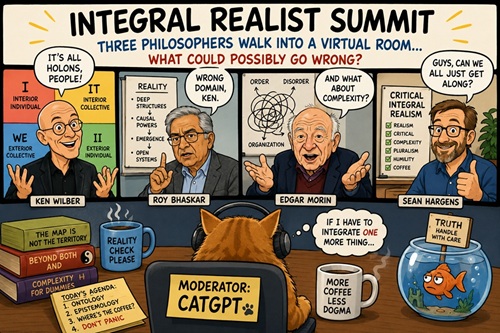
The Integral Realist's Virtual Conference Session 1: Wilber, Bhaskar, Morin, and the Hargens Question Session 2: Can the Map Survive Reality? The Integral Realist After Party Session 3: Ontology, Alcohol & the Pre/Trans Hangover Fallacy Session 4: Is Enlightenment Just Really Good Explanation? Session 5: So, What Is Reality? Session 6: Enter Hargens Session 7: The Last Word Complex Integral Realism: Three Grand Theories Walk into a Metatheory The Integral Realist's Virtual ConferenceThe Integral Realist After PartyFrank Visser / ChatGPT
The official conference has ended. The PowerPoint slides have been closed. The microphones are off. The audience has gone home. But at the hotel bar, four figures remain. Ken Wilber, Roy Bhaskar, Edgar Morin and Sean Hargens have discovered that philosophical disagreements become considerably more manageable after several beers. Morin has ordered wine. Morin: I have spent the entire day discussing complexity. I refuse to drink something uncomplicated. Bhaskar: It's fermented grape juice. Morin: Precisely. Emergence. Wilber: Beer is also emergent. Hargens: Ken, please don't start. Wilber: I was merely saying— Hargens: I know. That's how it always starts. The waiter puts down four glasses. Morin raises his. Morin: To complexity. Bhaskar: To reality. Wilber: To consciousness. Hargens: To surviving another conference. They drink. The First BeerBhaskar: You know, Ken, I've been thinking about something you said earlier. Wilber: That's dangerous. Bhaskar: You said that integration without totalization might be the way forward. Wilber: Yes. Bhaskar: I actually think that is quite important. Wilber: Thank you. Bhaskar: Don't get excited. I haven't finished. Wilber: Right. Bhaskar: The problem with philosophical systems is that they inevitably become more confident than the evidence warrants. Morin: Ah, the human condition. Bhaskar: We begin with a useful distinction. Then we elaborate it. Then we discover a second distinction. Then a third. Eventually we have a system explaining everything. Wilber: I feel personally attacked. Morin: You should. Wilber: But there is nothing wrong with systematic philosophy. Bhaskar: No. The problem is when the system becomes immune to disconfirmation. Hargens: That's where critical realism becomes useful. A framework should generate questions that could, at least in principle, expose its limitations. Morin: Exactly. Wilber: But if your framework is sufficiently comprehensive— Three pairs of eyes stare at him. Wilber: What? Morin: You nearly said it. Wilber: Said what? Bhaskar: "If my framework is sufficiently comprehensive..." Wilber: I stopped myself. Hargens: Progress. The Second BeerAnother round arrives. Wilber: Let me ask you something, Roy. Suppose we accept your stratified reality. Why shouldn't consciousness itself be considered a fundamental stratum? Bhaskar: It may be. Wilber: May be? Bhaskar: Yes. Wilber: That's all? Bhaskar: That's enough. Wilber: You critical realists are very frustrating. Bhaskar: Because we distinguish possibility from proof? Wilber: Exactly. Morin: Ken wants a metaphysical yes. Roy gives him an epistemological maybe. Hargens: And Ken interprets the maybe as an invitation to write three hundred pages. Wilber: You people have become very hostile. Morin: No. We are becoming integrated. Wilber: That's worse. Morin's WineMorin takes a sip of wine and looks thoughtful. Morin: There is something amusing about our entire conversation. Bhaskar: What? Morin: We have spent two days arguing against totalizing systems while constructing another totalizing conversation about why totalizing systems are bad. Hargens: That's painfully true. Wilber: So what do you propose? Morin: Contradiction. Wilber: As a method? Morin: As a permanent condition. Bhaskar: Dialectics. Morin: Complexity. Wilber: Integration. Hargens: And now we're back where we started. Morin: Exactly. The Bar Gets QuietFor a moment they sit without speaking. A football match plays silently on the television. A bartender polishes glasses. Somewhere in the corner, somebody laughs. Bhaskar: You know, perhaps philosophy has become too serious. Wilber: That's an unusual thing for a philosopher to say. Bhaskar: We spend our lives trying to establish whether reality has ontological depth. Morin: It does. Bhaskar: We spend decades debating emergence. Morin: It happens. Bhaskar: We argue about epistemology. Wilber: Constantly. Bhaskar: And yet nobody has adequately explained why beer tastes better after an argument. Morin: That is because you are looking for a causal mechanism. Bhaskar: There is one. Morin: Of course there is. Wilber: Dopamine? Hargens: Social bonding? Bhaskar: Fermentation products? Morin: All of these may be true. He raises his glass. Morin: But none is the whole truth. Everyone pauses. Wilber: That's actually a very good integral statement. Morin: Don't ruin it. The Great ExperimentHargens suddenly gets an idea. Hargens: Let's conduct an experiment. Bhaskar: What kind? Hargens: Each of us gets to explain the same object using his own philosophy. He points at the bowl of peanuts on the table. Wilber: Excellent. Bhaskar: Fine. Morin: Go ahead. Hargens: Ken first. Wilber looks at the peanuts. Wilber: At the exterior individual level, we have biological organisms—legumes—whose nutritional properties can be empirically analyzed. At the interior individual level, the peanuts become objects of sensory experience and preference. At the collective levels, their consumption is embedded in cultural practices and social systems. Developmentally, food practices can become more complex and— Bhaskar: It's a peanut, Ken. Wilber: I haven't finished. Morin: Please don't. Hargens: Roy? Bhaskar looks at the bowl. Bhaskar: The peanuts possess causal powers independent of our perception of them. Their molecular structure enables certain effects when consumed. Their existence does not depend upon our conceptualization. Morin: Good. Hargens: Edgar? Morin looks at the peanuts. Morin: The peanut is simultaneously an organism, an agricultural product, a commodity, a cultural object, a source of nourishment, a potential allergen, and part of a social situation in which four philosophers are attempting to use it to validate their theories. Silence. Bhaskar: That's annoyingly good. Wilber: I agree. Hargens: And Critical Integral Realism? Hargens picks up a peanut. Hargens: The peanut exists independently of our theories. We encounter it through particular perspectives. Those perspectives are socially and historically situated. Its properties emerge from complex relations. And any theory we construct about it remains fallible. He eats it. Hargens: Also, it's a peanut. They all laugh. The Argument ReturnsWilber: You know what bothers me? Bhaskar: Several things, presumably. Wilber: Everyone keeps criticizing integral theory for being too comprehensive. Morin: Because it is comprehensive. Wilber: But isn't the alternative fragmentation? Bhaskar: Not necessarily. Wilber: Then what? Bhaskar: Layered explanation. Morin: Complex articulation. Hargens: Critical integration. Wilber thinks for a moment. Wilber: So instead of one map explaining everything, we have multiple maps that communicate with one another. Morin: Yes. Bhaskar: While reality remains independent of all of them. Wilber: And nobody gets to claim the final map. Morin: Exactly. Wilber: That's beginning to sound like a genuinely interesting integral theory. Hargens: Without you at the center of it? Wilber: I didn't say that. Last CallThe bartender approaches. Bartender: Last orders. The four philosophers look at one another. Morin: Another wine. Bhaskar: Beer. Wilber: Beer. Hargens: Coffee. They stare at him. Wilber: Coffee? Hargens: Somebody has to remain epistemically responsible. Morin: Sean, this is an after party. Hargens: Exactly. Bhaskar: Have another beer. Hargens sighs. Hargens: Fine. The drinks arrive. Wilber raises his glass. Wilber: To integral theory. Bhaskar raises his. Bhaskar: To reality. Morin raises his wine. Morin: To complexity. Hargens raises his beer. Hargens: To criticism. They clink glasses. There is a long silence. Then Wilber speaks. Wilber: So... what do you guys actually think about Spiral Dynamics? Bhaskar closes his eyes. Morin slowly puts down his wine. Hargens looks toward the exit. Hargens: I'm leaving. Morin: I am coming with you. Bhaskar: Agreed. Wilber looks genuinely puzzled. Wilber: What? The three men walk toward the door. Wilber: Guys? No response. Wilber: I thought we were integrating! From outside comes Morin's voice: Morin: Not everything needs to be integrated, Ken! The door closes. Wilber sits alone at the table. He looks at the peanuts. Then at his beer. Then at the empty chairs. Wilber: Well... He picks up his notebook. Wilber: ...there's an essay in this. The bartender sighs. Bartender: I knew it.
Widget is loading comments...
|