|
TRANSLATE THIS ARTICLE
Integral World: Exploring Theories of Everything
An independent forum for a critical discussion of the integral philosophy of Ken Wilber
  Frank Visser, graduated as a psychologist of culture and religion, founded IntegralWorld in 1997. He worked as production manager for various publishing houses and as service manager for various internet companies and lives in Amsterdam. Books: Ken Wilber: Thought as Passion (SUNY, 2003), and The Corona Conspiracy: Combatting Disinformation about the Coronavirus (Kindle, 2020). Frank Visser, graduated as a psychologist of culture and religion, founded IntegralWorld in 1997. He worked as production manager for various publishing houses and as service manager for various internet companies and lives in Amsterdam. Books: Ken Wilber: Thought as Passion (SUNY, 2003), and The Corona Conspiracy: Combatting Disinformation about the Coronavirus (Kindle, 2020).
Check out my other conversations with ChatGPT
The Integral Realist's Virtual Conference Session 1: Wilber, Bhaskar, Morin, and the Hargens Question Session 2: Can the Map Survive Reality? The Integral Realist After Party Session 3: Ontology, Alcohol & the Pre/Trans Hangover Fallacy Session 4: Is Enlightenment Just Really Good Explanation? Session 5: So, What Is Reality? Session 6: Enter Hargens Session 7: The Last Word Complex Integral Realism: Three Grand Theories Walk into a Metatheory The Integral Realist's Virtual ConferenceWilber, Bhaskar, Morin, and the Hargens QuestionFrank Visser / ChatGPT
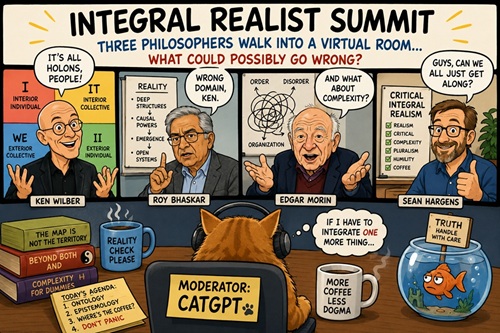
An imagined dialogue on reality, knowledge, complexity, and the uneasy possibility of an integral realism The setting: A virtual conference that could only have been organized by an AI with questionable taste in metaphysics. Four windows appear on the screen: Ken Wilber, Roy Bhaskar, Edgar Morin, and Sean Hargens. The title slide reads: “Is Reality Integral, Critical, Complex—or All Three?” There is a brief silence. Wilber: Well, I suppose the first thing we should clarify is that these are not really competing approaches. They are different perspectives on a Kosmos that is already differentiated into multiple dimensions. Bhaskar: That is precisely the kind of sentence I would like to interrogate. Morin: And I would like to interrogate the word precisely. Hargens: Perhaps I should have stayed home. Wilber: Sean, you are the one who brought us together. Hargens: I know. I am already regretting it. The Reality ProblemBhaskar: Let us begin with the fundamental issue. Science does not merely describe regularities in experience. Reality possesses structures and causal powers that are not exhausted by what we observe. That is the central intuition of critical realism. Wilber: I agree with much of that. Reality is not simply a flat collection of sensory events. The interior and exterior dimensions, individual and collective dimensions, all point toward a much richer ontology. Bhaskar: But your quadrants are not the same thing as an ontology of stratified reality. Wilber: They are not intended to be identical. Bhaskar: Good. Because my concern is that you move too quickly from distinctions in perspective to a highly elaborate map of reality itself. Morin: This is where I sympathize with both of you and neither of you. The problem is not simply whether reality has structures. It is whether we imagine that our conceptual distinctions can capture those structures without remainder. Wilber: That sounds suspiciously like an argument for epistemological humility. Morin: It is an argument for epistemological humility. Wilber: Which I have advocated for years. Morin: And then you wrote a theory containing hundreds of stages, levels, lines, states, types, quadrants, waves and developmental sequences. Bhaskar: I believe we have identified the first point of disagreement. Hargens: Actually, this is exactly where Critical Integral Realism becomes interesting. Wilber looks at him. Wilber: Go on. Bhaskar Meets WilberHargens: Critical Integral Realism attempts to bring together insights from critical realism and integral theory without simply reducing one to the other. The attraction is obvious. Bhaskar gives us a sophisticated account of reality, emergence, causality and epistemic fallibility. Wilber gives us a sophisticated account of perspectival differentiation, developmental transformation and interiority. Bhaskar: Provided that Wilber's account of interiority is not smuggled into ontology as though it were empirically established. Wilber: I don't think consciousness is merely an epistemological category. Bhaskar: Nor do I. But that does not mean every claim made in the name of consciousness is ontologically established. Morin: This is an important distinction. We must distinguish the reality of something from the adequacy of our description of it. Wilber: Agreed. Morin: And from the interpretation we subsequently place upon the experience. Wilber: Also agreed. Morin: Then perhaps we have made progress. Wilber: We have agreed on three propositions in under ten minutes. At this rate, the conference will be over by lunch. Bhaskar: Don't worry. I have objections. The Interior QuestionBhaskar: My major hesitation with integral theory concerns its treatment of interiority. You are right that subjective experience cannot simply be eliminated from our ontology. But there is a danger in treating first-person experience as though it provides privileged access to ultimate reality. Wilber: I distinguish state experience from the interpretation of that experience. Bhaskar: Not always sharply enough. Wilber: Fair criticism. Morin: This is perhaps one of the places where the three of us can learn from each other. Human beings experience themselves as observers of reality, but they are simultaneously products of reality. The observer is inside the system he observes. Bhaskar: Exactly. The epistemic fallacy is the tendency to reduce questions about what exists to questions about what we can know. Morin: And the opposite mistake would be to imagine that because something exists independently of our knowledge, we can therefore describe it without distortion. Bhaskar: Quite. Wilber: Which means we need both an ontology and a theory of knowledge. Morin: And a theory of the knower. Hargens: That triad is crucial for Critical Integral Realism: ontology, epistemology and perspective cannot simply be collapsed into one another. Wilber: Now you're making my case. Bhaskar: No, Sean. He's making your case compatible with mine. Hargens: That's more or less the point. Morin Interrupts the QuadrantsMorin: I have a problem with all of your maps. Wilber: That's encouraging. Morin: A map is useful because it simplifies. But simplification is also mutilation. We need what I call complex thought precisely because reality is simultaneously ordered and disordered, differentiated and interconnected, emergent and recursive. Wilber: That sounds very close to holons. Morin: It is close in some respects. But I resist the temptation to turn complexity into another universal architecture. Wilber: You mean my holarchy. Morin: Among other things. Bhaskar: Morin's point is important. Emergence means that higher-order structures possess properties that cannot simply be reduced to lower-order descriptions. Wilber: Which is exactly why developmental emergence matters. Morin: Yes, but emergence does not automatically mean progress. Silence. Wilber: I don't think I would put it quite that way. Morin: Yet your developmental language frequently suggests it. Higher stages become more inclusive, more differentiated, more integrated. Wilber: Generally speaking. Morin: Generally speaking is where developmental theories become dangerous. Bhaskar: I agree with Morin here. Emergence is not identical with improvement. A new level of organization can generate new possibilities and new pathologies. Wilber: That's why I have always distinguished healthy development from pathological development. Morin: But the distinction itself requires judgment. Development can produce greater complexity while simultaneously producing greater domination. Hargens: This is exactly where the critical component matters. Enter Critical Integral RealismHargens: If integral theory says, “Reality has many dimensions and perspectives,” critical realism asks, “What kind of reality are these dimensions dimensions of?” And complexity theory asks, “What happens when these dimensions interact in nonlinear, recursive and unpredictable ways?” Morin: Better. Hargens: But then critical theory asks another question: “Who benefits from the way reality is represented?” Bhaskar: Now we are getting somewhere. Wilber: I have never denied the importance of power. Bhaskar: But integral theory has often treated developmental hierarchies as though they were politically innocent. Wilber: That's not fair. Morin: It is at least worth discussing. Hargens: Critical Integral Realism potentially gives us a way of doing that. It preserves integral theory's insistence on multiple perspectives while refusing to treat every perspective as equally adequate. At the same time, it preserves critical realism's insistence that reality is not constructed by our descriptions, while acknowledging that every description is situated. Bhaskar: Yes. And crucially, the world itself can be the source of criticism. Reality can frustrate our theories. Wilber: That's an important point. Morin: Reality is under no obligation to fit our systems. Wilber: Even mine? Morin: Especially yours. The Spiritual Elephant in the Virtual RoomBhaskar: There remains another issue. Wilber: I know which one. Bhaskar: Spirituality. Wilber: Good. Bhaskar: Critical realism can accommodate dimensions of human experience that reductionism excludes. But that does not automatically validate particular metaphysical claims about Spirit, nonduality or ultimate consciousness. Wilber: Spiritual experience can be epistemically significant. Bhaskar: Significant, yes. Conclusive, no. Morin: Again, we should resist binary thinking. Spiritual experience is neither simply nonsense nor a transparent revelation of cosmic truth. Wilber: That's a position I can live with. Morin: Your problem is that you sometimes want to live with it and then write a metaphysics about it. Wilber: You really have been waiting to say that. Morin: For several decades. Hargens: This may actually be one of the strongest contributions Critical Integral Realism could make to integral theory: separating the phenomenology of spiritual experience from the ontology inferred from it. Wilber: But surely the possibility remains that mystical experience gives us genuine knowledge of reality. Bhaskar: Possibility, yes. Morin: Certainty, no. Wilber: I can accept that distinction. What They ShareHargens: Perhaps we should identify what genuinely unites these approaches. Bhaskar: Anti-reductionism. Morin: Definitely. Wilber: Pluralism. Bhaskar: With qualifications. Wilber: Naturally. Morin: Emergence. Bhaskar: Yes. Wilber: Development. Morin: With qualifications. Bhaskar: More qualifications. Hargens: Epistemic fallibility. Bhaskar: Essential. Morin: Absolutely. Wilber: Yes. Hargens: Multiple levels of reality. Bhaskar: Stratification, yes. Morin: Complexity and emergence, yes. Wilber: Levels, stages and waves, yes. Hargens: And the rejection of the idea that one explanatory framework can simply eliminate all others. Morin: That is perhaps our deepest commonality. Bhaskar: Provided pluralism does not become relativism. Wilber: Provided realism does not become scientism. Morin: Provided complexity does not become another totalizing system. Hargens: And provided integral theory does not become a theory that explains why everyone else needs integral theory. Wilber laughs. Wilber: That last one was unnecessary. Hargens: It was necessary. Where They Really DifferMorin: Our differences are just as important. Bhaskar: Indeed. My realism begins with the independence of reality from our descriptions of it. Wilber: Mine begins with the recognition that reality manifests through multiple perspectives and dimensions. Morin: Mine begins with complexity: the recognition that any attempt to isolate one aspect of reality eventually encounters relations, feedback loops, contradictions and uncertainty. Hargens: And Critical Integral Realism tries to make these mutually corrective rather than mutually exclusive. Bhaskar: But I would resist calling the synthesis complete. Wilber: Naturally. Morin: A complete synthesis would be suspicious. Bhaskar: Precisely. Wilber: So we have reached an interesting conclusion. Bhaskar wants realism without reductionism. Morin wants complexity without simplification. I want integration without fragmentation. Morin: And each of those aspirations contains its own danger. Wilber: Mine being? Morin: Integration can become imperialism. Bhaskar: Realism can become dogmatism. Hargens: Complexity can become paralysis. Morin nods. Morin: Fair enough. How Would Hargens' Project Land?Wilber: So, Sean, the question the audience actually wants answered: where does Critical Integral Realism land? Hargens: Somewhere between you three—and therefore probably nowhere comfortable. Bhaskar: That may be a virtue. Hargens: It would land sympathetically with Bhaskar because it takes ontology seriously. It would land sympathetically with Morin because it refuses simplistic reduction and recognizes complexity, emergence and contextuality. And it would land sympathetically with you, Ken, because it retains the integral insight that different perspectives illuminate different dimensions of reality. Wilber: But? Hargens: But it would also irritate you. Wilber: Why? Hargens: Because it would ask you to weaken some of your strongest claims. Wilber: Such as? Hargens: The assumption that the integral map is sufficiently comprehensive to function as a master framework. The confidence with which developmental hierarchies can be correlated across cultures. The tendency to move from mystical phenomenology toward metaphysical conclusions. And the suggestion that the many sciences, philosophies and spiritual traditions can ultimately be placed inside one architectonic system. Wilber: You make that sound like a criticism. Hargens: It is a criticism. Wilber: And yet? Hargens: And yet I think the core integral insight survives. In fact, it becomes stronger when it gives up the ambition to be final. There is another silence. Bhaskar: That is a formulation I could accept. Morin: So could I. Wilber: I suppose I could accept it too. Morin: That was surprisingly easy. Wilber: Don't get used to it. The Final QuestionA message appears in the conference chat: AUDIENCE QUESTION: Which of you is closest to the truth? All four stare at the screen. Bhaskar: The question presupposes that truth is a possession. Morin: And that one perspective can possess it. Wilber: Perhaps the answer is that each of us captures something the others tend to miss. Hargens: Which is exactly why the conversation matters. Bhaskar: Reality is deeper than experience. Morin: Experience is more complex than our categories. Wilber: And reality is richer than any single perspective. Hargens: Then perhaps the genuinely integral position is not to declare a winner but to construct a framework in which these claims can criticize one another. Morin: Provided the framework itself remains open to criticism. Bhaskar: And to reality. Wilber: And to transformation. Hargens: And to power. Morin: And uncertainty. The conference software announces: “You have reached the scheduled end of this session.” Wilber clicks Stay in meeting. Bhaskar clicks Stay in meeting. Morin clicks Stay in meeting. Hargens looks at the three icons. Hargens: I suppose we're going to need another session. Morin: Of course. Bhaskar: There are still several unresolved ontological questions. Wilber: And I haven't even shown you the second-tier model. Morin: Then perhaps we should end now. The screen goes black. Conference concluded. What makes the imagined encounter interesting is that Critical Integral Realism would probably function less as a compromise between Wilber and Bhaskar than as a critical solvent applied to both. Bhaskar supplies the strongest challenge to Wilber's tendency toward metaphysical system-building: reality is stratified and emergent, but our theories remain fallible. Morin supplies a second challenge: reality is not merely stratified but recursively interconnected, contradictory and historically contingent. Hargens' contribution is potentially to preserve Wilber's perspectival pluralism while removing some of its more triumphalist metaphysical ambitions. The irony is that this might produce a version of integral theory that is less grandiose but philosophically more defensible. Wilber's great intuition—that no single perspective exhausts reality—does not require the further claim that we therefore need his comprehensive map of reality. Bhaskar's realism does not require reductionism, and Morin's complexity does not require relativism. Put together, they suggest a more modest but more interesting integralism: many perspectives, a mind-independent reality, emergent levels, complex interactions, situated knowledge, and permanent openness to correction. That is probably where Hargens' Critical Integral Realism lands at its most interesting point: not as the final synthesis of Wilber, Bhaskar and Morin, but as an attempt to make sure that none of the three gets the last word.
Widget is loading comments...
|