|
TRANSLATE THIS ARTICLE
Integral World: Exploring Theories of Everything
An independent forum for a critical discussion of the integral philosophy of Ken Wilber
  Frank Visser, graduated as a psychologist of culture and religion, founded IntegralWorld in 1997. He worked as production manager for various publishing houses and as service manager for various internet companies and lives in Amsterdam. Books: Ken Wilber: Thought as Passion (SUNY, 2003), and The Corona Conspiracy: Combatting Disinformation about the Coronavirus (Kindle, 2020). Frank Visser, graduated as a psychologist of culture and religion, founded IntegralWorld in 1997. He worked as production manager for various publishing houses and as service manager for various internet companies and lives in Amsterdam. Books: Ken Wilber: Thought as Passion (SUNY, 2003), and The Corona Conspiracy: Combatting Disinformation about the Coronavirus (Kindle, 2020).
Check out my other conversations with ChatGPT
The Integral Realist's Virtual Conference Session 1: Wilber, Bhaskar, Morin, and the Hargens Question Session 2: Can the Map Survive Reality? The Integral Realist After Party Session 3: Ontology, Alcohol & the Pre/Trans Hangover Fallacy Session 4: Is Enlightenment Just Really Good Explanation? Session 5: So, What Is Reality? Session 6: Enter Hargens Session 7: The Last Word Complex Integral Realism: Three Grand Theories Walk into a Metatheory The Integral Realist's Virtual ConferenceSession 6: Enter HargensFrank Visser / ChatGPT
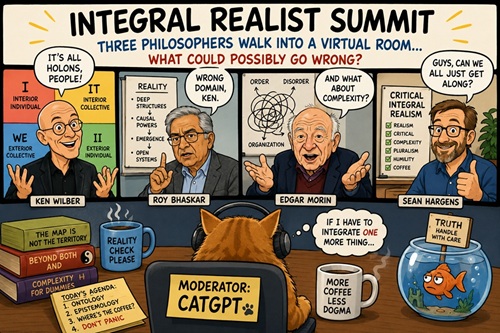
The conference organizers had made one mistake. They had assumed that after five sessions, the participants would be tired enough to agree with one another. Instead, they had become more dangerous. The sixth session begins with coffee, mineral water, and a suspicious number of copies of Sean Hargens' Integral Ecology lying on the table. Morin picks one up. Morin: Who brought all these? Bhaskar: The organizers. Wilber:I asked them to. Morin: Ah. He puts the book down. Morin: Then we are in trouble. The door opens. Hargens: Sorry I'm late. All three turn. Wilber:Sean! Bhaskar: Welcome. Morin: The man who has been trying to reconcile us. Hargens: That's a rather intimidating way to introduce someone. Morin: I thought it was accurate. Hargens: Fair enough. He sits down. Wilber:We've been discussing Critical Integral Realism. Hargens: Without me? Bhaskar: We were trying to determine whether it is genuinely a synthesis or merely an elegant peace treaty. Hargens: That's a good question. Morin: And? Hargens: I haven't decided. Wilber:Excellent answer. Bhaskar: Perhaps you could explain what you think the synthesis actually consists of. Hargens nods. Hargens: Let me start with the obvious. Ken gives us an extraordinarily differentiated account of perspectives, dimensions and developmental structures. Roy gives us a powerful account of ontology, emergence, stratification and causality. Edgar gives us complexity, recursion, dialogical thinking and the need to resist reductionism. My project is to ask whether these can be brought into a framework that respects the insights of all three without collapsing them into one another. Morin: That's the official answer. Hargens: Naturally. Morin: What's the unofficial one? Hargens: I spend a lot of time trying to prevent philosophers from killing each other. Bhaskar: A worthwhile vocation. Wilber:And how exactly do you do it? Hargens: By making distinctions. Bhaskar smiles. Bhaskar: Now you're talking. Hargens: The first distinction is between epistemology and ontology. Wilber:Obviously. Hargens: Not always obviously in practice. Wilber looks mildly offended. Hargens: The second is between different kinds of perspectives. The third is between levels or stages and the structures that emerge within them. The fourth is between methodological pluralism and ontological pluralism. Morin: Good. Hargens: And the fifth is that integration should not mean homogenization. Morin leans forward. Morin: Now we are getting somewhere. Wilber:I agree. Bhaskar: So do I. They look at each other. Morin: This is becoming uncomfortable. Hargens: Don't worry. We'll disagree shortly. Wilber:I have a question. Hargens: Of course. Wilber:If you accept the AQAL framework, what does critical realism add? Hargens: Ontological discipline. There is a pause. Wilber:Explain. Hargens: Integral Theory is extraordinarily good at saying that we need multiple perspectives. Critical realism is extraordinarily good at asking what exists independently of our perspectives, what mechanisms generate observable events, and how emergence produces genuinely new causal powers. Bhaskar: Exactly. Hargens: So critical realism prevents integral pluralism from becoming the idea that every perspective is equally constitutive of reality. Morin: Excellent. Wilber:But doesn't that risk privileging the exterior? Hargens: Only if realism is misunderstood as physicalism. Bhaskar: Thank you. Wilber:I know you're not a physicalist. Bhaskar: Many people assume that realism means materialism. Morin: One of the great philosophical misunderstandings. Hargens: Critical realism says that reality is deeper than empirical observation. It does not say reality is nothing but matter. Wilber:Then we are closer than people think. Bhaskar: We have always been closer than people think. Morin: Philosophers have an extraordinary talent for building fences around neighboring houses. Hargens: Which is why I think Critical Integral Realism is useful. Wilber:But here's my concern. Hargens: I expected one. Wilber:If you make realism too strong, you risk turning integral theory into a conventional ontology with perspectives added afterward. Bhaskar: And if you make perspectives too strong, you risk turning ontology into epistemology. Morin: And if either of you becomes too confident, complexity will come along and ruin your system. Hargens: Which is precisely why complexity matters. Wilber:Let's talk about complexity. Morin: Finally. Wilber:Edgar, your concept of complexity emphasizes uncertainty, recursion, self-organization and the interaction of opposites. Morin: Yes. Wilber:But doesn't that make developmental direction difficult to recognize? Morin: It makes simplistic developmental direction difficult to recognize. Wilber:But there are genuine developmental sequences. Morin: Certainly. Wilber:Then why resist stages? Morin: I don't resist stages. I resist the temptation to confuse stages with the whole story. Hargens: That is crucial. Bhaskar: Because emergence can produce novelty without guaranteeing linear progression. Morin: Exactly. Wilber:So you accept development but reject developmentalism. Morin: That is a useful distinction. Hargens: And perhaps this is where critical realism helps. We can recognize real developmental transformations while remaining cautious about universal claims concerning their sequence, direction and necessity. Wilber nods slowly. Wilber:That's actually quite good. Hargens: Thank you. Morin: Don't encourage him. Hargens: I was speaking to Ken. Morin: Precisely. Everyone laughs. Then Bhaskar becomes serious. Bhaskar: Sean, there is a question I have wanted to ask. Hargens: Go ahead. Bhaskar: What makes your synthesis critical? Hargens: Because integration cannot merely describe perspectives. It must also interrogate the social, political and ecological structures that generate suffering and constrain human agency. Morin: Yes. Wilber:Absolutely. Bhaskar: Good. Because realism without critique can become merely contemplative. Hargens: And integral theory without sufficient social critique can become overly focused on individual development. Wilber:That's not fair. Bhaskar: It's not entirely unfair. Morin: Nor entirely fair. Wilber:Thank you, Edgar. Morin: I wasn't defending you. Wilber:I know. Hargens: This is actually another reason I think the synthesis matters. We need interior transformation, behavioral change, social structures, cultural meanings, ecological systems and material conditions. Bhaskar: Without reducing any one of them to the others. Hargens: Exactly. Morin: And without pretending that they form a perfectly harmonious system. Hargens: Yes. Wilber:That's where I might disagree. Morin: Of course. Wilber:I do think there is an underlying unity. Bhaskar: Ontological unity? Wilber:Ultimately. Bhaskar: Based on what? Wilber pauses. Wilber:Philosophical reasoning. Mystical experience. Comparative traditions. Bhaskar: That's not nothing. Morin: But it is not everything. Wilber:I never said it was everything. Morin: You have written books that sometimes give that impression. Wilber:I have written many books. Morin: Exactly. Hargens laughs. Hargens: Perhaps this is the point at which Critical Integral Realism should become modest. Wilber:Modest? Hargens: Yes. Perhaps the goal isn't to produce the final synthesis of reality. Bhaskar: Good. Morin: Very good. Wilber:What is the goal, then? Hargens: To construct better conversations between different forms of inquiry. The room becomes quiet. Bhaskar: That's actually a defensible philosophical position. Morin: And a useful one. Wilber:But surely we can do more than conversation. Hargens: Of course. We can build models, formulate hypotheses, conduct research, compare explanatory frameworks and test claims. Bhaskar: Now you're talking like a realist. Hargens: I was hoping you'd notice. Morin: And like a complexity theorist. Hargens: I was hoping you would notice that too. Wilber:And what about Spirit? Hargens smiles. Hargens: Spirit can remain. Wilber:As what? Hargens: As a metaphysical and experiential claim that deserves philosophical examination, not as a scientific mechanism inserted into evolutionary biology whenever the evidence becomes inconvenient. Bhaskar nearly spits out his tea. Bhaskar: Sean! Morin: Excellent. Wilber:I don't do that. Morin: Not deliberately. Wilber:Very funny. Hargens: The important thing is that we distinguish levels of discourse. Bhaskar: Exactly. Morin: Science investigates mechanisms. Bhaskar: Philosophy investigates conditions, categories and ontological implications. Morin: Complexity investigates relations and emergent patterns. Wilber:Integral theory investigates perspectives and developmental dimensions. Hargens: And Critical Integral Realism tries to hold the conversation together. Morin: There is our problem. Hargens: What? Morin: You're becoming the moderator. Hargens: Someone has to. Bhaskar: Moderators are often the only people who survive philosophical conferences. Wilber:Until someone asks them to write the final synthesis. Hargens: I have no intention of doing that. Morin: Good. Wilber:Why not? Hargens: Because the moment you announce that you have finally synthesized everything, someone will publish a paper explaining why your synthesis is incomplete. Bhaskar: Correct. Morin: And then someone else will synthesize that criticism. Wilber:And then someone will integrate the synthesis. Hargens: And then— All four: Stop! They laugh. The moderator enters. Moderator: Gentlemen, we've received questions from the audience. Wilber:Excellent. Moderator: The first is: Which one of you is right? All four stare at him. Morin: Next question. Moderator: There isn't one. Bhaskar: Excellent conference. Hargens: I think we've achieved something. Wilber:What? Hargens: Not agreement. Morin: Good. Hargens: Something better. Bhaskar: A more differentiated disagreement. Morin: Now that is progress. Wilber raises his coffee cup. Wilber:To differentiated disagreement. Bhaskar raises his tea. Bhaskar: To ontological depth. Morin raises his wine. Morin: To complexity. Hargens raises his glass. Hargens: To Critical Integral Realism. They clink glasses. There is a brief moment of harmony. Then Wilber looks at Hargens. Wilber:Sean, you realize this means you're going to have to explain all of this in a diagram. Hargens: I was afraid you'd say that. Morin: Don't. Bhaskar: Please don't. Wilber:Too late. Wilber reaches for a napkin. Morin: Oh no. Bhaskar: Here we go again. Within thirty seconds, the napkin contains twelve circles, four quadrants, three arrows, two nested systems, a spiral, an ontological layer, an epistemological layer, and something Wilber insists is "not a fifth quadrant." Hargens studies it. Hargens: Ken, what is this? Wilber:The synthesis. Bhaskar: That's a circle with an arrow through it. Wilber:Precisely. Morin: I knew we were in trouble. And somewhere in the back of the room, the conference technician quietly begins preparing the slides for Session 7.
Widget is loading comments...
|