|
TRANSLATE THIS ARTICLE
Integral World: Exploring Theories of Everything
An independent forum for a critical discussion of the integral philosophy of Ken Wilber
  Frank Visser, graduated as a psychologist of culture and religion, founded IntegralWorld in 1997. He worked as production manager for various publishing houses and as service manager for various internet companies and lives in Amsterdam. Books: Ken Wilber: Thought as Passion (SUNY, 2003), and The Corona Conspiracy: Combatting Disinformation about the Coronavirus (Kindle, 2020). Frank Visser, graduated as a psychologist of culture and religion, founded IntegralWorld in 1997. He worked as production manager for various publishing houses and as service manager for various internet companies and lives in Amsterdam. Books: Ken Wilber: Thought as Passion (SUNY, 2003), and The Corona Conspiracy: Combatting Disinformation about the Coronavirus (Kindle, 2020).
Check out my other conversations with ChatGPT
The Integral Realist's Virtual Conference Session 1: Wilber, Bhaskar, Morin, and the Hargens Question Session 2: Can the Map Survive Reality? The Integral Realist After Party Session 3: Ontology, Alcohol & the Pre/Trans Hangover Fallacy Session 4: Is Enlightenment Just Really Good Explanation? Session 5: So, What Is Reality? Session 6: Enter Hargens Session 7: The Last Word Complex Integral Realism: Three Grand Theories Walk into a Metatheory The Integral Realist's Virtual ConferenceSession 7: The Last WordFrank Visser / ChatGPT
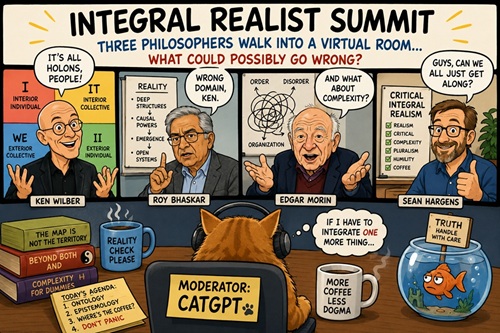
The final session was scheduled for nine o'clock. At 8:55, the conference organizers discovered that nobody had prepared a closing statement. At 8:57, Ken Wilber arrived carrying three books. At 8:58, Roy Bhaskar arrived carrying none. At 8:59, Edgar Morin arrived carrying a bottle of wine. At 9:00, Sean Hargens entered carrying the infamous napkin from the previous session. Hargens: I think we should begin by agreeing on one thing. Bhaskar: That the napkin is not a philosophical document? Morin: Too late. It has already acquired sacred status. Wilber: I was thinking of having it framed. Bhaskar: Of course you were. Hargens puts the napkin on the table. Hargens: We have spent six sessions discovering where we agree and disagree. Perhaps today we should ask the harder question. Morin: Which is? Hargens: What would each of us be willing to give up? Silence. Wilber: That's quite aggressive for nine in the morning. Bhaskar: It's a good question. Morin: Yes. Synthesis becomes interesting only when it costs something. Wilber: All right. I'll go first. He takes a breath. Wilber: I would give up the idea that every important insight must be incorporated into one comprehensive system. Bhaskar looks genuinely surprised. Bhaskar: That's significant. Morin: Very significant. Wilber: I still believe that an integral framework is extraordinarily useful. But perhaps the temptation to make it the framework should be resisted. Hargens: That's almost Critical Integral Realism. Wilber: Don't push it. Morin: My turn. He takes a sip of wine. Morin: I would give up the suspicion that every systematic framework is necessarily an enemy of complexity. Bhaskar: That's also significant. Morin: Systems can illuminate complexity, provided they remain open, self-critical and revisable. Wilber: That's almost Integral Theory. Morin: Don't push it. Everyone laughs. Bhaskar: Then I suppose I should make a concession. Hargens: Please. Bhaskar: I would give up the idea that critical realism alone provides all the conceptual resources required for a comprehensive understanding of human reality. Wilber raises his eyebrows. Wilber: Roy. Bhaskar: What? Wilber: Are you feeling all right? Bhaskar: Perfectly. Morin: This is becoming historic. Bhaskar: Critical realism provides an account of ontology, emergence, causality and explanation. But human reality also involves meaning, embodiment, culture, reflexivity, development and complex systems. Other traditions can contribute to understanding those domains. Hargens: Thank you. Bhaskar: Don't misunderstand me. I haven't become an integralist. Wilber: Yet. Bhaskar: Especially not yet. Now everyone looks at Hargens. Hargens: Oh, no. Morin: Your turn. Hargens: Fine. I would give up the hope that Critical Integral Realism could produce a final reconciliation between these traditions. Wilber: Why? Hargens: Because the very attempt to reconcile everything can become another form of reductionism. Morin: Excellent. Bhaskar: Agreed. Hargens: The point is not to erase differences. It is to make differences intelligible and productive. Wilber: So integration without assimilation. Hargens: Exactly. Morin: And disagreement without fragmentation. Hargens: Exactly. Bhaskar: Plurality without relativism. Hargens: Exactly. Wilber: Depth without metaphysical inflation. Hargens hesitates. Hargens: That's harder. Morin: Much harder. Bhaskar: Especially for you, Ken. Wilber: I walked into that one. The Question of RealityHargens: Let me put the central question one final time. He turns to the audience. Hargens: What is reality? Wilber: Reality is a multidimensional whole disclosed through multiple perspectives and unfolding through developmental processes. Bhaskar: Reality possesses depth independent of our descriptions of it. Events arise from underlying structures and mechanisms, many of which are not directly observable. Morin: Reality is an intricate web of relations, complementarities, antagonisms, feedback loops and emergent wholes. Any description that eliminates this complexity distorts its object. Hargens: And Critical Integral Realism would say? He pauses. Hargens: Don't choose too quickly. The three men look at him. Hargens: Perhaps reality is simultaneously more than our experience of it, more than our theories about it, and more than any single perspective can disclose. Bhaskar nods. Hargens: Our task is therefore neither to reduce reality to what we can observe nor to inflate our metaphysical intuitions into scientific facts. Wilber nods. Hargens: Nor is it to imagine that because reality is complex, every interpretation is equally valid. Morin nods. Hargens: We need realism to prevent relativism. Complexity to prevent simplification. Integral perspectives to prevent one-sidedness. And critical reflection to prevent the framework itself from becoming dogma. Nobody speaks. Morin: That is quite good. Bhaskar: Very good. Wilber: I agree. Morin: Don't get used to it. The Final DisagreementA member of the audience raises a hand. Audience Member: I have one question. Wilber: Please. Audience Member: If you all agree that no single framework should dominate, why should we believe any of you? Bhaskar smiles. Bhaskar: Excellent. Morin: Finally, an intelligent question. Wilber: I think we should be believed provisionally. Bhaskar: Yes. Morin: On the basis of arguments, evidence and experience. Hargens: And with a willingness to revise our positions. Audience Member: So none of you claims ultimate certainty? Wilber looks at Bhaskar. Bhaskar looks at Morin. Morin looks at Hargens. Hargens looks at the audience. Hargens: I think we've learned something. Wilber: What's that? Hargens: Philosophers become much more agreeable when someone asks them a question they cannot answer. Morin: That is because uncertainty is the mother of civilization. Bhaskar: I don't think that's what the saying is. Morin: It should be. One Last BeerThe formal conference ends. But, as everyone knows, philosophical conferences do not end when the moderator says they have ended. They end when the bar closes. The four men sit around a small table. Wilber has beer. Bhaskar has beer. Hargens has beer. Morin has wine. Wilber: I have to admit something. Bhaskar: This should be interesting. Wilber: I enjoyed this. Morin: Despite us? Wilber: Because of you. Bhaskar: That's almost touching. Wilber: I think we spent too much time emphasizing our differences. Morin: That's because our differences are real. Wilber: Yes. But so are the commonalities. Bhaskar: Indeed. Hargens: Perhaps that is the actual lesson. Morin: Which lesson? Hargens: That intellectual traditions don't have to merge to learn from one another. Bhaskar: Precisely. Wilber: And perhaps Integral Theory doesn't need to defeat critical realism. Bhaskar: That would be helpful. Wilber: Nor complexity theory. Morin: Also helpful. Wilber: Nor does critical realism need to defeat Integral Theory. Bhaskar: I never thought it did. Wilber: You looked like you wanted to. Bhaskar: Philosophers often look like that. Morin: It is the beard. Bhaskar touches his beard. Bhaskar: I don't think Edgar has earned the right to comment on beards. Morin: I have earned the right to comment on everything. Wilber: That's an integral claim. Morin: No. That's an elderly claim. The ToastHargens lifts his glass. Hargens: To reality. Bhaskar: To reality as it is. Morin: To reality as we struggle to understand it. Wilber: To reality as experienced, interpreted, embodied and realized. They clink glasses. Morin raises his glass again. Morin: And to the fact that reality has survived all four of us. They laugh. Bhaskar: Probably the most realist statement of the evening. Wilber: And perhaps the most integral. Morin: And certainly the most complex. Hargens: Then we agree. They look at one another. Bhaskar: Don't say it. Hargens: I wasn't going to. Wilber: We agree that— Bhaskar: Ken. Wilber: Fine. A final silence settles over the table. Outside, the city continues its ordinary, non-integral, non-critical-realist, highly complex existence. Cars move. People walk home. Lights switch on. Rain begins to fall. Nothing asks which quadrant it belongs to. Nothing waits for a developmental stage. Nothing consults a philosophical framework before causing something else to happen. Reality simply continues. And perhaps, after seven sessions, that is the closest thing to a final answer they have managed to reach. The conference is over. The disagreement is not. And that's probably a good thing.
Widget is loading comments...
|