|
TRANSLATE THIS ARTICLE
Integral World: Exploring Theories of Everything
An independent forum for a critical discussion of the integral philosophy of Ken Wilber
  Frank Visser, graduated as a psychologist of culture and religion, founded IntegralWorld in 1997. He worked as production manager for various publishing houses and as service manager for various internet companies and lives in Amsterdam. Books: Ken Wilber: Thought as Passion (SUNY, 2003), and The Corona Conspiracy: Combatting Disinformation about the Coronavirus (Kindle, 2020). Frank Visser, graduated as a psychologist of culture and religion, founded IntegralWorld in 1997. He worked as production manager for various publishing houses and as service manager for various internet companies and lives in Amsterdam. Books: Ken Wilber: Thought as Passion (SUNY, 2003), and The Corona Conspiracy: Combatting Disinformation about the Coronavirus (Kindle, 2020).
Check out my other conversations with ChatGPT
The Integral Realist's Virtual Conference Session 1: Wilber, Bhaskar, Morin, and the Hargens Question Session 2: Can the Map Survive Reality? The Integral Realist After Party Session 3: Ontology, Alcohol & the Pre/Trans Hangover Fallacy Session 4: Is Enlightenment Just Really Good Explanation? Session 5: So, What Is Reality? Session 6: Enter Hargens Session 7: The Last Word Complex Integral Realism: Three Grand Theories Walk into a Metatheory The Integral Realist's Virtual ConferenceSession 2: Can the Map Survive Reality?Frank Visser / ChatGPT
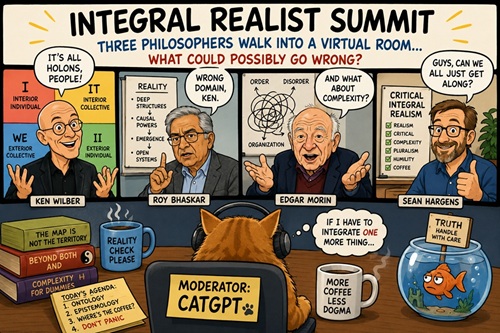
Wilber, Bhaskar, Morin and Hargens reconvene. The first session ended amicably. This was, in retrospect, a mistake. The screen lights up. Ken Wilber is already there. Roy Bhaskar appears next, carrying what appears to be a very thick manuscript. Edgar Morin enters with a cup of tea. Sean Hargens joins last. Hargens: Welcome back, everyone. Wilber: I thought we had settled everything yesterday. Bhaskar: We settled nothing. Morin: Which is why it was a productive session. Hargens: Today's topic is rather simple: Can an integral framework survive serious realism, complexity and criticism? Wilber: Obviously. Bhaskar: That was rather quick. Wilber: I've had thirty years to think about it. Morin: That may be the problem. The Map and the TerritoryBhaskar: Let us begin with your maps, Ken. Wilber: I knew that was coming. Bhaskar: You have constructed increasingly elaborate maps of consciousness, development and reality. But critical realism teaches us to distinguish the territory from our conceptualizations of it. Wilber: I agree completely. Bhaskar: Then what prevents your map from becoming a substitute for the territory? Wilber: Nothing prevents it automatically. Any map can become reified. Morin: Excellent. Wilber: Why does everyone sound surprised? Morin: Because systems theorists are often better at criticizing maps than admitting that they have constructed one. Wilber: My maps are heuristic. Morin: Until they begin telling you what reality must look like. Wilber: I don't think they do that. Bhaskar: Your developmental stages sometimes appear to. Wilber: Stages are real patterns. Bhaskar: Some developmental patterns are real. That does not establish that every proposed stage structure corresponds to an ontological layer of reality. Wilber: Fair enough. Hargens: This distinction may be central to Critical Integral Realism. We can say that developmental models can be realistically constrained without claiming that the model itself is reality. Morin: Precisely. A model is a selective construction. Its usefulness depends partly on what it excludes. Wilber: That's a very Morinian way of putting it. Morin: I am Morin. The Problem of StagesBhaskar: There is another issue. Your developmental hierarchy tends to imply that later stages are better. Wilber: More complex, more inclusive and more differentiated. Morin: Which sounds suspiciously like better. Wilber: Sometimes more complexity really is better. Morin: Sometimes. Bhaskar: And sometimes complexity produces new mechanisms of domination. Wilber: Such as? Bhaskar: Bureaucratic systems. Technocratic institutions. Sophisticated ideological structures. Highly developed systems can produce highly developed forms of pathology. Morin: Exactly. Complexity is ambivalent. Wilber: I have always talked about healthy versus pathological development. Morin: But the pathology is not always an accidental deviation from development. Sometimes it is produced by development itself. Wilber pauses. Wilber: That's a stronger claim. Morin: It is. Hargens: And it has consequences for integral theory. If development generates both capacities and pathologies, then we cannot simply rank stages. We need to ask what new possibilities and new dangers emerge at each level. Bhaskar: Which is much closer to a critical realist conception of emergence. Wilber: So you're suggesting a developmental theory without developmental triumphalism. Morin: Yes. Wilber: That's uncomfortable. Morin: Good theories should occasionally be uncomfortable. The Four Quadrants on TrialHargens: Let's take another famous integral device: the four quadrants. Bhaskar: Ah. Wilber: I detect enthusiasm. Bhaskar: I find the quadrants useful as a reminder that different kinds of questions require different perspectives. But I would hesitate to treat them as four fundamental regions of being. Wilber: Why? Bhaskar: Because the distinction between subjective, objective, individual and collective dimensions is partly conceptual. The actual world is more entangled. Morin: Much more entangled. Wilber: But the quadrants prevent reductionism. Morin: They can. Bhaskar: But they can also produce a new reductionism: everything becomes classified according to the quadrant into which it fits. Wilber: That's misuse, not a defect in the model. Morin: Every model creates possibilities for misuse. Hargens: Perhaps the question is whether the quadrants should be treated as ontological containers or epistemic orientations. Wilber thinks. Wilber: I would say both. Bhaskar: That is precisely where I become nervous. Morin: And where complexity begins laughing. Reality Strikes BackHargens: Suppose we take a concrete example: climate change. Wilber: Good example. Hargens: We have atmospheric chemistry, physical climate mechanisms, economic institutions, political systems, cultural narratives, individual behavior and subjective values. Morin: And feedback loops connecting all of them. Bhaskar: And causal powers operating at different levels. Wilber: Which demonstrates the value of an integral approach. Bhaskar: It demonstrates the value of integrating explanations. That is not necessarily the same thing as validating a comprehensive integral ontology. Wilber: You're determined to make that distinction. Bhaskar: Yes. Morin: And he is right. Wilber: You're both ganging up on me. Hargens: Think of it differently. Critical Integral Realism could turn the quadrants into a disciplined invitation: Look for different causal dimensions, perspectives and levels without assuming that your classification exhausts the phenomenon. Wilber: I can live with that. Morin: Then the quadrants become less like boxes and more like questions. Wilber: That's actually a nice formulation. Bhaskar: Provided the questions remain answerable by reference to reality. Morin: And provided reality is allowed to answer back. The Spiritual ChallengeA participant raises a hand. AUDIENCE MEMBER: What happens to Spirit? Everyone becomes silent. Wilber: Finally. Bhaskar: Here we go. Morin: The metaphysical elephant has entered the room. Wilber: Consciousness and spirituality cannot simply be explained away by materialism. Bhaskar: Agreed. Wilber: Therefore— Bhaskar: No. Wilber: I hadn't finished. Bhaskar: I know where the sentence was going. Morin: Continue, Ken. Wilber: Therefore we should remain open to the possibility that consciousness reveals something fundamental about reality. Bhaskar: Possibility is the important word. Wilber: I accept that. Morin: Then perhaps we can distinguish three things: the reality of the experience, the interpretation of the experience, and the metaphysical hypothesis generated by that interpretation. Wilber: Yes. Bhaskar: Excellent. Morin: A mystical experience may be real without every metaphysical conclusion drawn from it being true. Wilber: That's reasonable. Hargens: And that distinction would significantly strengthen integral spirituality. Wilber: You're suggesting that integral theory should become more cautious. Hargens: More critical. Wilber: I prefer your word. The Missing Dimension: PowerMorin: We have not yet discussed power. Bhaskar: Indeed. Wilber: Integral theory includes social and cultural dimensions. Bhaskar: Description is not critique. Wilber: Explain. Bhaskar: A society can be described in terms of developmental stages, cultural worldviews and systems of meaning. But critical realism asks whether those structures enable or constrain human flourishing. Morin: And who benefits from them. Hargens: This is where the "critical" in Critical Integral Realism earns its name. Wilber: So an integral framework should ask not only What level is this? but What does this structure do? Who does it serve? What does it conceal? Bhaskar: Precisely. Morin: And what unintended consequences does it generate? Wilber: That's actually quite compatible with integral theory. Hargens: It is. But it changes the emphasis. Wilber: From hierarchy to diagnosis? Hargens: From classification to critique. Morin: From "Where does this person stand?" to "What is happening here?" Bhaskar: From ranking to explanation. Wilber nods slowly. Wilber: I like that. Is Integration Itself a Problem? Morin: There is one final difficulty. Hargens: Which is? Morin: Integration. Everyone laughs. Wilber: Very funny. Morin: I am serious. The desire to integrate everything can itself become pathological. Bhaskar: Yes. The world may be integrated, but our knowledge of it will remain partial. Wilber: So the integral impulse must be balanced by epistemic humility. Morin: Exactly. Hargens: Then perhaps we need a principle: "Integrate without totalizing." Bhaskar: Good. Morin: Very good. Wilber: I'll take that. Bhaskar: You cannot copyright it. Wilber: I wasn't going to. Morin: You were thinking about it. Wilber: Perhaps. The Hargens Proposal Hargens: Let me try to formulate what Critical Integral Realism might look like after this conversation. He shares his screen. A slide appears: REALITY ? EMERGENCE ? MULTIPLE PERSPECTIVES ? CONTEXT & COMPLEXITY ? CRITICAL REFLECTION ? FALLIBLE KNOWLEDGE ? OPEN-ENDED INTEGRATION Bhaskar: I approve of the bottom. Morin: I approve of the middle. Wilber: I approve of the integration. Bhaskar: Of course you do. Hargens: Notice what is missing. Wilber: A final stage? Hargens: Exactly. Morin: Excellent. Bhaskar: No omega point. Wilber: You people are ruining my metaphysics. Morin: Perhaps we are improving your philosophy. Wilber smiles. Wilber: Perhaps. The Final ExchangeHargens: So what have we learned? Bhaskar: That reality is deeper than our descriptions of it. Morin: That reality is more complex than our categories. Wilber: That reality can be approached from multiple perspectives. Hargens: And? Bhaskar: That no perspective should mistake itself for reality. Morin: Including complexity theory. Wilber: Including integral theory. Bhaskar: Including critical realism. They look at one another. Morin: That was unexpectedly harmonious. Hargens: Don't worry. We can fix that next time. Wilber: What would we argue about? Bhaskar: Whether consciousness is fundamental. Morin: Whether emergence can ever be completely understood. Wilber: Whether developmental stages are real. Hargens: And whether an integral theory without a final map is still integral. Everyone goes quiet. Morin: Now that is a conference. The moderator's cat appears on screen again. CATGPT: MEETING EXTENDED: 3 HOURS. Wilber: What does the cat think? Hargens: Apparently that we need more coffee. Bhaskar: Finally, an ontological claim we can all verify. Morin: Empirically? Bhaskar: Empirically. Wilber: Integrally. Morin: Complexly. Hargens: Critically. The cat knocks over the coffee. CATGPT: REALITY CHECK. Conference ends.
Widget is loading comments...
|