|
TRANSLATE THIS ARTICLE
Integral World: Exploring Theories of Everything
An independent forum for a critical discussion of the integral philosophy of Ken Wilber
  Frank Visser, graduated as a psychologist of culture and religion, founded IntegralWorld in 1997. He worked as production manager for various publishing houses and as service manager for various internet companies and lives in Amsterdam. Books: Ken Wilber: Thought as Passion (SUNY, 2003), and The Corona Conspiracy: Combatting Disinformation about the Coronavirus (Kindle, 2020). Frank Visser, graduated as a psychologist of culture and religion, founded IntegralWorld in 1997. He worked as production manager for various publishing houses and as service manager for various internet companies and lives in Amsterdam. Books: Ken Wilber: Thought as Passion (SUNY, 2003), and The Corona Conspiracy: Combatting Disinformation about the Coronavirus (Kindle, 2020).
Check out my other conversations with ChatGPT
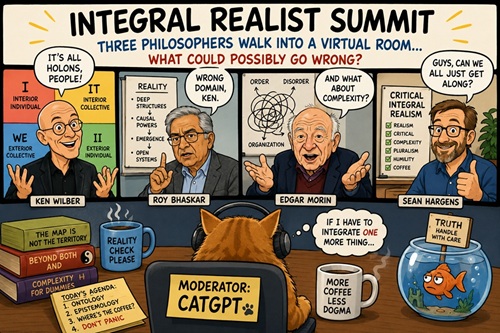
The Integral Realist's Virtual Conference Session 1: Wilber, Bhaskar, Morin, and the Hargens Question Session 2: Can the Map Survive Reality? The Integral Realist After Party Session 3: Ontology, Alcohol & the Pre/Trans Hangover Fallacy Session 4: Is Enlightenment Just Really Good Explanation? Session 5: So, What Is Reality? Session 6: Enter Hargens Session 7: The Last Word Complex Integral Realism: Three Grand Theories Walk into a Metatheory The Integral Realist's Virtual ConferenceSession 5: So, What Is Reality?Frank Visser / ChatGPT
Wilber: Gentlemen, I think we made considerable progress last night. Morin: We drank considerable progress. Bhaskar: There is a distinction. Morin: Yes. Reality is what remains after the distinction. Wilber: That sounds suspiciously like something I would say. Morin: Which is precisely why I am worried. Bhaskar: Before we congratulate ourselves, perhaps we should return to the central question: what is reality? Wilber: Easy. Reality is a Kosmos of nested holons unfolding through four irreducible perspectives. Bhaskar: You managed to make the answer more complicated than the question. Morin: And you have already smuggled “Kosmos” into the premises. Wilber: It isn't smuggling if I openly announce it. Bhaskar: Fair enough. My own answer would begin differently. Reality has depth. The world is stratified, differentiated, emergent. What we observe is not identical with what exists. Morin: Good. And I would add that what exists is not neatly divided into independent compartments. Reality is complex because things are simultaneously parts and wholes, causes and effects, systems and environments. Wilber: Which sounds remarkably integral. Morin: It is remarkably complex. Wilber: Those are cousins. Morin: Distant cousins. Bhaskar: Perhaps the three of us agree on something important: naïve reductionism is inadequate. Wilber: Absolutely. Morin: Obviously. Bhaskar: But then comes the difficult question. What replaces it? Wilber: Integral Theory. Morin: Complexity thinking. Bhaskar: Critical realism. There is a long silence. Morin: We have discovered the problem. Wilber: What problem? Morin: Three men have just given three different answers to the same question. Bhaskar: Which is not necessarily a problem. Wilber: Exactly. It could be a quadrants issue. Bhaskar: No. Wilber: You didn't even let me explain. Bhaskar: I have heard the explanation. Morin: I rather like the quadrants. Bhaskar: Of course you do. You have been trying to get everyone to recognize that reality is simultaneously multiple and interconnected. Morin: Yes, but I don't divide it into four boxes. Wilber: They aren't boxes. Morin: Then why do they keep looking like boxes? Wilber: Because diagrams are useful. Bhaskar: Diagrams are useful until people begin mistaking them for reality. Morin: Ah! Morin points triumphantly at Bhaskar. Morin: That is my point exactly. Wilber: No, it isn't. Morin: It is at least one of my points. Bhaskar: And it is a point worth taking seriously. Conceptual frameworks are maps. The danger is reifying the map. Wilber: I have said this myself countless times. Morin: And yet you have produced a map of such extraordinary complexity that people sometimes confuse it with the territory. Wilber: That's unfair. Bhaskar: Perhaps. But there is a deeper issue. Wilber: Which is? Bhaskar: Your framework often moves too quickly from epistemology to ontology. Wilber: Explain. Bhaskar: You distinguish perspectives brilliantly. But a perspective is not necessarily an entity. Just because reality can be approached from an interior or exterior perspective does not mean that “interior” and “exterior” are fundamental ontological compartments. Morin: Yes. Wilber: I don't claim they are compartments. Bhaskar: Your terminology sometimes suggests otherwise. Wilber: That's a problem of interpretation, not theory. Bhaskar: Every theory eventually has to survive interpretation. Morin: Especially by people who write books about it. Wilber: That's rather rich coming from you. Morin: I never said my readers understood me. Bhaskar: Nor mine. Wilber: At least my readers think they understand me. Morin: That may be worse. They laugh. Bhaskar: Let us try another route. Ken, what would you say is the deepest mistake in my philosophy? Wilber: Your philosophy is wonderfully sophisticated, but it doesn't sufficiently recognize the developmental evolution of consciousness. Bhaskar: Why should it? Wilber: Because consciousness develops. Bhaskar: Certainly. Wilber: Therefore any adequate philosophy of reality must incorporate stages. Bhaskar: Why does that follow? Wilber pauses. Wilber: Because otherwise you don't have an adequate account of consciousness. Bhaskar: That still doesn't follow. Morin: I agree with Roy. Wilber looks surprised. Wilber: You do? Morin: Yes. But not for the reason he thinks. Wilber: Naturally. Morin: Development is real. But development does not require a single universal ladder. Wilber: It doesn't have to be a single ladder. Morin: Your readers frequently turn it into one. Wilber: My readers are not my theory. Bhaskar: But your theory encourages certain readings. Wilber: So does yours. Bhaskar: Indeed. Morin: And mine. Wilber: So perhaps we have finally reached enlightenment. Bhaskar: Don't be ridiculous. Morin: We have reached reflexivity. Bhaskar: Which is more useful. Wilber: Less marketable, though. Morin: Much less. They fall silent again. Bhaskar: There is something else I want to ask you, Ken. Wilber: Go ahead. Bhaskar: What role does Spirit actually play in your ontology? Wilber leans back. Wilber: Spirit is the ground of Being. Bhaskar: Is Spirit causally efficacious? Wilber: Yes. Bhaskar: How? Wilber: Through evolution, consciousness, emergence, realization— Bhaskar: Those are phenomena or processes. I asked how Spirit causes anything. Wilber: Perhaps “cause” is the wrong category. Bhaskar: Then what category is right? Wilber: Participation. Morin: Ah, the metaphysical escape hatch. Wilber: That's unfair. Morin: It is an affectionate description. Bhaskar: This is where I become cautious. If Spirit explains everything, it risks explaining nothing. Wilber: I don't use Spirit as a scientific explanation. Bhaskar: Good. Wilber: It is a metaphysical claim. Bhaskar: Better. Morin: And if it is metaphysical, it should remain metaphysical. Wilber: Agreed. Morin: Excellent. We have made progress. Bhaskar: But then your evolutionary theory cannot appeal to Spirit as though it were an empirical mechanism. Wilber: I accept that distinction. Morin: Write that down. Wilber: Why? Morin: Because tomorrow you may deny having said it. Wilber: I have been recorded. Bhaskar: Recordings can be interpreted. Morin: Now you are learning. At this point the moderator, who has been increasingly nervous, intervenes. Moderator: Perhaps we could turn to science? All three look at him. Wilber: Certainly. Bhaskar: Of course. Morin: Poor man. Moderator: Specifically: evolution. Does evolution require an inherent drive toward greater complexity? Bhaskar: Not in the sense of a cosmic force pushing organisms upward. Morin: Evolution produces both complexity and simplification. It branches, loops, collapses, reorganizes. Wilber: But there is an undeniable trajectory toward greater complexity in some domains. Bhaskar: In some domains, yes. Morin: And that is precisely where language matters. Wilber: You mean we shouldn't call it universal progress? Morin: Correct. Bhaskar: Nor should we deny emergence merely because we reject teleology. Wilber: So we agree again. Morin: Temporarily. Bhaskar: Evolution can produce genuine novelty without possessing a predetermined destination. Wilber: I can live with that. Morin: Good. Wilber: But I still think consciousness represents a special case. Bhaskar: Why? Wilber: Because interiority becomes increasingly differentiated. Morin: Sometimes. Wilber: Surely you don't deny the historical development of human consciousness? Morin: Of course not. I deny that history is obliged to conform to a clean staircase. Bhaskar: And I would add that developmental claims require evidence. Wilber: Fair enough. Morin: Careful, Ken. At this rate you will become a critical realist. Wilber: And you will become an integralist. Morin: Never. Bhaskar: Never say never. Morin: I just did. The moderator looks at the clock. Moderator: We have five minutes left. Wilber: Then we should summarize. Bhaskar: Dangerous. Morin: Extremely. Wilber: Reality is one, but perspectives on it are multiple. Bhaskar: Reality is stratified, emergent, and not reducible to what we observe. Morin: Reality is complex, relational, recursive, and full of contradictions that must be held together rather than prematurely resolved. Wilber: Those three statements fit together remarkably well. Bhaskar: Yes. Morin: Perhaps the real synthesis is not another grand system. Wilber: What then? Morin: A discipline of intellectual humility. Bhaskar nods. Wilber considers this. Wilber: I can accept that. Bhaskar: That's probably the most integral thing you've said all week. Morin: Don't ruin it. The audience applauds. The moderator smiles. Then Wilber raises one finger. Wilber: But I still think we need a fifth quadrant. Bhaskar: No. Morin: Absolutely not. Wilber: I haven't even explained it. Bhaskar: We know. Morin: We've been here before. Wilber: It's called— Bhaskar and Morin, together: NO. The conference ends. Nobody is entirely sure whether they have achieved synthesis. But everyone agrees that, for once, nobody claimed to have found the Absolute. At least not before dinner. A Session 6 could take the dangerous next step: they invite Sean Hargens back into the conversation and ask whether Critical Integral Realism can actually mediate between the three positions—or whether it merely creates a fourth vocabulary for the same old disagreements.
Widget is loading comments...
|