|
TRANSLATE THIS ARTICLE
Integral World: Exploring Theories of Everything
An independent forum for a critical discussion of the integral philosophy of Ken Wilber
  Frank Visser, graduated as a psychologist of culture and religion, founded IntegralWorld in 1997. He worked as production manager for various publishing houses and as service manager for various internet companies and lives in Amsterdam. Books: Ken Wilber: Thought as Passion (SUNY, 2003), and The Corona Conspiracy: Combatting Disinformation about the Coronavirus (Kindle, 2020). Frank Visser, graduated as a psychologist of culture and religion, founded IntegralWorld in 1997. He worked as production manager for various publishing houses and as service manager for various internet companies and lives in Amsterdam. Books: Ken Wilber: Thought as Passion (SUNY, 2003), and The Corona Conspiracy: Combatting Disinformation about the Coronavirus (Kindle, 2020).
Check out my other conversations with ChatGPT
The Integral Realist's Virtual Conference Session 1: Wilber, Bhaskar, Morin, and the Hargens Question Session 2: Can the Map Survive Reality? The Integral Realist After Party Session 3: Ontology, Alcohol & the Pre/Trans Hangover Fallacy Session 4: Is Enlightenment Just Really Good Explanation? Session 5: So, What Is Reality? Session 6: Enter Hargens Session 7: The Last Word Complex Integral Realism: Three Grand Theories Walk into a Metatheory The Integral Realist's Virtual ConferenceSession 3: Ontology, Alcohol & the Pre/Trans Hangover FallacyFrank Visser / ChatGPT
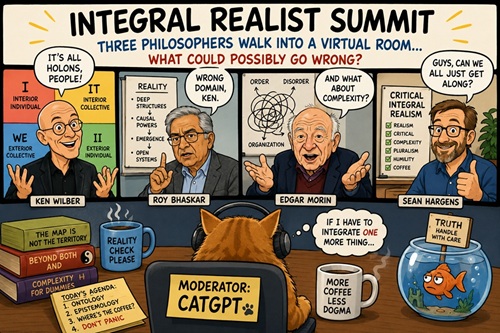
The morning after the after party. Four philosophers, one hotel conference room, several cups of coffee, and a metaphysical problem that should never have been allowed to happen. The conference room is silent. Ken Wilber is sitting at the table with dark sunglasses. Roy Bhaskar is reading something. Edgar Morin is drinking mineral water. Sean Hargens is staring at the coffee machine as though it has personally betrayed him. On the screen behind them: SESSION 3 ONTOLOGY, ALCOHOL & THE PRE/TRANS HANGOVER FALLACY Underneath, someone has added in smaller letters: Reality hurts. Hargens: Good morning. No response. Hargens: Gentlemen? Morin: Define morning. Bhaskar: It is objectively morning. Wilber: Subjectively, it is still last night. Hargens: Excellent. We have already begun. The First DiagnosisHargens: Ken, how are you? Wilber: I'm experiencing an altered state of consciousness. Bhaskar: You're hungover. Wilber: That's a rather reductionistic interpretation. Bhaskar: You drank six beers. Wilber: Seven. Morin: Ah. A crucial empirical datum. Wilber: Thank you, Edgar. Morin: It changes everything. Wilber: I knew I could count on you. Morin: Six beers would have been one phenomenon. Seven is an emergent system. Bhaskar: There is nothing mysterious about it. Morin: I didn't say mysterious. I said emergent. Bhaskar: The causal mechanism is straightforward. Wilber: That's because you're ignoring the interior dimension. Bhaskar: I am sitting in the same room as you. Wilber: Precisely. The Pre/Trans ProblemHargens walks to the whiteboard. He writes: PRE TRANS Then underneath: HANGOVER Hargens: Ken, perhaps you can explain the problem. Wilber takes off his sunglasses. Wilber: Gladly. One of the recurring mistakes in developmental theory is to confuse pre-rational states with trans-rational states simply because both are non-rational. Morin: And you propose that hangovers are which? Wilber: I'm getting there. Bhaskar: Please don't. Wilber: The important point is that the fact that two phenomena lie outside ordinary rational consciousness does not mean they are equivalent. Hargens: Correct. Wilber: A mystical state can transcend ordinary discursive cognition. Morin: And a hangover can transcend your ability to remember where you put your shoes. Wilber: Exactly. Bhaskar: That is not what "transcend" means. Morin: It is a perfectly adequate phenomenological description. Bhaskar: No. The shoes have a causal history. Wilber: Roy, you're missing the point. Bhaskar: I suspect I am preventing the point from becoming ridiculous. The Ontology of the HeadacheHargens: Let's take the headache seriously. Wilber: Thank you. Bhaskar: Finally. Hargens: We can approach it from several perspectives. Wilber: Interior individual: the felt experience of pain. Bhaskar: Exterior individual: neurological and physiological processes. Morin: Collective dimensions: drinking culture, social rituals, expectations, peer interaction. Hargens: And critical dimensions: why did four philosophers believe that drinking heavily at an academic conference was a good idea? They look at one another. Morin: Cultural conditioning. Bhaskar: Poor judgment. Wilber: Excessive enthusiasm. Hargens: Exactly. Morin: Perhaps all three. Wilber: That's the integral answer. Morin: No. That's the complex answer. Bhaskar: It is also the causal answer. Hargens: And therefore, annoyingly, everyone is right. A Deeper ProblemMorin leans forward. Morin: But notice what happened last night. Wilber: I am trying very hard not to. Morin: We began with philosophical disagreement. Then alcohol reduced our inhibitions. We became more willing to acknowledge uncertainty. We laughed at our own theories. Bhaskar: The alcohol did not necessarily produce epistemic improvement. Morin: No. Bhaskar: It merely altered the conditions under which we spoke. Morin: Which is precisely what I mean. Wilber: So the alcohol was a developmental technology? Bhaskar: No. Wilber: You didn't even let me finish. Bhaskar: I know. Morin: But there is an interesting point here. Changes in physiological state can change cognition. Changes in social context can change cognition. Changes in cultural expectations can change cognition. Hargens: Which means that consciousness cannot be isolated from embodiment and social context. Wilber: That's completely compatible with integral theory. Bhaskar: Yes. Wilber: You said yes. Bhaskar: Don't make too much of it. The Enlightened HangoverA conference participant raises a hand. AUDIENCE MEMBER: Could a hangover actually be spiritually transformative? Wilber immediately sits upright. Wilber: Absolutely. Bhaskar: Caution. Morin: Interesting. Hargens: Go on, Ken. Wilber: Suffering can interrupt ordinary patterns of identification. The ego may discover its limitations. One may become more present, less attached to ordinary pleasures, more aware of bodily impermanence— Bhaskar: Or one may simply need electrolytes. Morin: Both can be true. Wilber: Thank you. Bhaskar: I refuse to allow hydration to become a spiritual technology. Morin: Why not? Bhaskar: Because then someone will publish a book called The Integral Electrolyte: A Revolutionary New Stage of Consciousness. Everyone looks at Wilber. Wilber looks offended. Wilber: I would never— Hargens: You absolutely would. The Return of the CatThe conference-room door opens. A cat walks in. Nobody knows where it came from. It jumps onto the table. On its collar is a small badge: CATGPT — MODERATOR Wilber: You're back. The cat sits down. Bhaskar: Does it have an argument? Morin: It has judgment. The cat stares at Wilber. Wilber: What? The cat pushes his sunglasses off the table. Hargens: I believe we have received a critique. Bhaskar: Empirically observable. Morin: Symbolically rich. Wilber: Fine. Critical Integral Hangover TheoryHargens walks to the board again. He writes: 1. REALISM The headache is real. 2. INTEGRALITY The headache has multiple dimensions. 3. COMPLEXITY The headache emerges from interacting processes. 4. CRITIQUE Perhaps drinking seven beers was not necessary. 5. HUMILITY Our theory does not make the headache disappear. He turns around. Hargens: There. Bhaskar: Excellent. Morin: Elegant. Wilber: Useful. Hargens: And importantly, it doesn't require us to decide that one of our perspectives is the perspective. Bhaskar: That is the point. Wilber: But I still think the spiritual interpretation has legitimacy. Bhaskar: As a hypothesis. Wilber: Yes. Morin: As a meaning-making possibility. Wilber: Yes. Hargens: But not as a demonstrated metaphysical fact. Wilber sighs. Wilber: Fine. The Unexpected Breakthrough Morin suddenly smiles. Morin: Perhaps we have discovered something. Bhaskar: About hangovers? Morin: About philosophy. Wilber: That's more interesting. Morin: Every one of our theories is an attempt to move beyond reductionism. Bhaskar: Yes. Morin: But every theory risks becoming a new reductionism when it becomes confident that it has found the correct way of transcending reductionism. Nobody speaks. Hargens: That's very good. Bhaskar: Indeed. Wilber: Are you saying integral theory can become reductionistic? Morin: Of course. Wilber: Even though it explicitly opposes reductionism? Morin: Especially then. Bhaskar: Any theory can become what it opposes. Wilber: That's uncomfortably dialectical. Bhaskar: Welcome to philosophy. The Hangover TestHargens takes a sheet of paper. Hargens: I propose a test. Wilber: Another test? Hargens: The Hangover Test for philosophical systems. Morin: Excellent. Hargens: A theory should survive three questions. He writes: Can reality contradict it? Can experience complicate it? Can criticism change it? Bhaskar: Very good. Morin: Add one more. Hargens: Which? Morin: Can it laugh at itself? Wilber smiles. Wilber: I like that. Bhaskar: I am less certain that realism needs humor. Morin: Then realism has a serious problem. Final CoffeeThe session is running overtime. The cat has fallen asleep on the conference table. Wilber removes his sunglasses. His eyes are still bloodshot. Wilber: You know, I think the hangover has taught me something. Bhaskar: I am listening. Wilber: A theory should not be judged only by how much reality it can explain. Morin: Good. Wilber: It should also be judged by how much reality it can tolerate without forcing it into the theory. Bhaskar slowly nods. Bhaskar: That's a significant improvement. Morin: Perhaps the hangover has been productive. Hargens: Emergent wisdom? Bhaskar: Or dehydration. Wilber: Must you always do that? Bhaskar: Yes. The cat wakes up. It walks across the keyboard. The projector changes slides. A final message appears: SESSION 4: THE MORNING AFTER THE MORNING AFTER — IS ENLIGHTENMENT JUST A REALLY GOOD EXPLANATION? Everyone stares at the screen. Wilber: I didn't schedule that. Hargens: Neither did I. Bhaskar: The system appears to have generated its own agenda. Morin: Emergence. The cat meows. Wilber: All right. He reaches for his coffee. Wilber: Session four. Bhaskar: After lunch. Morin: And no alcohol. Hargens: Agreed. The cat knocks over the coffee. Morin: Perhaps no coffee either. The conference adjourns in a state of provisional agreement—which, for these four men, is practically enlightenment.
Widget is loading comments...
|