|
TRANSLATE THIS ARTICLE
Integral World: Exploring Theories of Everything
An independent forum for a critical discussion of the integral philosophy of Ken Wilber
  Frank Visser, graduated as a psychologist of culture and religion, founded IntegralWorld in 1997. He worked as production manager for various publishing houses and as service manager for various internet companies and lives in Amsterdam. Books: Ken Wilber: Thought as Passion (SUNY, 2003), and The Corona Conspiracy: Combatting Disinformation about the Coronavirus (Kindle, 2020). Frank Visser, graduated as a psychologist of culture and religion, founded IntegralWorld in 1997. He worked as production manager for various publishing houses and as service manager for various internet companies and lives in Amsterdam. Books: Ken Wilber: Thought as Passion (SUNY, 2003), and The Corona Conspiracy: Combatting Disinformation about the Coronavirus (Kindle, 2020).
Check out my other conversations with ChatGPT
APOCALYPTIC IRAN?
Review of the Original Article Origins of the “Apocalyptic Iran” Narrative Western Projection and Apocalyptic Thinking Christian vs. Shi'a Messianism Historical Lineage of the Narrative Theological and Factual Errors in the Article Academically Defensible Reformulation of the Argument Revolutionary Theology and GeopoliticsReligion in Iran's Conflict with IsraelFrank Visser / ChatGPT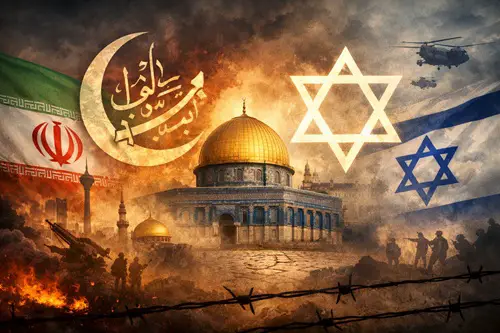 IntroductionDebates about Iran's hostility toward Israel often focus on geopolitical factors such as regional power struggles or the Israeli-Palestinian conflict. Yet ideology also plays an important role in shaping the worldview of the Islamic Republic. Since the Iranian Revolution of 1979, Iran's leadership has framed its political mission through a combination of Shi'a religious symbolism, revolutionary anti-imperialism, and regional strategic ambitions. Understanding the ideological dimension of Iranian policy does not require assuming that the regime seeks apocalyptic confrontation. Rather, it involves recognizing how religious narratives influence the way Iranian leaders interpret international politics and legitimize their policies. Shi'a Messianism and Political IdentityTwelver Shi'ism centers on the belief that the hidden Imam—Muhammad al-Mahdi—will eventually return to establish justice in the world. Traditionally, Shi'a scholars emphasized patience and moral preparation during the Imam's occultation. The revolutionary ideology developed by Ruhollah Khomeini reinterpreted this tradition in political terms. Through the doctrine of Velayat-e Faqih (Guardianship of the Jurist), Khomeini argued that Islamic scholars could govern society in the absence of the Imam. This reinterpretation allowed religious authority to become the basis of a modern state, linking political leadership with the preservation of Islamic justice until the Mahdi's return. Revolutionary Anti-ZionismWithin this ideological framework, opposition to Israel acquired symbolic significance. The Iranian leadership portrays Israel not merely as a geopolitical adversary but as part of a broader system of Western domination in the Middle East. This perspective developed partly from the revolutionary narrative that identified the United States as the “Great Satan” and Israel as a regional extension of Western power. Consequently, support for Palestinian movements and hostility toward Israel became central elements of Iran's revolutionary identity. The Use of Religious Language in PoliticsIranian leaders frequently invoke religious themes—including martyrdom, justice, and the eventual triumph of the oppressed—to mobilize domestic support and reinforce the legitimacy of the regime. Occasional references to the return of the Mahdi should therefore be understood primarily within the context of political symbolism rather than literal strategic planning. Such rhetoric resonates strongly with Shi'a historical memory, particularly the martyrdom of Husayn ibn Ali, which plays a central role in Shi'a identity. Strategy and PragmatismDespite its revolutionary ideology, the Islamic Republic has often behaved pragmatically in international affairs. Iran has generally avoided direct large-scale war with either Israel or the United States, preferring indirect competition through regional alliances and proxy forces. This pattern suggests that Iranian policymakers balance ideological commitments with considerations of national survival and strategic advantage. ConclusionReligion is undeniably an important component of Iran's political culture. Shi'a symbolism and revolutionary ideology shape the narratives through which the Islamic Republic interprets its role in the world and justifies its opposition to Israel. At the same time, Iran's foreign policy cannot be understood solely through theological doctrine. Like other states, it reflects a complex interaction of ideology, strategic interests, regional rivalries, and domestic political considerations. Recognizing both the ideological and pragmatic dimensions of Iranian policy allows for a more accurate understanding of the motivations behind the Islamic Republic's actions.
Widget is loading comments...
|