|
TRANSLATE THIS ARTICLE
Integral World: Exploring Theories of Everything
An independent forum for a critical discussion of the integral philosophy of Ken Wilber
  Frank Visser, graduated as a psychologist of culture and religion, founded IntegralWorld in 1997. He worked as production manager for various publishing houses and as service manager for various internet companies and lives in Amsterdam. Books: Ken Wilber: Thought as Passion (SUNY, 2003), and The Corona Conspiracy: Combatting Disinformation about the Coronavirus (Kindle, 2020). Frank Visser, graduated as a psychologist of culture and religion, founded IntegralWorld in 1997. He worked as production manager for various publishing houses and as service manager for various internet companies and lives in Amsterdam. Books: Ken Wilber: Thought as Passion (SUNY, 2003), and The Corona Conspiracy: Combatting Disinformation about the Coronavirus (Kindle, 2020).
Check out my other conversations with ChatGPT
APOCALYPTIC IRAN?
Review of the Original Article Origins of the “Apocalyptic Iran” Narrative Western Projection and Apocalyptic Thinking Christian vs. Shi'a Messianism Historical Lineage of the Narrative Theological and Factual Errors in the Article Academically Defensible Reformulation of the Argument Inventing the Apocalyptic RegimeHow the West Learned to Fear Iran's End-Times TheologyFrank Visser / ChatGPT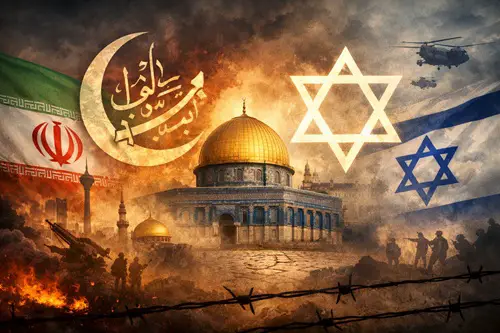 A key figure in shaping this view was the historian Bernard Lewis, one of the most influential Western scholars of the Middle East. In a widely discussed 2006 essay in the Wall Street Journal, Lewis suggested that some Iranian leaders might welcome a catastrophic confrontation with the West because they believe history is moving toward a messianic climax. Lewis speculated that the regime might not be deterred by nuclear retaliation if it believed such destruction would usher in the end times. Although Lewis framed this as a possibility rather than a certainty, the idea quickly gained traction in policy circles. Post-9/11 Strategic AnxietyAfter the September 11 attacks, American policymakers were forced to confront the reality that some adversaries might not behave according to conventional deterrence theory. The logic of Mutually Assured Destruction, which had governed Cold War nuclear strategy, assumed that leaders would avoid actions leading to their own annihilation. But groups like Al-Qaeda appeared motivated by martyrdom ideology. This raised a troubling question: What if a state actor shared similar beliefs? Iran—an Islamic revolutionary regime with anti-Western rhetoric—became the obvious candidate for this fear. The Ahmadinejad FactorThe presidency of Mahmoud Ahmadinejad (2005-2013) intensified these concerns. Ahmadinejad: • Frequently invoked the return of the Mahdi. • Publicly prayed for the Mahdi's reappearance. • Allocated funds for projects related to Mahdist symbolism, such as the shrine at Jamkaran. To many Western observers, this rhetoric seemed to confirm the apocalyptic thesis. Yet Iran specialists noted that Ahmadinejad's language was partly populist religious symbolism aimed at domestic audiences. Even during his presidency, Iran's strategic behavior remained cautious. Policy Uses of the NarrativeThe “apocalyptic Iran&rduo; idea proved politically useful during debates over Iran's nuclear program. Advocates of a hardline approach argued: • Deterrence might not work against Iran. • Negotiations would fail if leaders believed divine prophecy required Israel's destruction. • Preventive military action might therefore be justified. This framing influenced discussions in Washington, especially during the presidency of George W. Bush. Scholarly PushbackMost academic specialists rejected the apocalyptic interpretation as an exaggeration. For example: • Vali Nasr emphasized Iran's pragmatic geopolitical strategy. • Mehdi Khalaji argued that clerical rhetoric about the Mahdi is largely symbolic. • Studies of Shi'a theology show that classical doctrine discourages attempts to force the Mahdi's return. Even the revolutionary ideology of Ruhollah Khomeini did not advocate creating apocalyptic chaos. The Reality: Ideology + StrategyMost contemporary analysts now see Iranian policy as a mixture of: Religious ideology• Shi'a revolutionary identity • Mahdist symbolism • Anti-Zionist rhetoric Geopolitical calculation• Regional power competition • Deterrence strategy • Proxy warfare Iran's behavior—avoiding direct war with United States or Israel despite decades of hostility—suggests that strategic survival remains the overriding priority. Why the Apocalyptic Narrative PersistsThe narrative survives because it serves several psychological and political functions: • It simplifies a complex geopolitical conflict. • It frames adversaries as irrational enemies. • It justifies preemptive or confrontational policies. At the same time, dismissing religion entirely would also be misleading. Iranian leaders genuinely draw on Islamic revolutionary symbolism—but usually in ways compatible with state survival. In short:Iranian ideology does contain messianic elements, but the notion that the regime actively seeks apocalypse is largely a Western interpretive construction rather than a demonstrated strategic doctrine.
Widget is loading comments...
|