|
TRANSLATE THIS ARTICLE
Integral World: Exploring Theories of Everything
An independent forum for a critical discussion of the integral philosophy of Ken Wilber
  Frank Visser, graduated as a psychologist of culture and religion, founded IntegralWorld in 1997. He worked as production manager for various publishing houses and as service manager for various internet companies and lives in Amsterdam. Books: Ken Wilber: Thought as Passion (SUNY, 2003), and The Corona Conspiracy: Combatting Disinformation about the Coronavirus (Kindle, 2020). Frank Visser, graduated as a psychologist of culture and religion, founded IntegralWorld in 1997. He worked as production manager for various publishing houses and as service manager for various internet companies and lives in Amsterdam. Books: Ken Wilber: Thought as Passion (SUNY, 2003), and The Corona Conspiracy: Combatting Disinformation about the Coronavirus (Kindle, 2020).
Check out my other conversations with ChatGPT
APOCALYPTIC IRAN?
Review of the Original Article Origins of the “Apocalyptic Iran” Narrative Western Projection and Apocalyptic Thinking Christian vs. Shi'a Messianism Historical Lineage of the Narrative Theological and Factual Errors in the Article Academically Defensible Reformulation of the Argument Mirror ApocalypsesHow Western End-Times Thinking Shapes Perceptions of IranFrank Visser / ChatGPT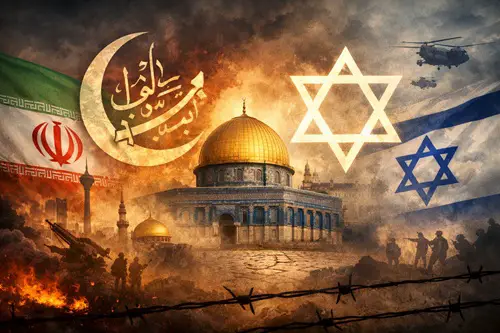 An intriguing feature of the “apocalyptic Iran” narrative is that it often reveals as much about Western psychological frameworks as it does about Iranian ideology. Many scholars have noted that the discourse surrounding Iran's supposed end-times ambitions sometimes mirrors Western religious and cultural narratives about apocalypse, especially those circulating in the United States. The Projection HypothesisSome analysts argue that Western observers project their own apocalyptic imagery onto Iranian politics. The Middle East has long been imagined in Western culture as the stage for biblical end-time drama—an idea deeply embedded in Christian eschatology. In particular, many evangelical interpretations of prophecy link the fate of Israel to the events preceding the Second Coming of Christ. According to dispensationalist theology—popularized by writers such as Hal Lindsey—conflict in the Middle East is not merely geopolitical but cosmically significant. Thus when Iranian leaders use religious rhetoric, Western audiences already primed with their own apocalyptic narratives may interpret those statements through a lens of existential end-times conflict. The Cold War TemplateAnother source of projection comes from Cold War strategic thinking. During the nuclear standoff between the United States and the Soviet Union, analysts frequently worried about whether ideological regimes might act irrationally or even welcome global destruction. The fear that a rival power might be undeterrable became a recurring theme in strategic literature. After the collapse of the Soviet Union, similar anxieties migrated to new perceived adversaries, including Iran. In this sense, the “apocalyptic regime” narrative is part of a broader intellectual tradition in which enemies are imagined as outside the logic of rational deterrence. Media AmplificationModern media ecosystems amplify these interpretations. Statements by Iranian officials—especially dramatic slogans such as “Death to Israel”—circulate widely in Western media without the political context in which they are often delivered. Figures like Mahmoud Ahmadinejad became emblematic of this phenomenon. His speeches about the Mahdi were often interpreted literally as policy declarations rather than as ideological rhetoric directed toward domestic audiences. The Strategic RealityWhen analysts examine Iran's behavior rather than its rhetoric, a different picture often emerges. Despite decades of hostility toward Israel, Iran has generally acted cautiously in ways consistent with regime survival: • Avoiding direct large-scale war with Israel or the United States • Using proxy forces instead of conventional confrontation • Maintaining plausible deniability in regional conflicts These patterns resemble traditional power politics rather than apocalyptic strategy. Mutual MythologiesInterestingly, both sides of the conflict cultivate narratives that portray the other as existentially dangerous. Iranian revolutionary discourse describes the United States as the “Great Satan.” Meanwhile, Western commentary sometimes depicts Iran as a regime driven by religious nihilism. These mirror-image mythologies reinforce each other, making compromise politically difficult. A More Nuanced InterpretationA growing number of scholars therefore interpret Iranian ideology as symbolic revolutionary language embedded within pragmatic statecraft. The Islamic Republic does draw on Shi'a themes of martyrdom and messianic justice, rooted in the memory of Ruhollah Khomeini's revolution. But these ideas typically function as legitimating narratives, not literal strategic goals. In other words, religion shapes the regime's identity and rhetoric, while geopolitical calculations guide its actual behavior. ConclusionThe idea that Iran seeks apocalyptic war is best understood as a hybrid narrative—partly rooted in real religious symbolism within Iranian politics, but also shaped by Western cultural anxieties about ideological enemies. Recognizing this dynamic does not minimize the seriousness of Iran's hostility toward Israel. Rather, it encourages a more careful distinction between revolutionary rhetoric and strategic intent.
Widget is loading comments...
|