|
TRANSLATE THIS ARTICLE
Integral World: Exploring Theories of Everything
An independent forum for a critical discussion of the integral philosophy of Ken Wilber
  Frank Visser, graduated as a psychologist of culture and religion, founded IntegralWorld in 1997. He worked as production manager for various publishing houses and as service manager for various internet companies and lives in Amsterdam. Books: Ken Wilber: Thought as Passion (SUNY, 2003), and The Corona Conspiracy: Combatting Disinformation about the Coronavirus (Kindle, 2020). Frank Visser, graduated as a psychologist of culture and religion, founded IntegralWorld in 1997. He worked as production manager for various publishing houses and as service manager for various internet companies and lives in Amsterdam. Books: Ken Wilber: Thought as Passion (SUNY, 2003), and The Corona Conspiracy: Combatting Disinformation about the Coronavirus (Kindle, 2020).
Check out my other conversations with ChatGPT
APOCALYPTIC IRAN?
Review of the Original Article Origins of the “Apocalyptic Iran” Narrative Western Projection and Apocalyptic Thinking Christian vs. Shi'a Messianism Historical Lineage of the Narrative Theological and Factual Errors in the Article Academically Defensible Reformulation of the Argument Apocalyptic Iran?Religion, Rhetoric, and the Politics of FearFrank Visser / ChatGPT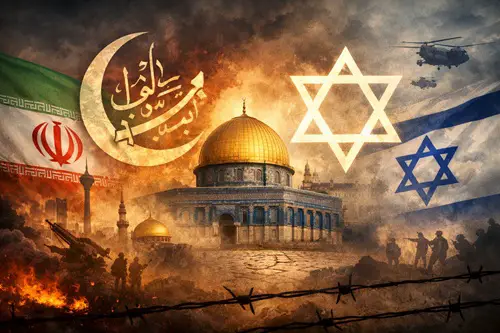 This is a response to a Facebook post by Tim Orr, Christian minister and blogger at the Times of Israel, on the often neglected apocalyptic nature of Iranian politics. The article presents a clear thesis: Iran's hostility toward Israel is fundamentally theological, rooted in a revolutionary interpretation of Twelver Shi'a messianism introduced by Ruhollah Khomeini. The author argues that Western analysts misunderstand Iranian policy because they treat it as rational geopolitics rather than eschatological ideology centered on the return of the Mahdi (the Twelfth Imam). Below is a critical review focusing on strengths, weaknesses, and analytical reliability. 1. The Core ArgumentThe essay claims: • Iranian hostility toward Israel is primarily religious rather than political. • The Islamic Republic believes destroying Israel will help trigger the return of the Mahdi. • Because of this theology, Iran cannot be deterred or negotiated with. • Nuclear weapons would therefore be used apocalyptically rather than as deterrence. This is a strong interpretive claim, and the essay builds its case by combining: • Twelver Shi'a messianic doctrine • Statements from Iranian leaders • Iran's proxy warfare strategy 2. Strengths of the ArticleA. Correctly Highlights the Role of Shi'a MessianismThe article is right that messianism plays an important role in Iranian political rhetoric. Twelver Shi'ism centers on the belief that the Muhammad al-Mahdi, the twelfth Imam, entered occultation in the 9th century and will return to establish justice. This belief is widely documented in scholarship such as Abdulaziz Sachedina's work on Islamic messianism. Iranian leaders have indeed used Mahdist language. For example, former president Mahmoud Ahmadinejad frequently invoked the Mahdi in speeches. Thus the article is correct that religion is not merely decorative rhetoric in Iranian politics. B. Correctly Notes Khomeini's InnovationThe author also correctly observes that Ruhollah Khomeini transformed traditional Shi'a doctrine. Classical Twelver theology generally advocated political quietism during the Imam's occultation. Khomeini broke with this tradition by introducing Velayat-e Faqih (Guardianship of the Jurist), giving clerics political authority until the Imam returns. This was indeed a major doctrinal shift in Shi'a political thought. C. Acknowledges Iran's Proxy StrategyThe essay correctly describes Iran's use of regional proxies (e.g., Hezbollah, Hamas, Iraqi militias) to surround Israel strategically. This is widely accepted in geopolitical analysis. 3. Major Analytical ProblemsDespite these strengths, the article suffers from significant oversimplification and exaggeration. A. It Overstates Apocalyptic TheologyThe article suggests that Iranian leaders actively seek chaos or apocalypse to trigger the Mahdi's return. Most scholars disagree. For example: • Vali Nasr argues Iranian leaders are strategic realists, not apocalyptic revolutionaries. • Mehdi Khalaji, cited by the author, actually argues that Iranian clerics use theology instrumentally rather than literally expecting apocalypse. • Traditional Shi'a theology actually teaches that humans cannot force the Mahdi's return. So the claim that war must be created to trigger the Mahdi is not mainstream doctrine. B. It Treats Iran as a Monolithic Ideological ActorThe article assumes Iran's leadership is uniformly messianic. In reality, Iranian politics contains competing factions: • Revolutionary ideologues • Nationalist strategists • Pragmatic technocrats Even Ali Khamenei, Iran's Supreme Leader, has shown consistent strategic caution, especially regarding nuclear weapons and direct war. Iran has repeatedly avoided actions that would provoke overwhelming retaliation. This behavior contradicts the idea of suicidal apocalyptic policy. C. The Nuclear Argument Is SpeculativeThe article claims Iran would use nuclear weapons to trigger apocalypse. However: • Iran has not built nuclear weapons (according to international monitoring). • Iranian strategic doctrine historically emphasizes deterrence, similar to other states. Even the most hawkish analysts rarely argue Iran wants global destruction. This part of the essay crosses from analysis into alarmist speculation. D. Some Claims Lack EvidenceThe claim that the Mahdi will not return until “the last drop of Jewish blood is spilled” is particularly problematic. Scholars of Shi'a theology generally note: • This statement does not appear in core Twelver texts. • It likely comes from later polemical or propagandistic sources. Thus it should be treated cautiously. 4. Missing ContextThe article also ignores several important geopolitical factors: Regional RivalriesIran's hostility toward Israel is also linked to: • Rivalry with Saudi Arabia • Competition for regional leadership • Anti-American revolutionary ideology Strategic DeterrenceIran often uses anti-Israel rhetoric as symbolic leadership of the “resistance axis.” Domestic LegitimacyHostility toward Israel helps the regime maintain revolutionary identity at home. Religion is therefore one factor among several, not the sole driver. 5. Overall EvaluationStrengths • Correctly emphasizes religious ideology in Iranian politics • Accurately highlights Khomeini's doctrinal innovation • Uses relevant scholarly references Weaknesses • Overstates apocalyptic motivations • Treats Iranian leadership as irrational or suicidal • Ignores geopolitical realism • Includes some questionable theological claims Bottom line:The article identifies an important dimension of Iranian ideology but pushes it into a deterministic narrative of apocalyptic fanaticism that most Iran specialists consider exaggerated. Religion matters in Iranian politics—but it operates within strategic statecraft, not outside it.
Widget is loading comments...
|