|
TRANSLATE THIS ARTICLE
Integral World: Exploring Theories of Everything
An independent forum for a critical discussion of the integral philosophy of Ken Wilber
  Frank Visser, graduated as a psychologist of culture and religion, founded IntegralWorld in 1997. He worked as production manager for various publishing houses and as service manager for various internet companies and lives in Amsterdam. Books: Ken Wilber: Thought as Passion (SUNY, 2003), and The Corona Conspiracy: Combatting Disinformation about the Coronavirus (Kindle, 2020). Frank Visser, graduated as a psychologist of culture and religion, founded IntegralWorld in 1997. He worked as production manager for various publishing houses and as service manager for various internet companies and lives in Amsterdam. Books: Ken Wilber: Thought as Passion (SUNY, 2003), and The Corona Conspiracy: Combatting Disinformation about the Coronavirus (Kindle, 2020).
Check out my other conversations with ChatGPT
APOCALYPTIC IRAN?
Review of the Original Article Origins of the “Apocalyptic Iran” Narrative Western Projection and Apocalyptic Thinking Christian vs. Shi'a Messianism Historical Lineage of the Narrative Theological and Factual Errors in the Article Academically Defensible Reformulation of the Argument The Long Tradition of Explaining Islam Through FanaticismFrom Enlightenment Polemics to the War on TerrorFrank Visser / ChatGPT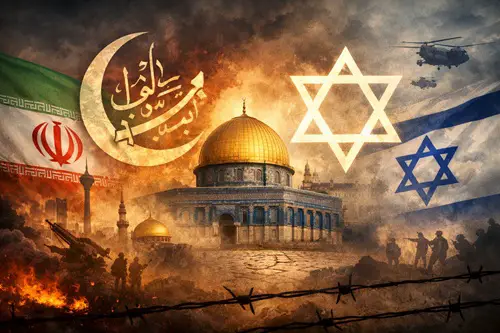 The article you shared fits into a long Western genre that portrays Islam—especially Shi'a Islam—as inherently apocalyptic, fanatical, and immune to rational politics. Versions of this narrative have appeared repeatedly for almost three centuries, each time adapting to new geopolitical fears. Understanding that lineage helps explain why the argument feels familiar. 1. Enlightenment-Era PolemicsIn the 18th century, European writers often depicted Islam as a religion driven by fanaticism and conquest. One of the most famous examples is Voltaire, whose play Mahomet portrayed the Prophet as manipulating religion for political power. European intellectuals were less interested in accurate theology than in using Islam as a symbolic contrast to Enlightenment rationality. Muslims were portrayed as governed by religious passions rather than political calculation. 2. Orientalist ScholarshipIn the 19th and early 20th centuries, this narrative evolved within Orientalist scholarship. Writers such as Ernest Renan argued that Islamic civilization was inherently resistant to reason and modernity. Although framed as academic analysis, these arguments often relied on broad cultural generalizations. The Middle East was imagined as a region where religion dominated politics in ways fundamentally different from the supposedly secular West. This intellectual tradition was later critiqued by Edward Said in Orientalism, which argued that Western scholarship frequently projected its own political anxieties onto the Islamic world. 3. The Cold War RecastingDuring the Cold War, the dominant Western fear shifted from religious fanaticism to communist ideology. After the collapse of the Soviet Union, analysts sought new frameworks for understanding global threats. Islamism increasingly filled that role. The Iranian Revolution of 1979 reinforced this perception. The overthrow of a Western-backed monarchy by a religious movement seemed to confirm the idea that Islamic politics operated outside conventional ideological categories. 4. Post-9/11 Apocalyptic NarrativesAfter the September 11 attacks, Western commentary increasingly emphasized the theme of religiously motivated irrationality. Some writers suggested that Islamist movements sought not merely political power but civilizational or apocalyptic confrontation. Influential historians such as Bernard Lewis speculated that certain Iranian leaders might welcome catastrophic war if they believed it would hasten the arrival of the Mahdi. Although presented as analytical hypotheses, such ideas strongly shaped media narratives and policy debates. 5. The Structure of the GenreTexts in this tradition share several recurring features: Theological determinism Political actions are explained almost entirely by religious doctrine. Civilizational contrast Islamic societies are portrayed as governed by faith, whereas Western societies are portrayed as rational. Apocalyptic framing The conflict is interpreted as existential rather than political. Policy implications Negotiation or compromise is portrayed as impossible. The article you shared follows this template almost exactly. 6. The Historical IronyIronically, Western history itself contains numerous episodes where political movements were deeply shaped by apocalyptic religious expectations. Examples include: • The millenarian movements during the English Civil War • The radical Anabaptist kingdom during the Münster Rebellion • Various evangelical end-times movements in modern America Yet Western political culture generally treats these episodes as exceptions, while similar phenomena in Islamic contexts are sometimes presented as essential features of the religion. 7. A More Balanced ViewModern scholarship generally avoids this civilizational framing. Researchers emphasize that Iranian politics, like politics everywhere, is shaped by a complex mix of: • ideology • institutional power struggles • regional geopolitics • national interests • religious symbolism Religion matters—but it rarely functions as the single deterministic cause of state behavior. ConclusionThe article you presented echoes a long-standing Western interpretive tradition that explains Middle Eastern politics primarily through religious fanaticism and apocalyptic belief. Recognizing this lineage does not mean dismissing the ideological elements in Iranian rhetoric. Rather, it encourages a more careful approach that distinguishes between religious symbolism, political mobilization, and actual strategic decision-making.
Widget is loading comments...
|