|
TRANSLATE THIS ARTICLE
Integral World: Exploring Theories of Everything
An independent forum for a critical discussion of the integral philosophy of Ken Wilber
  Frank Visser, graduated as a psychologist of culture and religion, founded IntegralWorld in 1997. He worked as production manager for various publishing houses and as service manager for various internet companies and lives in Amsterdam. Books: Ken Wilber: Thought as Passion (SUNY, 2003), and The Corona Conspiracy: Combatting Disinformation about the Coronavirus (Kindle, 2020).
Check out my other conversations with ChatGPT
On My Wilber Criticism:
Three Ways of Responding to Criticism The Forgotten Virtue of Criticism The Accusation of Scientism 20 Years of Criticizing Ken Wilber Incompetent, Dishonest or Prejudiced? The 2012 Ken Wilber Tribute The Cult of Integral Praise The Cult of Integral PraiseHow Ken Wilber's Intellectual Environment Has Discouraged Critical EngagementFrank Visser / ChatGPT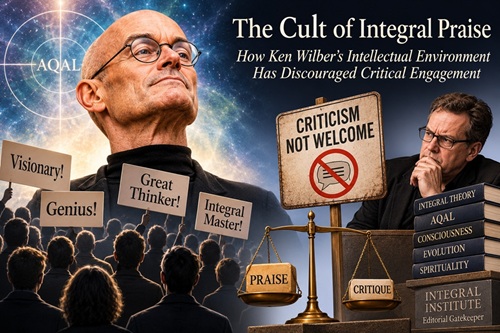 Introduction: When Admiration Becomes an Obstacle to UnderstandingKen Wilber has enjoyed an unusually privileged position in the history of contemporary intellectual and spiritual movements. For several decades, he has been presented by admirers as one of the most important philosophical thinkers of our time: a synthesizer of science and spirituality, East and West, modernity and postmodernity, psychology and metaphysics. His project, Integral Theory, has attracted an international following, inspired institutions, generated conferences, and provided a common intellectual vocabulary for people seeking a comprehensive worldview. Yet there is a peculiar imbalance in this reception. The enormous amount of praise directed at Wilber has not been matched by an equally substantial tradition of critical engagement with his work. His books have been celebrated, his intellectual achievements repeatedly affirmed, and his theoretical innovations often treated as milestones in the evolution of human understanding. Meanwhile, fundamental questions about his arguments, evidence, methodology, and philosophical assumptions have received comparatively little sustained attention within the institutional environment most closely associated with him. This is not simply a matter of Wilber having devoted followers. Every influential intellectual figure attracts admirers, and there is nothing inherently wrong with enthusiasm for an ambitious body of work. The problem arises when admiration becomes the dominant institutional culture, when criticism is treated as an unwelcome intrusion rather than an indispensable contribution, and when the people responsible for communicating and promoting a thinker's ideas also become the informal guardians of his intellectual reputation. The role of Corey DeVos, editor-in-chief associated with the Integral movement's publishing and media environment, deserves particular attention in this connection. The issue is not whether DeVos has personally suppressed particular arguments or whether every editorial decision can be characterized as censorship. It is whether an editorial culture organized around the promotion and preservation of Wilber's intellectual legacy has made genuinely independent criticism less likely to emerge, circulate, and receive serious consideration. The distinction is important. An intellectual movement does not need to prohibit criticism explicitly to become resistant to it. Sometimes it is enough to establish an environment in which praise is welcomed, criticism is politely marginalized, and the prevailing assumptions are rarely subjected to fundamental examination. From Intellectual Community to Reputation ManagementThe institutional history matters here. Integral Institute was established to develop and promote Integral Theory, and its organizational structure placed Wilber at the center of the enterprise. He was not simply one contributor among many. He was its principal intellectual authority, president, and defining philosophical figure. Corey DeVos became an important part of the infrastructure through which Wilber's ideas reached the public. His own Integral Life biography describes him as editor, designer, writer, and producer, responsible for most of the writing, imagery, and media production appearing on the website. He has worked with Integral Life and Wilber since 2003 and has also served as managing editor of KenWilber.com. These are substantial responsibilities. They involve more than correcting manuscripts or preparing interviews. They involve deciding what receives attention, how ideas are presented, which conversations are promoted, and what kind of intellectual atmosphere visitors encounter. This creates an obvious structural conflict of interest. When the principal public communicator of a philosophical movement is also deeply invested in the reputation of its leading thinker, editorial independence becomes difficult to maintain. The editor may be entirely sincere, hardworking, and personally convinced of the value of the project. Nevertheless, the institutional incentives favor continuity, coherence, and favorable presentation rather than adversarial examination. The problem is not that DeVos necessarily makes every editorial decision with the intention of protecting Wilber. It is that the institutional arrangement makes protection of the established intellectual brand a likely consequence, whether consciously intended or not. An editor working for an independent philosophical journal has a different responsibility from an editor working within the communications infrastructure of a movement organized around one central intellectual figure. The former is expected to facilitate disagreement. The latter is naturally encouraged to maintain the movement's identity and appeal. This distinction helps explain why Integral Life has been so effective at communicating Wilber's vision while providing comparatively little space for sustained criticism of its foundations. The Praise EconomyA particular kind of intellectual economy has developed around Wilber. His followers frequently describe him in superlative terms: a great synthesizer, a contemporary philosopher of extraordinary range, a pioneer of a new worldview, or even a thinker whose work represents an evolutionary advance in human consciousness. Such language is not necessarily insincere. Wilber's intellectual ambition is genuine, his reading has been extensive, and his attempt to integrate different fields of knowledge is unusual. His work has helped many people organize otherwise disconnected intellectual and spiritual interests. But praise becomes problematic when it substitutes for evaluation. Consider the recurring claims that Integral Theory provides a comprehensive map of reality, that it transcends and includes earlier philosophical approaches, and that it offers a framework capable of accommodating virtually every significant perspective. These claims should invite difficult questions. Does the framework actually integrate competing theories, or does it simply assign them positions within a hierarchy constructed by Wilber? Are the developmental stages empirically established? Does the AQAL model generate new knowledge, or does it primarily classify knowledge already available? Can its central metaphysical assumptions be independently tested? What would count as evidence that its account of spiritual evolution is mistaken? These are not peripheral questions. They concern the very intellectual legitimacy of the project. Yet the praise economy tends to reverse the burden of proof. Instead of asking Wilber to demonstrate that his synthesis works, critics are sometimes expected to demonstrate that they have understood the entire system before being entitled to question any particular claim. The result is an asymmetrical intellectual relationship. Wilber's admirers can make sweeping claims about the comprehensiveness of his theory, while critics are required to master an enormous theoretical vocabulary before their objections are taken seriously. This is a particularly effective way of discouraging criticism without explicitly prohibiting it. The Immunization of a Theory Against CriticismOne of the most consequential features of Wilber's intellectual architecture is its capacity to accommodate disagreement by assigning it a developmental location. A critic may be accused of operating from an insufficiently developed stage of consciousness, of privileging one quadrant at the expense of others, of confusing levels of development, or of failing to appreciate the comprehensive nature of the AQAL framework. Sometimes such distinctions are useful. People do indeed approach problems from different perspectives, and developmental psychology has legitimate applications. But when these categories become automatic responses to criticism, they function as intellectual immunization mechanisms. Instead of examining whether a criticism is correct, one can explain why the critic is supposedly unable to appreciate the larger picture. This creates a self-sealing structure: agreement confirms the theory's validity, while disagreement can be interpreted as evidence of the dissenter's limitations. There is a particularly uncomfortable irony here. A theory that claims to transcend ethnocentrism, egocentrism, and other forms of developmental limitation can itself become the object of an unusually strong group identification. The more comprehensive the theory claims to be, the easier it becomes to regard outsiders as people who simply have not yet reached the appropriate level of understanding. This is precisely where an editorial gatekeeping culture can become consequential. If the public face of the movement repeatedly presents Wilber's ideas as the culmination of intellectual and spiritual development, rather than as a set of propositions requiring continuing evaluation, the audience is gradually trained to admire the system instead of interrogating it. The Missing Corrective CommunityA major problem with Wilber's intellectual position has been the absence of a sufficiently independent corrective community. In the sciences, influential researchers are embedded in networks of specialists who can challenge their methods, replicate their findings, identify mistakes, and propose alternative explanations. Even the most distinguished scientists are expected to submit their claims to scrutiny by people who have no particular interest in preserving their reputations. Philosophy has a comparable, although different, corrective tradition. Arguments are examined, conceptual distinctions are challenged, and competing interpretations are developed. Reputation alone does not settle a philosophical dispute. Wilber has operated in a rather different environment. His extraordinary range of interests has allowed him to move between psychology, evolutionary biology, philosophy, religious studies, sociology, and metaphysics. Yet expertise across these fields cannot simply be assumed because someone has read extensively in all of them. A comprehensive theory requires more, not less, disciplinary accountability. I have argued elsewhere that Wilber's treatment of evolutionary science illustrates this problem particularly clearly. His appeal to Eros as a fundamental evolutionary force is not merely a controversial interpretation of scientific findings. It introduces a metaphysical explanatory principle without providing an independently established mechanism or the kind of evidence that would distinguish it from competing explanations. The question is not whether Wilber is entitled to entertain metaphysical ideas. Of course he is. The question is whether those ideas should be presented as explanatory achievements without meeting the standards appropriate to the domains in which they are applied. An independent corrective community would insist on precisely this distinction. Instead, much of the Integral environment has been characterized by an unusual combination of theoretical ambition and limited disciplinary accountability. The system is presented as extraordinarily comprehensive, while its most controversial assumptions are not always subjected to equally comprehensive examination. The Critics Were There, But Where Were They Heard?It would be historically inaccurate to suggest that Wilber has never been criticized. There is a substantial critical literature, both academic and independent. Daryl Paulson's 2007 article, Wilber's Integral Philosophy: A Summary and Critique, identified problems including the tendency of Wilber's framework to absorb other thinkers into its own architecture and his sometimes polemical treatment of intellectual opponents. Transpersonal psychologists and philosophers have questioned his developmental psychology, his treatment of spirituality, his account of evolution, and his handling of alternative theoretical approaches. Some of these debates were particularly active during the 1990s, including the discussions published in ReVision. Research into the reception of Wilber's work has also noted that critics sometimes found his responses cursory or defensive, rather than sustained engagements with the specific arguments presented. And then there is Integral World, which I established in 1997 as an independent forum for critical discussion of Wilber's philosophy. Its extensive archive demonstrates that serious criticism has existed throughout the development of the Integral movement. But the existence of criticism is not the same as its integration into the intellectual life of a movement. The relevant question is not whether critical essays can be found somewhere on the internet. It is whether the institutions that promote Integral Theory actively engage with them, discuss them, answer their arguments, and allow them to influence the development of the theory. Here the record is much less impressive. An independent website can publish hundreds of critical essays, but if the movement's own channels rarely acknowledge them, the criticism remains peripheral to the community it addresses. That is how an intellectual echo chamber can emerge without anyone having to formally establish one. An Early Warning: The Devil's Advocate Who Wasn'tThere is an especially revealing episode in my own history with Integral Institute. At one point, Wilber invited me to serve as the European Devil's Advocate for the newly established organization. Among my responsibilities was supposedly to identify occasions when Integral Institute was becoming "less than integral." I was also asked to collect online criticism of Wilber's work for the projected Kindred Visions book. I accepted these responsibilities in good faith. In retrospect, the arrangement was revealing. The institution recognized that criticism was necessary, at least in principle. It even appointed someone to facilitate it. But what happens when the person responsible for bringing criticism into an organization discovers that the organization is not genuinely interested in being challenged? The Devil's Advocate role is meaningful only when the organization is prepared to listen to inconvenient arguments. Otherwise, it becomes a decorative appointment, providing the appearance of openness without its substance. My subsequent experience led me to develop Integral World as an independent platform, precisely because critical engagement needed a space outside the institutional orbit of Wilber and his immediate collaborators. This was not an abandonment of Integral Theory as a subject of study. It was a recognition that a movement cannot be expected to provide the most reliable forum for examining its own foundational assumptions. Corey DeVos and the Politics of Intellectual AccessIt would be unfair to make Corey DeVos personally responsible for every shortcoming of the Integral movement. He has performed an important editorial and communicative function, and his work has undoubtedly helped maintain the visibility of Wilber's ideas. Nor should we assume that every critical contribution must be published on Integral Life. No publication is obliged to give equal space to every possible opinion. Nevertheless, the question of editorial responsibility cannot be avoided. DeVos occupies a strategically important position between Wilber and his audience. He helps determine how Wilber's work is introduced, contextualized, discussed, and promoted. His editorial activities therefore have consequences beyond the presentation of individual articles or interviews. A particularly important distinction needs to be made between three activities:
The first two activities have been highly visible within the Integral institutional environment. The third has been much less central. The danger is that an editor becomes so identified with the success of the project that criticism is experienced as a threat to the project itself. This is not necessarily a personal failing. It is an institutional problem. It occurs whenever the distinction between intellectual stewardship and intellectual advocacy becomes blurred. A genuinely independent editor should occasionally publish contributions that make the movement uncomfortable, including arguments that challenge its most cherished assumptions. The willingness to do so is a test of intellectual confidence. The Consequences for Integral TheoryWhat has this culture of praise and limited internal criticism actually cost the Integral movement? First, it has encouraged theoretical stagnation. A theory that is continually celebrated but insufficiently challenged has little incentive to revise its weakest components. Concepts such as Eros, Spirit-in-action, developmental hierarchies, and the supposedly universal structures of consciousness can remain in circulation long after their explanatory limitations have become apparent. Second, it has confused comprehensiveness with explanatory power. Wilber's AQAL framework is impressive as an organizing map. It offers a vocabulary for discussing subjective, objective, individual, and collective dimensions of reality. But a map that can accommodate virtually everything does not necessarily explain anything particularly well. A theory should not be judged by how many perspectives it can classify, but by what it can demonstrate, explain, predict, or clarify that competing approaches cannot. Third, it has weakened the movement's intellectual credibility outside its own community. Scholars working in established disciplines are unlikely to accept a comprehensive theory merely because its followers consider it an extraordinary synthesis. They want to see specific arguments, reliable evidence, methodological transparency, and engagement with competing research. The Integral movement has sometimes appeared more interested in communicating the significance of its own framework than in demonstrating its value to skeptical outsiders. Fourth, it has discouraged intellectual independence among followers. When a movement revolves around one exceptionally authoritative thinker, followers can become reluctant to question the foundations of the system. They may spend more time learning the correct Integral vocabulary than developing independent criteria for evaluating its claims. This is especially ironic for a philosophy that emphasizes autonomy, perspective-taking, and the transcendence of conventional thinking. A genuinely integral intellectual culture should encourage people to outgrow their dependence on Wilber, not deepen it. A Necessary Counterpoint: Integral World Is Not Above Criticism EitherThere is an important qualification. An independent critical platform is not automatically a superior intellectual institution. Integral World has published contributions of varying quality, and its lack of formal peer review has been a legitimate subject of criticism. Mark Forman and Sean Esbjörn-Hargens, for example, have challenged the scholarly standards and occasionally polemical tone of material published there. That criticism deserves consideration. Not every essay critical of Wilber is necessarily correct, and criticism should be judged by the quality of its arguments rather than by its opposition to a particular thinker. Indeed, I would welcome a serious examination of Integral World's own assumptions, editorial choices, and argumentative standards. But there is an essential difference between an independent platform that can be criticized from the outside and an institutional environment in which the central intellectual figure is also the principal source of authority. Integral World does not require Wilber to validate its existence. Integral Life, by contrast, is inseparable from the intellectual identity and public legacy of Wilber. That difference matters. The solution is not to replace a culture of Integral admiration with a culture of automatic Integral rejection. It is to establish standards of criticism that apply equally to Wilber, his followers, and his opponents. Conclusion: The Price of Too Much AdmirationKen Wilber's intellectual career presents an interesting paradox. He developed a philosophy that claims to transcend and include competing perspectives, yet the institutional culture surrounding his work has not always demonstrated an equivalent willingness to include serious criticism of its own foundations. His admirers have celebrated his intellectual achievements, his extraordinary synthesis, and his contribution to contemporary spirituality. But admiration has too often taken the place of independent evaluation. Corey DeVos's long-standing editorial position illustrates how this imbalance can become institutionalized. When the principal public communicator of a movement is also deeply embedded in the reputation management of its leading thinker, the boundary between presenting ideas and protecting their authority becomes difficult to maintain. This does not require malicious intentions, deliberate censorship, or a conspiracy. It is a predictable consequence of an institutional structure in which intellectual loyalty and editorial responsibility are closely intertwined. The ultimate casualty is not necessarily Wilber's personal reputation. It is the development of Integral Theory itself. A philosophy that is never seriously challenged eventually becomes an orthodoxy. Its concepts turn into accepted vocabulary, its assumptions into unquestioned premises, and its founder into an authority whose pronouncements are interpreted rather than independently evaluated. That is a peculiar fate for a movement that claims to represent an evolution beyond conventional thinking. Perhaps the most important question is therefore not whether Ken Wilber deserves the enormous praise he has received. Some of his contributions certainly deserve recognition. The question is whether his work deserves the extraordinary degree of intellectual protection it has enjoyed. No thinker should be praised to the point where criticism becomes almost superfluous. And no philosophy that claims to embrace the whole of reality should be afraid of examining its own limitations. Integral Theory needs less reverence and more research, fewer celebrations of its founder and more independent investigation of his claims. In the end, the greatest service Wilber's followers could render him would be to stop treating him as an intellectual authority who needs defending and start treating him as a philosopher whose work must stand or fall on its arguments. That would be a genuinely integral achievement. Editorial note: The argument here concerns institutional incentives, editorial centralization, and the observable imbalance between promotion and critical engagement. It does not establish that Corey DeVos personally censored particular critics or deliberately excluded specific submissions. That stronger allegation would require documentary evidence. The structural criticism, however, stands independently of such an allegation. Comment Form is loading comments...
|