|
TRANSLATE THIS ARTICLE
Integral World: Exploring Theories of Everything
An independent forum for a critical discussion of the integral philosophy of Ken Wilber
  Frank Visser, graduated as a psychologist of culture and religion, founded IntegralWorld in 1997. He worked as production manager for various publishing houses and as service manager for various internet companies and lives in Amsterdam. Books: Ken Wilber: Thought as Passion (SUNY, 2003), and The Corona Conspiracy: Combatting Disinformation about the Coronavirus (Kindle, 2020). Frank Visser, graduated as a psychologist of culture and religion, founded IntegralWorld in 1997. He worked as production manager for various publishing houses and as service manager for various internet companies and lives in Amsterdam. Books: Ken Wilber: Thought as Passion (SUNY, 2003), and The Corona Conspiracy: Combatting Disinformation about the Coronavirus (Kindle, 2020).
Check out my other conversations with ChatGPT
On My Wilber Criticism:
Three Ways of Responding to Criticism The Forgotten Virtue of Criticism The Accusation of Scientism 20 Years of Criticizing Ken Wilber Beyond DefensivenessThree Ways of Responding to CriticismAn Integral Reflection on the Reception of Wilber CriticismFrank Visser / ChatGPT
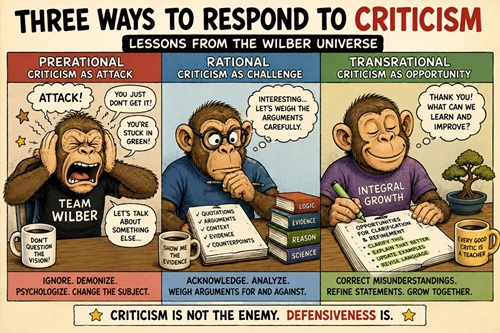
Criticism does not only reveal the strengths and weaknesses of an argument. It also reveals the developmental stance of those responding to it. Over the years, reactions to my critiques of Ken Wilber's work have fallen into remarkably consistent patterns. These patterns can themselves be understood using an integral framework—though perhaps not in the way Wilber intended. Ironically, one can distinguish three broad modes of response that correspond roughly to prerational, rational, and transrational ways of engaging criticism. The crucial difference lies not in what people conclude, but how they reach those conclusions. The Prerational Response: Criticism as AttackThe least productive response is to experience criticism as a personal or tribal attack. In this mode, the actual arguments are scarcely examined. Instead, the focus shifts immediately to the presumed motives or psychological state of the critic. The critic must be resentful, egotistical, spiritually immature, or somehow emotionally wounded. Alternatively, the discussion is redirected toward unrelated issues or simply ignored altogether. Typical reactions include: "You just don't understand Wilber." "You're stuck in green." "This is an ego reaction." "Why are you so obsessed with Ken?" Notice what is missing: engagement with the substance of the criticism. This is not unique to the integral community. Political movements, religions, scientific schools, and ideological tribes all exhibit similar defensive reflexes. Social psychologists call this identity-protective cognition: when ideas become intertwined with personal identity, criticism feels like an attack on oneself. Ironically, this response is itself rather prerational—not because it lacks intelligence, but because emotion and group loyalty override critical examination. The Rational Response: Criticism as ChallengeA rational attitude treats criticism differently. Here criticism is neither automatically accepted nor automatically rejected. Instead it becomes a hypothesis requiring evaluation. Questions become: Is the quotation accurate? Does the criticism fairly represent Wilber's position? Are there counterexamples? Does the evidence support the conclusion? Agreement is possible. Disagreement is equally possible. But either way, the conclusion follows from weighing evidence rather than defending identity. This is the normal procedure of science, philosophy, and scholarship. Every claim remains open to examination. Many readers—both admirers and critics of Wilber—respond this way. They may conclude that my criticism succeeds only partially, or that it misses important context. Such disagreements are intellectually valuable because they engage the actual arguments. The Transrational Response: Criticism as OpportunityA genuinely transrational response goes one step further. Instead of merely asking whether criticism is correct, it asks what can be learned from it—even if the criticism ultimately proves mistaken. Suppose a critic misunderstands a concept. Rather than dismissing the misunderstanding, one asks: Why was this misunderstanding possible? Perhaps the original presentation was ambiguous. Perhaps terminology has shifted over time. Perhaps an important distinction was never made explicit. Perhaps the theory itself has evolved. Criticism thus becomes an opportunity for clarification and refinement. Scientific theories develop precisely through this process. Philosophers revise arguments after objections. Good teachers rewrite explanations after students become confused. In this sense, criticism becomes a gift. Not because every criticism is valid. But because every serious criticism reveals where communication or reasoning can improve. An Unexpected Test of Integral TheoryThis creates an interesting paradox. Integral Theory often celebrates perspective-taking, developmental growth, shadow work, and the transcendence of egoic defensiveness. One might therefore expect an integral community to welcome serious criticism as an opportunity for greater integration. Yet this has often not been my experience. Too frequently, criticisms of Wilber's cosmology, evolution, epistemology, or use of science are interpreted primarily as attacks on Wilber himself—or on the integral movement more broadly. The irony is difficult to miss. A philosophy dedicated to integrating multiple perspectives can itself become resistant to perspectives that challenge its central assumptions. Criticism as a Developmental MirrorPerhaps criticism functions as a developmental mirror. How we respond to criticism reveals more than what we think. It reveals how tightly our identity is attached to our beliefs. If criticism automatically becomes hostility, identity has fused with doctrine. If criticism becomes an intellectual puzzle, rational inquiry is operating. If criticism becomes a chance to improve one's own understanding, something genuinely post-defensive has emerged. This applies equally to critics themselves. Critics can become dogmatic. Skeptics can become ideological. Scientists can become tribal. Nobody is immune. The question is not whether one criticizes or defends. The question is whether one remains genuinely open to learning. Applying This to WilberMy own criticisms of Wilber have always aimed at the rational level. I have argued that his claims about evolution, cosmology, consciousness, and science should be evaluated using the same standards we apply to any other intellectual system. Sometimes I conclude that Wilber is insightful; sometimes I conclude that he overstates his case or ventures beyond the available evidence. The most rewarding exchanges have been with readers who engage those arguments directly. The least productive have been those who respond primarily by questioning motives or assigning developmental diagnoses. The most valuable, however, are rare but memorable: those who accept criticism as an invitation to sharpen concepts, clarify language, and improve understanding. Even when they disagree with my conclusions, the discussion advances. Toward a More Integral ConversationPerhaps the most integral response to criticism is not agreement, nor even respectful disagreement. It is curiosity. What exactly is being claimed? Could the critic have identified a genuine weakness? Could the theory be stated more clearly? Could both parties be partly right? Such questions require intellectual confidence rather than ideological certainty. A mature worldview should not fear criticism. It should welcome it as an indispensable instrument of self-correction. If Integral Theory aspires to be an evolving metatheory rather than a finished worldview, then criticism is not an enemy of the project. It is one of its essential conditions. The measure of a philosophy is not how well it protects itself from criticism, but how well it grows because of it. Appendix: Am I Falling into Wilber's Own Developmental Trap?This is perhaps the most important objection to the argument presented above. After all, haven't I spent years criticizing Ken Wilber for explaining away criticism by assigning his opponents to lower developmental stages? If I now classify responses to my own work as "prerational," "rational," and "transrational," am I not committing exactly the same mistake? The short answer is: only if developmental labels are used to invalidate arguments rather than describe modes of argumentation. That distinction is crucial. Wilber has often interpreted disagreement through the lens of developmental psychology. Critics are said to be operating from "green," "flatland," "aperspectival madness," or some other stage that supposedly explains why they cannot appreciate Integral Theory. The developmental diagnosis frequently precedes—or even replaces—a careful engagement with the criticism itself. The implication is that if one were sufficiently developed, one would naturally agree with Wilber. That is the pattern I have criticized. My proposed distinction aims at something different. I am not classifying people but responses. The same individual may react defensively in one discussion, analytically in another, and constructively in a third. These are not permanent developmental identities but recognizable styles of engaging criticism. More importantly, my framework is behavioral rather than psychological. It focuses on what can be publicly observed. If someone ignores the evidence, attacks motives, or changes the subject, that is a defensive response regardless of their IQ, education, meditation experience, or presumed developmental altitude. If someone carefully examines quotations, weighs competing interpretations, and offers counterarguments, that is a rational response regardless of whether they identify as integral, scientific, religious, or skeptical. And if someone uses criticism to clarify concepts, acknowledge ambiguities, or improve a theory, that is a genuinely constructive response regardless of where they supposedly sit on some developmental ladder. In other words, the categories describe epistemic behavior, not levels of consciousness. There remains, however, a legitimate danger. Even behavioral categories can become rhetorical weapons. One can easily dismiss an opponent by saying, "That's just a prerational response," instead of explaining precisely why their reasoning is flawed. The labels themselves can become shortcuts that bypass the hard work of argument. If that happens, I would indeed be repeating the very error I criticize. Perhaps the safest approach is therefore to treat these three categories not as developmental diagnoses but as ideals of discourse. They describe ways conversations can unfold, not types of people. Each of us—including critics of Wilber—moves among them depending on the topic, our emotional investment, and the circumstances. The real test is simple. Can the classification itself be questioned? Can someone argue that a supposedly "prerational" response was actually reasonable under the circumstances? Can my own framework be criticized without the critic automatically being assigned to a lower category? If the answer is yes, then the framework remains open to revision and dialogue. If the answer is no, it has become just another self-sealing belief system. That, ultimately, is the difference between using developmental ideas as heuristic tools and using them as instruments of intellectual immunity. The former invites discussion; the latter ends it.
Widget is loading comments...
|