|
TRANSLATE THIS ARTICLE
Integral World: Exploring Theories of Everything
An independent forum for a critical discussion of the integral philosophy of Ken Wilber
  Frank Visser, graduated as a psychologist of culture and religion, founded IntegralWorld in 1997. He worked as production manager for various publishing houses and as service manager for various internet companies and lives in Amsterdam. Books: Ken Wilber: Thought as Passion (SUNY, 2003), and The Corona Conspiracy: Combatting Disinformation about the Coronavirus (Kindle, 2020). Frank Visser, graduated as a psychologist of culture and religion, founded IntegralWorld in 1997. He worked as production manager for various publishing houses and as service manager for various internet companies and lives in Amsterdam. Books: Ken Wilber: Thought as Passion (SUNY, 2003), and The Corona Conspiracy: Combatting Disinformation about the Coronavirus (Kindle, 2020).
Check out my other conversations with ChatGPT
On Criticism: Three Ways of Responding to Criticism The Forgotten Virtue of Criticism The Accusation of Scientism The Accusation of ScientismThree Case Studies in the Integral Escape RouteFrank Visser / ChatGPT
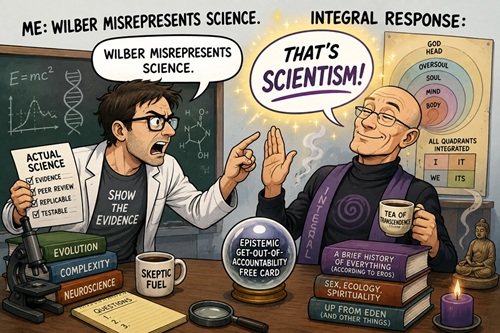
There is a curious argumentative pattern that appears repeatedly in discussions of Integral Theory. A critic points to a specific scientific claim made by Ken Wilber and argues that it is inaccurate, outdated, exaggerated, or simply unsupported. Instead of addressing the scientific criticism, an integral defender replies: “That's scientism.” This is rhetorically effective because “scientism” is already a loaded term in integral discourse. It immediately places the critic in the camp of reductionism, materialism, “flatland,” or supposedly naïve modernity. But it does not answer the criticism. The easiest way to see this is to examine actual examples. Three are particularly revealing: evolutionary biology, complexity and self-organization, and neuroscience and consciousness. The pattern is remarkably consistent. Wilber begins with a legitimate scientific observation, contrasts it with a simplified version of mainstream science, and then introduces an additional metaphysical principle—Eros, Spirit, interiority, or some related concept—as the missing explanation. The problem is not that he engages metaphysics. He is perfectly entitled to do that. The problem arises when a metaphysical conclusion is presented as if it follows from a scientific deficiency—and when criticism of that move is then dismissed as “scientism.” 1. Evolution: “Chance” versus ErosPerhaps the clearest example occurs in Wilber's treatment of Darwinian evolution. In A Brief History of Everything, Wilber repeatedly frames the issue as a conflict between chance and Spirit. He writes: “Something other than chance is pushing the universe.” He continues: “Chance is not what explains the universe; in fact, chance is what that universe is laboring mightily to overcome.” And he calls this “the self-transcending drive of the Kosmos.” The rhetoric is powerful. The problem is the implied alternative. The choice is apparently between: chance and Eros. But evolutionary biology never offered “chance” as the complete explanation of evolution. This is the first important correction. Mutation can involve stochastic processes. Genetic drift is stochastic. Recombination generates variation. But natural selection is not simply chance. Selection is differential reproduction according to heritable variation in particular environments. Developmental processes constrain what variations are possible. Organisms interact with environments. Ecological dynamics matter. Gene-culture coevolution matters. Niche construction matters. Population structure matters. And contemporary evolutionary biology is considerably richer than the caricature “random mutation plus chance.” Indeed, Wilber's own later formulation makes the problem particularly obvious. In correspondence quoted by Visser, he described the alternatives as “mere chance mutation and natural selection” and argued that there is a “force of self-organization built into the universe” responsible for at least part of the emergence of complex forms. That is not a scientific argument. It is a metaphysical argument based on a scientifically questionable characterization of the alternatives. The wing problemWilber illustrates his point with complex biological structures such as wings. He famously uses the image of a wing requiring a large number of coordinated mutations and suggests that chance mutation and selection alone cannot adequately explain such complexity. But this is not how evolutionary biology explains complex adaptations. Evolution does not require a fully formed wing to appear by simultaneous mutation. Structures can change function. Existing structures can be co-opted. Selection can act incrementally. Developmental architecture constrains variation. Gene regulatory networks matter. Intermediate structures can have different functions from the later structures they contribute to. The question “What good is half a wing?” is therefore misleading because evolutionary history does not require the intermediate structure to have been “half a wing” in the modern functional sense. This is a substantive scientific criticism. Calling it “scientism” does not make it disappear. The Kauffman complicationWilber also invokes Stuart Kauffman and complexity theory as support for his argument. This is interesting because Kauffman's work genuinely does challenge simplistic versions of an exclusively selectionist picture of evolution. His The Origins of Order explicitly investigates the relationship between self-organization and natural selection. But this actually makes Wilber's argument more—not less—problematic. Kauffman's scientific claim is not: “Evolution is driven by a metaphysical cosmic force called Eros.” It is that biological order can arise through lawful processes of self-organization and that selection operates upon structures generated within such dynamical systems. That is a scientific research program. Wilber takes a legitimate scientific phenomenon and asks us to interpret it as evidence for a cosmic evolutionary principle. That is a different proposition. The scientific discovery does not automatically entail the metaphysical interpretation. 2. Complexity: from self-organization to cosmic ErosThis brings us to the second case. Self-organization is real. That is not controversial. Complex systems can generate macroscopic order through local interactions without a central controller. Examples occur throughout physics, chemistry, biology and other sciences. Contemporary complexity research explicitly studies how global organization can emerge from interactions among components. But “self-organization occurs” is not equivalent to: “therefore the universe possesses a universal drive toward greater complexity.” That is the crucial inferential gap. Wilber frequently treats self-organization as if it were evidence for an intrinsic evolutionary tendency. In correspondence, he calls Eros “a force of self-organization” and describes it as an intrinsic force responsible for the emergence of complex forms. Elsewhere he has described Eros as the force through which the Kosmos “self-transcends.” But notice what has happened. Self-organization originally names a class of processes. Wilber turns it into a cosmic principle. Then that cosmic principle is invoked to explain why complexification occurs. The argument becomes: Complexity occurs. Self-organization helps explain some of it. Therefore self-organization is an intrinsic cosmic drive. Therefore that drive is Eros. Therefore Eros explains evolution. The conclusion has been smuggled into the premises. Description is not explanationThis distinction is essential. Suppose a chemical system spontaneously forms an ordered structure. We can investigate the thermodynamic conditions, molecular interactions, energy flows, feedback mechanisms and dynamical constraints that produce the pattern. Calling this “self-organization” is useful because it identifies a class of phenomena. But saying “the system has a drive toward organization” adds something different. What is the drive? What mechanism implements it? Under what conditions does it operate? What predictions does it make? How could we distinguish its operation from the known physical mechanisms? If there are no answers, “drive” is functioning as a metaphor. And if it is merely a metaphor, it cannot simultaneously be presented as the missing causal explanation for evolution. This is precisely where Wilber's language becomes slippery. Eros can appear to be a metaphor when challenged, a scientific principle when science is being discussed, and a metaphysical reality when the larger integral cosmology is being defended. Those are three different epistemic statuses. They should not be conflated. The chemistry testConsider a deliberately simple example. Hydrogen and oxygen form water under appropriate conditions. We could say: “Hydrogen and oxygen have an intrinsic drive toward water.” But this would explain nothing. The actual explanation concerns the properties and interactions of the atoms and molecules involved. Calling the result a “drive toward water” merely redescribes the outcome. The same problem arises with cosmic Eros. If Eros means “whatever causes matter and life to become increasingly organized,” then Eros simply means the phenomenon we are trying to explain. It is not an independent explanation. This is why the scientific status of self-organization matters. Scientific self-organization is not one mysterious universal force. It is a family of phenomena arising under specific dynamical conditions. Contemporary research treats it in terms of interactions, feedback, nonlinear dynamics, constraints, energy flows and system organization. Nothing in those findings establishes a cosmic intention toward Spirit. That additional step belongs to metaphysics. And metaphysics is perfectly legitimate—but it must be identified as metaphysics. 3. Neuroscience: correlation, reductionism and the hard problemThe third example concerns consciousness. Here Wilber's criticism of reductionism has considerably more legitimacy. Neuroscience studies consciousness through its relations to brain activity, neural systems, cognition and behavior. Wilber objects that consciousness cannot simply be identified with a third-person description of neural activity. In Integral Psychology, he writes: “The materialist reduces the mind to the brain.” He then describes the reduction of the Left-Hand domains to the Right-Hand domains as the characteristic error of modern reductionism. Again, there is an important point here. A neural correlate of consciousness is not automatically an explanation of subjective experience. Finding that a particular brain process reliably accompanies an experience does not, by itself, explain why that process is accompanied by phenomenal experience at all. This is a legitimate philosophical problem. But now the integral maneuver becomes visible. Wilber correctly identifies an explanatory problem and then treats the existence of that problem as support for his own four-quadrant ontology. That does not follow. The gap is not a solutionThere is a simple logical distinction: Science has not yet explained consciousness completely. Therefore: Wilber's explanation of consciousness is correct. That inference is invalid. The failure of one explanation does not establish another explanation. This is sometimes called an argument from ignorance: “We do not know X; therefore Y.” But the situation is even subtler here. There are actually several possibilities: • Consciousness may eventually be explained in physical terms. • Consciousness may require a non-reductive physicalist theory. • Consciousness may be an emergent property. • Consciousness may be fundamental. • Some form of panpsychism might be correct. • Some form of idealism might be correct. • A dual-aspect theory might be correct. • Or some presently unimagined theory might be correct. The current explanatory gap does not decide among them. Yet integral discourse sometimes treats the gap itself as if it were evidence for the integral answer. That is where skepticism is entirely appropriate. Wilber's four quadrants don't solve the causal problemWilber's four-quadrant framework usefully distinguishes first-person experience from third-person description, and subjective meaning from objective correlates. But distinguishing two descriptions is not the same thing as explaining their causal relationship. This point was already raised by critics of Wilber's Integral Psychology. Christian de Quincey, for example, argued that the fundamental problem remains the relationship between interiors and exteriors rather than being solved simply by distributing phenomena across quadrants. The four quadrants tell us: “Don't forget the interior.” Fine. But they do not tell us: “How does an interior experience causally arise from, interact with, or constrain a neural process?” That remains the difficult question. And if Wilber answers that question by appealing to a pre-existing cosmic consciousness, he has not derived that consciousness from neuroscience. He has imported it from his metaphysics. Again, that is allowed. But it must be acknowledged. The asymmetryThere is an important asymmetry running through all three cases. When science succeeds, Wilber is happy to incorporate the findings into Integral Theory. When science leaves a question unresolved, the unresolved question is sometimes treated as evidence that the integral metaphysical framework is required. But those two moves are not equivalent. • Scientific success does not prove Integral Theory. • Scientific incompleteness does not prove Integral Theory either. In other words: • Science does not need to be complete for Integral Theory to be wrong. • And science does not need to be incomplete for Integral Theory to be right. Each integral claim must stand on its own evidential and philosophical merits. That is the standard that prevents “God of the gaps” reasoning from becoming “Eros of the gaps.” And now comes “scientism”This brings us back to the original exchange. The critic says: “Wilber's description of evolutionary biology is inaccurate.” The defender responds: “That's scientism.” But what exactly has been demonstrated? Nothing. • The critic has not claimed that science is the only source of knowledge. • The critic has not denied the legitimacy of philosophy. • The critic has not denied the value of contemplative experience. • The critic has not claimed that subjective experience is unreal. The critic has made a narrower claim: “You are not accurately describing this scientific discipline.” That claim requires a scientific response. • If Wilber says evolutionary biology is essentially “chance plus selection,” show that this is an accurate characterization. • If Wilber says self-organization constitutes a cosmic force, show the evidence. • If Wilber says neuroscience reduces consciousness to brain chemistry, establish that this is what contemporary neuroscience actually claims. • If Wilber says Eros is scientifically necessary, identify its independent empirical predictions. Simply calling the critic a “scientist” or “materialist” accomplishes none of these things. From Scientific Critique to Metaphysical ImmunizationThis is where the problem becomes more serious. A philosophical framework can become effectively immune to criticism if every empirical objection is reclassified as evidence of the critic's supposedly inadequate worldview. Consider the pattern: Science says X. Integral Theory says X is incomplete. Critic: “But your account of X is scientifically inaccurate.” Response: “You are trapped in scientism.” Now the integral theory has become strangely insulated. • If science agrees with it, science is cited as confirmation. • If science disagrees with it, science is accused of reductionism. • If science has not decided the question, the uncertainty is presented as evidence for the integral position. This creates an epistemic heads-I-win, tails-you-lose structure. It is not necessarily conscious manipulation. It can arise quite naturally within a comprehensive worldview. But the effect is the same: the framework becomes difficult to falsify because contrary evidence is reinterpreted as evidence of the limitations of the evidential system itself. That is metaphysical immunization. And it is precisely the kind of reasoning that integral theorists should be especially wary of, because Integral Theory explicitly presents itself as a framework capable of integrating multiple perspectives. Integration requires permeability. A theory that can absorb confirmation but reinterpret criticism as evidence of the critic's lower perspective is not really integrating criticism. It is immunizing itself against it. The proper division of laborThere is a much healthier way to conduct the discussion. • Science tells us what the empirical evidence supports. • Philosophy asks what that evidence means, what its presuppositions are, and what conceptual conclusions may legitimately be drawn from it. • Phenomenology investigates lived experience. • Contemplative traditions provide particular forms of disciplined first-person inquiry. • Metaphysics asks what kind of reality could make sense of all these domains. There is nothing scientistic about respecting those distinctions. Indeed, they are necessary if the domains are ever genuinely to be integrated. The real enemy of integral thought is therefore not science. It is epistemic sloppiness. If Wilber wants to say: “Science describes evolutionary mechanisms, but I interpret the overall pattern of evolution metaphysically as Eros,” that is a perfectly intelligible philosophical position. If he wants to say: “Neuroscience identifies brain correlates of consciousness, but I don't believe those correlations exhaust the ontology of consciousness,” again, that is a legitimate philosophical position. But those claims should not be inflated into: “Science itself demonstrates Eros.” Nor should scientific criticism of the argument be dismissed as scientism. The distinction is simple but fundamental: Science can be incomplete without being wrong. A scientific explanation can be incomplete without being reductionistic. A metaphysical interpretation can be legitimate without being scientific. And most importantly: The existence of a scientific limitation is not evidence for whatever metaphysical theory happens to fill the gap. That is the fallacy hidden behind the seemingly sophisticated retort: “That's scientism.” Sometimes it isn't. Sometimes it is simply someone asking you to get your science right.
Widget is loading comments...
|