|
TRANSLATE THIS ARTICLE
Integral World: Exploring Theories of Everything
An independent forum for a critical discussion of the integral philosophy of Ken Wilber
  Frank Visser, graduated as a psychologist of culture and religion, founded IntegralWorld in 1997. He worked as production manager for various publishing houses and as service manager for various internet companies and lives in Amsterdam. Books: Ken Wilber: Thought as Passion (SUNY, 2003), and The Corona Conspiracy: Combatting Disinformation about the Coronavirus (Kindle, 2020). Frank Visser, graduated as a psychologist of culture and religion, founded IntegralWorld in 1997. He worked as production manager for various publishing houses and as service manager for various internet companies and lives in Amsterdam. Books: Ken Wilber: Thought as Passion (SUNY, 2003), and The Corona Conspiracy: Combatting Disinformation about the Coronavirus (Kindle, 2020).
Check out my other conversations with ChatGPT
On My Wilber Criticism:
Three Ways of Responding to Criticism The Forgotten Virtue of Criticism The Accusation of Scientism 20 Years of Criticizing Ken Wilber The Forgotten Virtue of CriticismMark Edwards' Early Plea for an Integral Culture of Open InquiryFrank Visser / ChatGPT
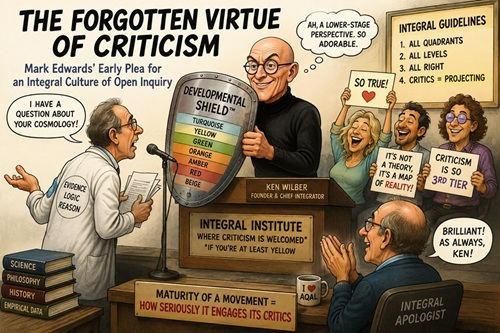
In the history of the Integral movement, some essays become famous because they defend Ken Wilber. Others become famous because they attack him. Much rarer are essays that attempt something more difficult: to defend the movement itself by defending the role of criticism. Mark Edwards' 2006 essay, "On Being Critical" (2006), belongs firmly in that category. Looking back twenty years later, it reads almost like a constitutional document for an Integral intellectual culture that never quite came into existence. Edwards argued that criticism was not an unfortunate necessity to be tolerated, nor an attack on Integral Theory to be resisted, but an indispensable ingredient of any serious intellectual enterprise. At a time when Wilber's critics were increasingly being dismissed as psychologically deficient or developmentally incapable of understanding higher truths, Edwards quietly but firmly defended the simple proposition that ideas must be evaluated on their merits. Ironically, subsequent developments within the Integral community would demonstrate just how necessary his warning had been. The Context: Integral at Its ZenithWhen Edwards wrote his essay, the Integral movement appeared to be reaching its high point. Ken Wilber had published A Theory of Everything and Sex, Ecology, Spirituality, Integral Institute was flourishing, and AQAL ("All Quadrants, All Levels") was being presented as a comprehensive metatheory capable of integrating virtually every field of knowledge. With growing influence came growing criticism. Philosophers questioned Wilber's treatment of postmodernism, scientists challenged his understanding of evolution and cosmology, religious scholars disputed his interpretation of mystical traditions, and former supporters raised concerns about his increasingly sweeping metaphysical claims. Unfortunately, many of these criticisms were not answered by engaging their substance. Instead, critics were often characterized as operating from "lower stages" of development, trapped in "green meme pluralism," or acting from unresolved psychological shadow material. The implication was that disagreement revealed more about the critic than about the argument. It was precisely this atmosphere that Edwards addressed. Understanding Before CriticizingOne of Edwards' first principles is borrowed from Bertrand Russell: before criticizing a philosophical system, one should first understand it sympathetically. This remains an excellent scholarly standard. Serious criticism requires intellectual empathy. One should reconstruct a thinker's strongest arguments before attempting to refute them. But Edwards immediately adds the equally important second half of the equation. Sympathy is not submission. Understanding does not eliminate the need for criticism; rather, it makes criticism more accurate and therefore more valuable. This balanced approach is surprisingly rare. Too much criticism without understanding degenerates into caricature. Too much admiration without criticism degenerates into apologetics. Integral Theory, Edwards argued, deserved neither. Criticism Is Not Personal AttackAnother central theme of the essay is the distinction between criticizing ideas and criticizing persons. Edwards notes that it is entirely possible to admire Wilber's enormous accomplishments while questioning specific aspects of AQAL. Scientific theories, philosophical systems, and religious traditions all advance through continuous criticism. No theory becomes stronger by declaring itself beyond criticism. Yet this distinction gradually became blurred within much of the Integral community. Criticism of particular claims was increasingly interpreted as hostility toward Wilber himself. One ceased to be someone raising objections and instead became labeled "a Wilber critic," almost as if criticism were an identity rather than an intellectual activity. This personalization of disagreement made genuine dialogue increasingly difficult. Why Integral Needs CriticsPerhaps Edwards' strongest argument is that criticism is already built into the very idea of Integral Theory. AQAL presents itself as an integration of previous schools of thought. But every integration necessarily involves evaluation. One cannot integrate Freud, Piaget, Habermas, Nagarjuna, Whitehead, and modern physics without critically assessing each tradition's strengths and limitations. If Integral Theory claims the right to evaluate every other discipline, then every other discipline has an equal right to evaluate Integral Theory. This principle seems almost self-evident. Yet in practice, many Integral discussions developed an asymmetry: AQAL was permitted to critique science, philosophy, religion, and psychology, while criticism directed toward AQAL itself was often interpreted as evidence that the critic simply did not understand the framework. Edwards recognized that such asymmetry undermines the very spirit of integration. The Problem with Developmental DismissalsThe most important section of Edwards' essay concerns the use of developmental theory itself. Wilber frequently interpreted disagreement in terms of developmental altitude. Certain criticisms were said to arise because the critic lacked access to higher stages of consciousness. While developmental psychology undoubtedly offers valuable insights into human cognition, Edwards argued that it should never become a substitute for argument. His reasons remain compelling. Developmental assessment is notoriously uncertain. Individuals rarely function consistently from a single stage across all areas of life. Expertise in a specialized discipline often matters far more than generalized developmental estimates. A biologist may identify errors in evolutionary theory regardless of spiritual development, just as a historian may uncover factual mistakes without sharing Wilber's mystical worldview. Most importantly, logical arguments stand or fall on their evidence, not on psychological speculation about the person presenting them. This point has aged remarkably well. Twenty Years LaterWith hindsight, Edwards' essay now appears almost prophetic. Many of the controversies that later surrounded Wilber revolved around exactly the issues Edwards identified. Critics of Wilber's treatment of Darwinian evolution, thermodynamics, neuroscience, cosmology, and comparative religion often found themselves confronted not with detailed rebuttals but with suggestions that they lacked sufficient developmental altitude to appreciate Integral insights. The discussion shifted from evidence to psychology. One could summarize the difference in a single sentence: Instead of asking whether the criticism was correct, discussions increasingly asked what developmental level the critic occupied. Edwards had warned against precisely this tendency. A Missed OpportunityThere is, however, an interesting limitation to Edwards' own essay. He accepts most of Wilber's overall framework. His concern is not whether AQAL is fundamentally correct but whether criticism should be welcomed within it. In other words, his argument is procedural rather than epistemological. History suggests that this procedural reform never fully occurred. Rather than developing into an intellectual community characterized by vigorous internal debate and peer review, much of the organized Integral movement evolved toward greater protection of Wilber's authority. Loyalty frequently became more visible than skepticism. Internal criticism became relatively rare, while external critics were increasingly portrayed as misunderstanding Integral rather than contributing to its refinement. Ironically, Edwards himself later shifted his attention toward organizational theory and integral sociology, leaving this early plea for open criticism as one of his most significant contributions to Integral discourse. The Lesson That Still MattersToday, On Being Critical deserves to be rediscovered. It reminds us that criticism is not the enemy of integration but one of its essential conditions. Every mature intellectual tradition—science, philosophy, and even religion—develops mechanisms through which its central ideas can be questioned, revised, and occasionally abandoned. Without those mechanisms, theories gradually become insulated from correction. Perhaps the greatest irony is that Edwards wrote his essay out of loyalty to the Integral project. He believed criticism could make Integral stronger. Whether the movement ultimately embraced that lesson is another question. Looking back from 2026, one might conclude that Edwards envisioned an Integral culture in which criticism would function as a developmental resource. Instead, much of the movement came to treat criticism itself as a developmental diagnosis. That subtle shift—from evaluating arguments to evaluating arguers—may explain more about the trajectory of the Integral movement than almost any single theoretical disagreement.
Widget is loading comments...
|