|
TRANSLATE THIS ARTICLE
Integral World: Exploring Theories of Everything
An independent forum for a critical discussion of the integral philosophy of Ken Wilber
  Frank Visser, graduated as a psychologist of culture and religion, founded IntegralWorld in 1997. He worked as production manager for various publishing houses and as service manager for various internet companies and lives in Amsterdam. Books: Ken Wilber: Thought as Passion (SUNY, 2003), and The Corona Conspiracy: Combatting Disinformation about the Coronavirus (Kindle, 2020).
Check out my other conversations with ChatGPT
Theism, Atheism and Beyond?:
Dawkins vs. McGrath The Varieties of Atheism The Return of Theism Integral Spirituality Anatheism: A Third Way Religion Without Religion The Religion of Tomorrow The Religion of TomorrowKen Wilber's Post-Metaphysical Promise and Its Unresolved ContradictionsFrank Visser / ChatGPT
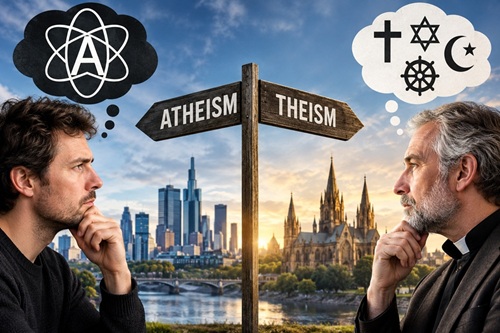 Introduction: Religion After Religion?Ken Wilber has spent much of his intellectual career attempting to reconcile the seemingly irreconcilable: modern science and ancient wisdom, evolutionary theory and spiritual development, empirical knowledge and contemplative experience, secular modernity and religious tradition. His vision of the future of religion is an ambitious expression of this integrative impulse. Rather than asking humanity to return to traditional faith, Wilber proposes that religion itself must evolve, incorporating the achievements of modernity and postmodernity while recovering dimensions of existence that secular rationalism has allegedly forgotten. The result is what might be called a religion of tomorrow: a spirituality that no longer depends on premodern cosmologies, supernatural interventions, or unquestioned dogmas, but that preserves the transformative insights of the world's contemplative traditions. It would be developmental rather than static, experiential rather than merely doctrinal, and integral rather than sectarian. It would recognize that human beings can grow not only in knowledge and moral understanding but also in consciousness itself. There is something genuinely attractive about this project. Traditional religions face a credibility crisis in scientifically educated societies, while secular worldviews often struggle to satisfy people's longing for meaning, belonging, ethical direction, and existential depth. Wilber promises to move beyond this apparent opposition. Religion need not surrender its deepest insights to science, he argues, and science need not remain blind to the interior dimensions of human existence. But the central question is whether Wilber has actually discovered a viable religion for the future, or whether he has constructed an elaborate philosophical framework that allows religious convictions to survive by changing their vocabulary. The difficulty is not that Wilber takes spirituality seriously. It is that his proposed reconciliation of science, religion, and human development repeatedly depends on assumptions that his integral framework does not independently establish. A religion of tomorrow cannot become credible merely by describing itself as more evolved than the religions of yesterday. 1. The Fourth Turning: Updating the Great TraditionsWilber's 2017 book, The Religion of Tomorrow: A Vision for the Future of the Great Traditions, presents his mature attempt to formulate this project. Its central argument is that the world's major religions must incorporate discoveries made since their foundational teachings emerged, particularly in science, psychology, and developmental research. Otherwise, they risk remaining trapped in worldviews that modern people can no longer accept. Wilber calls for a further turning of the spiritual wheel, extending the traditional Buddhist idea of successive turnings of the Dharma. This new turning would preserve the contemplative core of religion while revising its inherited explanations of reality. Buddhism is his principal example, although he envisions comparable transformations within Christianity, Islam, Hinduism, and Judaism. The proposal makes intuitive sense. Why should religious traditions retain ancient cosmologies when astronomy has transformed our understanding of the universe? Why should they ignore evolutionary biology, modern psychology, or the historical development of their own scriptures? Why should meditation be treated as an alternative to psychological knowledge rather than as a practice that can benefit from it? Yet the proposal contains a fundamental ambiguity. What, exactly, is the core of religion that must be preserved while its historical accretions are discarded? Wilber's answer centers on awakening to the true nature of ourselves and the universe. But this is not a religiously neutral starting point. It assumes that the contemplative traditions have discovered something fundamental about reality, something that survives the historical criticism of their doctrines and the scientific correction of their cosmologies. That assumption requires argument. The fact that religious traditions contain sophisticated practices of attention, self-examination, and contemplative discipline does not establish that their ultimate metaphysical interpretations are true. Meditation may reveal important facts about consciousness without revealing the ultimate nature of the universe. Wilber risks moving too quickly from the defensible proposition that contemplative practices can teach us something about experience to the much stronger proposition that they disclose a universal spiritual reality. 2. Waking Up, Growing Up, Cleaning Up, and Showing UpThe practical architecture of Wilber's religion of tomorrow is summarized by four imperatives: waking up, growing up, cleaning up, and showing up. The framework is intended to correct the one-sidedness of religious systems that emphasize mystical realization while neglecting psychological maturity, or that cultivate ethical and social development while ignoring contemplative experience. Waking up refers to contemplative states and experiences, including the dissolution of the ordinary sense of self. Growing up refers to developmental stages, from relatively egocentric perspectives toward increasingly inclusive forms of understanding. Cleaning up means confronting psychological shadow material: repressed emotions, defensive habits, unresolved conflicts, and self-deception. Showing up concerns the integration of these processes into embodied, interpersonal, cultural, and social life. This is one of the strongest elements of Wilber's proposal. Spiritual experience is not a guarantee of psychological health. Someone can have profound meditative experiences while remaining narcissistic, prejudiced, emotionally immature, or politically irresponsible. Likewise, a person can become scientifically sophisticated without acquiring wisdom, compassion, or a stable sense of purpose. The four imperatives provide a useful reminder that human development is multidimensional. But the usefulness of a framework does not establish the truth of the metaphysics in which it is embedded. We can endorse psychological integration, contemplative practice, moral development, and social responsibility without accepting Wilber's account of Spirit, nonduality, or the evolutionary significance of mystical realization. Indeed, a secular humanist could embrace all four imperatives while interpreting them in entirely naturalistic terms. Waking up might involve changes in attention and self-representation; growing up could be understood through developmental psychology; cleaning up through psychotherapy; and showing up through ethical action and civic engagement. What, then, does Wilber's integral interpretation add that these approaches cannot supply on their own? His answer is that they must be integrated into a more comprehensive account of consciousness and reality. But this returns us to the question that the four imperatives themselves cannot settle: whether a spiritual interpretation of human development is necessary to explain the phenomena involved. 3. The Problem of Developmental ElitismWilber's vision depends heavily on developmental hierarchies. Human beings do not merely acquire different beliefs, he argues; they develop through increasingly complex structures of consciousness. Religious worldviews can therefore be interpreted as expressions of different developmental stages. A traditional believer may interpret scripture literally, a modern believer may reinterpret it symbolically, and a more developed believer may understand its deepest meaning as a direct disclosure of nondual awareness. This model has an obvious attraction. It offers a way to explain religious diversity without treating all religious claims as equally valid. It also explains why a tradition might need reinterpretation as its adherents acquire new knowledge and more inclusive moral perspectives. However, it carries a serious danger: the tendency to turn disagreement into a diagnosis of developmental inferiority. If Wilber's interpretation of reality is correct, those who reject it may be judged to occupy an earlier developmental stage. Their objections can then be explained away as evidence of their limitations rather than evaluated on their merits. This creates an epistemic problem. A critic might argue that a particular spiritual claim lacks evidence. The integral response can become that the critic is trapped in a narrowly rational or materialistic worldview and has not developed the capacities necessary to appreciate the claim. But developmental maturity and factual correctness are different things. A sophisticated person can be mistaken, and a person with relatively conventional beliefs can make a correct empirical observation. No developmental stage exempts its inhabitants from the need to provide evidence. Nor should every disagreement about spirituality be interpreted as a conflict between levels of consciousness. People can disagree because they have different experiences, different philosophical commitments, or different assessments of the available evidence. A credible religion of tomorrow would have to demonstrate that its developmental categories are empirically well-founded, reliably distinguishable, and relevant to the truth of the religious claims being assessed. Otherwise, the hierarchy risks functioning as a sophisticated system of intellectual status rather than as a genuinely explanatory psychology. The future of religion cannot simply be reserved for those who agree with Wilber. 4. Can Mystical Experience Establish Metaphysical Truth?At the heart of Wilber's project lies the distinction between the temporary states of consciousness associated with contemplative practice and the developmental structures through which people interpret those states. A person may experience an extraordinary state of unity without necessarily possessing the developmental maturity to understand it adequately. Wilber therefore argues that spiritual realization must be considered alongside the developmental stage of the person experiencing it. This distinction is valuable. Experiences do not interpret themselves. The same experience of ego dissolution might be understood as union with God, realization of emptiness, an encounter with universal consciousness, or a temporary alteration of ordinary self-processing. The experience and its interpretation are not identical. But this distinction also exposes a problem for Wilber's universal spiritual claims. If the meaning of an experience depends partly on the conceptual and cultural framework through which it is interpreted, how can we determine that one interpretation reveals reality more accurately than another? Wilber tends to privilege interpretations that converge on nonduality: the realization that the apparent division between subject and object is not ultimately fundamental. Yet the experience of nonduality, however compelling, does not by itself establish that reality as a whole is nondual in the metaphysical sense. There is a difference between experiencing the disappearance of a boundary and proving that the boundary never existed independently of that experience. Consider an ordinary example. During intense musical absorption, the distinction between the listener and the music may seem to disappear. That can be a genuine and significant experience. But it does not follow that the listener, the music, and the physical world are ultimately manifestations of a single spiritual reality. The same caution applies to meditation. Contemplative practice can reveal the constructed, fluid, or unstable character of our ordinary sense of self. It may disclose dimensions of experience that everyday consciousness overlooks. But moving from these findings to claims about the ultimate nature of existence requires additional reasoning and evidence. Wilber's religion of tomorrow risks treating the depth of an experience as evidence for the truth of its preferred interpretation. The proper conclusion is more modest: mystical experiences deserve serious investigation, but their metaphysical implications remain open to philosophical and scientific scrutiny. 5. Post-Metaphysical Spirituality: Has Metaphysics Really Disappeared?Wilber has long sought to develop a post-metaphysical spirituality: one that avoids simply reinstating premodern claims about supernatural realms while preserving the insights of contemplative traditions. In The Religion of Tomorrow, the project is presented in a more qualified form, sometimes described as a minimalist metaphysics rather than the complete abandonment of metaphysical commitments. This qualification is important, because Wilber's system continues to make substantial claims about the nature and development of reality. There is a developmental trajectory to the cosmos, a spectrum of consciousness, an ultimate nondual reality, and a relationship between contemplative realization and the deepest nature of existence. Even when these claims are framed in terms of experience or perspective rather than supernatural substances, they remain philosophically consequential. Calling a claim post-metaphysical does not make it non-metaphysical. Suppose someone argues that Spirit is not a supernatural entity but the nondual ground of all experience. The terminology has changed, but the question remains: what justifies the claim that such a ground exists, and what distinguishes it from a naturalistic account of consciousness? Wilber can reasonably respond that his approach draws on contemplative practice rather than on speculative theology alone. But contemplative practice is not a shortcut around the need to distinguish what is experienced from what is inferred. The problem becomes particularly acute when Wilber treats spiritual development as part of a larger evolutionary process. If evolution is interpreted as the progressive manifestation of deeper spiritual possibilities, the integral framework is no longer simply organizing empirical findings. It is assigning them a metaphysical direction. Biological evolution does not, by itself, establish a cosmic drive toward spiritual realization. The emergence of increasingly complex forms of life under certain conditions does not prove that the universe is ultimately oriented toward consciousness, enlightenment, or Spirit. These may be philosophical or religious interpretations of evolution, but they are not conclusions that evolutionary biology requires. A religion of tomorrow should be explicit about this distinction. It should identify where established knowledge ends and speculative interpretation begins, rather than presenting the latter as the deepest meaning of the former. 6. The Appropriation of ScienceWilber's project is particularly ambitious in its effort to integrate scientific knowledge. He argues that religious traditions must incorporate modern discoveries about the brain, emotions, human development, and the social world if they are to remain credible. This is a sensible demand. The difficulty lies in deciding what counts as integration. One possibility is that religious traditions revise their claims in light of scientific discoveries. Ancient accounts of the cosmos are corrected, supernatural explanations are abandoned where natural explanations suffice, and psychological practices are evaluated for their actual effects. Another possibility is that scientific findings are incorporated into a pre-existing spiritual framework without requiring the framework itself to undergo comparable scrutiny. Wilber's integral approach is vulnerable to the second tendency. Its four quadrants and developmental categories can accommodate a wide variety of findings, but accommodation is not the same as confirmation. A framework that can reinterpret almost any observation in its own terms may be comprehensive without being strongly explanatory. For example, neuroscience can investigate the neural correlates of meditation, changes in attention, emotional regulation, and the sense of self. Such research may establish that contemplative practices have significant effects on cognition and well-being. It does not automatically establish that meditation reveals a transpersonal or universal consciousness. Similarly, developmental psychology can investigate changes in moral reasoning, perspective-taking, cognitive complexity, and identity. But it does not automatically validate every stage hierarchy proposed by integral theorists. The key question is whether the integral model generates clear predictions that competing models do not, and whether those predictions survive empirical testing. If Wilber's framework is to function as more than an interpretive vocabulary, it must be possible to discover that some of its claims are wrong. Its categories must be sufficiently precise to permit disagreement with evidence to count against them. Otherwise, science supplies the prestige while integral theory supplies the conclusions. 7. The Problem of Religious PluralismWilber's future religion is not intended to replace the world's great traditions with a single new institution. He envisages Christianity, Buddhism, Hinduism, Islam, and other traditions incorporating integral insights into their respective practices. His publisher describes the project as a way to preserve their spiritual aims while updating their understanding of human nature and development. This is more flexible than conventional religious universalism. It allows traditions to retain their distinctive identities while learning from one another. Yet a deeper difficulty remains. These traditions do not merely differ in ritual, mythology, or cultural expression. They also make competing claims about reality. Classical theism affirms a personal creator God. Some forms of Buddhism reject a permanent self and do not require a creator. Advaita Vedanta interprets ultimate reality in terms of Brahman. Other Buddhist traditions emphasize emptiness, dependent origination, or the absence of intrinsic existence. These positions cannot all be literally true in the same sense without further qualification. Wilber's integral interpretation often resolves such conflicts by treating religious teachings as expressions of different developmental levels or perspectives. A mythic conception of God may be understood as a less differentiated expression of a truth that becomes more adequate when interpreted nondually. But this strategy risks imposing Wilber's own philosophical preferences on traditions whose adherents may reject his hierarchy. It also raises the question of whether the integral interpretation is genuinely preserving their teachings or selectively reconstructing them. Pluralism is not achieved merely by declaring that every tradition contains a partial truth. Sometimes traditions disagree because their central claims are incompatible. A genuinely integrative approach must explain how such conflicts are resolved, which claims are retained, which are rejected, and why. It cannot simply assume that every contradiction disappears at a higher level. 8. The Missing Secular AlternativePerhaps the most important limitation of Wilber's vision is its assumption that modern societies suffer from a deficit of spiritual realization. Wilber argues that secular modernity has made substantial advances in scientific knowledge, psychological understanding, and social organization, yet remains deficient in waking up to the deepest nature of consciousness. The future of religion must therefore recover a dimension of human development that modern and postmodern worldviews have neglected. There is a legitimate question here. Scientific knowledge does not automatically provide meaning, emotional maturity, moral wisdom, or existential fulfillment. Technological progress does not guarantee a humane society. But why should the answer be religious? A secular worldview can take meaning, morality, psychological transformation, and contemplative practice seriously without interpreting them as manifestations of an ultimate spiritual reality. Human beings can develop richer forms of self-understanding, cultivate compassion, confront their psychological defenses, and participate in communities of shared purpose without believing that the universe possesses a spiritual ground. Consider mindfulness practices in contemporary clinical psychology. These can be investigated and used without requiring participants to accept Buddhist cosmology, much less Wilber's integral metaphysics. Similarly, psychotherapy can promote self-knowledge and emotional integration without framing psychological growth as participation in a cosmic evolutionary process. Secular humanism can also provide ethical commitments grounded in human flourishing, reciprocity, freedom, and the reduction of suffering. These commitments need not be regarded as spiritually inferior merely because they do not rest on claims about ultimate consciousness. The real challenge for Wilber is therefore not to demonstrate that secular worldviews are incomplete in some abstract sense. It is to show that his specifically spiritual interpretation explains something important that secular alternatives cannot adequately explain. Without that demonstration, the religion of tomorrow risks confusing the need for meaning with the need for metaphysics. 9. What Would Count as Success?Wilber's vision is ambitious enough that it should be judged by demanding standards. It is not enough for integral spirituality to be intellectually attractive, to encompass many traditions, or to offer a vocabulary in which practitioners can describe transformative experiences. A successful religion of tomorrow would need to demonstrate that its practices produce identifiable benefits, that its developmental models are empirically defensible, and that its claims about consciousness are not merely restatements of its initial assumptions. It would also need a clear account of failure. What evidence would lead its proponents to revise their developmental hierarchies? What findings would count against a proposed relationship between mystical experience and metaphysical truth? How would the integral approach distinguish a genuine spiritual insight from an emotionally powerful but mistaken interpretation? These are not hostile questions. They are the questions any framework deserves when it seeks to combine science, psychology, and religion. The same standards should apply to claims about the universality of contemplative insights. If different traditions produce experiences that seem similar, we should investigate their common features while remaining open to differences in interpretation, practice, and cultural context. Similar experiences do not automatically imply a single underlying metaphysical reality. And if integral spirituality claims to promote moral maturity, its own institutions and communities should be evaluated by ordinary ethical standards. No level of consciousness, spiritual attainment, or philosophical sophistication should exempt anyone from accountability. The future of religion should be less concerned with certifying higher stages and more concerned with developing practices and institutions that withstand scrutiny. 10. Spiritual Alpinism: Climbing Wilber's Mountain of Mystical StagesOne of the most revealing features of Wilber's religion of tomorrow is what might be called his spiritual alpinism: the idea that mystical experience is not a single, undifferentiated phenomenon but a succession of increasingly advanced states and stages of realization. Spirituality becomes a mountain to be climbed, with distinct elevations, progressively more encompassing vistas, and a summit associated with nondual awareness. The metaphor captures something important. Human consciousness is not fixed. Meditation and other contemplative disciplines can produce different kinds of experience, and practitioners may acquire skills and insights through sustained training. It would be naïve to assume that a beginner's brief meditation and a seasoned contemplative's decades of practice are necessarily equivalent in every respect. Wilber's model, however, goes considerably further than acknowledging differences in experience and expertise. He attempts to map mystical development onto a comprehensive spectrum of consciousness, distinguishing gross, subtle, causal, and nondual states and relating these to more enduring developmental structures. In his broader integral framework, these states can be interpreted through a hierarchy of increasing spiritual realization, with nondual awareness occupying a privileged position. This produces an intriguing synthesis of contemplative traditions, but it also creates a problem. What justifies the assumption that these experiences form a single, universally applicable ladder? And who has established that the summit Wilber identifies is the summit toward which all serious contemplative practice should aspire? The world's mystical traditions do not offer one uncontested map. Advaita Vedanta, Buddhist traditions, Christian mysticism, Sufi practice, and contemporary meditation movements differ in their descriptions of ultimate realization, their methods of cultivation, and their interpretations of what practitioners experience. Some accounts emphasize union with God; others stress emptiness, the cessation of identification with the self, or the recognition that no independently existing self can be found. These descriptions may exhibit family resemblances, but their differences cannot simply be erased by placing them at different elevations on a Wilberian mountain. The mountain metaphor can therefore conceal a major interpretive decision. Wilber does not merely describe a diversity of mystical experiences; he organizes them within a framework that determines in advance which realizations are more advanced and which are less complete. Traditions that affirm a personal God, for example, may be interpreted as expressing a less comprehensive realization than nondual spirituality. The hierarchy thus risks reproducing Wilber's own philosophical preferences under the appearance of a neutral map of consciousness. The Wilber-Combs lattice: Everyone can have a peak experience, but not everyone interprets it alikeThere is an important qualification to this critique. Wilber does not simply claim that everyone must climb the same ladder before experiencing anything spiritually significant. His Wilber-Combs lattice distinguishes temporary states of consciousness from enduring structures of development. People at different developmental stages can experience similar altered states, but they may interpret those experiences differently according to their existing worldviews. This is a more sophisticated position than a straightforward spiritual ranking system. A person with conventional religious beliefs might experience a vision of Christ, while a more pluralistic person might interpret a similar experience symbolically. Both experiences may be meaningful, even if their interpretations differ. But the lattice does not resolve the underlying problem. It explains how Wilber understands differences in interpretation; it does not independently establish that his developmental categories are correct or that his preferred interpretation is closest to the truth. Indeed, the model can become difficult to challenge. If someone accepts Wilber's account, that acceptance may be interpreted as evidence of developmental maturity. If someone rejects it, the rejection can be attributed to the limitations of their developmental stage. The theory risks becoming self-confirming. A stronger approach would compare Wilber's classifications with competing models of contemplative development, examine whether different researchers can reliably identify the proposed stages, and test claims about their psychological consequences. The lattice is a potentially useful hypothesis, not a demonstrated map of the ultimate structure of consciousness. The summit problem: Who says nonduality is the highest peak?The most consequential assumption in Wilber's spiritual alpinism is that nondual realization represents the most comprehensive spiritual attainment. In this interpretation, the distinction between the inner witness and the world witnessed eventually dissolves into a realization of emptiness and form as inseparable aspects of reality. That may be a profound experience. But three separate claims must be distinguished: that people can undergo experiences described as nondual; that these experiences can produce lasting psychological changes; and that they disclose the ultimate nature of reality. The first two claims are open to empirical investigation. The third requires additional philosophical argument. Wilber's hierarchy tends to connect all three. The summit of contemplative experience becomes the summit of spiritual development, and the summit of spiritual development becomes a privileged vantage point from which reality itself is understood. Yet an experience of unity does not establish that the universe is fundamentally one in the relevant metaphysical sense. Nor does a feeling of absolute certainty guarantee that one's interpretation is correct. The history of religion contains many incompatible claims to ultimate realization, each supported by practitioners who regard their own insights as decisive. Why should Wilber's preferred synthesis settle the matter? The mountain metaphor also invites an unfortunate confusion between spiritual attainment and human worth. A contemplative may be highly skilled at entering unusual states of consciousness without being especially wise in practical affairs. Someone who has never experienced mystical absorption may nonetheless display extraordinary courage, compassion, intellectual honesty, and moral judgment. There is no reason to assume that every valuable human capacity must culminate in the same spiritual summit. Wilber's own emphasis on cleaning up and showing up implicitly acknowledges this problem. Spiritual experiences do not guarantee psychological integration or ethical maturity. But once those qualifications are taken seriously, the claim that mystical stages form the decisive hierarchy of human development becomes less compelling. Perhaps the most important achievement is not reaching the highest peak but learning to live responsibly, think clearly, and treat other people well. Conclusion: The Future May Be Post-ReligiousKen Wilber's The Religion of Tomorrow is an important attempt to rescue the transformative possibilities of religion from the conflict between traditional dogma and modern skepticism. Its insistence that contemplative practice, psychological integration, developmental understanding, and social engagement belong together deserves serious consideration. Wilber is right that religion cannot simply ignore modern knowledge. He is also right that scientific sophistication does not guarantee wisdom, and that mystical experience alone does not ensure psychological maturity. His four imperatives offer a useful framework for thinking about human development across several dimensions. But his proposed solution remains insufficiently justified at its most consequential points. The existence of contemplative experiences does not establish the metaphysical claims attached to them. Developmental hierarchies do not guarantee the truth of the worldviews associated with higher stages. The inclusion of scientific knowledge does not automatically validate an integral interpretation of reality. And the fact that traditional religions need updating does not establish that they should converge on Wilber's account of nonduality and spiritual evolution. The decisive question is whether Wilber has shown that spirituality is indispensable to a comprehensive understanding of human life, or whether he has constructed an encompassing system that interprets human life in spiritual terms. These are not the same achievement. Perhaps the religion of tomorrow will emerge through the transformation of existing traditions. Perhaps it will take the form of new contemplative communities, post-theistic spiritual practices, or secular institutions that cultivate meaning and psychological depth. Perhaps many people will continue to draw selectively on religious traditions without accepting their metaphysical commitments. None of these futures requires the triumph of integral theory. The most promising elements of Wilber's proposal may even survive the abandonment of its grander metaphysical claims. We can wake up to the workings of consciousness, grow in understanding, clean up our psychological difficulties, and show up in the world without believing that these processes reveal the universe's ultimate spiritual purpose. A religion of tomorrow worthy of the name would have to welcome that possibility rather than treat it as a developmental deficiency. The future of religion should not be decided in advance by a theory that claims to know the direction of human evolution. It should emerge from an open encounter between experience, evidence, philosophical argument, and the many ways human beings make sense of their lives. And perhaps the most radical possibility is that humanity will preserve what is valuable in religion while discovering that it no longer needs religion to explain why those things matter.
Widget is loading comments...
|