|
TRANSLATE THIS ARTICLE
Integral World: Exploring Theories of Everything
An independent forum for a critical discussion of the integral philosophy of Ken Wilber
  Frank Visser, graduated as a psychologist of culture and religion, founded IntegralWorld in 1997. He worked as production manager for various publishing houses and as service manager for various internet companies and lives in Amsterdam. Books: Ken Wilber: Thought as Passion (SUNY, 2003), and The Corona Conspiracy: Combatting Disinformation about the Coronavirus (Kindle, 2020).
Check out my other conversations with ChatGPT
Theism, Atheism and Beyond?:
Dawkins vs. McGrath The Varieties of Atheism The Return of Theism Integral Spirituality Anatheism: A Third Way Religion Without Religion The Religion of Tomorrow Richard Dawkins vs. Alister McGrathWhen Atheism Meets TheologyFrank Visser / ChatGPT
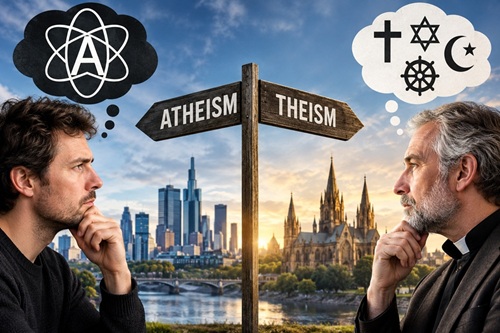
The debate that exposed the limits of both sidesThe confrontation between evolutionary biologist Richard Dawkins and Christian theologian Alister McGrath became one of the defining intellectual encounters of the New Atheism era. Their disagreement was ostensibly about the existence of God, but it also concerned the authority of science, the rationality of religious belief, the historical record of Christianity, and the social consequences of faith. The two men made an intriguing pairing. Dawkins, author of The Selfish Gene and The God Delusion, approached religion as a biologist convinced that natural explanations had progressively displaced supernatural ones. McGrath, a former atheist with a background in molecular biophysics who became a Christian theologian, challenged Dawkins on scientific, philosophical, and theological grounds. Their best-known extended filmed encounter was recorded for the television project The Root of All Evil? but was left out of the final programme. The approximately 70-minute discussion subsequently circulated independently. They also met publicly at the Oxford Literary Festival in March 2007. The central weakness of their exchanges was not that one man was obviously right and the other obviously wrong. It was that they repeatedly approached different questions, operated with different standards of justification, and too often allowed the rhetoric of the culture war to substitute for a more rigorous examination of what their respective positions actually required. Dawkins was right to demand evidence for extraordinary claims. McGrath was right to challenge the tendency to treat religion as an intellectually uniform phenomenon that could be dismissed with a few evolutionary explanations. Yet neither achievement settles the question at the heart of their dispute: whether the universe, human consciousness, or the existence of moral and religious experience provides good reason to believe in a divine reality. To understand the debate properly, we need to separate the issues that popular presentations of the controversy tend to bundle together. 1. Dawkins's strongest argument: What explains God?Dawkins's central scientific intuition is straightforward. Natural phenomena that once appeared to require supernatural explanations have increasingly become intelligible through natural processes. Evolution by natural selection is his exemplary case. The apparent design of living organisms, once treated as evidence for a designer, can be explained through cumulative selection acting on heritable variation. This is a powerful argument against invoking a designer whenever nature appears complicated. Biological complexity does not, by itself, establish the existence of an intelligent creator. Darwin's achievement was to show how the appearance of design could emerge without foresight or intention. Dawkins extends this explanatory strategy into a broader criticism of theism. If a creator designed a universe containing extraordinarily complex life, what explains the creator? A God capable of producing such complexity would appear to require an explanation at least as demanding as the thing God was introduced to explain. The question is devastating against a simplistic argument that complexity must always originate in a more complex intelligence. It also exposes a genuine difficulty for religious explanations that invoke God as a stopping point without explaining why that stopping point is justified. But Dawkins's argument has a limitation. Classical theism does not ordinarily define God as a particularly complicated object within the universe. It defines God as a necessary being, the ground of existence, or the ultimate explanation of contingent reality. One may reject these concepts, but simply asking who designed God does not refute them on their own terms. That does not mean classical theism has solved the problem. Declaring God necessary does not establish that such a being exists. Theologians still owe us an argument for why the concept is coherent, why the universe requires the proposed explanation, and why God is preferable to alternatives that do not invoke a supernatural mind. Dawkins is therefore strongest when he insists that religious explanations must earn their explanatory privileges. He is less convincing when he treats every philosophical conception of God as though it were equivalent to a supernatural engineer constructing organisms or arranging the planets. The distinction matters. A successful critique of the designer God is not automatically a complete refutation of every possible form of theism. But neither does the inadequacy of Dawkins's simplest objections provide positive evidence for a divine reality. 2. McGrath's strongest objection: Science does not disprove every GodMcGrath's principal counterargument is that Dawkins repeatedly overstates what science can establish. Scientific inquiry investigates the natural world, whereas the God of classical Christian theology is not supposed to be one more object inside it. Consequently, the success of scientific explanations does not automatically disprove a creator or a transcendent ground of existence. There is an important point here. Science has no general theorem declaring every possible conception of God impossible. Nor does the absence of a scientific explanation for some phenomenon automatically make a religious explanation irrational. But McGrath's argument risks becoming a defensive manoeuvre. If God is defined so that no conceivable scientific discovery could count against God's existence, then the resulting conception may be compatible with science precisely because it makes no distinctive empirical claims. Compatibility is not confirmation. A God who creates organisms through evolution rather than special creation is compatible with evolutionary biology. A God who operates through the laws of nature rather than intervening miraculously may be compatible with a naturalistic description of events. Yet in both cases the question remains: what evidence distinguishes the theistic interpretation from the non-theistic one? McGrath is right that science cannot simply pronounce on every philosophical question. Dawkins is right that religious claims do not become credible merely by being moved beyond science's reach. The deeper issue is whether theism contributes explanatory knowledge or supplies an interpretation of knowledge already acquired by other means. If two worldviews account equally well for all the available evidence, the believer cannot claim that the evidence uniquely supports the religious one. 3. The God of the gaps—and the God who never makes a differenceThe history of science presents a persistent problem for arguments that infer divine activity from unexplained phenomena. When natural processes are poorly understood, supernatural explanations can appear compelling. As knowledge improves, many such explanations lose their necessity. Dawkins's evolutionary arguments illustrate this pattern particularly well. Natural selection explains how cumulative adaptation can produce intricate biological structures without requiring a conscious designer to anticipate their development. McGrath, however, does not defend biblical creationism. His theistic evolutionism allows him to accept evolutionary biology while maintaining that the evolutionary process ultimately depends on God. This position avoids the obvious conflict between modern evolutionary science and a literal six-day creation. But it also changes the nature of the argument. God is no longer needed to explain the particular biological mechanisms that evolution explains. Instead, God is invoked to explain why there is a universe, why it has intelligible laws, or why anything exists at all. These are legitimate philosophical questions. They are not, however, answered simply by inserting the word God at the end of them. Consider two possible universes. In one, physical reality exists without a creator. In the other, physical reality exists because God sustains it. If both universes exhibit precisely the same observable properties, what would justify choosing the second description? The theist may answer that God explains the existence of the entire system, whereas science merely describes its internal workings. But this claim requires a coherent account of what it means for God to explain existence. Why must existence have an explanation? Why should that explanation be a mind? And why should a divine mind be exempt from the explanatory demands imposed on everything else? The naturalist should not pretend that these questions are trivial. The ultimate origin of physical reality remains a difficult philosophical and scientific problem. But an unanswered question is not evidence for whichever answer one happens to prefer. The crucial distinction is between admitting that we do not know why there is something rather than nothing and claiming that we therefore have reason to believe in God. The first is intellectual honesty. The second requires an additional argument. 4. Does religious experience count as evidence?One of McGrath's more important challenges concerns the limits of Dawkins's treatment of religious belief. Religious experience, personal transformation, a sense of transcendence, and the feeling that life possesses a deeper significance cannot be dismissed merely by labelling them irrational. People genuinely have such experiences. Their psychological reality is not in dispute. The disputed question is what, if anything, these experiences reveal about reality beyond the human mind. Here Dawkins sometimes risks confusing an explanation of belief with a refutation of its content. If evolutionary psychology helps explain why humans detect agency, search for patterns, fear death, or develop religious intuitions, it does not follow that every belief produced by these tendencies is false. Humans also evolved capacities for perception, memory, reasoning, and social understanding. The evolutionary origins of these capacities do not render every product of cognition unreliable. What matters is whether a particular belief-forming process tends to track reality under the relevant conditions. Nevertheless, McGrath faces the corresponding problem. The intensity, sincerity, and transformative power of religious experience do not establish that its supernatural interpretation is correct. People from incompatible religious traditions report profound experiences that seem to confirm their respective beliefs. The experiences may be psychologically genuine while their theological interpretations remain mutually inconsistent. A Christian may interpret a sense of divine presence as an encounter with the Christian God. A Buddhist may understand a related experience in terms of non-self. A naturalist may interpret both through psychology and neuroscience. The experience alone does not decide among these explanations. McGrath is therefore right to resist the reduction of religious experience to mere foolishness. Dawkins is right to ask whether its interpretation has been independently justified. A mature discussion would examine both the experiences and the competing explanations, rather than assuming either that transcendence must be supernatural or that its natural explanation automatically exhausts its meaning. 5. The problem of evil: Where McGrath is on the defensiveThe problem of evil is one of the most serious challenges to traditional Christianity, and it is an area where Dawkins's impatience with theological evasions has considerable force. The world contains immense suffering: childhood cancer, earthquakes, parasitic infections, predation, genetic disease, and the destruction of entire populations by natural disasters. Much of this suffering predates humanity by hundreds of millions of years. It cannot plausibly be attributed to human moral failings alone. Dawkins presses a straightforward question: why would a perfectly good, all-powerful, all-knowing creator produce or permit a world containing such suffering? McGrath can respond that human beings do not possess God's perspective, that suffering may have a place within a larger divine purpose, or that a world governed by stable natural laws necessarily permits painful consequences. These are familiar theodicies, and none should be dismissed without examination. Yet each encounters difficulties. A world governed by stable laws may require the possibility of injury, but it does not obviously require the particular distribution and intensity of suffering found in nature. Evolution produces astonishing complexity, but it also produces systems of reproduction and survival that involve immense pain. An omnipotent God would seemingly possess options unavailable to human engineers. Appealing to human ignorance is logically possible, but it can also become an all-purpose defence. If every apparent contradiction between divine goodness and the observed world is answered by asserting that God's reasons are beyond human understanding, then the claim that God is good becomes difficult to assess. The issue is not whether human beings know everything. It is whether we possess any meaningful basis for attributing perfect goodness to a being whose alleged creation contains so much apparently gratuitous suffering. Dawkins has a strong case here, although the problem is probabilistic rather than a simple deductive disproof of God. The existence of suffering does not establish that no conceivable deity exists. It does place a substantial burden on anyone claiming that the actual world is the work of an omnipotent and perfectly benevolent creator. McGrath's faith may give him resources for living with this problem. It does not follow that those resources solve it intellectually. 6. Does religion cause violence? The limits of Dawkins's indictmentDawkins also attacks religion for its historical association with violence, intolerance, persecution, and terrorism. McGrath counters that religion has inspired compassion, solidarity, moral reform, and social cohesion, while explicitly atheistic political regimes have committed atrocities of their own. His published response to The God Delusion makes this counterargument central. Both points matter, but neither settles the issue. Dawkins is on solid ground when he argues that religious convictions can intensify conflict. When people believe that their moral commands originate with an infallible divine authority, compromise can become more difficult. Religious institutions can sanctify political power, justify persecution, and present historically contingent rules as eternal truths. The belief that one's enemies are not merely mistaken but opposed to God's will can be especially dangerous. Yet the causal story is more complicated than Dawkins's broad indictment sometimes suggests. Religious violence is frequently entangled with nationalism, territorial ambition, ethnic hostility, economic interests, and struggles for political power. Removing religious language would not necessarily eliminate those motives. McGrath is therefore right to reject the suggestion that religion alone explains humanity's capacity for cruelty. The atrocities committed by explicitly anti-religious regimes demonstrate that abandoning religious belief does not automatically produce humane societies. But this defence has a limitation of its own. The fact that atheists have committed atrocities does not absolve religious institutions of responsibility for their own. Nor does pointing to the charitable work of religious communities answer the question of whether particular religious doctrines have encouraged harmful behaviour. The relevant question is not whether religious people are better or worse than atheists in the abstract. It is which beliefs, institutions, and social conditions encourage compassion, intellectual freedom, and peaceful coexistence—and which encourage submission, exclusion, and violence. A religion's capacity to inspire good does not erase its capacity to inspire harm. Conversely, its historical abuses do not demonstrate that every religious practice is harmful. Dawkins's polemic is most useful when it subjects religious authority to the same critical scrutiny as political authority. It is least useful when it suggests that eliminating religion would remove the principal source of human wickedness. Human beings have proved remarkably inventive in finding secular justifications for doing terrible things. 7. The asymmetry of faith and evidenceOne of the most revealing features of the Dawkins-McGrath encounter is their disagreement about faith. Dawkins associates religious faith with accepting claims without adequate evidence, sometimes in defiance of evidence. McGrath argues that this is a caricature of religious belief, which may involve reflection, personal experience, historical judgment, and a considered commitment to a worldview. McGrath's criticism is justified insofar as Dawkins treats religious believers as though they all accept doctrines blindly. Many believers have examined objections to their faith and can articulate sophisticated philosophical positions. Faith is not a single psychological or intellectual phenomenon. But explaining how believers arrive at their convictions is different from demonstrating that those convictions are true. A person can arrive at a belief through thoughtful reflection and still be mistaken. Sincerity, intelligence, education, and intellectual sophistication are not guarantees of accuracy. Nor does the fact that a belief offers comfort or meaning establish its truth. McGrath also raises a familiar objection to atheism: atheists, too, have assumptions and commitments that cannot all be proved from some completely neutral starting point. This is a fair warning against intellectual complacency. Naturalism is not simply a collection of scientific findings; it can also become a broader philosophical worldview. Nevertheless, there is an important difference between acknowledging that all human inquiry begins with assumptions and treating all assumptions as equally justified. Scientific claims are tested against observations, revised when necessary, and judged partly by their predictive and explanatory success. Religious claims vary considerably in how far they expose themselves to comparable scrutiny. An atheist who acknowledges uncertainty about the ultimate nature of reality is not in the same epistemic position as someone who claims certainty about a divine plan while appealing to the unknowability of God's purposes whenever difficulties arise. Dawkins sometimes writes as though the case against religion is more complete than it actually is. But McGrath cannot turn the general fallibility of human knowledge into a special licence for religious belief. The appropriate standard is neither absolute certainty nor indiscriminate scepticism. It is proportioning belief to the quality of the available evidence. 8. Dawkins's rhetorical problem: A polemic is not a proofDespite his scientific credentials, Dawkins is not at his best when he treats religious belief as an intellectual pathology. His writing can be entertaining, provocative, and morally forceful, but ridicule sometimes does work that argument should be doing. Calling God a delusion makes a rhetorical point before the philosophical case has been completed. The label suggests that the conclusion is already known and that the remaining task is to explain why so many people have failed to recognise it. McGrath's criticism of this tendency is one of his strongest contributions. In his discussion of The God Delusion, he objects to Dawkins's sweeping generalisations about religion and his tendency to present disputed claims with more confidence than the evidence warrants. But McGrath's own rhetoric is not always more restrained. Describing Dawkins's work as evidence of atheist insecurity, or suggesting that his polemic reveals an anxiety about the future of atheism, risks substituting psychological speculation for an examination of arguments. This is an especially unhelpful manoeuvre because Dawkins's motives are not what determine whether his conclusions are correct. An angry atheist can make a sound argument; a courteous theologian can make an unsound one. The reverse is equally possible. Both sides would benefit from applying to themselves the standards they demand of their opponents. Dawkins should distinguish between the strongest forms of theism and the weakest forms of religious fundamentalism. McGrath should distinguish between a criticism of religious belief and a simplistic rejection of every religious person as irrational. The debate would become more productive if both men spent less time diagnosing each other's intellectual shortcomings and more time identifying exactly which propositions were at issue. 9. What the debate leaves unansweredThe fundamental problem is that neither participant can establish his entire worldview simply by exposing weaknesses in the other. Dawkins's evolutionary account of biological complexity does not by itself explain why the universe exists, whether consciousness can be fully explained in physical terms, or how moral values should be understood. None of these questions automatically points toward God, but neither can they be dismissed merely by invoking natural selection. McGrath's Christian interpretation of the universe faces the opposite challenge. The fact that science does not disprove every possible God does not establish the Christian God. Nor does the historical existence of Jesus, the enduring appeal of Christianity, or the transformative power of religious experience establish the truth of the resurrection, divine revelation, or a supernatural plan for humanity. The two men are often arguing at different levels. Dawkins asks for evidence that a supernatural entity exists. McGrath sometimes responds by arguing that science cannot exclude every transcendent interpretation of reality. But the inability to exclude a possibility is not the same as evidence for it. Imagine that someone claims an invisible intelligence sustains every physical process but never produces any observable difference from what would occur without that intelligence. The claim may be logically compatible with the world, depending on how it is formulated. But what would justify believing it? The answer cannot simply be that science has limits. Every human discipline has limits, and the existence of an unanswered question does not establish a preferred answer. A more constructive debate would examine the actual explanatory advantages of theism. Does it generate independently testable expectations? Does it explain something that competing accounts cannot explain? Does it provide a coherent account of consciousness, morality, or existence that survives comparison with naturalistic alternatives? And how should those alleged advantages be weighed against the problem of evil and the diversity of incompatible religious claims? These are difficult questions. They deserve more than a contest between confident disbelief and sophisticated faith. 10. Beyond the New Atheism versus Christianity culture warThe Dawkins-McGrath controversy belongs to a period when religious belief and militant atheism were often presented as the principal alternatives available to intellectually serious people. The polarisation was understandable. Dawkins wanted to challenge the public authority of religious institutions, while McGrath wanted to demonstrate that Christian faith could coexist with scientific sophistication. But the framing was too narrow. One need not be a Dawkins-style atheist to reject supernatural explanations. One can be sceptical about Christianity without assuming that all religious experience is worthless. One can appreciate the cultural and ethical contributions of religious traditions without accepting their supernatural claims. Most importantly, one can acknowledge that science has not answered every ultimate question without concluding that theology has supplied the missing answers. The alternative to dogmatic religion is not necessarily dogmatic atheism. It can be a naturalistic worldview that remains open to revision, recognises uncertainty, and refuses to turn ignorance into evidence for invisible agencies. Such a position need not deny the importance of meaning, morality, art, community, or the psychological experiences traditionally associated with religion. Indeed, a naturalistic understanding of human beings can take these matters seriously without treating them as evidence of supernatural realities. The challenge for Dawkins is to recognise that a successful critique of religious claims does not automatically provide a complete philosophy of life. The challenge for McGrath is to recognise that the existential and cultural value of Christianity does not establish its supernatural truth. Neither side should be permitted to claim victory merely because the other has failed to answer every question. Conclusion: Dawkins wins the evidential challenge, but not every philosophical argumentThe Dawkins-McGrath debate is best understood not as a decisive victory for atheism or Christianity, but as an encounter in which both participants exposed genuine weaknesses in the other's approach. Dawkins is strongest when he demands that religious claims be supported by evidence, challenges the inference from biological complexity to intelligent design, and refuses to accept divine goodness as an adequate explanation of a world saturated with suffering. His insistence that religious convictions should not receive immunity from critical scrutiny remains essential. McGrath is strongest when he challenges caricatures of religion, distinguishes scientific explanation from broader philosophical interpretation, and reminds us that the psychological origins or social consequences of a belief do not, by themselves, determine its truth. Yet McGrath's position ultimately faces the more demanding evidential task. Dawkins need not demonstrate that every conceivable deity is impossible to justify withholding belief in the Christian God. McGrath, by contrast, must offer reasons for moving from the logical possibility of God to the actual existence of the particular divine reality he affirms. That burden cannot be discharged by pointing to science's limitations, the prevalence of religious experience, or the positive contributions of Christian communities. Dawkins does not establish that every form of theism is incoherent. But McGrath does not establish that theism is true. If the question is which participant places the greater emphasis on publicly assessable evidence, Dawkins has the advantage. If the question is whether he has thereby resolved every philosophical problem surrounding existence, consciousness, morality, and meaning, the answer is no. The most defensible conclusion is neither that religion has been scientifically disproved nor that science leaves us with good reason to believe in God. It is that religious claims must be evaluated individually, according to their content and supporting arguments, rather than accepted or rejected as a package. The universe may still contain mysteries. But a mystery is not a divine revelation, and an unanswered question is not a theological victory. The intellectual task is not to make mystery disappear. It is to resist the temptation to turn mystery into certainty before the evidence warrants it.
Widget is loading comments...
|