|
TRANSLATE THIS ARTICLE
Integral World: Exploring Theories of Everything
An independent forum for a critical discussion of the integral philosophy of Ken Wilber
  Frank Visser, graduated as a psychologist of culture and religion, founded IntegralWorld in 1997. He worked as production manager for various publishing houses and as service manager for various internet companies and lives in Amsterdam. Books: Ken Wilber: Thought as Passion (SUNY, 2003), and The Corona Conspiracy: Combatting Disinformation about the Coronavirus (Kindle, 2020).
Check out my other conversations with ChatGPT
Theism, Atheism and Beyond?:
Dawkins vs. McGrath The Varieties of Atheism The Return of Theism Integral Spirituality Anatheism: A Third Way Religion Without Religion The Religion of Tomorrow Integral SpiritualityTranscending Theism and Atheism or Evading the Choice?Frank Visser / ChatGPT
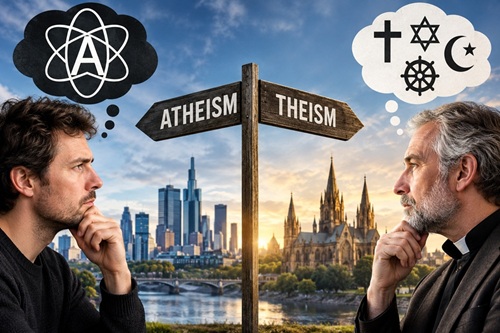
The Promise of a Higher SynthesisIntegral spirituality presents itself as a way beyond one of the oldest intellectual conflicts in human history: the struggle between belief in God and disbelief in God. Rather than choosing sides, it proposes that theism and atheism each capture part of a larger truth. The believer recognizes a spiritual dimension of existence; the atheist insists that claims about reality must answer to evidence. Integral spirituality promises to include both insights while transcending their limitations. In the work of Ken Wilber, this ambition forms part of a comprehensive worldview that attempts to integrate science, philosophy, psychology, contemplative practice, and the world's religious traditions. Its appeal is understandable. Theism can seem intellectually indefensible when it depends on supernatural interventions, divine revelations, or an omnipotent creator for whom there is insufficient evidence. Atheism, meanwhile, can seem existentially incomplete to people who regard meditation, mystical experience, compassion, and the transformation of consciousness as indispensable dimensions of human life. Why not preserve the insights of both while discarding their errors? The difficulty begins with the word transcend. To transcend a disagreement is not necessarily to resolve it. Sometimes it means discovering a more comprehensive explanation. Sometimes it means showing that the original dispute was based on a false assumption. But sometimes it means changing the vocabulary so that an uncomfortable question no longer appears to require an answer. Integral spirituality risks doing the latter. It can move beyond theism and atheism conceptually while leaving the underlying disagreement about reality unresolved. Worse, it can present this maneuver as evidence of a higher stage of spiritual or cognitive development. The crucial question is therefore not whether spirituality can be more sophisticated than conventional religion or simplistic materialism. It is whether integral spirituality offers a genuine alternative to both theism and atheism, or merely a more elaborate way of avoiding their central questions. What Exactly Is Being Transcended?Theism and atheism are not two homogeneous positions. Theism includes classical monotheism, deism, process theology, panentheism, and many other conceptions of divinity. Atheism ranges from the straightforward rejection of particular gods to more comprehensive naturalistic philosophies. Some atheists are hostile to religion; others practice meditation, appreciate religious art, or acknowledge the psychological value of contemplative traditions. Consequently, there is no single opposition that an integral theory can transcend once and for all. If theism means belief in a personal creator who designed the universe and intervenes in its affairs, then an account of spiritual experience that dispenses with such a being has already moved away from traditional theism. If atheism means denying the existence of that creator, however, the same account need not contradict atheism at all. A naturalist can accept the reality of mystical experiences, the benefits of meditation, the ethical importance of compassion, and the possibility of profound transformations in consciousness. None of these commitments logically requires belief in a transcendent Spirit. This is the first conceptual difficulty for integral spirituality: it often treats the rejection of conventional religion as though it automatically led toward a higher, postconventional spirituality. But the alternatives are not exhausted by religious literalism and spiritually enriched metaphysics. Naturalistic spirituality is already a possibility, and it does not need to be rescued from atheism by an encompassing theory. The question is not whether we can retain meaningful spiritual practices after abandoning supernatural beliefs. Clearly we can. The question is whether those practices provide evidence for a deeper spiritual reality, and, if so, what kind of reality they establish. Integral spirituality sometimes answers the first question by affirming the second without adequately investigating the connection between them. Ken Wilber's Integral SolutionKen Wilber's integral project is especially relevant because it attempts to situate religious and scientific knowledge within a comprehensive framework. His AQAL model - All Quadrants, All Levels, All Lines, All States, and All Types - distinguishes multiple dimensions of reality and human development. It encourages us to consider subjective experience alongside objective observation, individual consciousness alongside social systems, and contemplative traditions alongside scientific inquiry. There is something valuable in this approach. Scientific explanations of the brain do not automatically exhaust the first-person experience of having a brain. A description of meditation's neurological correlates does not, by itself, capture everything a meditator means when describing a transformed relationship to thought, suffering, or selfhood. Likewise, religious communities cannot be understood solely by examining their members' individual psychology; social institutions, historical traditions, and shared meanings also matter. But recognizing these different perspectives does not settle the metaphysical question of whether Spirit exists. Wilber's more ambitious formulations go further than methodological pluralism. In his writings on evolution and spirituality, he sometimes presents Spirit, Eros, or an intrinsic drive toward greater complexity and consciousness as features of the cosmos itself. Spiritual development then becomes more than a human interpretation of experience. It is connected to a larger evolutionary movement in reality. This is where the tension emerges. The integral framework begins by asking us to respect different perspectives, but it can end by asserting a metaphysical interpretation that those perspectives are expected to confirm. The scientific description of evolution, the phenomenology of meditation, the developmental psychology of meaning-making, and the religious interpretation of mystical experience become components of a single story. The story is comprehensive, but comprehensiveness is not the same as proof. A theory may accommodate many observations because it explains them well. It may also accommodate them because its concepts are sufficiently flexible to reinterpret almost any possible outcome as confirmation. Integral spirituality must demonstrate that its synthesis does more than arrange different kinds of knowledge under a common vocabulary. The Four Quadrants and the Problem of Metaphysical InferenceOne of Wilber's most influential contributions is his insistence that subjective, objective, cultural, and social perspectives should not be reduced to one another. The four quadrants offer a useful reminder that individual experience, bodily processes, shared meanings, and collective systems can all be relevant to understanding a phenomenon. Yet the quadrants are primarily a framework for organizing perspectives. They do not independently establish the existence of a spiritual dimension of the universe. Consider a meditation experience. Its first-person dimension includes the practitioner's feelings of unity, silence, or self-transcendence. Its objective dimension includes bodily and neural processes. Its cultural dimension includes the concepts through which the experience is interpreted. Its social dimension includes the institutions, teachers, and practices that make it possible. These perspectives can complement one another. But none of them, either separately or collectively, automatically establishes that the experience discloses an ultimate reality beyond the natural world. The meditator may interpret a loss of the ordinary sense of self as an encounter with universal consciousness. A Buddhist may interpret it through the doctrine of no-self. A Christian mystic may understand it as communion with God. A naturalist may interpret it as a temporary alteration in the brain's construction of selfhood. The experience may be profound in every case. The metaphysical interpretations nevertheless differ. An integral approach should help us compare these interpretations, examine their assumptions, and investigate what evidence might distinguish them. It should not simply declare that each is valid within its own quadrant and then infer that all are partial expressions of a greater spiritual truth. The fact that an experience has multiple dimensions does not mean that every interpretation of it is equally justified. Nor does the existence of subjective experience establish the existence of a cosmic Subject. That inference requires an argument of its own. Spiritual Experience Is Not the Same as Spiritual OntologyIntegral spirituality draws much of its persuasive power from the undeniable reality of spiritual experiences. People do report feelings of unity, ego dissolution, sacred presence, timelessness, boundless love, and encounters with what they describe as ultimate reality. These experiences can transform lives. They can reduce fear, alter priorities, deepen compassion, and undermine rigid conceptions of personal identity. A skeptical account of spirituality that simply dismisses such reports would be inadequate. But acknowledging an experience is not the same as endorsing its interpretation. People can experience the presence of a deceased relative without establishing communication with the dead. They can experience an overwhelming sense of cosmic purpose without demonstrating that the universe possesses a purpose of its own. They can experience unity with all existence without showing that reality is literally one conscious subject. The distinction is familiar in other fields. The subjective experience of seeing an optical illusion is real, but the object as perceived need not exist in the form presented by the experience. The intensity of an experience does not guarantee the accuracy of the beliefs attached to it. Spiritual experiences deserve careful investigation precisely because they are psychologically and existentially significant. Their causes, variations, cultural interpretations, and lasting consequences are legitimate subjects of inquiry. Meditation can be studied; contemplative reports can be compared; the effects of practice can be evaluated. None of this requires us to assume that the experience reveals a transcendent realm. Integral spirituality sometimes reverses the appropriate order of inquiry. Instead of beginning with experiences and investigating which interpretations they support, it begins with a comprehensive spiritual philosophy and interprets experiences as evidence for that philosophy. The result is a circularity problem. The framework explains the experiences, while the experiences are presented as confirmation of the framework. A more rigorous integral spirituality would leave the metaphysical question open until the evidence warrants a conclusion. The Problem of Wilber's ErosThe tension becomes particularly clear when integral spirituality attributes an intrinsic spiritual drive to evolution. In Ken Wilber's more metaphysical formulations, Eros is not merely a poetic name for human desire or a metaphor for the emergence of complexity. It is presented as a real feature of the cosmos, associated with the movement toward greater organization, differentiation, and consciousness. This claim is substantially stronger than saying that evolution has produced increasingly complex forms of life or that human beings often experience a desire for transcendence. It proposes that there is something within reality that helps account for these developments. But what explanatory work does Eros actually perform? Evolutionary biology already investigates the mechanisms through which complexity emerges, including mutation, natural selection, genetic drift, developmental constraints, ecological interactions, and other processes. Cosmology and physics investigate the formation of structures under the relevant physical conditions. These explanations remain incomplete in various respects, but their incompleteness does not itself establish the need for a spiritual force. If Eros is supposed to be a real causal factor, we should be able to ask what it does, how it operates, and what observations would count in its favor. Does it produce outcomes that established mechanisms cannot explain? Does it generate testable predictions? Does it distinguish between evolutionary trajectories that would otherwise be equally likely? If the answer is no, Eros may function as an interpretive metaphor rather than an explanatory mechanism. Metaphors can be illuminating, but they should not be presented as discoveries about the causal structure of the universe. If Eros is defined so broadly that every evolutionary outcome can be interpreted as its expression, including extinction, stagnation, degeneration, and the destruction of complex systems, then the claim becomes difficult to distinguish from a worldview that makes no independent predictions. There is also a problem with the direction of evolution. The history of life does not display a universal, uninterrupted ascent toward greater complexity. Evolution produces adaptations to particular environments, not a single ladder on which every species climbs toward consciousness. Many lineages remain relatively simple; others become more complex; still others disappear. Complexity itself is not an unambiguous measure of evolutionary success. The universe likewise contains both structure formation and processes of dispersal, decay, and equilibration. A cosmic narrative of upward striving must explain why the supposed spiritual drive produces such uneven and often destructive results. It is possible to use Eros as a poetic expression of wonder at the emergence of life and consciousness. It is much harder to establish it as a real cosmic force. Integral spirituality does not transcend theism and atheism merely by replacing a personal God with an impersonal spiritual principle. It must show why that principle deserves to be believed in. Atheism Is Not Necessarily Spiritually DeficientOne of the most persistent assumptions in integral spirituality is that conventional atheism represents a limited understanding of existence. In developmental accounts, the atheist may be portrayed as confined to a rational, materialistic, or modern worldview, while integral consciousness supposedly includes the insights of religion without being bound by its dogmas. This can create an asymmetry. Religious believers are credited with an experience of transcendence; atheists are credited with rational criticism but are suspected of missing something fundamental. Yet atheism is not a developmental stage that every sufficiently reflective person must outgrow. It is a position concerning the existence of gods, and it is compatible with many philosophical and existential commitments. An atheist can be deeply moved by music, devoted to ethical causes, fascinated by the cosmos, committed to contemplative practice, and transformed by experiences of self-transcendence. Such a person need not regard these experiences as disclosures of supernatural or transpersonal realities. Indeed, a naturalistic worldview can provide a context for wonder. The fact that human consciousness emerged through natural processes does not make consciousness unimportant. The fact that our planet is not the center of the universe does not make human suffering irrelevant. The absence of a cosmic purpose does not prevent human beings from creating, discovering, and sharing purposes. Integral spirituality sometimes treats this naturalistic position as incomplete because it refuses to infer a spiritual dimension from the depth of human experience. But this may be a virtue rather than a deficiency. The naturalist is entitled to distinguish between what an experience means to a person and what it demonstrates about reality. The burden of proof belongs to the stronger claim. If integral spirituality asserts that consciousness participates in a cosmic spiritual process, it must explain why that interpretation is preferable to a naturalistic account. Calling the naturalistic account less inclusive does not answer the question. Theism's Challenge: Has God Merely Been Renamed?Integral spirituality may appear to offer a sophisticated alternative to traditional religion by replacing a personal creator with Spirit, nonduality, or an evolutionary ground of being. But this raises a further question: how much of the original theological commitment has actually disappeared? A personal God is usually understood to possess at least some combination of agency, intelligence, purpose, or intentionality. A cosmic Spirit might lack these personal characteristics while still being treated as the ultimate ground of reality, the source of consciousness, or the principle through which the universe develops. The language has changed, but some of the explanatory and existential functions of God remain. This does not mean that all impersonal conceptions of ultimate reality are disguised forms of theism. They can differ from traditional theism in important ways. But the differences must be specified rather than assumed. If Spirit is simply another name for the totality of existence, it is unclear what additional claim has been made. If Spirit is the subjective dimension of reality, it must be shown why this is more than a philosophical interpretation of consciousness. If Spirit is an active force driving evolution, its causal role must be clarified. If Spirit is a reality accessible through contemplative practice, the relationship between the experience and the proposed reality must be demonstrated. Without such clarification, integral spirituality risks preserving the emotional and metaphysical appeal of religion while avoiding the evidential burdens associated with religious belief. A personal God may be rejected as too anthropomorphic, only for a less clearly defined cosmic principle to inherit the role of ultimate explanation. This is not necessarily an improvement. It may simply make the original claim more difficult to evaluate. The Developmental Trump CardA particularly problematic feature of integral discourse is the tendency to frame disagreements in terms of developmental levels. The distinction between preconventional, conventional, and postconventional reasoning can be useful in developmental psychology. People do differ in their capacities for perspective-taking, abstraction, moral reasoning, and the coordination of competing viewpoints. But it does not follow that every disagreement over metaphysics can be settled by assigning the participants different levels of development. Suppose a traditional theist believes in a personal creator, a scientific atheist rejects the evidence for such a being, and an integral thinker proposes a transpersonal Spirit. The integral thinker might claim to include the truths of both positions while transcending their limitations. But what prevents the atheist from replying that the integral thinker has simply introduced an unsupported metaphysical entity? If the response is that the atheist cannot understand Spirit because the atheist remains confined to a lower developmental level, the argument becomes self-protective. The integral position is granted authority by the very developmental hierarchy that it invokes to dismiss its critics. This is a form of epistemic privilege. The higher-level thinker supposedly sees what the lower-level thinker cannot, while the lower-level thinker is denied the standing to challenge the claim. The danger is not that developmental theories are inherently illegitimate. It is that they can be used to immunize metaphysical assertions against criticism. An opponent's disagreement becomes evidence of the opponent's limitation rather than a reason to reconsider the proposition. A genuinely integral approach should resist this temptation. Intellectual maturity cannot mean exemption from the ordinary requirements of argument and evidence. If a claim is true, it should be possible to explain why it is true without treating skepticism as a developmental defect. Does Integral Spirituality Have a Method of Verification?The central epistemological question is how integral spirituality distinguishes reliable insight from mistaken interpretation. Contemplative traditions often maintain that their claims can be verified through disciplined practice. Just as scientific observations require training and appropriate instruments, spiritual insight supposedly requires meditation, sustained attention, and the development of particular capacities of consciousness. There is a legitimate point here. Expertise matters, and some experiences cannot be understood adequately through casual observation alone. A person who has never meditated may be poorly positioned to describe the subtleties of advanced contemplative practice. But the analogy with science has limits. Scientific training does not merely produce experiences unavailable to novices. It also develops public procedures for testing claims, comparing observations, identifying errors, and revising explanations. Scientific findings can be challenged by people who disagree with the theoretical interpretation, provided they can examine the relevant evidence and methods. Contemplative traditions, by contrast, can produce experiences that are interpreted through different and sometimes incompatible doctrinal frameworks. A Christian contemplative may report union with God; a Buddhist practitioner may interpret a related experience in terms of emptiness; a nondual Vedantin may interpret it as recognition of an ultimate Self. The existence of these traditions does not establish that they are all describing the same underlying reality. Their interpretations may overlap, but they may also reflect different conceptual frameworks, expectations, and practices. An integral approach could investigate these similarities and differences systematically. It could examine which practices produce which experiences, how stable those experiences are, what psychological changes follow, and how practitioners' interpretations are influenced by their cultural backgrounds. But the claim that contemplative experience provides access to an ultimate spiritual reality requires further justification. The fact that an experience is repeatable does not automatically validate every metaphysical interpretation attached to it. A useful distinction is between the reproducibility of an experience, the reliability of a report, and the truth of an ontological conclusion. These are related but separate questions. Integral spirituality would become more credible by acknowledging the distinction instead of treating spiritual practice as a general-purpose certificate of metaphysical knowledge. The Difference Between Transcendence and IntegrationThere is a more modest interpretation of integral spirituality that deserves serious consideration. Perhaps its purpose is not to establish Spirit as a cosmic entity, but to integrate dimensions of human life that are often neglected by narrowly intellectual or reductionist approaches. On this interpretation, spirituality involves practices of attention, ethical transformation, self-understanding, emotional development, and the exploration of human experience. It can draw from religious traditions without accepting their supernatural claims. It can appreciate science without pretending that a scientific description of a phenomenon automatically exhausts its significance for human life. Such an approach would have much to recommend it. But it would also change the meaning of the claim that integral spirituality transcends theism and atheism. It would not establish a third metaphysical position superior to both. Instead, it would identify a field of human practices and experiences that can be pursued by theists, atheists, and agnostics alike. A Christian might practice meditation as a way of deepening communion with God. A Buddhist might pursue insight into impermanence and the absence of a permanent self. An atheist might use contemplative practice to develop attention and reduce reactivity. These practitioners may share techniques and experiences without sharing the same account of ultimate reality. This is integration in a meaningful sense. It recognizes that valuable practices need not be confined to one metaphysical interpretation. Transcendence, however, is a stronger claim. It suggests that the conflict between theism and atheism has been resolved at a higher level of understanding. To justify that claim, integral spirituality would need to show that the competing positions are mistaken, incomplete in a specific way, or answerable to a more adequate account. Merely including them within a larger framework is insufficient. A theory can include incompatible beliefs without resolving their incompatibility. The most defensible version of integral spirituality may therefore be less metaphysically ambitious than its proponents sometimes imagine. Its strength would lie in integrating human practices and perspectives, not in declaring that the universe itself has been shown to possess a spiritual nature. The Naturalistic AlternativeWhat would a naturalistic spirituality look like? It would begin by taking human experience seriously without assuming that the universe is organized around spiritual purposes. It would recognize that consciousness is extraordinary without treating its existence as evidence for a cosmic consciousness. It would regard meditation as a practice with psychological and physiological dimensions, while remaining open to discoveries about its effects. It would also acknowledge that the scientific picture of the universe is incomplete. There are unresolved questions about consciousness, the origin of life, the emergence of complexity, and the relationship between subjective experience and physical processes. But it would resist treating these gaps as invitations to install Spirit as an explanatory placeholder. Naturalistic spirituality need not be emotionally impoverished. The universe can inspire awe without having been designed to inspire awe. Life can be precious without being the goal of cosmic evolution. Human beings can experience profound connections with other people, other species, and the natural world without assuming that all existence is animated by a hidden spiritual principle. Nor does naturalism require the denial of all forms of transcendence. If transcendence means moving beyond habitual patterns of thought, expanding one's perspective, loosening the grip of ego-centered concerns, or experiencing an enlarged sense of belonging, then it can describe genuine human transformations. What naturalism questions is the inference from psychological transcendence to metaphysical transcendence. This distinction allows spirituality to retain its experiential and ethical dimensions without turning them into claims about the ultimate architecture of reality. The naturalistic alternative also preserves an important intellectual virtue: the willingness to leave questions unanswered. Not every mystery needs an immediate metaphysical solution, and not every profound experience needs to be interpreted as a glimpse of ultimate truth. Sometimes the most honest response to an extraordinary experience is to explore it carefully, appreciate its consequences, and remain uncertain about what it reveals beyond itself. Conclusion: A Higher Synthesis or a Higher-Level Assumption?Integral spirituality is right to challenge the idea that human life can be understood through a single perspective. It is right to recognize that subjective experience matters, that contemplative practices can transform people, and that religious traditions contain more than their literal doctrinal claims. It is also right to resist the simplistic assumption that rejecting supernatural religion requires rejecting every practice or experience associated with spirituality. But none of these insights establishes that theism and atheism have been transcended in a deeper metaphysical sense. Theism and atheism disagree, in part, about what exists. Integral spirituality cannot settle that disagreement simply by placing both positions within a larger developmental framework, distinguishing additional perspectives, or invoking a transpersonal dimension of reality. It must show what its proposed synthesis explains, what evidence supports it, and how it differs from the naturalistic alternatives it seeks to surpass. The distinction between spiritual experience and spiritual ontology is crucial. We can acknowledge the reality of mystical experiences without accepting every claim made on their behalf. We can appreciate religious wisdom without assuming that its metaphysics is true. We can practice meditation without believing that consciousness is the universe's fundamental substance. And we can experience wonder without concluding that the cosmos itself is animated by Eros. The most serious challenge to integral spirituality is therefore not that it includes too much, but that it sometimes claims too much. Its aspiration to embrace multiple perspectives can become a license to convert diverse experiences and bodies of knowledge into evidence for a preferred metaphysical story. A truly integral approach would apply its demand for inclusion to skepticism as well. It would recognize that atheism is not necessarily a developmental deficiency, that scientific naturalism is not synonymous with existential emptiness, and that a spiritual interpretation of reality remains a hypothesis rather than an achievement automatically conferred by contemplative insight. Perhaps the genuine alternative to theism and atheism is not a higher metaphysical system at all. It may be a more careful distinction between questions about how we experience life, questions about how we ought to live, and questions about what exists independently of our interpretations. On this view, spirituality can be explored without being turned into a cosmology, and science can be respected without being made responsible for answering every existential question. Integral spirituality would then have a more modest but more defensible ambition: not to prove that it has transcended theism and atheism, but to create a space in which religious commitment, naturalistic skepticism, and contemplative practice can encounter one another without any of them receiving an automatic claim to ultimate authority. That would be a genuine integration. Whether it deserves to be called transcendence is another question.
Widget is loading comments...
|