|
TRANSLATE THIS ARTICLE
Integral World: Exploring Theories of Everything
An independent forum for a critical discussion of the integral philosophy of Ken Wilber
  Frank Visser, graduated as a psychologist of culture and religion, founded IntegralWorld in 1997. He worked as production manager for various publishing houses and as service manager for various internet companies and lives in Amsterdam. Books: Ken Wilber: Thought as Passion (SUNY, 2003), and The Corona Conspiracy: Combatting Disinformation about the Coronavirus (Kindle, 2020).
Check out my other conversations with ChatGPT
Theism, Atheism and Beyond?:
Dawkins vs. McGrath The Varieties of Atheism The Return of Theism Integral Spirituality Anatheism: A Third Way Religion Without Religion The Religion of Tomorrow The Varieties of AtheismWhat Disbelief Means, and Why It Provokes Such Different ReactionsFrank Visser / ChatGPT
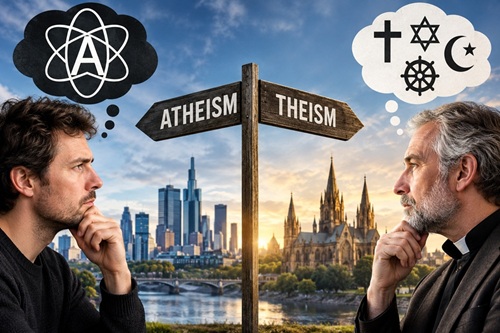 Introduction: Atheism Is Not One ThingAtheism is often treated as though it were a single, easily identifiable position: the belief that God does not exist. Yet this simple definition conceals a remarkably diverse collection of intellectual positions, existential attitudes, moral commitments, and cultural identities. Some atheists are militant opponents of religion; others are indifferent to it. Some reject every supernatural claim, while others remain open to forms of spirituality. Some arrive at atheism through scientific skepticism, others through philosophical argument, personal experience, or disillusionment with religious institutions. The reception of atheism is equally varied. For some believers, atheism represents liberation from inherited dogma. For others, it is a symptom of moral decline, spiritual blindness, or intellectual arrogance. Among secular intellectuals, meanwhile, atheism can be regarded as an obvious consequence of modern knowledge, a philosophically defensible but unnecessary commitment, or even a distraction from the more pressing question of how human beings can live meaningful lives without supernatural guarantees. Any serious examination of atheism must therefore do two things. It must distinguish the varieties of disbelief without collapsing them into caricatures, and it must examine the cultural assumptions that shape how atheists are perceived. The central question is not simply whether God exists, but what it means to live without belief in God, how confidently that conclusion can be defended, and why the absence of religious belief continues to provoke such strong reactions. Atheism deserves neither automatic celebration nor automatic condemnation. Like theism, it comes in intellectually sophisticated and intellectually careless forms. Its merits depend on the arguments supporting it, the standards of evidence it adopts, and the conclusions its adherents draw about morality, knowledge, human nature, and the meaning of existence. 1. The First Distinction: Not Believing Versus Believing There Is No GodA fundamental distinction in contemporary discussions of atheism separates psychological belief from philosophical conviction. An agnostic atheist does not believe in God but does not claim to know with certainty that no god exists. An explicit or positive atheist, by contrast, may affirm that God does not exist, perhaps because the concept is incoherent, the evidence is inadequate, or particular arguments for God's existence fail. The distinction matters because the statement "I do not believe that God exists" is not logically equivalent to "I believe that God does not exist." The former withholds assent; the latter makes a claim about reality. One can reject the evidence for a proposition without claiming to have conclusively demonstrated its negation. This is especially important because the word God has no single universally accepted meaning. A personal creator who answers prayers, an impersonal absolute underlying existence, a pantheistic identification of God with nature, and a metaphysical principle of cosmic consciousness are not interchangeable concepts. Arguments against one conception may leave others untouched, although that does not mean the alternatives are thereby justified. Atheism is consequently not a complete worldview. It tells us something about a person's position on the existence of gods, but it does not, by itself, establish what that person believes about consciousness, morality, free will, politics, human nature, or the future of civilization. An atheist can be a scientific naturalist, a philosophical materialist, a humanist, an existentialist, a Buddhist who rejects a creator deity, or someone who simply finds religious questions uninteresting. Treating all these positions as expressions of the same comprehensive doctrine is the first mistake that critics and defenders of atheism alike must avoid. 2. The Varieties of AtheismThe indifferent atheistThe least theatrical variety of atheism may also be the most common in increasingly secular societies: indifference. The indifferent atheist does not necessarily oppose religion, campaign against religious institutions, or spend time debating God's existence. Religion simply occupies little space in everyday life. This form of atheism is sociologically important because secularization does not always proceed through intellectual conversion. People do not necessarily read Darwin, study the problem of evil, or discover the contradictions of scripture before losing their faith. They may simply stop attending religious services, cease to regard religious teachings as authoritative, and organize their lives around entirely secular concerns. Such atheism can be difficult for religious apologists to understand. They may assume that unbelief must be a deliberate philosophical rebellion against God. Yet indifference is not necessarily a rebellion at all. It may reflect the fact that religious belief has lost its cultural centrality. Its weakness, however, is that indifference does not answer the intellectual questions raised by religion. A person who never thinks about God has not necessarily reached a considered conclusion about the existence of a deity. Indifference is a practical orientation, not a philosophical achievement. It can be entirely reasonable, but it should not automatically be mistaken for a well-developed argument. The skeptical atheistThe skeptical atheist approaches religious claims through a general commitment to critical inquiry. Claims about revelation, miracles, divine intervention, reincarnation, or supernatural powers are not granted exemption from ordinary standards of evidence merely because they belong to a religious tradition. This position is closely associated with scientific naturalism, although the two are not identical. Scientific naturalism seeks explanations through publicly accessible investigation, empirical evidence, and methods that permit correction. Skeptical atheism applies similar standards to religious propositions. Its strongest argument is methodological. When competing religious traditions make incompatible claims about supernatural reality, what reliable procedure can distinguish truth from error? Appeals to personal revelation, sacred texts, mystical experience, and tradition may be psychologically compelling, but they are not equally persuasive to people outside the relevant community. Nor do they reliably adjudicate conflicts between religious traditions. The skeptical atheist therefore asks believers to explain why their preferred supernatural interpretation deserves acceptance over alternatives. Yet skepticism must be applied consistently. Atheists can also become dogmatic, dismiss evidence prematurely, or confuse a currently successful scientific explanation with a final account of reality. Scientific inquiry provides powerful reasons to resist unsupported supernatural explanations, but it does not establish every philosophical thesis associated with atheism. The strongest skepticism remains open to correction, including correction of its own assumptions. The philosophical atheistPhilosophical atheism attempts to show that belief in God is unjustified, unnecessary, or incoherent through sustained argument. Its traditional resources include the problem of evil, the apparent hiddenness of God, the absence of convincing evidence for divine intervention, the tensions between divine foreknowledge and human freedom, and criticisms of arguments from design or first causes. The problem of evil is particularly powerful against conceptions of God that combine unlimited power, perfect goodness, and comprehensive knowledge. The existence of apparently gratuitous suffering creates a serious challenge to the expectation that such a deity would govern the world. But philosophical atheism is not limited to disproving the existence of a benevolent creator. Some arguments challenge the coherence of divine attributes; others question whether the concept of a supernatural person is intelligible in the first place. Still others maintain that naturalistic explanations make certain traditional theological hypotheses explanatorily redundant. The danger is overstatement. Refuting one argument for God does not prove that every possible god is nonexistent. Likewise, showing that a particular conception of omnipotence is incoherent does not automatically dispose of every nontraditional conception of divinity. A strong philosophical atheist therefore specifies the target. The case against a personal creator who intervenes in history may be much stronger than the case against an abstract, minimally defined metaphysical ground of existence. The latter, however, may also explain considerably less than its proponents suggest. The scientific naturalistThe scientific naturalist regards nature as the domain within which reliable explanations should be sought. This position is often associated with evolutionary biology, neuroscience, cosmology, and the other sciences that have progressively displaced supernatural explanations from many areas of inquiry. Evolution is a particularly significant example. Biological complexity no longer requires the hypothesis that organisms were separately designed in their present forms. Natural selection, genetic variation, mutation, developmental constraints, and other evolutionary processes provide a powerful explanatory framework for the diversity of life. Similarly, neuroscience has established extensive connections between mental activity and the functioning of the brain. Changes in the brain can alter memory, personality, perception, and consciousness. These findings create serious difficulties for simple accounts of an immaterial mind that operates independently of the body. But the scientific naturalist must distinguish empirical findings from broader philosophical conclusions. Evidence that mental life depends on the brain does not, by itself, settle every question about the nature of consciousness. Nor does the success of evolutionary explanations establish that every aspect of reality has already been explained scientifically. Methodological naturalism—the practice of seeking natural explanations in scientific inquiry—is not logically identical to metaphysical naturalism, the claim that reality contains nothing supernatural. The first is a methodological commitment; the second is a comprehensive philosophical position. The atheist who ignores this distinction risks making science carry more metaphysical weight than its actual findings support. The more defensible position is that naturalistic explanations have repeatedly succeeded where supernatural explanations have failed to deliver comparable, independently testable results. That is a substantial argument, even without pretending that every philosophical question has been settled. The militant atheistMilitant atheism, in its intellectual rather than literal military sense, regards religion as a significant social problem that deserves active opposition. Its proponents may argue that religious institutions perpetuate dogmatism, inhibit scientific understanding, legitimize authoritarianism, or preserve discriminatory moral codes. Richard Dawkins, Christopher Hitchens, Daniel Dennett, and Sam Harris became prominent representatives of the modern public debate over religion, although their arguments and emphases differ considerably. Their collective contribution was to challenge the convention that religion should be treated as a uniquely privileged subject, immune from the criticism routinely applied to other systems of belief. They insisted that religious claims should be scrutinized openly and that the social consequences of religious institutions should be evaluated rather than excused. This was an important corrective to a culture in which criticism of religion could be treated as inherently offensive, while criticism made in the name of religion was often granted special protection. Nevertheless, the militant atheist can fall into a mirror-image error. Religion is not one institution, one doctrine, or one psychological disposition. It encompasses authoritarian and liberal traditions, intellectual inquiry and anti-intellectualism, compassion and cruelty, political resistance and political conformity. A general indictment of religion may obscure the differences that make particular traditions worth evaluating separately. Moreover, attacking religious belief does not automatically persuade religious believers. Mockery may energize an already skeptical audience while making dialogue with committed believers more difficult. The public atheist who treats every believer as intellectually deficient risks reproducing the very dogmatism that atheism claims to oppose. Militancy can be justified when it confronts coercion, abuse, censorship, or demonstrably harmful policies. It becomes less defensible when it substitutes contempt for argument. The existential and humanist atheistExistential and humanist atheism begin with a different concern. Rather than concentrating exclusively on the nonexistence of God, they ask how human beings can live ethically and meaningfully without supernatural guarantees. For the humanist, morality need not descend from a divine lawgiver. Human beings possess interests, vulnerabilities, capacities for suffering, and possibilities for flourishing. These provide a basis for moral reflection, mutual concern, and the construction of institutions that protect human welfare. The existentialist emphasizes that the absence of a predetermined cosmic purpose need not render life meaningless. Meaning may arise through relationships, creative activity, intellectual discovery, political engagement, and the projects to which people commit themselves. This is not necessarily the claim that individuals can invent meaning arbitrarily. Human beings are embodied, social creatures whose choices unfold under real constraints. Their projects can be judged in terms of their consequences, coherence, honesty, and effects on others. The challenge is to explain how moral obligations can be more than personal preferences. Secular philosophers have developed sophisticated accounts of moral realism, contractualism, consequentialism, virtue ethics, and human flourishing. None requires the simple inference that without God, anything goes. Atheism does not itself provide a moral philosophy, but neither does theism automatically provide a satisfactory one. A divine command may be invoked to justify a moral rule, yet the believer must still explain how divine commands are identified, interpreted, and distinguished from human projections. The humanist atheist's task is not to demonstrate that every moral question has an easy secular answer. It is to show that ethical reasoning can proceed without assuming that moral authority depends on supernatural legislation. The spiritual but non-theistic atheistOne final variety complicates the familiar opposition between religion and atheism: the person who rejects gods but retains a sense of spiritual depth, contemplative practice, or existential wonder. Some forms of Buddhism do not posit a creator God. Naturalistic interpretations of meditation and contemplative traditions can preserve practices of attention, compassion, and self-examination without requiring supernatural cosmologies. Some atheists also use the language of spirituality to describe experiences of awe, connectedness, or the dissolution of the ordinary sense of self. These experiences are not automatically evidence for a supernatural reality. A powerful experience of unity with the universe establishes, first of all, that someone experienced a profound sense of unity. Additional arguments are required to establish that the experience disclosed an independently existing metaphysical truth. Nevertheless, it would be a mistake to dismiss such experiences merely because they can be studied psychologically or neurologically. An experience can have natural causes and still be personally transformative. Explaining how an experience arises does not necessarily exhaust its significance. The crucial distinction is between acknowledging the depth of human experience and claiming that this depth demonstrates the existence of a cosmic intelligence, universal consciousness, or transcendent realm. A naturalistic atheist can accept the former while remaining unconvinced by the latter. 3. The Varieties of Agnosticism: A Different Kind of DisagreementAtheism's reception is complicated by the fact that not everyone who rejects religious certainty is an atheist. Agnosticism has its own varieties, ranging from a cautious suspension of judgment to the philosophical claim that human beings are incapable of knowing whether any gods exist. Thomas Huxley coined the term agnostic in the nineteenth century to describe an intellectual attitude emphasizing what could be established through evidence rather than what was asserted on the basis of faith or metaphysical speculation. In contemporary usage, agnosticism may concern knowledge, while atheism concerns belief. Someone can therefore be an agnostic atheist: they do not believe in God but do not claim certainty that God does not exist. Equally, someone can be an agnostic theist who believes in God while admitting that this belief cannot be established as knowledge. This distinction helps expose an ambiguity in religious debate. When a believer demands that an atheist prove that no conceivable deity exists, the demand may set an unnecessarily high standard. A person need not disprove every logically imaginable entity before declining to believe in it. Conversely, an atheist who claims absolute certainty about the nonexistence of every possible deity may be making a stronger assertion than the available arguments warrant. The appropriate degree of confidence depends on the specific claim. There may be compelling reasons to reject a deity described in terms that conflict with established evidence or contain logical contradictions. There may be less decisive grounds for rejecting an undefined entity that is insulated from empirical investigation. But the fact that a proposition cannot be conclusively disproved does not give it a claim on our belief. Possibility, plausibility, and demonstrated truth are different standards. Agnosticism is most useful when it clarifies the limits of a particular argument. It is less useful when it becomes a general excuse for treating every position as equally credible, regardless of its evidential support. 4. The Reception of Atheism: From Heresy to RespectabilityThe social reception of atheism has changed dramatically across history, but it has never followed a simple progression from religious ignorance to secular enlightenment. In many historical societies, religious belief was woven into political authority, communal identity, law, education, and everyday custom. Rejecting the dominant religion could therefore be interpreted not merely as an intellectual disagreement but as an act of disloyalty. The unbeliever threatened an entire social order. The consequences varied across cultures and periods. In some settings, accusations of impiety could lead to exclusion, censorship, or punishment. In others, skeptical traditions existed within religious cultures themselves, sometimes expressed through philosophical schools, satirical literature, or critiques of priestly authority. The history of atheism is not a history of universal religious conformity interrupted only by modern science. The European Enlightenment helped establish more favorable conditions for open criticism of religious authority. Advances in scientific knowledge, religious conflict, political liberalism, and philosophical skepticism contributed to an intellectual environment in which inherited beliefs could increasingly be challenged. The French Revolution, nineteenth-century freethought movements, and the spread of secular education further altered the relationship between religion and public life. Yet atheism did not simply become respectable everywhere. In some countries, explicitly atheist regimes persecuted religious believers and attempted to suppress religious institutions. These episodes complicate any simplistic identification of atheism with freedom. The coercive suppression of religion is not a logical consequence of disbelief in God, but neither can its historical association with certain political movements be ignored. In contemporary democracies, atheists generally enjoy greater legal protection than in many earlier periods, although the degree of social acceptance varies considerably. In some environments, disbelief is ordinary and unremarkable. In others, atheists may face suspicion concerning their morality, patriotism, trustworthiness, or capacity to experience wonder. The central irony is that societies often judge atheism through assumptions that atheists themselves do not share. If a culture presumes that morality depends on divine authority, the atheist may appear morally suspect before saying anything about ethics. If a culture regards religious identity as inseparable from national belonging, the atheist may appear culturally alien even when sharing the community's language, history, and civic commitments. The reception of atheism therefore tells us as much about the receiving society as it does about atheism itself. 5. The Moral Panic: Can Atheists Be Good People?Perhaps the most persistent objection to atheism is the claim that without God there can be no objective morality. The argument takes several forms. Some contend that moral rules require a divine legislator. Others maintain that without an afterlife and divine judgment, people lack sufficient motivation to behave ethically. Still others argue that a purely naturalistic universe cannot accommodate genuine moral obligations. These arguments should not be treated as identical. The question of what makes moral claims true is different from the question of what motivates people to act morally. A person might believe that morality is objective while denying that it requires God. Another might believe in God while acting selfishly. Neither case settles the philosophical issue. The motivational argument is particularly weak as a generalization about atheists. People can care about others because they experience empathy, value relationships, recognize reciprocal obligations, or understand the consequences of suffering. These motivations do not disappear when supernatural punishment is removed from the picture. Indeed, a person who refrains from cruelty solely because they fear divine punishment has not necessarily demonstrated a deeper moral understanding than someone who refrains because they recognize the suffering cruelty causes. The philosophical question is more demanding. Can moral judgments be objectively justified without a divine source? There is no single agreed-upon secular solution, but secular moral philosophy offers several serious approaches. Some ground morality in facts about conscious well-being; others emphasize rational consistency, reciprocal justification, human flourishing, or moral properties that are not reducible to divine commands. Religious ethics faces its own difficulties. If something is good simply because God commands it, morality can appear arbitrary. If God commands something because it is already good, goodness seems conceptually independent of the command. This familiar dilemma does not refute every form of religious ethics, but it demonstrates that invoking God does not automatically solve the foundations of morality. The reasonable conclusion is modest but important: atheism does not entail immorality, and theism does not guarantee virtue. Both religious and secular people must explain their ethical commitments and accept scrutiny of their conduct. Atheists should not claim that secular morality has solved every philosophical problem. Religious critics should not pretend that the absence of God makes morality impossible without first engaging with the substantial alternatives. 6. The New Atheism: Necessary Intervention or Intellectual Overreach?The early twenty-first-century New Atheism movement brought these disputes into popular culture with unusual intensity. Books by Richard Dawkins, Christopher Hitchens, Sam Harris, and Daniel Dennett helped turn religious belief into a subject of aggressive public criticism. The movement emerged amid several concerns, including religiously motivated terrorism, disputes over evolution and education, the influence of religious organizations on public policy, and the persistence of supernatural claims in societies with advanced scientific institutions. Its most valuable contribution was to challenge an asymmetry in public debate. Religious ideas could be defended in terms of revelation, tradition, or sacred authority, while critics were sometimes expected to maintain a special politeness that believers were not required to reciprocate. The New Atheists rejected the notion that religious claims deserved immunity from ordinary intellectual scrutiny. They also helped popularize an important distinction between respecting people and respecting their beliefs. A person may deserve dignity, freedom of conscience, and protection from discrimination without every proposition that person holds deserving deference. This distinction remains indispensable in pluralistic societies. Freedom of religion includes the freedom to criticize religion, and freedom of expression must protect both believers and unbelievers. But the New Atheist movement also displayed limitations. Its more polemical expressions sometimes treated religion as a largely uniform phenomenon, underestimated the social and psychological functions of religious communities, and presented the relationship between science and religion in overly categorical terms. The question is not whether religion has contributed to violence, oppression, and resistance to scientific knowledge. It plainly has in particular contexts. The question is whether these facts justify treating religion as a single explanatory category, rather than investigating the institutions, incentives, historical circumstances, and political conditions that produce particular outcomes. The same standard applies to atheism. The existence of atheist authoritarian regimes does not establish that atheism inevitably produces tyranny. Nor does the existence of religiously motivated atrocities establish that religion inevitably produces violence. Historical explanation requires more than identifying a person's declared worldview. The New Atheists were often strongest when exposing unsupported claims and challenging the special status of religious authority. They were less convincing when polemical certainty replaced careful differentiation. Their legacy is therefore mixed but consequential. They expanded the space for open criticism of religion, while sometimes encouraging a style of debate in which defeating an opponent appeared more important than understanding the strongest version of the opposing position. 7. Why Some Religious Critics Misunderstand AtheismReligious criticism of atheism frequently begins with an assumption that the atheist must have replaced God with something else: materialism, scientism, individualism, political ideology, or an unacknowledged spiritual commitment. Sometimes this observation identifies a genuine inconsistency. An atheist who claims that science alone can answer every meaningful question, for example, has adopted a philosophical position that cannot simply be equated with the methods of science. An atheist who rejects all metaphysical claims without argument may be relying on assumptions that deserve examination. But such criticisms often confuse atheism with one particular comprehensive worldview. Atheism does not logically entail materialism, scientism, moral relativism, political liberalism, or the belief that human beings are nothing more than biological machines. These positions may be associated with some atheists, but each requires its own argument. Another common objection is that atheism cannot account for consciousness, reason, morality, beauty, or the apparent intelligibility of the universe. These are serious philosophical topics. Yet identifying an explanatory challenge for naturalism does not establish that a supernatural explanation is correct. Suppose the nature of consciousness remains incompletely understood. The conclusion should be that consciousness remains incompletely understood, not that a nonphysical soul or universal consciousness has thereby been demonstrated. The same principle applies to the origin of the universe and the foundations of morality. There is a crucial difference between identifying a gap in an explanation and filling that gap with a justified alternative. The reverse mistake also occurs. Some atheists assume that because religious beliefs have psychological or cultural explanations, their truth has been disproved. Explaining why people believe something does not establish whether the belief is true. A belief may arise through social conditioning and nevertheless be correct; it may arise through an intense personal experience and nevertheless be mistaken. A serious debate must distinguish the origins of beliefs from the evidence supporting their content. Religious critics are right to demand philosophical rigor from atheists. They are wrong when they assume that every atheist secretly worships matter, that unbelief necessarily produces nihilism, or that unresolved questions about human existence constitute positive evidence for God. 8. Why Some Atheists Misunderstand ReligionThe intellectual limitations of atheism deserve equal attention. Some atheists reduce religion to a collection of empirically testable propositions and then treat the failure of those propositions as an exhaustive account of religious life. But religion also functions as ritual, identity, community, moral formation, consolation, artistic expression, and a framework for interpreting suffering and death. None of these functions proves religious doctrines true. A belief may be comforting without being accurate, and a community may provide solidarity while preserving mistaken ideas. Nevertheless, understanding religion requires explaining why it persists and what people actually derive from it. A person who loses belief in God may discover that the loss involves more than abandoning a proposition. It may mean losing a community, a language of hope, a framework for mourning, or a sense of continuity with previous generations. Atheists who dismiss these attachments as mere irrationality may fail to understand the human circumstances of religious commitment. There is also a tendency among some atheists to assume that the scientific explanation of a phenomenon eliminates its existential significance. A naturalistic account of love, for instance, need not make love less valuable. An evolutionary explanation of altruism does not establish that generosity is fraudulent. A neurological account of musical appreciation does not render music meaningless. Explanations of how experiences arise and evaluations of what those experiences mean operate at different, though sometimes interacting, levels. This does not require atheists to adopt religious language or accept supernatural interpretations. It requires them to recognize that a naturalistic explanation need not be an existentially impoverished one. The strongest atheism can criticize religious claims without reducing religious people to fools, hypocrites, or victims of mass delusion. It can recognize the human achievements of religious cultures while distinguishing those achievements from claims about supernatural reality. Indeed, an atheism that understands religion well is better equipped to criticize it than one that knows only its most obviously objectionable forms. 9. The Psychology of Disbelief: Why Atheism Feels ThreateningThe reception of atheism cannot be explained through philosophical arguments alone. Belief in God is often connected to emotional security, social belonging, moral identity, and the hope that life participates in a larger order. Disbelief can therefore be experienced as a threat even when it is expressed respectfully. If someone believes that the universe is governed by a loving intelligence, that suffering ultimately serves a purpose, and that death is not the end of personal existence, atheism can seem to remove several sources of reassurance at once. The atheist is not merely rejecting a hypothesis about the universe but apparently undermining an entire structure of existential confidence. This helps explain why arguments against atheism sometimes focus less on its reasoning than on its supposed psychological consequences. Atheists are described as bitter, arrogant, spiritually empty, or unwilling to confront their mortality. Such characterizations may occasionally describe particular individuals, but they cannot establish the truth or falsity of atheism. The reverse psychological suspicion is equally familiar. Atheists sometimes explain religious belief as wishful thinking, fear of death, or a desire for parental protection. These interpretations may illuminate certain cases, but they are not universal explanations. Religious believers can be intellectually serious, psychologically independent, and fully aware of the possibility that their beliefs are mistaken. Both sides risk committing the genetic fallacy: judging a belief's truth solely by speculating about its psychological origins. There is, however, a legitimate psychological question concerning the willingness to revise one's beliefs. When a worldview is deeply integrated with one's identity, contrary evidence may be experienced as a personal threat. This applies to religious and nonreligious commitments alike. Political ideologies, scientific orthodoxies, and secular philosophies can all become identity-protective systems. The relevant distinction is not between religious people who are emotionally invested and atheists who are purely rational. It is between people who allow their commitments to be questioned and people who insulate them from criticism. A mature intellectual culture should make it possible to revise one's beliefs without treating revision as humiliation. That principle is especially important in discussions of religion, where disagreement often touches the deepest questions of human existence. 10. Is Atheism the Inevitable Outcome of Modernity?One influential account of secularization suggests that scientific progress, education, urbanization, and modernization will gradually undermine religious belief. The apparent success of naturalistic explanations makes supernatural explanations less necessary, while pluralism exposes individuals to competing religions and weakens the authority of inherited traditions. There is considerable plausibility in this account. In societies where religious authority has weakened, people can organize their lives without continually consulting religious institutions. Scientific education can challenge literal interpretations of sacred texts, while social security and improved living conditions may reduce dependence on religious institutions for certain forms of assistance and reassurance. Yet the relationship between modernity and atheism is not straightforward. Modern societies differ considerably in religious practice and belief. Religious movements can flourish amid technological sophistication, scientific achievement, and higher education. Secularization may involve declining institutional participation without an equivalent disappearance of private belief. Nor is the public presence of religion necessarily evidence that supernatural claims have survived intellectual scrutiny. Religion may persist because it provides identity, community, political organization, or continuity with cultural traditions. Conversely, declining religious participation does not prove that every individual has become a committed philosophical atheist. Modernity changes the conditions under which religious belief is maintained, but it does not dictate a single outcome. A further complication is that secular societies can develop their own forms of dogmatism. Nationalism, political utopianism, conspiracy theories, and ideological movements can offer simplified accounts of the world, demand loyalty, and divide humanity into the enlightened and the corrupt. Their existence does not make them equivalent to religion, but it warns against assuming that abandoning religious belief automatically produces intellectual independence. Atheism is not a vaccine against irrationality. Its value depends on whether disbelief is accompanied by habits of critical reflection, evidential discipline, and openness to correction. The historical significance of modernity may therefore lie less in making everyone atheist than in making religious belief increasingly one option among several, subject to public criticism rather than protected by unquestioned authority. 11. The Problem of Meaning: Does the Universe Need to Care?The deepest existential objection to atheism is not always that it cannot explain how the universe works. It is that it apparently leaves the universe without an ultimate purpose. If there is no divine creator, no cosmic plan, and no guaranteed destination toward which evolution or history is moving, what makes human existence meaningful? The question contains an assumption worth examining: that meaning must originate outside human life to be genuine. Why should that be so? We routinely distinguish between something being meaningful and something having been designed by a supernatural intelligence. A friendship can matter because of the relationship itself. Scientific discovery can matter because it expands understanding. Political resistance can matter because it reduces suffering or protects freedom. Artistic creation can matter because it gives form to experiences that would otherwise remain inarticulate. None of these activities becomes meaningless merely because the universe has no demonstrated intention behind it. The atheist can acknowledge that human beings are temporary inhabitants of a vast cosmos without concluding that their lives are worthless. Cosmic scale is not a reliable measure of personal or moral significance. A brief human life may matter enormously to the people who live it and to those whose lives it affects. Nevertheless, secular accounts of meaning should not pretend that they answer every existential difficulty. Human projects are vulnerable to failure, historical oblivion, physical decline, and death. Atheism cannot promise that everything will ultimately be redeemed, that justice will finally prevail, or that personal consciousness will survive bodily death. Religions offer powerful answers to these concerns, but the emotional power of an answer is not evidence of its truth. The question is whether the promised cosmic resolution is supported by reasons sufficient to justify belief. A naturalistic worldview accepts that some losses may be irreversible and that the universe may not provide an ultimate moral accounting. This can be disturbing, but it need not lead to despair. It can instead intensify the importance of the time and relationships available to us. The absence of guaranteed cosmic meaning does not establish the absence of human meaning. It changes where meaning must be sought and what kind of justification it requires. 12. Atheism's Own Dogmas: When Disbelief Becomes a CreedA critical essay on atheism should not conclude that atheists are invariably more rational than believers. Such a conclusion would replace one sweeping generalization with another. Atheism can become dogmatic when a person treats every religious claim as false before examining it, dismisses philosophical questions as meaningless because they are not readily testable, or assumes that the natural sciences have already settled every question worth asking. It can also become an identity organized around opposition. In that case, the atheist's worldview depends on the continued existence of religious opponents. Every religious mistake becomes confirmation of a preferred narrative, while positive religious achievements are ignored or explained away. This is not necessarily the dominant form of atheism, but it is a recognizable possibility. Three distinctions are especially important. First, atheism should not be confused with scientism. Science is an indispensable means of investigating the natural world, but the philosophical interpretation of scientific findings involves questions about evidence, explanation, causation, and the limits of knowledge. Those questions cannot always be settled by collecting additional measurements alone. Second, atheism should not be confused with moral superiority. The absence of religious belief does not guarantee honesty, compassion, or intellectual humility. Atheists remain human beings with ordinary capacities for self-deception, motivated reasoning, prejudice, and self-interest. Third, atheism should not be confused with a complete explanation of reality. Rejecting the existence of gods does not automatically solve the problems of consciousness, the foundations of mathematics, the nature of moral truth, or the origin of the universe. These questions remain open to investigation and philosophical disagreement. None of these qualifications weakens the case against unsupported supernatural claims. On the contrary, they strengthen it by establishing a consistent standard. If religious claims should be subjected to critical examination, so should the philosophical assumptions made in the name of atheism. The most defensible atheism is not a declaration that everything is known. It is a judgment that the available evidence does not justify belief in gods, combined with a willingness to examine the consequences and limits of that judgment. Conclusion: Atheism as a Position, Not a Complete PhilosophyThe varieties of atheism reveal that disbelief in God is not a single intellectual or existential condition. It can be indifferent or militant, cautious or assertive, scientifically motivated or philosophically developed, humanistic or existential, dismissive of spirituality or open to non-supernatural forms of contemplative experience. These positions deserve separate evaluation. The arguments of a philosophical atheist should not be confused with the indifference of someone who has simply grown up outside religion. The naturalist's commitment to scientific explanation should not be equated with the militant atheist's cultural polemics. Nor should the humanist's ethical commitments be treated as automatic consequences of disbelief. The reception of atheism likewise reflects several different concerns. Some religious objections arise from serious philosophical questions about morality, consciousness, or the foundations of reality. Others reflect social anxieties, inherited prejudices, or the assumption that religious identity is essential to human decency. Atheist criticism, meanwhile, has exposed the weaknesses of supernatural claims and challenged the privileged status of religious authority, but it has sometimes overreached by treating religion as intellectually uniform or assuming that disbelief confers automatic rational superiority. The central issue is therefore not whether atheism should be celebrated or condemned as a whole. It is whether particular claims are justified, whether the arguments supporting them withstand criticism, and whether the people making them apply their standards consistently. Atheism has a strong case when it demands evidence for claims about supernatural reality, distinguishes the unknown from the unknowable, and refuses to treat the emotional appeal of a belief as proof of its truth. It becomes weaker when it mistakes the failure of one religious argument for the disproof of every conceivable deity, or when it assumes that scientific knowledge has already resolved every philosophical question. Religious belief faces a corresponding challenge. It cannot establish its truth merely by pointing to the inadequacies of atheism, the human need for meaning, or the persistence of unanswered questions. An unexplained phenomenon is not automatically evidence for God, just as an emotionally powerful experience is not automatically evidence of transcendence. Ultimately, atheism is best understood as a position on one fundamental question rather than a complete account of human existence. It does not tell us what to value, how to live, which political institutions to support, or what makes a life worthwhile. Those questions require further inquiry, argument, and experience. Perhaps the most important distinction is not between believers and unbelievers but between those who regard their convictions as beyond criticism and those who remain willing to reconsider them. A thoughtful atheist need not deny the depth of religious experience to question its supernatural interpretation. A thoughtful believer need not regard atheism as a moral defect to defend religious convictions. Both can acknowledge the difference between what they find meaningful, what they find plausible, and what they can reasonably claim to know. The varieties of atheism are therefore not merely a taxonomy of disbelief. They offer an opportunity to examine the standards by which we distinguish knowledge from conviction, explanation from speculation, and existential comfort from truth. That examination is valuable whether its participants ultimately believe in God, reject the idea, or remain uncertain. The goal should not be to make disbelief compulsory or belief immune from challenge. It should be to create an intellectual culture in which neither position is granted automatic superiority, and in which the quality of an argument matters more than the identity of the person making it.
Widget is loading comments...
|