|
TRANSLATE THIS ARTICLE
Integral World: Exploring Theories of Everything
An independent forum for a critical discussion of the integral philosophy of Ken Wilber
  Frank Visser, graduated as a psychologist of culture and religion, founded IntegralWorld in 1997. He worked as production manager for various publishing houses and as service manager for various internet companies and lives in Amsterdam. Books: Ken Wilber: Thought as Passion (SUNY, 2003), and The Corona Conspiracy: Combatting Disinformation about the Coronavirus (Kindle, 2020).
Check out my other conversations with ChatGPT
Theism, Atheism and Beyond?:
Dawkins vs. McGrath The Varieties of Atheism The Return of Theism Integral Spirituality Anatheism: A Third Way Religion Without Religion The Religion of Tomorrow Anatheism: The Return of God Through the Back Door?A Critical Examination of Richard Kearney's Attempt to Rethink Faith Beyond Theism and AtheismFrank Visser / ChatGPT
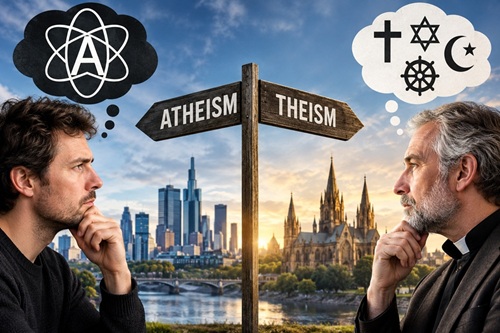 1. The Promise of a Third WayWhat if the choice between belief in God and disbelief in God were not the final word on religion? What if, instead of choosing between theism and atheism, we could discover a third possibility: a return to God after having passed through doubt, skepticism, and even the rejection of religious belief? This is the provocative suggestion of Irish philosopher Richard Kearney, who developed the concept of anatheism in his 2010 book Anatheism: Returning to God After God. The term combines the Greek prefix ana, suggesting a return, renewal, or movement upward, with theism. Anatheism is thus not simply theism restored after atheism has been defeated. It is an attempt to approach God again after the traditional certainties of religion have been dismantled. Kearney's proposal has considerable appeal in a secular age. It recognizes that inherited religious beliefs can no longer be taken for granted, while refusing to conclude that the disappearance of traditional certainty necessarily exhausts the possibilities of religious experience. God may return, but only as a question rather than an unquestionable answer. The central attraction of anatheism is that it takes doubt seriously. Its central problem, however, is whether it genuinely moves beyond the familiar opposition between theism and atheism, or merely provides a sophisticated way for religious belief to survive the intellectual challenges of secular modernity. 2. What Exactly Is Anatheism?Kearney's starting point is the experience of encountering the stranger. Drawing on biblical hospitality, phenomenology, and hermeneutics, he suggests that the possibility of God emerges when we welcome the other without knowing in advance who or what we are welcoming. The stranger might be a refugee, a visitor, a vulnerable person, or someone whose presence disrupts our established categories. Such encounters confront us with an ethical choice: we can close the door, or we can extend hospitality without guarantees. The biblical story of Abraham welcoming unexpected visitors is an important model. The guests may be ordinary strangers, yet their arrival is retrospectively interpreted as an encounter with the divine. The sacred appears not as an object that can be identified beforehand but as a possibility disclosed through hospitality. Anatheism attempts to preserve this openness. Rather than accepting God on the authority of tradition, one suspends judgment and makes oneself receptive to the possibility that the sacred might appear in an unexpected form. This is neither conventional theism nor straightforward atheism. The conventional theist claims that God exists and organizes belief around that conviction. The atheist rejects, or at least lacks belief in, the existence of God as understood by the relevant religious tradition. The anatheist instead emphasizes the possibility of an encounter whose significance cannot be settled in advance. But this formulation immediately raises a question. Is anatheism a new position concerning the existence of God, or is it primarily a new attitude toward uncertainty, otherness, and human experience? Much of its philosophical appeal depends on keeping those two questions distinct. 3. The Theological Advantage of Not Having to DecideAnatheism occupies an intriguing position in the contemporary religious landscape. Traditional theism often struggles to reconcile belief in an omnipotent, benevolent God with suffering, religious pluralism, and the apparent silence of the universe. Atheism, meanwhile, is sometimes criticized for dismissing dimensions of human experience that believers regard as spiritually significant. Anatheism appears to avoid both difficulties. It does not insist on an all-powerful supernatural being who intervenes in history, but neither does it rule out the possibility that encounters with others may disclose something sacred. Yet this flexibility comes at a price. If anatheism does not commit itself to the existence of God, it becomes difficult to establish what distinguishes it from a secular philosophy of hospitality. If it does commit itself to God's possible presence, it must explain what that possibility means and why it deserves to be taken seriously. The anatheist can respond that this is precisely the point: God is neither an object to be demonstrated nor a hypothesis to be eliminated. The divine is approached through an existential openness that precedes the final decision to believe or disbelieve. But this response risks turning anatheism into a position that cannot lose. If the sacred appears, anatheism can interpret the experience as a return of God. If it does not appear, anatheism can insist that the possibility remains open. If the evidence for a supernatural reality is absent, it can argue that the divine was never meant to be understood as an empirically detectable object in the first place. A philosophy that accommodates every possible outcome may be existentially attractive, but it becomes intellectually difficult to distinguish from a carefully protected form of agnosticism. 4. Has God Really Returned?The phrase "returning to God after God" suggests a dramatic intellectual and existential journey. One begins within a religious world, experiences its collapse, passes through doubt or disbelief, and then discovers a renewed possibility of faith. Such a trajectory is psychologically plausible. People sometimes abandon the religious traditions of their upbringing only to rediscover ritual, prayer, religious literature, or spiritual community later in life. Others emerge from secular skepticism with a renewed appreciation for the symbolic resources of religious traditions. But these experiences do not all amount to a return to God. Someone who leaves Christianity and subsequently discovers the moral power of the Sermon on the Mount may have returned to a religious text without returning to belief in a supernatural being. Someone who finds transcendence in music, nature, or human solidarity may be using religious language metaphorically. Someone who experiences an overwhelming sense of unity may be describing a psychological state rather than discovering a previously hidden dimension of reality. These distinctions matter because anatheism sometimes seems to slide between different meanings of the divine. God can mean a personal creator, a transcendent reality, an ethical demand, an experience of radical otherness, or a name for the mysterious depth of existence. Those meanings are not interchangeable. If God means a personal supernatural agent, then the question of God's existence remains open to philosophical and evidential scrutiny. If God means the ethical demand made upon us by another human being, then God's existence may not be at issue at all. The ethical demand can be real without being supernatural. Anatheism gains much of its attractiveness by allowing these meanings to resonate with one another. But resonance is not identity. The fact that human life contains experiences of mystery, obligation, and wonder does not establish that these experiences share a divine source. 5. Hospitality Without MetaphysicsOne of Kearney's strongest ideas is that hospitality involves a willingness to encounter the other without first reducing the other to an established category. We do not know everything about the stranger who arrives at our door. We must decide how to respond before we possess complete knowledge. This is an important ethical insight. Human relationships require trust, vulnerability, and an ability to tolerate uncertainty. An insistence on certainty before any encounter can take place would make ordinary social life impossible. Yet why should this ethical insight require anatheism? A secular humanist can argue that hospitality is justified by the vulnerability and dignity of human beings, their capacity to suffer, and the social conditions necessary for human flourishing. None of these considerations requires the possibility that the stranger is secretly God. Indeed, hospitality can be understood as a practice whose value does not depend on the metaphysical status of the person received. We welcome refugees because they are human beings in need of protection, not because they might embody a divine presence. The same principle applies to moral responsibility more generally. Compassion, generosity, and solidarity do not become less meaningful when detached from supernatural interpretations. Kearney's religious reading may deepen the experience for those who already inhabit a theological imagination. It may help them see ordinary encounters as occasions for spiritual transformation. But it does not follow that the religious interpretation supplies the foundation of the ethical insight. There is also a practical danger in treating the stranger as a possible manifestation of God. The stranger can become an instrument in the believer's spiritual drama, valued not simply as another person but as a vehicle for an encounter with transcendence. Hospitality should not require such an interpretation. The other person is not obliged to function as someone else's revelation. The secular alternative is therefore not a diminished form of hospitality. It is hospitality without theological conditions. 6. The Problem of the Sacred StrangerAnatheism's emphasis on radical openness raises another difficulty. If we cannot know in advance whether the stranger brings a divine possibility, how do we distinguish genuine revelation from deception, manipulation, or danger? Openness is not always a virtue. Strangers may be benevolent or malicious; religious authorities may inspire compassion or exploit vulnerability. An ethical commitment to hospitality cannot mean abandoning judgment. This is not an argument for indiscriminate suspicion. It is an argument for combining openness with discernment. We can remain willing to encounter others while retaining the right to evaluate their actions, claims, and demands. The same applies to religious experience. A profound sense of presence may be transformative, but the intensity of an experience does not guarantee the truth of the interpretation attached to it. People from incompatible religious traditions report encounters that feel equally compelling. Their subjective certainty cannot, by itself, settle which interpretation is correct. Anatheism can acknowledge this ambiguity, but it cannot simply appeal to mystery whenever competing interpretations arise. If a supposed encounter with the divine generates cruelty, submission to abusive authority, or contempt for outsiders, its ethical consequences deserve scrutiny regardless of how sacred it feels to the participant. The lesson is not that religious experiences are necessarily false. It is that experiences require interpretation, and interpretations remain open to criticism. 7. Anatheism and the Problem of Religious PluralismAnatheism has an obvious attraction in a religiously pluralistic world. Rather than insisting that one tradition possesses the exclusive truth, it invites a more hospitable encounter with religious difference. The idea that the sacred might arrive in an unfamiliar form can challenge dogmatism. It can encourage Christians to learn from Muslims, Buddhists to engage with Jews, and religious believers to listen to secular critics without treating them as spiritually deficient. But pluralism also exposes a problem. Religious traditions disagree not only about rituals and symbols but about fundamental claims concerning reality. Some affirm a personal creator; others reject such a creator. Some traditions speak of an immortal soul; others challenge the idea of a permanent self. Some interpret salvation as a relationship with God; others understand liberation in terms that do not require God at all. These differences cannot all be resolved by saying that every tradition offers a possible encounter with the sacred. Such a formulation may be generous, but it risks dissolving substantive disagreements into a common vocabulary of openness. Nor is it clear that all religious traditions would recognize themselves in Kearney's framework. To describe another tradition as an expression of an underlying anatheistic possibility may impose a philosophical interpretation that its practitioners reject. A genuinely pluralistic approach must permit differences to remain differences. It must also permit religious people and secular critics to question one another's claims without presuming that all positions secretly converge upon the same mystery. Anatheism is most persuasive as an invitation to dialogue, not as a theory that explains what all religions really mean. 8. The Return of God as a Psychological PhenomenonThere is another way to understand anatheism: as a description of a recurring psychological process. Religious belief is not always a simple matter of accepting or rejecting propositions. It is also bound up with identity, family, culture, memory, fear, hope, ritual, and the search for meaning. A person can intellectually reject religious doctrines while remaining emotionally attached to the world those doctrines once made intelligible. Under certain circumstances, the old religious vocabulary may become available again. A bereavement, a natural landscape, an encounter with extraordinary kindness, or a period of personal crisis may reactivate feelings once associated with God. Such experiences need not be dismissed as illusions. They may disclose real features of human existence: our dependence on others, our vulnerability, our awareness of mortality, and our capacity for wonder. But explaining these experiences does not require assuming that a supernatural being has returned. The psychological account also helps explain why anatheism may appeal particularly to people who have outgrown conventional religious belief without becoming indifferent to religious questions. It offers a way to reclaim the existential richness of religion without having to restore its entire doctrinal structure. This can be a legitimate personal achievement. Yet it is important to distinguish the recovery of religious meaning from the discovery of religious truth. A person may find a myth profoundly illuminating without believing that its events occurred. A ritual may provide comfort without requiring supernatural efficacy. A prayer may articulate gratitude, grief, or hope without demonstrating that anyone is listening. Anatheism is valuable to the extent that it helps people explore these possibilities honestly. It becomes less convincing when the meaningfulness of an experience is treated as evidence for the metaphysical interpretation that accompanies it. 9. Does Anatheism Transcend Theism and Atheism?The claim to transcend an established opposition deserves particular scrutiny. Intellectual movements frequently present themselves as moving beyond an outdated dichotomy. Sometimes they genuinely reveal a neglected alternative. At other times, they change the vocabulary while leaving the original problem unresolved. Anatheism can certainly transcend theism and atheism in a limited existential sense. A person need not be permanently confined to a religious identity or an anti-religious identity. Someone can reconsider inherited beliefs, remain uncertain, appreciate religious practices, and engage seriously with theological questions without settling into a fixed position. But this freedom does not establish a third answer to the question of God's existence. Consider three propositions. First, God exists. Second, God does not exist, or there is insufficient reason to believe that God exists. Third, the question should remain open to reconsideration. The third proposition is not logically equivalent to the first two, but it does not resolve the question they address. It expresses an attitude toward inquiry rather than a conclusion about reality. A theist can be open to reconsideration, an atheist can acknowledge uncertainty about philosophical definitions of God, and an agnostic can welcome religious experience without accepting supernatural claims. Consequently, anatheism's distinctive contribution cannot simply be its willingness to suspend judgment. Skeptics, agnostics, and religious pluralists have long defended versions of that position. Its more distinctive contribution is the suggestion that renewed openness to the divine can emerge through ethical encounters, hospitality, and a willingness to risk being changed by the other. That is a worthwhile philosophical and spiritual proposal. It is not, however, a demonstration that theism and atheism have been transcended in any decisive metaphysical sense. The distinction is important. Anatheism may offer a new way of inhabiting uncertainty without offering a new answer to the question that produced it. 10. The Danger of an Unfalsifiable GodTheological concepts become particularly difficult to criticize when they are deliberately separated from claims that could be evaluated against evidence. If God is understood as an invisible supernatural agent, questions about God's existence, powers, and relationship to the natural world arise. Different theological traditions offer different answers, and those answers can be examined philosophically and, where empirical claims are involved, scientifically. But if God is redefined as the possibility of meaning, the openness of existence, the ethical demand of the stranger, or the mystery that remains after explanation, the situation changes. These phenomena may be real, but their reality does not establish the existence of a divine being. The more God becomes a name for whatever remains meaningful after traditional belief has been abandoned, the less clear it becomes what the word contributes. This is not a demand that every meaningful concept be scientifically measurable. Love, justice, beauty, and obligation are not simply physical objects. Nevertheless, we can investigate their psychological, social, and philosophical dimensions without assuming that they are manifestations of a supernatural reality. Anatheism must therefore answer a question that its most evocative language can obscure: what difference does the divine make to our understanding of the world? If the answer is that God explains the existence of the universe, the emergence of consciousness, or the binding force of morality, then arguments and evidence are needed. If the answer is that God gives believers a distinctive way to interpret experiences of hospitality and wonder, then the proposal may be existentially fruitful without establishing any additional feature of reality. The latter claim is defensible. The former remains unproven. 11. What Does Anatheism Actually Add?A charitable reading of Kearney does not require treating anatheism as a scientific hypothesis or a new metaphysical system. Its purpose may be primarily hermeneutic: to offer a way of interpreting human encounters, religious symbols, and experiences of radical openness. On that reading, anatheism provides a language for people who cannot return to traditional faith but do not wish to reduce religion to an irrelevant residue of premodern thought. It recognizes that the abandonment of literal belief does not automatically eliminate the emotional, ethical, and imaginative significance of religious traditions. That is a genuine contribution. Religious stories can continue to provoke reflection after their supernatural claims have been rejected. The figure of the stranger can challenge our moral complacency. Biblical narratives can illuminate human dilemmas without being treated as transcripts of divine action. Religious practices can acquire new meanings in secular contexts. Yet one can accept all these possibilities without adopting anatheism. Literary interpretation, secular humanism, existentialism, phenomenology, and moral philosophy already provide resources for understanding how inherited religious traditions can remain significant beyond literal belief. The burden on anatheism is therefore to show what its theological vocabulary makes possible that these alternatives cannot adequately accomplish. Perhaps it helps some people remain receptive to experiences they would otherwise dismiss. Perhaps the language of God conveys an emotional and existential depth that purely secular terminology does not capture for them. Those are plausible claims about the role of religious language in human life. But they do not establish that the sacred has an existence independent of the people who experience it, interpret it, and name it. Anatheism can be defended as a practice of interpretation. It is much harder to defend as an ontological discovery. 12. A Secular Alternative: Wonder Without ReturnThe critical response to anatheism need not be a return to a rigid atheism that regards religious experience as inherently foolish or worthless. Such a position would overlook much of what makes Kearney's proposal attractive. A secular alternative can embrace wonder without treating wonder as evidence of transcendence. It can defend hospitality without imagining that the stranger may be God. It can acknowledge the limits of human knowledge without turning those limits into reasons to believe in something beyond the natural world. The universe is astonishing enough without being required to reveal a hidden spiritual intention. Evolution has produced organisms capable of consciousness, language, moral reflection, and scientific inquiry. Human beings can experience profound attachment, grief, awe, and solidarity in a world that offers no guarantee of cosmic purpose. These facts do not settle every philosophical question. Nor do they eliminate the possibility that some forms of religious experience raise interesting unresolved problems. They do, however, demonstrate that meaningfulness need not depend on a theological interpretation. The secular alternative also has an advantage in its treatment of uncertainty. It need not convert the unknown into a privileged opening for the divine. It can simply acknowledge what remains unexplained, investigate what can be investigated, and remain open to revision. This is not a claim that science answers every existential question. It is a refusal to assume that whatever science has not explained must belong to a sacred domain. There is something liberating about this position. We need not know whether the universe possesses an ultimate purpose before deciding how to live responsibly within it. We need not identify a transcendent source of value before recognizing the suffering of others. We need not return to God in order to rediscover the importance of human relationships. Wonder does not require a supernatural object. Openness does not require metaphysical suspension. And hospitality does not require a hidden theology. Conclusion: Anatheism as an Invitation, Not a DiscoveryRichard Kearney's anatheism deserves attention because it addresses a real problem in contemporary religious thought. Many people cannot honestly return to the certainties of inherited faith, yet they remain interested in the ethical, imaginative, and existential possibilities that religion has historically expressed. Anatheism offers such people a vocabulary of return without restoration. It suggests that God might be approached again, not as an unquestionable authority but as a possibility emerging through encounters with strangers and experiences that unsettle established assumptions. Its strength lies in this existential openness. Its weakness lies in the ambiguity of its central concept. When God is no longer clearly distinguished from ethical responsibility, psychological transformation, or the experience of mystery, the claim that God has returned becomes difficult to evaluate. Anatheism can show how religious meaning survives the loss of religious certainty. It can encourage hospitality, pluralism, and intellectual humility. It can provide a language through which former believers reinterpret their religious inheritance without simply reinstating its doctrines. But it does not establish that a divine reality has been rediscovered. Nor does it demonstrate that theism and atheism have been superseded by a more comprehensive position. The crucial question is whether anatheism is willing to let the possibility of God's absence remain as serious as the possibility of God's presence. If it is, then it offers a legitimate exploration of uncertainty, though one that need not be uniquely religious. If it is not, then its openness may conceal a preference for a theological conclusion that has been made increasingly difficult to challenge. Perhaps the most important lesson is that we do not have to decide in advance whether the universe is sacred in order to respond meaningfully to the world. We can welcome the stranger without wondering whether God has arrived in disguise. We can experience wonder without interpreting it as revelation. We can acknowledge mystery without turning it into metaphysics. Anatheism invites us to reconsider the possibility of God after the collapse of traditional belief. A critical secularism offers a different invitation: to reconsider the possibilities of human life after the collapse of the assumption that those possibilities must lead back to God. The first may be a path to renewed faith. The second is a path to meaning without theological guarantees. Neither should be confused with proof. And neither should be allowed to escape critical examination merely because it speaks in the language of openness, humility, or mystery.
Widget is loading comments...
|