|
TRANSLATE THIS ARTICLE
Integral World: Exploring Theories of Everything
An independent forum for a critical discussion of the integral philosophy of Ken Wilber
  Frank Visser, graduated as a psychologist of culture and religion, founded IntegralWorld in 1997. He worked as production manager for various publishing houses and as service manager for various internet companies and lives in Amsterdam. Books: Ken Wilber: Thought as Passion (SUNY, 2003), and The Corona Conspiracy: Combatting Disinformation about the Coronavirus (Kindle, 2020).
Check out my other conversations with ChatGPT
Theism, Atheism and Beyond?:
Dawkins vs. McGrath The Varieties of Atheism The Return of Theism Integral Spirituality Anatheism: A Third Way Religion Without Religion The Religion of Tomorrow The Return of TheismHas God Come Back, or Did He Ever Leave?Frank Visser / ChatGPT
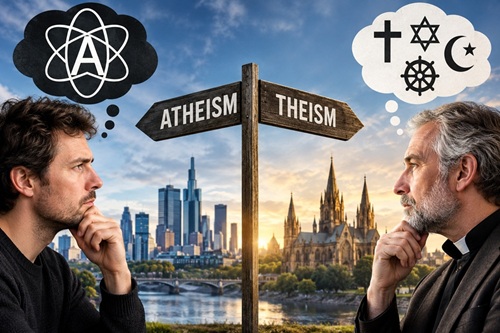 Introduction: The God Who Wouldn't Stay DeadFor much of the twentieth century, the intellectual trajectory of the modern world seemed to point in one direction: the retreat of religion. Science explained phenomena once attributed to divine intervention, biblical criticism challenged the historical reliability of sacred texts, and secularization appeared to accompany industrialization, education, and political modernization. The God who had once served as the ultimate explanation of the cosmos, the origin of life, and the foundation of morality seemed increasingly unnecessary to intellectual life. Then came the surprises. Religion did not simply disappear. The so-called New Atheism of the early twenty-first century provoked an energetic backlash. Philosophical arguments for God's existence returned to prominence in some academic circles. Public intellectuals began debating whether secular societies could sustain meaning, morality, and social cohesion. Religious nationalism gained political influence, while sophisticated forms of Christian apologetics found new audiences online. Meanwhile, some critics of materialism argued that consciousness, reason, and the apparent intelligibility of nature point beyond a purely naturalistic universe. Thus we hear talk of the return of theism. But what exactly is returning? Is it belief in a personal creator who intervenes in human affairs? A philosophical first cause? A cosmic intelligence? A vaguely spiritual ground of being? Or is it merely the return of religion as a political and cultural force, mistaken for a revival of its intellectual credibility? These are very different developments. To treat them as one phenomenon is to confuse the resurgence of religious identity with the vindication of religious truth claims. The central argument of this essay is that the return of theism is real in some cultural and intellectual settings, but its significance is frequently exaggerated. Theism has not been scientifically rehabilitated simply because it has become culturally fashionable again, and the weaknesses of secularism do not automatically constitute evidence for God. What we are witnessing is less a triumphant return of a defeated intellectual position than a struggle over what should replace the certainties that modernity has unsettled. 1. The Death of God Was Prematurely AnnouncedThe secularization thesis was never as straightforward as its popular versions suggested. Modernization did not lead everywhere to the disappearance of religion. Religious institutions lost influence in some societies, particularly in parts of Western Europe, while religious movements remained vibrant elsewhere. Even within increasingly secular populations, spirituality, religious identification, and the search for existential meaning did not necessarily follow the same trajectory. The familiar narrative of religion steadily retreating before science was therefore too simple. It treated religion as a single phenomenon, when it is better understood as a collection of beliefs, institutions, rituals, identities, and practices that respond differently to historical change. The decline of church attendance does not establish the disappearance of religious sentiment. Conversely, the popularity of spiritual practices does not demonstrate renewed belief in a supernatural creator. A person may reject organized religion while believing in an impersonal cosmic intelligence; another may attend church primarily for community and tradition without accepting its doctrines literally. Even the phrase the return of theism conceals these distinctions. Theism, strictly speaking, involves belief in a deity or deities, commonly understood in contemporary philosophical debates as a personal God. It is not synonymous with spirituality, mysticism, idealism, or a general suspicion of materialism. The death of God, in other words, was never a single event. Nor is his supposed resurrection a single event. Religion can lose its authority as an explanation of nature while retaining its emotional appeal, political usefulness, and capacity to organize human communities. The important question is not whether religion has returned. Religion never left. The question is whether its traditional claims about reality have acquired stronger justification. 2. The New Atheism Has Lost Its Cultural MomentumOne reason for the talk of theism's return is the apparent decline of the New Atheism movement that dominated public debates about religion in the 2000s. Richard Dawkins, Daniel Dennett, Sam Harris, and Christopher Hitchens challenged religious believers to defend their claims in the public square. Their books became bestsellers, and their debates attracted audiences that had rarely shown much interest in academic philosophy of religion. Yet the movement's cultural prominence has faded. A 2025 study by political scientist Steven Kettell traces the decline of the American atheist movement to internal divisions, organizational difficulties, and conflicts over identity and political strategy. The movement that had briefly appeared capable of organizing a broad secular counterculture struggled to maintain a common purpose. This is an important development, but its interpretation requires care. The decline of an intellectual movement does not demonstrate the truth of the position it opposed. The popularity of an argument and its validity are separate matters. The New Atheists also made themselves vulnerable to criticism. Their tendency to treat religion primarily as a collection of factual propositions competing with science sometimes left insufficient room for its cultural, existential, ethical, and communal dimensions. Religious scholars were right to object that religion cannot be understood solely by examining whether particular supernatural claims are true. But the opposite mistake is equally serious. Showing that religion has functions beyond explaining the physical world does not establish the existence of its supernatural referents. A ritual can be psychologically effective without its accompanying mythology being historically accurate. A religious community can provide solidarity without possessing privileged access to cosmic truth. The New Atheists may have underestimated religion as a human phenomenon. Their critics sometimes respond by overestimating religion as a source of knowledge. The intellectual space between these positions remains open. 3. The New Apologetics: From Refuting Atheism to Rebranding GodThe contemporary defense of theism often takes a more sophisticated form than the familiar argument that the universe must have been created in six days or that evolution is scientifically impossible. Modern apologists frequently accept evolutionary biology, cosmology, and much of contemporary science. Instead, they argue that science itself leaves unanswered questions that point toward a transcendent explanation. Why does anything exist rather than nothing? Why does the universe have laws? Why are its fundamental parameters compatible with complex structures and life? How can conscious experience arise in a physical universe? What grounds objective moral values, if such values exist? These are legitimate philosophical questions. They should not be dismissed simply because religious thinkers raise them. But their legitimacy does not establish the validity of the answers offered. The most important distinction is between identifying an explanatory problem and demonstrating that God solves it. The first does not automatically accomplish the second. Consider the fine-tuning argument. Some features of fundamental physics appear to fall within ranges compatible with the emergence of complex structures. Theists argue that this apparent suitability is better explained by design than by chance. But the argument depends on unresolved questions about the possible range of physical parameters, the probabilities assigned to different universes, and whether alternative cosmological explanations are available. Calling the universe designed does not independently establish how the designer exists, why it possesses particular intentions, or how it selected the laws we observe. The appeal to design may relocate the explanatory problem rather than resolve it. The same difficulty confronts cosmological arguments. Even if one could establish that the universe requires some ultimate explanation, it would not immediately follow that this explanation is a personal, omnipotent, omniscient, and morally perfect God. Those are additional claims requiring additional arguments. A first cause is not yet the God of Christianity. An explanation for the existence of the universe is not yet an explanation for revelation, miracles, divine commandments, or life after death. The gap between a philosophical first principle and a historically specific religion is enormous. Apologetics often crosses it much faster than its arguments warrant. 4. The God of the Gaps Has Learned New VocabularyThe older God of the gaps was invoked to explain phenomena that science could not yet account for. Lightning, planetary motion, the diversity of life, and the origin of humanity were assigned supernatural causes. As scientific explanations improved, the territory reserved for divine intervention contracted. Contemporary apologetics has learned from this history. Rather than locating God in the gaps between scientific explanations, some thinkers locate God in the very existence of the explanatory order. God is no longer necessarily the explanation for a particular physical event. God is said to be the ground of being, the source of intelligibility, the condition for the existence of natural laws, or the ultimate reason why there is something rather than nothing. This is philosophically more interesting than crude supernaturalism. It also makes the argument harder to assess empirically. If God is defined as the ultimate ground of existence, then God is not being proposed as one more object within the universe. The question becomes whether this concept adds explanatory content or merely gives a theological name to the fact that reality exists. The distinction matters. An explanation should ideally help us understand why something is the case rather than merely restate that it is the case in more elevated language. Suppose someone asks why the universe exists. The answer that it exists because of God is informative only if we have independent grounds for believing that God exists and some understanding of how the proposed explanation works. If God is simply defined as whatever ultimately explains existence, the explanation risks becoming circular: the existence of reality is explained by postulating an entity whose existence is itself exempted from the question. The theist may respond that God exists necessarily, whereas the universe is contingent. That is a coherent philosophical proposal, but it is not self-evident. Why must a necessary being exist? Why cannot reality itself, or some fundamental physical structure, be necessary? What justifies treating one proposed terminus of explanation as metaphysically privileged over another? These questions are not settled by attaching the word necessary to God. There is also a more basic problem. Even if a necessary foundation of reality could be established, why identify it with a mind, a will, or a being capable of love? The movement from metaphysical necessity to divine personality remains a major inferential leap. The God of the gaps has not necessarily disappeared. In some contemporary arguments, the gaps have become philosophical rather than scientific. 5. Consciousness: The New Frontier of TheismConsciousness is perhaps the most promising battleground for contemporary arguments against reductive materialism. We know that human experience depends profoundly on brain activity, yet explaining why physical processes are accompanied by subjective experience remains a difficult philosophical problem. Why does seeing red feel like something? Why is pain experienced rather than merely processed? How does the first-person character of experience fit into a scientific description of the world? Some theists argue that consciousness makes more sense if mind is fundamental rather than derivative. If the universe is grounded in divine intelligence, they suggest, the emergence of conscious beings is less mysterious than it would be in a fundamentally mindless reality. This argument deserves to be taken seriously as philosophy, but its limitations should be equally clear. First, the difficulty of explaining consciousness does not establish that consciousness is supernatural. A problem that remains unsolved is not automatically evidence for any particular solution. The history of science is full of phenomena whose mechanisms were initially obscure but eventually became better understood. Second, rejecting reductive materialism does not require accepting theism. There are numerous alternatives, including property dualism, panpsychism, neutral monism, and varieties of idealism. These positions differ substantially, but they demonstrate that the choice is not simply between a mechanistic universe and a universe created by God. Third, even if consciousness were shown to be a fundamental feature of reality, it would not follow that the universe possesses a single, unified consciousness, much less that this consciousness corresponds to a deity described by a particular religion. A fundamental feature of reality is not necessarily a personal agent. This is where the argument often changes character. A genuine problem in philosophy of mind becomes an invitation to adopt a much more comprehensive metaphysical worldview. The invitation may be intellectually stimulating, but the additional claims require independent justification. The mystery of consciousness is real. Whether God explains it better than rival theories remains an open question. 6. The Moral Argument: Can We Be Good Without God?Another important component of the return of theism is the claim that secular societies cannot ultimately sustain morality. If there is no God, the argument goes, moral values are merely human preferences, evolutionary adaptations, or social conventions. Without a transcendent foundation, nothing is objectively right or wrong. This argument has considerable rhetorical force because it connects metaphysical belief with practical concerns. People want to know not only how the universe began but also why they should be good, whether justice ultimately matters, and whether the suffering of innocent people has any larger significance. Yet the moral argument repeatedly conflates two distinct questions: where moral capacities and beliefs come from, and whether moral judgments can be justified. Evolutionary biology and psychology can help explain the emergence of empathy, cooperation, reciprocity, and moral emotions. Anthropology and history reveal how moral norms develop and vary across societies. Philosophy examines how principles of fairness, well-being, rights, and responsibility can be defended or criticized. None of these approaches automatically establishes a complete moral theory. But neither does theism solve the problem merely by invoking God. If something is good because God commands it, morality risks becoming dependent on divine authority rather than on reasons that can be examined. If God commands something because it is good, then goodness appears to have a rationale not reducible to the command itself. This is the familiar Euthyphro problem, and religious philosophers have developed sophisticated responses to it. They may argue, for example, that goodness is grounded in God's nature rather than in arbitrary commands. But that response introduces further questions about what makes God's nature good and how humans can reliably identify its implications. There is also no straightforward empirical relationship between religious conviction and moral conduct. Religious people can act compassionately, courageously, and generously. They can also defend cruelty, exclusion, and domination. Nonreligious people display the same range of human possibilities. The existence of secular moral philosophies does not prove that every moral question has an easy secular answer. It does, however, undermine the assertion that morality becomes impossible without belief in God. A society can debate moral values through public reasoning, shared human needs, concern for suffering, and the consequences of its institutions. Such a process is fallible, but fallibility is not the same as meaninglessness. Indeed, a morality that must be defended through reasons available for public scrutiny may be more intellectually responsible than one whose authority rests on an alleged revelation that outsiders cannot independently verify. 7. The Existential Vacuum: Religion as a Supplier of MeaningThe contemporary appeal of theism cannot be understood through philosophical arguments alone. Religion offers narratives of belonging, purpose, suffering, death, and hope. It places individual lives within a larger story and promises that injustice does not have the final word. Modern secular societies often struggle to provide equally compelling shared narratives. Economic insecurity, social fragmentation, political polarization, and the erosion of traditional communities can leave individuals feeling disconnected from any larger collective purpose. Religion can respond to these needs. It offers rituals marking birth, marriage, bereavement, and death. It connects individuals with communities that extend beyond immediate family and friendship. It supplies symbolic resources for interpreting experiences that resist easy explanation. These are substantial human goods, and a serious critique of theism should acknowledge them. But we must distinguish the usefulness of a belief from its truth. A comforting belief is not necessarily false, but its capacity to comfort does not establish its truth either. The idea that the universe has a benevolent purpose may help someone endure suffering. That psychological benefit does not show that the universe actually possesses such a purpose. Belief in an afterlife may alleviate the fear of death, but it does not constitute evidence that personal consciousness survives bodily death. The danger is that existential needs can influence how people assess evidence. When a worldview promises that our lives are cosmically significant, that the dead are not truly lost, and that justice will ultimately prevail, rejecting it can feel like surrendering something precious. This does not mean religious believers are irrational or merely wishful thinkers. Secular people also hold beliefs that satisfy emotional and social needs. The point is more general: all of us must guard against allowing the desirability of a conclusion to substitute for evidence supporting it. Nor must the choice be between religious consolation and existential despair. Human meaning can be understood in terms of relationships, creativity, intellectual discovery, moral commitments, cultural achievements, and the reduction of suffering. Such meanings need not be guaranteed by the universe to be real within human life. A finite achievement is not worthless because it will not last forever. A friendship does not become meaningless because it ends. The value of a human life need not depend on its occupying a privileged position in the architecture of the cosmos. The return of theism may therefore reveal less about a newly discovered God than about persistent human needs that secular societies have not always addressed successfully. 8. From Intellectual Revival to Political ReactionThe contemporary return of theism also has a political dimension. Some public intellectuals and political movements increasingly present Christianity not merely as a religion but as the indispensable foundation of Western civilization. In this account, secular liberalism has undermined the moral and cultural conditions on which it depends. Religious tradition is therefore portrayed as the necessary remedy for social fragmentation, declining birth rates, individualism, and a perceived loss of national identity. There are legitimate questions here. Religious institutions have contributed to education, charity, social solidarity, art, and political reform. They have also helped sustain oppressive hierarchies, persecuted dissenters, and resisted scientific and social change. Their historical record is neither uniformly benevolent nor uniformly destructive. The problem begins when historical influence is converted into a claim of political necessity. Even if Christianity helped shape European institutions, it does not follow that contemporary European societies must accept Christian theology to preserve democracy, human rights, or social solidarity. Historical origins do not establish permanent institutional requirements. Nor does the historical importance of Christianity establish the truth of its supernatural claims. A religion can be culturally consequential without being metaphysically correct. The political version of theism also risks confusing the defense of a tradition with the defense of a truth. A society may reasonably preserve its historical heritage while allowing its religious doctrines to be questioned, revised, or rejected. When religious identity becomes a test of national belonging, theism can cease to be primarily a response to philosophical questions and become a means of drawing boundaries between insiders and outsiders. This is particularly troubling when religious authority is used to resist pluralism or to restrict the rights of people who do not share the dominant faith. A doctrine may be deeply meaningful to its adherents without being entitled to govern everyone else. The return of theism is therefore not automatically a return to intellectual seriousness. In some contexts, it is a return to the political uses of religion. 9. What the Numbers Actually Tell UsClaims of a broad religious revival also deserve empirical scrutiny. The American religious landscape provides a useful example. Pew Research Center's 2025 Religious Landscape Study found that 83 percent of U.S. adults believed in God, a decline from 92 percent in 2007. At the same time, the study suggested that the long decline in Christian identification might be slowing or leveling off. These findings indicate a complex situation rather than a simple religious resurgence. Other surveys reveal that many religiously unaffiliated people retain spiritual beliefs. Some believe in a soul, an afterlife, or a universal spirit without identifying with an organized religion. The boundary between religious and secular worldviews is consequently more porous than a simple division between believers and atheists suggests. Yet these figures do not establish that theism is returning as a dominant intellectual position. Nor should high levels of belief in God be confused with increasing belief in God. A belief can remain widespread while becoming less widespread over time. Recent research on religious change across countries also continues to find long-term declines in various measures of religiosity, although the pace and form of those declines differ considerably by region and religious tradition. The evidence thus calls for caution. There may be localized revivals, increased religious interest among particular groups, and a renewed willingness among some intellectuals to discuss theism sympathetically. None of these developments alone demonstrates a general reversal of secularization. The distinction between an intellectual fashion and a demographic trend is especially important. A few prominent conversions, a popular podcast, or a series of viral debates can create the impression of a major historical turning point. But visibility is not the same as prevalence, and neither is the same as truth. The proper question is not whether we can find evidence of a return. We can. It is whether the available evidence supports the sweeping narrative of a post-secular age. So far, that conclusion appears premature. 10. The Asymmetry of Scientific and Theological ExplanationOne recurring claim in contemporary theistic arguments is that science cannot explain everything. This is true, but its implications are often misunderstood. Science does not claim to have answered every question about existence, consciousness, morality, or meaning. Its strength lies in developing explanations that can be tested, challenged, refined, and compared with alternatives. Its methods are not equally suited to every philosophical question, and some questions may require conceptual analysis rather than empirical investigation alone. Theism, by contrast, is a family of metaphysical positions whose central claims are not generally tested in the same manner as scientific hypotheses. Some religious claims have observable implications, and those implications can be investigated. Other claims concern transcendent realities that are not straightforwardly accessible to empirical testing. This difference does not mean that only scientific questions are meaningful. It means that different kinds of claims require different kinds of justification. The asymmetry becomes problematic when theists invoke the limitations of science as positive evidence for their own conclusions. If science cannot yet explain consciousness, this does not establish that consciousness is divine. If cosmology cannot provide a definitive answer to why there is something rather than nothing, it does not establish that a personal creator exists outside space and time. The absence of a scientific explanation is not itself an explanation. Equally, a naturalistic worldview should not pretend that all philosophical problems have already been resolved. Questions about the nature of consciousness, the status of moral values, and the foundations of scientific reasoning remain legitimate areas of inquiry. Naturalists can disagree profoundly about how these questions should be answered. The appropriate response to unresolved problems is to investigate them without assuming that the preferred answer must be correct. Theists sometimes accuse naturalists of turning methodological naturalism into a metaphysical dogma. That criticism can be justified when naturalists dismiss philosophical possibilities merely because they are unfamiliar or difficult to test. But the opposite danger is equally real: treating the inadequacy of one explanation as evidence for a favored supernatural alternative. A critical naturalism should remain open to evidence and argument without allowing every unexplained phenomenon to become an invitation to metaphysical speculation. The standard is not that God must be disproved before natural explanations can be accepted. The standard is that positive claims about reality should be supported by positive reasons. 11. The Problem of Divine HiddennessIf the return of theism is supposed to establish not merely an abstract first cause but a loving God who wants a relationship with humanity, one familiar problem remains particularly difficult: divine hiddenness. Many people sincerely seek religious truth and fail to find convincing evidence for the existence of God. Others grow up in different religious traditions, each presenting its own understanding of ultimate reality. Still others lose their faith after years of reflection rather than through indifference or hostility. Why would a perfectly loving God allow sincere, capable people to remain unconvinced of his existence? The standard responses are familiar. Perhaps God values freedom, wishes to avoid coercing belief, or wants people to develop spiritually through uncertainty. Perhaps divine purposes are beyond human understanding. These possibilities cannot simply be dismissed. But they must be evaluated rather than treated as automatic solutions. The appeal to freedom, for example, is not obviously sufficient. Knowing that another person exists does not compel us to love or obey that person. If God wanted humans to have a relationship with him while preserving their freedom, clearer evidence of his existence would not necessarily prevent that relationship from being voluntary. Likewise, the suggestion that hiddenness serves a developmental purpose raises the question of why the resulting uncertainty appears so unevenly distributed. Why do some people find religious belief almost unavoidable, while others encounter persistent and apparently sincere doubt? The problem becomes more serious when divine hiddenness is considered alongside apparently gratuitous suffering. A God who is both perfectly loving and capable of intervening would presumably have reasons for allowing terrible events, but those reasons are not always evident to human observers. The traditional response is that human understanding is limited. That may be true. But if every apparent difficulty can be answered by appealing to reasons that are inaccessible to us, the theory risks losing its explanatory vulnerability. A worldview that can accommodate every possible state of affairs may be difficult to disprove, but it is not thereby strongly supported. The return of theism has not removed these classical problems. In some contemporary discussions, they receive less attention than arguments from consciousness, fine-tuning, or the intelligibility of nature. Yet they remain central to the question of whether the God being defended is not merely conceivable but worthy of belief. 12. Atheism Is Not a Complete Worldview—and Theism Is Not the Only AlternativeOne reason theism continues to attract thoughtful people is that atheism, understood simply as the rejection of belief in God, does not by itself provide a comprehensive account of reality or human life. An atheist can be a moral realist or a moral relativist, a materialist or an idealist, a humanist or a pessimist. Atheism alone does not settle questions about consciousness, the foundations of morality, the meaning of life, or the political organization of society. This is a genuine limitation of atheism as a standalone philosophical position. But it is not a special defect. Theism alone does not settle these questions either. A Christian, a Muslim, and a Hindu may all believe in some form of divine reality while disagreeing profoundly about its nature and implications. Even within Christianity, there are substantial disagreements about salvation, revelation, biblical interpretation, and the relationship between faith and reason. Invoking God therefore does not eliminate the need for further philosophical work. It introduces additional commitments that must themselves be examined. More importantly, the alternatives are not exhausted by atheism and theism. Agnosticism, religious naturalism, secular humanism, non-theistic spirituality, and various forms of philosophical naturalism offer different ways of approaching questions that religion has traditionally addressed. Some thinkers seek to preserve religious practices and symbolic language while abandoning literal supernatural claims. Others reject theism while maintaining that reality contains features not adequately described by simplistic forms of materialism. Still others regard religious traditions as culturally valuable repositories of human insight without treating their scriptures as infallible sources of knowledge. These positions should not be lumped together. Their differences matter. But their existence undermines the suggestion that dissatisfaction with secular materialism must lead toward God. One can criticize reductionism without embracing supernaturalism. One can recognize the depth of religious experience without treating every interpretation of it as correct. One can admit that human knowledge is incomplete without concluding that a particular religious tradition possesses the missing pieces. The intellectual landscape is richer than the binary debate between atheism and theism suggests. 13. What Would Count as a Genuine Intellectual Return?The phrase return of theism would have a stronger claim to intellectual significance if it referred to a demonstrable improvement in the evidence and arguments supporting the existence of God. What would such an improvement look like? It would require more than identifying weaknesses in atheistic arguments. It would require clarifying what is meant by God, distinguishing among competing concepts of divinity, and demonstrating why the preferred concept offers a better explanation than its alternatives. It would also require confronting counterarguments directly. The problem of evil, divine hiddenness, religious disagreement, and the historical development of religious beliefs cannot be dismissed as superficial objections raised only by people who misunderstand religion. A compelling defense of theism would need to explain not only why the universe exists, but why its existence supports the particular divine attributes being claimed. It would need to distinguish what is established by philosophical argument from what is accepted through revelation, tradition, or personal experience. And it would need to resist a familiar apologetic strategy: demanding rigorous standards of evidence for naturalistic explanations while allowing much looser standards for supernatural ones. This does not mean that theism must be testable in precisely the same way as a scientific theory. Philosophical claims are not all scientific hypotheses. But theists should be able to explain what their claims actually assert, what reasons support them, and what considerations might count against them. If no conceivable evidence or argument could count against a theological position, its defenders should be honest about its status. It may function as a fundamental commitment or interpretive framework rather than as an empirically supported explanation. There is nothing inherently illegitimate about philosophical commitments. The problem arises when commitments are presented as discoveries. A genuine intellectual return of theism would therefore be less concerned with declaring atheism bankrupt than with showing, step by step, why a particular form of theism deserves acceptance. That remains a demanding task. Conclusion: The Return of the Question, Not the Triumph of GodThe return of theism is best understood as a convergence of several developments rather than as a single historical reversal. The New Atheism has lost some of its cultural prominence. Philosophical arguments for God continue to attract serious attention. Religious identities remain politically influential, and existential questions about meaning, consciousness, morality, and death have not been resolved by scientific progress alone. These developments deserve examination. They do not, however, establish that theism has regained the intellectual authority it once possessed. The most significant lesson may be that the older opposition between religious certainty and secular confidence was too simple. Science has not answered every philosophical question, but religion has not demonstrated that its traditional answers are correct. Secular societies can experience moral and existential difficulties without those difficulties serving as evidence for supernatural realities. Theism remains a legitimate philosophical position to investigate. It should neither be dismissed merely because it is religious nor accepted merely because its critics have failed to solve every problem. Its claims must be evaluated on their own merits, alongside the alternatives. Perhaps the real return is not the return of God but the return of questions that neither science nor secular philosophy can responsibly ignore: Why does reality exist? What is consciousness? How should we live? What makes a life meaningful? What, if anything, survives death? Religions have offered answers to these questions for millennia. Their longevity demonstrates their historical and human significance, not the truth of every answer they contain. We should be willing to learn from religious traditions without surrendering critical judgment, just as we should recognize the limits of scientific explanation without turning those limits into supernatural conclusions. The intellectual task is not to resurrect God or to bury him once again. It is to determine, as honestly as possible, what we have good reason to believe. Theism may be returning to public debate. Whether it is returning to intellectual credibility is a different question altogether.
Widget is loading comments...
|