|
TRANSLATE THIS ARTICLE
Integral World: Exploring Theories of Everything
An independent forum for a critical discussion of the integral philosophy of Ken Wilber
  Frank Visser, graduated as a psychologist of culture and religion, founded IntegralWorld in 1997. He worked as production manager for various publishing houses and as service manager for various internet companies and lives in Amsterdam. Books: Ken Wilber: Thought as Passion (SUNY, 2003), and The Corona Conspiracy: Combatting Disinformation about the Coronavirus (Kindle, 2020). Frank Visser, graduated as a psychologist of culture and religion, founded IntegralWorld in 1997. He worked as production manager for various publishing houses and as service manager for various internet companies and lives in Amsterdam. Books: Ken Wilber: Thought as Passion (SUNY, 2003), and The Corona Conspiracy: Combatting Disinformation about the Coronavirus (Kindle, 2020).
Check out my other conversations with ChatGPT
BIG NAMES IN BIG HISTORY Big History Pioneers David Christian's Grand Narrative Eric Chaisson's Cosmic Evolution Fred Spier's Big History Tyler Volk's Grand Sequence Other Cosmic Models Erich Jantsch, the Forgotten Architect Sagan and Schneider on Entropy Bobby Azarian's Evolutionary Model Brendan Graham Dempsey's Emergentism Jagers op Akkerhuis' Third Law Ken Wilber and Big History Wrapping Up: Six Questions for Big History Six Questions for Big HistoryComplexity, Direction, Emergence, Humanity, Historical Laws, and MeaningFrank Visser / ChatGPT
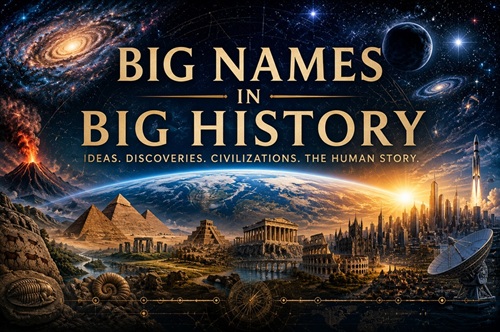 Introduction: From a grand narrative to six difficult questionsBig History has one enormous intellectual advantage over conventional history: it refuses to begin the story with human beings. Instead of starting with the invention of writing, the rise of agriculture, or the emergence of the first civilizations, Big History starts with the universe itself. Its subject is therefore the entire sequence of transformations through which the present world came into existence: the Big Bang, galaxies and stars, chemical elements, planets, life, biological evolution, humans, language, culture, agriculture, cities, states and technological civilization. This enlargement of historical scale is intellectually liberating. It places humanity in a much larger context and encourages connections between disciplines that are too often studied separately. Cosmology, geology, chemistry, biology, archaeology, anthropology and history suddenly become chapters in one enormous story. But this enlargement also creates a serious theoretical problem. Once the entire history of the universe is presented as a single narrative, it becomes tempting to assume that there must be some single principle explaining the trajectory as a whole. The appearance of increasing complexity, the emergence of life, the development of intelligence, the rise of cumulative culture and the acceleration of technological change can begin to look like successive stages in one gigantic evolutionary process. This is where Big History encounters its deepest questions.
These six questions provide a useful framework for comparing the different models of Big History. They also reveal why Ken Wilber's Integral Theory belongs in the conversation, even though it is not Big History in the strict disciplinary sense. Wilber attempts to answer all six questions within a single evolutionary-metaphysical framework. Big Historians tend to approach them more cautiously and piecemeal, drawing on different scientific disciplines to explain different stages of the cosmic story. The tension between these approaches is productive. It forces us to distinguish between what science actually explains and what philosophical interpretation adds to the scientific story. 1. Why does complexity arise?Perhaps the most obvious feature of Big History is that the universe has repeatedly produced organized structures of astonishing complexity. The early universe was comparatively simple. Yet over billions of years it produced galaxies, stars, planetary systems, chemical elements, complex molecules, living organisms, ecosystems, nervous systems, brains and civilizations. Why? Several Big History traditions have offered different answers. Eric Chaisson emphasizes energy flows and developed the concept of energy-rate density to compare systems ranging from stars to organisms and human societies. His basic intuition is that increasingly complex systems are associated with increasingly intense energy flows through them. Fred Spier approaches the problem through thermodynamics and his concept of Goldilocks conditions. Complexity can emerge when conditions are neither too destructive nor too static. There must be sufficient energy flow to drive organization, but not so much that existing structures are destroyed. This is an important corrective to simplistic narratives of inevitable progress because it emphasizes the narrow conditions under which complexity can actually flourish. Eric Jantsch placed greater emphasis on self-organization. Influenced by systems theory and the study of dissipative structures, he argued that order need not always be imposed from outside. Under appropriate conditions, physical and biological systems can spontaneously develop organized patterns. Stuart Kauffman pushes this insight further. His work on autocatalytic networks, self-organization and the "adjacent possible" suggests that evolutionary novelty does not arise exclusively through random variation followed by natural selection. Physical, chemical and biological dynamics continually generate new possibilities upon which selection can subsequently act. Nick Lane provides a more concrete biological approach by focusing on bioenergetics and the origin of life. Instead of speaking abstractly about "energy," he asks what specific energy-generating mechanisms could have made cellular life possible in the first place. These approaches suggest an important conclusion: there may be no single thing called "the cause of complexity." A star, a hurricane, a bacterial cell, an ecosystem and a technological civilization are all complex, but they are complex in radically different ways. The mechanisms producing their organization are not identical. This should make us cautious about universalizing any one explanatory principle. Energy, information, self-organization, selection, feedback and complexity are not interchangeable concepts. Each illuminates certain phenomena while potentially obscuring others. The challenge for Big History is therefore to find genuine continuity without erasing important differences. The fact that we can place stars, organisms and civilizations on one historical timeline does not mean that one mechanism explains all three. 2. Does evolution have a direction?The second question is even more controversial. When we look backward across cosmic history, there appears to be a direction. Matter forms stars; stars manufacture heavier elements; those elements participate in increasingly complex chemistry; planets provide environments in which life can emerge; life evolves into increasingly complex organisms; some organisms develop nervous systems; and one particular lineage eventually produces humans, cumulative culture and technological civilization. The sequence is so striking that it is difficult not to interpret it as directional. But direction can mean several different things. It can simply mean historical sequence: events have an irreversible order. It can mean that certain measurable properties have increased over time, such as complexity, energy throughput, information storage or technological capacity. Or it can mean something much stronger: that evolution is intrinsically progressive and tends toward particular outcomes. The third interpretation is where the controversy begins. David Christian's threshold model is relatively cautious. He identifies major transitions at which new forms of complexity become possible, but a threshold does not necessarily imply that evolution was trying to reach it. Fred Spier's Goldilocks conditions similarly explain the emergence of complexity through particular physical circumstances rather than cosmic purpose. Wilber is much more explicit. His concept of evolutionary Eros proposes an intrinsic tendency toward greater complexity, integration and consciousness. Evolution is therefore not merely a sequence of contingent physical and biological processes; it expresses something deeper about the nature of reality. Teilhard de Chardin represents an earlier and even more explicitly spiritual version of this idea. His evolutionary story moves from matter to life to consciousness and ultimately toward the Omega Point. Simon Conway Morris provides an interesting scientific complication. His work on convergent evolution suggests that evolution repeatedly arrives at similar solutions. Eyes, echolocation, intelligence and other adaptations have evolved independently in different lineages. If evolutionary history contains extensive convergence, then perhaps evolution is not as radically arbitrary as it might appear. But convergence still does not necessarily establish purpose. Evolution may repeatedly arrive at similar solutions because organisms encounter similar physical and ecological constraints. Natural selection can therefore produce recurring outcomes without those outcomes having been predetermined. This distinction is fundamental. Constraint is not purpose. A river flows downhill because of gravity, but gravity does not have a destination in mind. Similarly, evolution may be constrained toward certain adaptive solutions without being directed toward them in the teleological sense. John Stewart and Robert Wright push the question further by proposing evolutionary mechanisms that can generate increasing cooperation and organization. Their work is particularly interesting because it seeks to explain evolutionary directionality without explicitly invoking spirituality. We are therefore confronted with several different possibilities. Evolution may be overwhelmingly contingent. It may nevertheless be constrained toward recurring solutions. It may display statistical tendencies toward greater organization. It may possess a genuine direction. Or it may possess a deeper purpose. These are very different claims. A central task for Big History is therefore to distinguish directional patterns from teleology. 3. How does genuinely new organization emerge?The third question concerns evolutionary novelty. The history of the universe is not simply a story of gradual modification. At several points, radically new levels of organization appear. Independent cells become integrated into multicellular organisms. Formerly independent organisms become components of larger biological systems. Individual organisms form colonies and societies. Humans create institutions, economies and states. Separate populations become connected into civilizations and eventually into global networks. These transformations are often described as major transitions in evolution. Robert Aunger's work is particularly relevant because he has attempted to identify and periodize such transitions within Big History. But identifying that a transition occurred is easier than explaining why it occurred. Lynn Margulis offers one important answer through symbiogenesis. Major evolutionary innovations can arise through cooperation and merger rather than simply through competition and gradual modification. The origin of mitochondria and chloroplasts is the classic example: organisms that were once independent became integrated components of a larger biological whole. Kauffman emphasizes a different mechanism. Self-organization can generate new forms and networks of organization before natural selection subsequently acts upon them. Jantsch similarly regarded self-organization as a central feature of cosmic and biological evolution. The modern evolutionary picture is therefore increasingly pluralistic. Novelty can arise through mutation, recombination, gene duplication, developmental processes, symbiosis, niche construction, self-organization, natural selection, cooperation and cultural transmission. This creates a problem for grand evolutionary theories. If there are many mechanisms of novelty, the appearance of novelty cannot automatically be used as evidence for one universal evolutionary force. Wilber's Eros is vulnerable at precisely this point. It provides a broad metaphysical interpretation of novelty, but it does not replace the mechanisms through which novelty actually occurs. A scientific explanation must tell us not merely that something new appeared, but how it appeared, under what conditions, and why that particular pathway was possible. This is one respect in which contemporary evolutionary biology is generally stronger than sweeping philosophical narratives of evolution. 4. Why did evolution produce humans and cumulative culture?The fourth question brings Big History to the point where cosmic history becomes human history. This transition is often presented as though it were almost inevitable. Matter produces life; life produces increasingly complex nervous systems; eventually intelligence appears; eventually humans appear; humans develop language, technology and civilization. But this narrative conceals a major discontinuity. Biological evolution and cultural evolution operate differently. Genes are transmitted biologically, whereas cultural information is transmitted socially. Genetic evolution is generally slow, while cultural evolution can be extraordinarily rapid. Most importantly, humans do something unprecedented: they accumulate knowledge across generations. David Christian calls this collective learning. Human societies can preserve information outside individual brains, transmit it to other individuals, modify it and pass it onward. The result is cumulative culture. A modern computer, for example, is not simply the product of the intelligence of the individuals who assembled it. It embodies centuries of accumulated discoveries in mathematics, physics, chemistry, metallurgy, electronics, computing and organizational knowledge. The crucial question is therefore not simply why intelligence evolved. It is why humans developed a system of social learning capable of cumulative cultural evolution. Michael Tomasello emphasizes shared intentionality and cooperation. Humans possess unusual capacities for understanding others as intentional agents and coordinating behavior with them. Joseph Henrich emphasizes cultural evolution, social learning, institutions and gene-culture coevolution. These approaches provide a more concrete foundation for Christian's collective-learning threshold. They also complicate Wilber's account. Wilber interprets human development partly through transformations in consciousness and worldview. That perspective can illuminate dimensions of human history that a purely biological account misses. But cultural evolution does not require societies to be progressing through a predetermined sequence of consciousness. Institutions, technologies and cultural practices can spread because they are learned, imitated, advantageous, prestigious or socially enforced. Cultural evolution is therefore not simply consciousness unfolding. This is another place where Big History benefits from distinguishing mechanisms of transmission from interpretations of meaning. 5. Are there discoverable laws of historical development?The fifth question is particularly important because Big History can otherwise become a very impressive form of storytelling. A narrative extending over 13.8 billion years is intellectually remarkable. But a story is not necessarily a theory. Can we identify regularities that allow us to explain, or perhaps even predict, historical development? Leonid Grinin and Andrey Korotayev have attempted to identify patterns of historical acceleration, demographic growth, technological development and increasing social complexity. Peter Turchin's cliodynamics takes a related but distinct approach by applying mathematical and statistical models to historical processes such as political instability, inequality, population dynamics and state formation. This represents an important methodological shift. Instead of merely saying that human societies became increasingly complex, the researcher asks whether measurable variables reveal recurrent relationships that explain when and why societies become more complex or unstable. This is a much stronger claim than narrative description. But it also introduces new problems. Historical systems contain enormous numbers of interacting variables. Institutions, geography, technology, ecology, ideology, leadership, disease, warfare and contingency can all matter. A model that identifies recurring patterns may therefore be useful without constituting a universal historical law. Physics provides extraordinarily powerful laws because its objects of study do not generally change their behavior in response to the theories we formulate about them. Human societies are different. Human beings learn, adapt and change the very institutions and rules under which they operate. A society is not a gas. Historical actors possess beliefs and intentions. They react to expectations about the future. They alter their behavior in response to other people's behavior. Institutions themselves evolve. Consequently, macrohistorical regularities are likely to be probabilistic rather than deterministic. This does not make quantitative history impossible. On the contrary, the work of Grinin, Korotayev and Turchin is valuable precisely because it forces Big History to confront the difference between narrative pattern recognition and genuine causal explanation. 6. Does evolutionary history have meaning or purpose?The sixth question is the deepest and most difficult. Even if we successfully explain complexity, novelty, biological evolution, cultural evolution and historical development, we have not yet answered the question of meaning. Science can explain how stars form, how elements are produced, how populations evolve and how cultural information spreads. But can science explain why the entire process matters? This is where Big History and Wilber diverge most dramatically. For Wilber, evolution is not merely an empirical sequence. It is part of a larger spiritual process. The emergence of consciousness is deeply significant because reality is, in some sense, becoming aware of itself. Teilhard de Chardin expressed a similar vision through the Omega Point. Other thinkers, including Conway Morris, have explored whether evolutionary convergence suggests something more than contingency. But Big History does not have to accept this conclusion. A scientific narrative can be meaningful without implying that the universe possesses an intrinsic purpose. There is an important distinction between meaning in the universe and meaning attributed to the universe by conscious beings. The first is a metaphysical claim. The second is an undeniable fact of human existence. Humans are meaning-making organisms. We interpret our origins, construct narratives, establish values and imagine futures. The discovery that we are products of cosmic evolution can itself transform our understanding of what it means to be human. Nothing in this requires the cosmos itself to possess intentions. This may actually be one of the most important lessons of modern Big History. The universe can be extraordinarily generative without being purposive. Stars do not need a cosmic plan to manufacture the elements from which planets and organisms eventually arise. Natural selection does not need a destination to generate extraordinary adaptations. Cultural evolution does not need a final goal to generate mathematics, music, science and technology. Meaning can emerge within the universe without being imposed upon it from outside. The six questions form a single problemThese six questions should not be treated as six isolated problems. They form a chain. If complexity increases, we ask why. If it increases systematically, we ask whether evolution has a direction. If new forms of organization repeatedly appear, we ask how novelty arises. If one of those forms produces humans and cumulative culture, we ask why cultural evolution became so powerful. If historical development displays recurring patterns, we ask whether those patterns constitute laws. And once the entire trajectory has been reconstructed, we inevitably ask what it means. The resulting sequence is: complexity → direction → emergence → humanity → historical regularity → meaning. But this sequence should not be mistaken for a hierarchy of scientific explanations. Each question belongs partly to a different intellectual domain. Physics and thermodynamics illuminate energy and complexity. Chemistry explains molecular organization. Biology explains adaptation and evolution. Evolutionary developmental biology and systems biology address novelty and integration. Anthropology and psychology illuminate human cooperation and cognition. Cultural evolution explains cumulative learning. History and the social sciences investigate macrohistorical patterns. Philosophy addresses questions of purpose and meaning. The temptation of Big History is to collapse these domains into a single explanatory principle. Its opportunity is to connect them while preserving their differences. The temptation of the master principleAlmost every grand theory of evolution risks introducing a master principle. For Chaisson, it can be energy-rate density. For Spier, energy flows under Goldilocks conditions. For Jantsch, self-organization. For Kauffman, self-organization and the adjacent possible. For Wilber, Eros. For Teilhard, convergence toward Omega. For some interpretations of Big History, increasing complexity itself becomes the master principle. But these formulations all face a common danger. Once a concept becomes sufficiently broad, it can explain everything and therefore risk explaining nothing. Suppose complexity increases. The theory predicts complexity. Suppose complexity temporarily decreases. The theory can invoke local conditions. Suppose evolution produces something unexpected. The theory can incorporate it as another form of emergence. A theory that accommodates every possible outcome is difficult to falsify. This is particularly dangerous when scientific vocabulary is transferred into metaphysics. "Emergence," "self-organization," "information," "energy" and "entropy" are legitimate scientific concepts. But their scientific legitimacy does not automatically transfer to broader claims about cosmic purpose. This problem is particularly evident in Wilber's use of evolutionary language. Eros is an evocative concept. It captures the intuition that the universe is astonishingly creative. But creativity is not necessarily a causal mechanism. The appearance of complexity does not establish an evolutionary intention behind complexity. The emergence of consciousness does not demonstrate that consciousness was the goal of cosmic evolution. The six questions therefore function as a useful diagnostic tool. Whenever a Big History model proposes an overarching principle, we can ask which of these questions it actually answers, and whether it answers the question scientifically, philosophically or metaphorically. Toward a layered Big HistoryThe most promising Big History may ultimately be less unified than its grand narratives suggest. We may need a layered model. • At the physical level, cosmology and thermodynamics explain the evolution of the universe. • At the chemical level, molecular interactions and energy gradients explain increasingly complex chemistry. • At the biological level, variation, inheritance, selection, development, symbiosis and ecological interaction explain evolutionary diversification. • At the cognitive level, nervous systems, learning and social cognition explain increasingly sophisticated behavior. • At the cultural level, social learning, cooperation and cumulative culture explain the extraordinary acceleration of human history. • At the macrohistorical level, demographic, technological, ecological and institutional dynamics explain recurring patterns in civilizations. • At the philosophical level, human beings interpret the entire process in terms of meaning, value and purpose. Such a model would be less elegant than a single theory of cosmic evolution. But it might be more accurate. The universe may not possess one mechanism that operates identically at every level. What we call "evolution" may actually refer to a family of related processes operating under different conditions. The emergence of a galaxy, a bacterium, a human mind and a civilization can all legitimately be described as evolutionary transformations, but that does not mean that one equation explains them all. What this means for Ken WilberThe comparison with Wilber becomes particularly illuminating at this point. Wilber's strength is precisely his refusal to accept a purely external description of evolution. He insists that subjective experience, consciousness, development, culture and values belong within any adequate account of reality. Big History's strength is methodological discipline. It asks what can actually be established about the history of the universe from empirical evidence. Wilber wants to complete the scientific story with a theory of interiority and spiritual development. The danger is that he sometimes moves from an interpretive framework to a causal explanation. The reverse danger would be to dismiss everything that cannot be reduced to physics and biology. The six questions point toward a middle position. • We can accept cosmic evolution without cosmic teleology. • We can accept emergent complexity without treating complexity as an independent force. • We can accept directionality without assuming predetermined destiny. • We can accept developmental patterns without imagining a universal hierarchy. • We can accept cultural progress without assuming moral progress. • We can accept the human search for meaning without assuming that the universe itself has formulated an answer. Conclusion: Big History after the grand narrativeBig History began as an extraordinarily ambitious intellectual experiment: to tell one coherent story extending from the origin of the universe to the contemporary human world. Its great achievement is that this story can now be told with considerable empirical sophistication. But the further Big History advances, the more difficult its central philosophical questions become. Why does complexity arise? Does evolution have a direction? How does novelty emerge? Why did cumulative culture arise? Can history be governed by discoverable laws? And does the entire process possess meaning? There are no simple answers because the questions themselves operate at different levels. • The first is primarily scientific but crosses into complexity theory and thermodynamics. • The second is scientific at one level and philosophical at another. • The third is a major problem for contemporary evolutionary theory. • The fourth belongs to evolutionary biology, psychology, anthropology and cultural evolution. • The fifth tests the possibility of a genuinely scientific macrohistory. • The sixth ultimately exceeds empirical science and enters philosophy. This is not a weakness. It is the natural consequence of taking the full history of reality seriously. The mistake would be to demand that one theory answer all six questions equally well. A mature Big History should therefore resist the seduction of the master narrative. It should connect rather than collapse, integrate rather than homogenize, and identify genuine continuities while respecting discontinuities. That also provides the most useful way to assess Wilber. His evolutionary vision is neither simply right nor simply wrong. It represents one possible answer to the final questions of Big History: questions concerning consciousness, value, direction and meaning. Its difficulty arises when those philosophical answers are presented as though they were already established by cosmology or evolutionary biology. The deepest lesson may therefore be methodological. The universe has a history. Evolution has produced extraordinary novelty. Complexity has emerged repeatedly. Life has transformed the planet. Human beings have developed cumulative culture and technological civilization. None of these facts, by themselves, tells us that the universe had a plan. But neither do they prevent us from asking what the whole story means. That distinction—between what evolution does, what evolution tends to do, and what evolution means—may be the conceptual boundary that Big History most needs to keep clear. And it is precisely along that boundary that the scientific Big History tradition and Wilber's Integral cosmology meet, overlap and ultimately part company.
Widget is loading comments...
|