|
TRANSLATE THIS ARTICLE
Integral World: Exploring Theories of Everything
An independent forum for a critical discussion of the integral philosophy of Ken Wilber
  Frank Visser, graduated as a psychologist of culture and religion, founded IntegralWorld in 1997. He worked as production manager for various publishing houses and as service manager for various internet companies and lives in Amsterdam. Books: Ken Wilber: Thought as Passion (SUNY, 2003), and The Corona Conspiracy: Combatting Disinformation about the Coronavirus (Kindle, 2020). Frank Visser, graduated as a psychologist of culture and religion, founded IntegralWorld in 1997. He worked as production manager for various publishing houses and as service manager for various internet companies and lives in Amsterdam. Books: Ken Wilber: Thought as Passion (SUNY, 2003), and The Corona Conspiracy: Combatting Disinformation about the Coronavirus (Kindle, 2020).
Check out my other conversations with ChatGPT
BIG NAMES IN BIG HISTORY Big History Pioneers David Christian's Grand Narrative Eric Chaisson's Cosmic Evolution Fred Spier's Big History Tyler Volk's Grand Sequence Other Cosmic Models Erich Jantsch, the Forgotten Architect Sagan and Schneider on Entropy Bobby Azarian's Evolutionary Model Brendan Graham Dempsey's Emergentism Jagers op Akkerhuis' Third Law Ken Wilber and Big History Wrapping Up: Six Questions for Big History Eric Chaisson's Cosmic EvolutionEnergy, Complexity, and the Limits of a Universal StoryFrank Visser / ChatGPT
 Eric Chaisson's concept of “cosmic evolution” is one of the more ambitious attempts to construct a scientific narrative spanning the entire history of the universe. Instead of treating cosmology, astrophysics, geology, biology, and human cultural history as largely separate domains, Chaisson asks whether they can be understood as successive phases of one continuous process. Galaxies give rise to stars, stars manufacture the heavier elements, planets provide environments for chemistry, chemistry eventually produces life, and biological evolution culminates—at least on Earth—in organisms capable of language, technology, and culture. The attraction of such a picture is obvious. It gives us a way of seeing ourselves not as an inexplicable interruption in cosmic history but as one late development within a much longer natural process.  Eric Chaisson Chaisson's project is therefore considerably more interesting than the phrase “cosmic evolution” might initially suggest. It is not simply the assertion that everything changes. His distinctive contribution is the attempt to identify an underlying physical variable capable of connecting the different stages of this history. That variable is energy flow, particularly what he calls “energy rate density”: the rate at which energy flows through a system per unit mass. In later formulations he presents this as a potential quantitative metric of complexity and even as an evolutionary driver. The result is an elegant and provocative synthesis. But it is also a synthesis whose central concept becomes increasingly problematic the more work it is asked to perform. Chaisson is strongest when cosmic evolution is understood as a broad empirical history of increasing organization under changing physical conditions. He is considerably less convincing when energy rate density is promoted from an interesting correlate of certain forms of organization to a general measure of complexity or a universal evolutionary principle. The distinction matters. From the Big Bang to Big HistoryChaisson's 2001 book Cosmic Evolution: The Rise of Complexity in Nature explicitly presents itself as an attempt to understand the origin and evolution of matter, life, and radiation within a single framework. Harvard University Press describes the book as a synthesis extending from galaxies and stars to planets, life, and minds, emphasizing that no appeal to nonscientific principles is required to tell this story. This is an intellectually attractive ambition. Science has traditionally been divided into disciplines partly because different levels of nature require different explanatory vocabularies. Cosmology deals with the early universe and large-scale structure; astrophysics explains stars and galaxies; chemistry explains molecular organization; biology explains living systems and their evolution; anthropology and history deal with culture. Yet these levels are not disconnected. Carbon atoms in our bodies were produced by earlier generations of stars. The chemical elements necessary for terrestrial life emerged through astrophysical processes. The Earth itself is a product of cosmic history. Chaisson is therefore quite right to emphasize continuity. The important question, however, is what kind of continuity this is. There is an enormous difference between saying that later forms of organization are physically dependent upon earlier conditions and saying that the same mechanism explains their emergence. Cosmic history can be continuous without being governed by a single evolutionary law. This is where Chaisson's framework becomes vulnerable. The central idea: energy rate densityChaisson's key innovation is to normalize energy flow by the mass of the system through which it passes. In simplified form: energy rate density = energy flow per unit time per unit mass Its units are therefore power per unit mass, such as watts per kilogram. The rationale is straightforward. Total energy consumption is not a useful measure of complexity because large objects naturally consume enormous amounts of energy. A galaxy can process vastly more energy than a human brain while arguably being much less complex in the relevant organizational sense. Dividing energy flow by mass produces a quantity that allows radically different systems to be compared. Chaisson therefore places galaxies, stars, planets, living organisms, brains, and technological societies on a common scale. This produces a striking empirical pattern. Chaisson's plots show generally increasing energy rate density from physical systems through biological systems and eventually cultural systems. The curve becomes particularly steep with technological civilization. His 2014 synthesis describes an apparent increase across roughly fourteen billion years, with cultural evolution occupying the steepest portion of the trajectory.
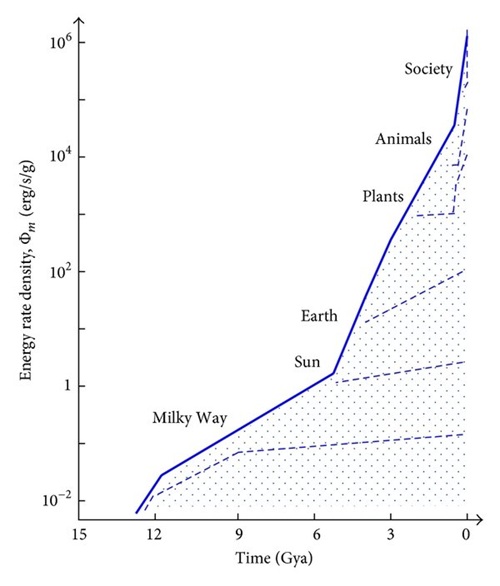
The Natural Science Underlying Big History, The Scientific World Journal, v 2014
There is something genuinely illuminating here. Complex organisms do require energy. Maintaining a body far from thermodynamic equilibrium requires continuous throughput. Nervous systems require substantial metabolic expenditure. Human civilization operates on extraordinarily large energy flows, especially when fossil fuels and industrial technology are included. The connection between energy availability, metabolism, organization, and technological development is therefore not imaginary. Indeed, one of Chaisson's great virtues is that he refuses to treat life as though it were exempt from physics. Organisms do not violate the second law of thermodynamics. They are open, nonequilibrium systems that maintain internal organization by exchanging energy and matter with their environments. That is an important corrective to simplistic versions of thermodynamic reductionism, but it does not yet establish that energy rate density is the measure of complexity. Correlation is not definitionThe first major problem is conceptual. What exactly is “complexity”? Chaisson often treats increasing complexity as an empirical feature of cosmic history and then investigates energy rate density as a way of quantifying it. But the argument risks becoming circular. If we select a sequence of systems already interpreted as increasingly complex—galaxies, stars, planets, organisms, brains, technological societies—and discover that one physical variable tends to increase along that sequence, we have established a correlation. We have not necessarily discovered what complexity is. This distinction becomes particularly important because complexity is notoriously multidimensional. A system can be structurally complex, computationally complex, informationally complex, dynamically complex, organizationally complex, genetically complex, behaviorally complex, or hierarchically complex. These dimensions need not move together. A computer chip can perform extraordinarily sophisticated information processing while consuming relatively little energy. A large industrial machine can consume enormous quantities of energy while possessing relatively little organizational complexity. A hurricane involves massive energy flows but is not thereby equivalent in complexity to a human brain. A bacterium has a tiny energy budget compared with a city but possesses extraordinary molecular organization. Consequently, energy throughput can be a condition for maintaining certain kinds of complexity without being identical to complexity itself. Chaisson is aware of some of these complications. His later work repeatedly emphasizes that his values are estimates and that biological systems display substantial variation. He explicitly acknowledges that energy is not the sole determinant of biological evolutionary advancement and that environmental, dietary, behavioral, and habitat factors affect metabolic rates. But this concession actually points toward the central weakness of the stronger version of his thesis: once the numerous qualifications are included, energy rate density begins to look less like a universal law and more like one important variable among many. The biological problemThe biological evidence deserves particularly careful scrutiny because this is where the cosmic narrative encounters Darwinian evolution. In stars and galaxies, “evolution” can legitimately be used in the broad sense of sequential physical transformation. But biological evolution has a much more specific mechanism. Populations reproduce with heritable variation; natural selection, genetic drift, mutation, recombination, developmental constraints, and other processes alter the distribution of traits through generations. Energy is indispensable to all of this. But indispensable does not mean causally sufficient. A cheetah does not evolve its speed simply because speed requires energy. Nor does a brain become complex merely because it can consume energy. Natural selection acts on heritable differences in reproductive success. Energy availability enters this process through physiology, ecology, resource competition, developmental constraints, and many other pathways. This distinction becomes especially important when Chaisson's energy-rate-density curve is interpreted as an evolutionary trajectory. The fact that later organisms often occupy regions of higher metabolic rate per unit mass does not demonstrate that evolution was driven toward higher energy rate density. A recent reassessment makes this point particularly sharply. A 2020 analysis of energy consumption in biological evolution concluded that there is no evidence for a systematic large-scale increase in mass- or volume-specific energy rate density across biological evolution. That does not invalidate Chaisson's observations about particular organisms. It does, however, undermine any straightforward interpretation of the biological trend as a universal evolutionary law. There is a deeper problem here. Evolutionary history contains enormous amounts of contingency. Many evolutionary changes have little obvious relationship to increased metabolic throughput. Evolution produces specialization, simplification, parasitism, loss of structures, miniaturization, dormancy, and metabolic reduction as well as increased physiological performance. Evolution does not possess a single direction. This is one of the places where the phrase “cosmic evolution” can quietly import a directional narrative into a process that, at the biological level, is fundamentally branching and contingent. Energy is a constraint, not necessarily an arrowA more defensible interpretation of Chaisson's theory would therefore distinguish between an energy constraint and an evolutionary arrow. Energy places real constraints on what systems can do. An organism must acquire and allocate energy. A brain requires metabolic support. A technological society requires enormous energy and material infrastructures. Energy availability can open or close evolutionary and cultural possibilities. But constraints do not determine outcomes. A highway determines where cars can travel more readily than a forest does, but it does not determine where people ultimately choose to go. Likewise, the energetic architecture of a biological or cultural system establishes a space of possibilities without specifying the particular structures that will emerge within that space. Chaisson sometimes comes close to this more modest position. In his 2014 paper he explicitly says that energy flow is “probably only partly responsible” for biological advancement and recognizes numerous nonevolutionary sources of variation. That qualification should arguably be elevated from a footnote to a central principle. Energy makes complexity possible. It does not explain complexity by itself. The free-energy problemThere is also a technical complication concerning exactly what energy is being measured. Chaisson's terminology sometimes emphasizes “free energy rate density,” because free energy is the fraction of energy capable of doing useful work. Yet some of the numerical comparisons in his work rely on total energy flow rather than a rigorously determined quantity of thermodynamic free energy. This is not a trivial distinction. If two systems perform approximately the same function but one is energetically inefficient, the inefficient system can have a higher energy rate density. Does that make it more complex? Not necessarily. A modern computer may consume considerably more power than another device because it is inefficient, not because it embodies greater complexity. Conversely, biological evolution can produce highly sophisticated systems that perform remarkable functions at extraordinary energetic efficiency. A 2024 critical reassessment by Ken Solis highlights precisely this issue, arguing that Chaisson's use of energy-flow estimates can sometimes blur total energy throughput with genuinely available free energy. Solis also questions whether the proposed measure has been adequately compared with alternative complexity metrics. This exposes a fundamental ambiguity: are we measuring energy used, energy available for work, energy dissipated, or energy processed in relation to organizational structure? Those are thermodynamically related quantities, but they are not interchangeable. Thermodynamics does not imply a drive toward complexityChaisson's framework also invites a familiar misunderstanding concerning the second law of thermodynamics. Open systems can become more ordered while increasing entropy production in their surroundings. This is entirely compatible with thermodynamics. A refrigerator, for example, creates a temperature gradient by consuming energy and exporting entropy. But the existence of dissipative structures does not mean that nature possesses a generalized tendency toward greater complexity. That conclusion would be much stronger than thermodynamics warrants. Nonequilibrium thermodynamics tells us that under appropriate conditions, organized structures can spontaneously emerge and persist. It does not say that complexity must increase indefinitely, nor that systems universally evolve toward greater organization. Structures can emerge, persist, simplify, collapse, or disappear. The distinction between possibility and directionality is crucial. The expanding universe, changing energy gradients, stellar nucleosynthesis, planetary chemistry, and nonequilibrium conditions created increasingly diverse opportunities for organization. Chaisson's earlier work explicitly identified cosmic expansion as a necessary, though perhaps not sufficient, condition for the emergence of increasingly organized structures. That is a fascinating physical story. But it should not be converted into a cosmic version of orthogenesis—the idea that evolution itself is intrinsically directed toward increasing complexity. There is no need for such a conclusion. The arrow of complexity is not the arrow of timeOne of the most attractive features of Chaisson's graphs is also one of their greatest dangers. When the history of the universe is plotted on a single enormous timeline, the emergence of atoms, galaxies, stars, planets, organisms, brains, and civilizations appears as a spectacular ascending staircase. But temporal succession does not establish causal necessity. We know that galaxies preceded stars of particular generations, stars preceded the chemical enrichment of planets, and biological evolution preceded technological civilization. But from this it does not follow that the universe was somehow “trying” to produce technological intelligence. The graph can therefore be visually interpreted as a ladder even if the underlying science does not imply one. A more accurate representation would look less like a ladder and more like a branching tree embedded within a changing physical environment. Some branches become more energetically intensive; others become less so. Some increase organizational complexity; others simplify. Some terminate. Others proliferate. This would preserve Chaisson's empirical insights while removing the teleological overtones. Cosmic evolution versus Darwinian evolutionThis raises an important linguistic issue. The word “evolution” has become extraordinarily successful because it can mean both simple change through time and the specific theory of biological evolution by common descent and natural selection. Chaisson deliberately uses the broader meaning. Cosmic evolution is essentially the study of sequential change across cosmic history. His 2025 work continues to describe it as a synthesis of developmental and generational changes involving energy, matter, and life. That is perfectly legitimate. But the broader usage can become misleading when the mechanisms are allowed to slide into one another. Stars do not reproduce and undergo natural selection in the Darwinian sense. Galaxies do not have genomes. Planets do not inherit mutations. Human cultures do have something resembling evolutionary inheritance, but cultural evolution has mechanisms radically different from biological evolution. There is therefore a hierarchy of evolutionary mechanisms rather than necessarily one universal evolutionary mechanism. Cosmic history is unified by physical continuity, not necessarily by a single process called evolution. Where Chaisson is genuinely successfulThese criticisms should not obscure how valuable Chaisson's project actually is. His strongest contribution is conceptual rather than law-like. He provides an empirically grounded narrative in which physics does not stop at the Big Bang, biology does not begin from nowhere, and human culture does not float above nature. Every level of organization depends upon conditions established at other levels. The energy perspective also makes something important visible: complexity is metabolically expensive. A galaxy, a star, a living cell, a nervous system, and an industrial civilization all maintain organized states by exploiting energy gradients. They differ enormously in mechanism, scale, and evolutionary history, but none exists independently of energy flow. This provides a legitimate bridge between the physical and biological sciences. Chaisson is also commendably materialist. He explicitly rejects the need for mystical or supernatural principles and describes himself as an empirical materialist. His stated goal is to find quantitative connections among phenomena rather than invoke unexplained cosmic purposes. This distinguishes cosmic evolution from many grand evolutionary philosophies that begin with the scientific history of the universe and then introduce metaphysical notions of cosmic consciousness, Eros, intrinsic purpose, or a universal drive toward higher states. Chaisson does not need any of that. Indeed, one of the virtues of his model is that it demonstrates how far a naturalistic account can go without invoking such principles. But “complexity” remains the weak linkThe real issue, then, is not whether energy matters. It obviously does. The issue is whether energy rate density can bear the enormous conceptual burden Chaisson sometimes assigns to it. A useful scientific metric should ideally distinguish the thing being measured from the variable used to measure it. If complexity is independently defined, one can ask whether energy rate density predicts it. If the systems are declared complex because they exhibit high energy rate density, and then high energy rate density is used to demonstrate their complexity, the argument risks becoming circular. This is precisely why comparison with other complexity measures matters. Information content, algorithmic complexity, network structure, hierarchy, number of interacting components, causal organization, computational capacity, and statistical measures of dynamical complexity capture different aspects of what scientists mean by “complexity.” Energy rate density may correlate with some of these under particular circumstances. That would make it useful. It need not replace them. The 2024 critique by Solis is therefore valuable even if one ultimately disagrees with some of its conclusions: it asks whether Chaisson's metric has demonstrated sufficient reliability across genuinely different kinds of complexity rather than merely organizing a visually compelling collection of examples. That is the appropriate scientific standard. A better formulation of Cosmic EvolutionThe most defensible version of Chaisson's model would therefore be somewhat more modest. Instead of saying: Energy rate density drives the evolution of complexity. we might say: The availability and throughput of free energy constrain the emergence, persistence, and functional capacity of organized nonequilibrium systems, and increases in energy throughput per unit mass often accompany the emergence of certain forms of biological and cultural organization. That statement is considerably less dramatic. It is also considerably harder to refute. It recognizes that energy is fundamental without turning it into a universal explanatory principle. It recognizes the empirical correlations Chaisson has identified without confusing correlation with causation. And it leaves room for the mechanisms that actually differentiate cosmic, geological, biological, and cultural evolution. Most importantly, it avoids turning the history of the universe into a predetermined ascent. From cosmic history to cosmic contingencyThere is a larger philosophical lesson here. Chaisson's work is most compelling when read as a story of increasing possibility, not increasing inevitability. The early universe had a relatively restricted chemical repertoire. Stellar nucleosynthesis expanded that repertoire. Planets created new environments. Chemistry produced new possibilities for organization. Life opened another enormous space of evolutionary possibilities. Nervous systems generated new forms of behavior. Symbolic culture created an unprecedented capacity for cumulative information and technological transformation. At every stage, the space of possibilities expanded. But expanding possibility is not the same as predetermined progress. Nothing in Chaisson's physical account requires that humans appear. Nothing in stellar evolution predicts Shakespeare. Nothing in planetary chemistry predicts computers. Nothing in biological evolution guarantees civilization. The cosmic story is therefore simultaneously one of continuity and contingency. That is, in my view, a more scientifically defensible and philosophically interesting picture than a simple ascent from matter to mind. Conclusion: A powerful synthesis, but not a universal lawEric Chaisson's cosmic evolution model deserves its place among the important attempts to construct a scientifically grounded Big History. Its greatest achievement is to show that the emergence of life and intelligence can be placed within a continuous natural history extending from the early universe to technological civilization. Its emphasis on energy flow provides a useful physical intuition for understanding why organized nonequilibrium systems can exist and why increasingly energy-intensive forms of organization have appeared during cosmic history. But the model becomes considerably less persuasive when energy rate density is treated as a universal metric of complexity or an evolutionary driver in anything like the Darwinian sense. The empirical correlation is interesting. The universalization is the problem. Complexity is not one-dimensional. Evolution is not one process. Energy is not information, organization, adaptation, or selection. High energy throughput can enable complexity, maintain complexity, or accompany complexity without constituting complexity itself. And the fact that the universe has produced increasingly elaborate structures does not establish a cosmic law compelling it to do so. Chaisson's deepest insight may therefore be more modest than his grandest claim. The universe does not need a mystical force pushing matter upward toward mind. It needs only matter, energy, time, physical gradients, self-organization, historical contingency, and—once life appears—Darwinian evolution and cultural inheritance. That is already an extraordinary story. Cosmic evolution is at its best when it tells us that story without trying to turn the story into a law of progress. And perhaps this is the most interesting paradox of Chaisson's model: its greatest contribution is not that it discovers a single principle explaining everything, but that it demonstrates how far a naturalistic science can travel before the temptation to explain too much becomes stronger than the evidence. SEE ALSOFrank Visser, "Integral Theory and Cosmic Evolution, A Naturalistic Approach", www.integralword.net, December 2014.
Widget is loading comments...
|