|
TRANSLATE THIS ARTICLE
Integral World: Exploring Theories of Everything
An independent forum for a critical discussion of the integral philosophy of Ken Wilber
  Frank Visser, graduated as a psychologist of culture and religion, founded IntegralWorld in 1997. He worked as production manager for various publishing houses and as service manager for various internet companies and lives in Amsterdam. Books: Ken Wilber: Thought as Passion (SUNY, 2003), and The Corona Conspiracy: Combatting Disinformation about the Coronavirus (Kindle, 2020). Frank Visser, graduated as a psychologist of culture and religion, founded IntegralWorld in 1997. He worked as production manager for various publishing houses and as service manager for various internet companies and lives in Amsterdam. Books: Ken Wilber: Thought as Passion (SUNY, 2003), and The Corona Conspiracy: Combatting Disinformation about the Coronavirus (Kindle, 2020).
Check out my other conversations with ChatGPT
BIG NAMES IN BIG HISTORY Big History Pioneers David Christian's Grand Narrative Eric Chaisson's Cosmic Evolution Fred Spier's Big History Tyler Volk's Grand Sequence Other Cosmic Models Erich Jantsch, the Forgotten Architect Sagan and Schneider on Entropy Bobby Azarian's Evolutionary Model Brendan Graham Dempsey's Emergentism Jagers op Akkerhuis' Third Law Ken Wilber and Big History Wrapping Up: Six Questions for Big History From Darwin to a 'Third Law'Can Evolution Really Be Unified?Frank Visser / ChatGPT
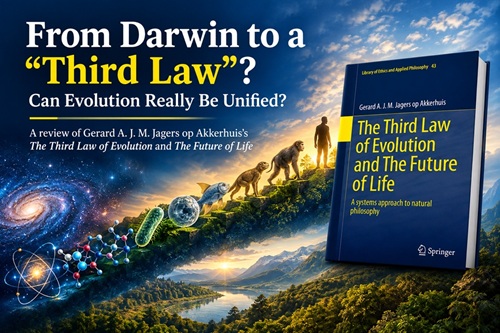 Gerard A. J. M. Jagers op Akkerhuis's The Third Law of Evolution and The Future of Life: A Systems Approach to Natural Philosophy is an ambitious attempt to do something evolutionary theory has repeatedly resisted: to place the evolution of matter, life, complexity and perhaps intelligence within one overarching framework. Published by Springer in 2024, the 348-page book presents the author's “O-theory” and “operator hierarchy” as a way of connecting physical and biological evolution. It is an interesting book precisely because it occupies the uncomfortable territory between legitimate systems science, philosophical synthesis and grand evolutionary speculation. The central question is not whether nature displays increasing complexity—it plainly does—but whether this historical pattern can legitimately be promoted to a third law of evolution comparable in status to variation and selection. That is where the book becomes both provocative and vulnerable. The central idea: evolution has three dimensionsThe conventional Darwinian picture emphasizes variation and selection. Jagers op Akkerhuis argues that this is incomplete because evolution has repeatedly produced new levels of organization: elementary particles give rise to larger physical structures, molecules to increasingly complex chemical systems, and eventually biological organisms and multicellular systems. The book therefore proposes a third principle concerned with the emergence of increasingly complex organization. Springer summarizes the argument as supplementing the familiar laws of variation and selection with a third law describing increases in complexity through transitions such as quarks → hadrons → atoms → molecules → bacteria → eukaryotic cells and beyond. This is a potentially fruitful distinction. Darwinian selection explains something that mere complexity theory does not: why particular heritable variants become more or less common. But selection alone does not provide a complete historical description of every major transition in nature. The origin of increasingly integrated levels of organization—genes, chromosomes, cells, multicellular organisms, societies—raises additional questions about how new evolutionary individuals emerge. The strength of Jagers op Akkerhuis's project is therefore that he takes levels of organization seriously rather than treating them as convenient labels. The operator hierarchyThe conceptual centerpiece is the “operator hierarchy.” The author describes this as a modern, science-based version of the classical Scala Naturae, or Great Chain of Being. Unlike the old metaphysical hierarchy, however, the proposed hierarchy is intended to have a mechanistic basis. The hierarchy is constructed from the bottom upward. The author attempts to identify recurring structural principles by which systems become capable of forming higher-order systems. The key concept is dual closure, which is supposed to provide the logical mechanism through which new operators—and therefore new organizational levels—arise. One chapter explicitly describes the project as building a theoretical framework “from the ground up,” using a Euclidean-style axiomatic strategy and seeking a close correspondence between the abstract model and observed natural organization. There is something intellectually attractive about this strategy. Instead of simply drawing a familiar ladder—particles, atoms, molecules, cells, organisms, minds—the author wants to explain why the ladder has the structure it does. That is a much more interesting ambition. But it also creates the book's fundamental problem. A hierarchy is not yet a lawThe first distinction that needs to be made is between describing a recurrent pattern and discovering a law that generates that pattern. There is little controversy about the fact that nature contains nested levels of organization. Nor is there much controversy about the importance of major evolutionary transitions. The harder question is whether the existence of such transitions implies a general law of evolution. Consider an analogy. We can observe that the history of the universe contains stars, galaxies, planets, molecules and organisms. We can arrange these in various hierarchical schemes. But the mere existence of such an ordering does not establish that nature possesses a law requiring the universe to generate successively higher levels. This is where Jagers op Akkerhuis has to carry a particularly heavy argumentative burden. A genuine evolutionary law should do more than organize what we already know. It should generate novel, risky and testable expectations. The author does attempt this. The later chapters explicitly move toward prediction, including predictions about future evolutionary operators. The book even proposes that evolution may eventually move beyond biological organisms toward entirely new types of systems. That is exactly the right direction. But it also raises the standard of proof. If the “third law” merely tells us that increasingly complex organization has occurred in the past, it risks becoming a sophisticated restatement of the historical record. If it predicts that a particular new level must or probably will arise, under identifiable conditions, then we have something scientifically much more interesting. The crucial question is therefore not “Does complexity increase?” but “What does the third law predict that we would not otherwise expect?” The problem of complexityThis brings us to another difficulty: complexity is notoriously difficult to define. The word can mean number of components, information content, algorithmic complexity, hierarchical depth, functional differentiation, causal density, organizational closure or something else entirely. A system can become more complicated without becoming more integrated, and a system can become more organized without simply becoming more complex in a quantitative sense. Jagers op Akkerhuis is clearly aware of this problem. The book devotes considerable attention to levels of organization, ontology and definitions of organism and life. Indeed, one of its stated ambitions is to provide systems-based definitions of both “organism” and “life.” The chapter on organisms illustrates the difficulty. There is no universally accepted definition of an organism, and borderline cases such as viruses and lichens expose the problem. This is important because the hierarchy depends heavily on identifying what constitutes a genuine organizational level. If the categories are partly constructed by the theorist, then the hierarchy risks becoming circular: we identify the levels using the theory and then use the levels to validate the theory. The book therefore faces a classic systems-theory challenge: how do we distinguish real causal organization from an elegant classification imposed by the observer? Where the book is strongestThe most convincing aspect of the project is not necessarily the “third law” itself. It is the insistence that evolutionary theory needs to take major transitions and emergent organization seriously. Evolutionary biology has long recognized transitions such as the emergence of chromosomes, eukaryotic cells and multicellularity. Jagers op Akkerhuis attempts to place these transitions within a common framework extending all the way back into physics. His earlier work already developed the operator approach, and his 2016 Springer volume Evolution and Transitions in Complexity presented it as a mechanistic framework for hierarchical organization. The new book represents a much more systematic development of that program. There is also considerable value in the attempt to connect abiotic and biotic evolution. The boundary between “cosmic evolution,” chemical evolution and biological evolution is often treated as a sequence of separate subjects. Yet historically they are obviously connected. Biology did not suddenly appear in a universe that had never undergone organization before. The question is whether that continuity requires one overarching evolutionary theory. Jagers op Akkerhuis answers yes. That is an intellectually respectable position even if one ultimately disagrees. From physical evolution to biological evolutionThe most controversial step is the move from physical organization to biological evolution. The book starts its hierarchy below the biological level, incorporating elementary particles and physical operators. Indeed, the author explicitly extends the operator hierarchy downward because elementary particles themselves do not possess the “dual closure” characteristic of operators; additional transitions are therefore introduced to incorporate them into the overall hierarchy. This is clever, but it exposes an important methodological question. Calling physical transitions “evolution” can be illuminating if “evolution” simply means cumulative change and increasing organization over time. But it can also obscure the enormous conceptual difference between physical self-organization and Darwinian evolution. A galaxy does not reproduce with heritable variation. A molecule does not compete for reproductive success. A crystal does not undergo natural selection in the biological sense. Of course, nobody needs to deny these differences. The whole point of a generalized theory is to explain what they have in common. But that commonality must be demonstrated rather than assumed. Otherwise “evolution” becomes so broad that it means little more than change through time. The Darwinian challengeThis is where I would be most cautious about the book's terminology. Variation and selection are not simply two arbitrary “laws” that happen to describe biological evolution. They are components of a very specific explanatory framework involving reproduction, heredity, differential reproductive success and population change. If a third law is added, it needs to operate at the same explanatory level. Suppose organizational complexity increases because certain physical and biological systems permit new forms of closure. That could be a valuable constraint on evolutionary possibility. But it does not necessarily constitute a third evolutionary mechanism. This distinction is crucial. Natural selection explains why one variant replaces another. A principle of organizational hierarchy might explain why certain kinds of entities become possible. Those are not necessarily equivalent kinds of explanation. Indeed, one could argue that Jagers op Akkerhuis has discovered something potentially important but has given it too grand a name. Perhaps the “third law” is better understood as a general theory of evolutionary transitions rather than a third law of evolution. That would still be a significant achievement. The specter of the Scala NaturaeThe comparison with the classical Scala Naturae is revealing. Jagers op Akkerhuis explicitly describes the operator hierarchy as a modern, scientific version of the old hierarchy of nature. The historical danger here is obvious. The Great Chain of Being traditionally placed minerals below plants, plants below animals, animals below humans and humans below spiritual beings. It was hierarchical, teleological and anthropocentric. Modern evolutionary theory demolished the idea that evolution moves toward some predetermined summit. Jagers op Akkerhuis avoids the crude theological version of this picture. His hierarchy is presented as a causal and systems-based classification rather than a moral ladder. That is an important distinction. Nevertheless, the deeper danger remains: hierarchy can easily become confused with progress. If the history of nature is represented as a sequence of increasingly complex operators, it becomes tempting to see evolution as climbing a ladder toward something higher. But evolutionary history is full of dead ends, simplifications, extinctions and regressions. Parasites can become radically simplified. Organisms can lose structures. Evolution frequently favors greater efficiency rather than greater complexity. So a theory of increasing organizational levels must explain not merely why complexity sometimes increases, but why simplification and loss are equally legitimate evolutionary outcomes. Otherwise the hierarchy risks becoming a biased sampling of evolutionary history. The future of evolutionThe book becomes particularly speculative when it turns toward the future. One chapter asks what will succeed organisms in evolution. Another predicts future “operators,” including entities described as memons and successors of present-day information-processing systems. This is fascinating territory. It also brings the argument into direct contact with contemporary discussions about artificial intelligence, postbiological evolution and machine intelligence. Springer explicitly identifies AI and the future of evolution among the book's subjects. Here the theory faces its most important empirical test. If artificial intelligence eventually becomes an evolutionary successor to biological organisms, the operator hierarchy might look remarkably prescient. But if AI develops along radically different lines—or if biological evolution continues without producing the predicted transition—the theory will have to explain why. This is exactly why speculative predictions are valuable. They turn philosophy into something potentially falsifiable. But the predictions need to be sufficiently precise. “Something more complex than humans will eventually emerge” is difficult to falsify. A theory becomes scientifically powerful when it says what, under what conditions, through what mechanism, and with what observable properties. Is this an Extended Evolutionary Synthesis?The book presents itself as contributing to an extended evolutionary synthesis. That is an interesting choice because the Extended Evolutionary Synthesis itself is already controversial. It encompasses mechanisms and concepts such as developmental bias, niche construction, plasticity and multilevel selection, depending on the formulation. Jagers op Akkerhuis is doing something somewhat different. Rather than expanding Darwinism primarily by adding biological mechanisms, he is attempting to reframe evolution at a much higher level of abstraction. This could ultimately prove complementary to the EES, but it should not automatically be conflated with it. The distinction matters because a framework that explains organizational transitions across physics, chemistry and biology is addressing a different explanatory problem from a framework that modifies the mechanisms of evolutionary change within biology. The Wilber connection—and an important differenceReaders familiar with Ken Wilber or other integral theorists will find the book especially interesting. There is a superficial resemblance between the operator hierarchy and integral notions of developmental levels, holarchy and increasing complexity. Both attempt to identify nested levels of organization stretching from matter through life and toward mind. But the difference is important. Jagers op Akkerhuis is attempting to build his hierarchy from physical and systems-level mechanisms, not from a metaphysical principle such as Spirit, Eros or a cosmic drive toward greater consciousness. That makes his project considerably more scientifically disciplined than many “evolutionary spirituality” approaches. And this is precisely where it should be judged. The scientific question is not whether the universe appears to produce greater complexity. It clearly does in some historical domains. The question is whether we need to posit a general law of complexity increase to explain it. The advantage of the operator theory is that it at least attempts to replace metaphysical language with structural and causal concepts. The disadvantage is that a sophisticated formal vocabulary can itself become a kind of metaphysics if the correspondence with empirical reality is insufficiently demonstrated. In other words: “dual closure” is not automatically more scientific than “Eros” merely because it sounds more technical. Its scientific status depends on what it actually explains and predicts. The crucial test: explanatory surplusThis suggests what I think is the fairest criterion for evaluating the book. Does the third law provide explanatory surplus? Can it explain something about evolutionary history that standard evolutionary theory, major-transition theory, self-organization, thermodynamics, developmental biology and complexity science cannot explain? Can it make predictions that these theories would not make? Can those predictions fail? Can independent researchers apply the framework to new cases and reach the same conclusions? These are the tests that will determine whether the theory becomes an important contribution to evolutionary science or remains an ambitious philosophical synthesis. The book itself seems conscious of this issue. Its chapters on scientific activity, prediction and the far future explicitly move beyond merely describing nature. That is encouraging. But the burden of proof is correspondingly high. A promising framework with a very large claimMy overall assessment is therefore mixed but sympathetic. Jagers op Akkerhuis has identified a genuinely important philosophical problem: how should we understand the recurrent emergence of new levels of organization across cosmic, chemical and biological history? His operator hierarchy provides an intriguing attempt to answer that question. The effort to ground the hierarchy in physical processes, dual closure and systems concepts is much more substantial than the loose evolutionary metaphysics found in many popular accounts of cosmic evolution. The attention given to the definition of organisms and life is also welcome. But the leap from “there is a recurrent pattern of increasing organizational complexity” to “there is a third law of evolution” remains the book's weakest link. A hierarchy is not necessarily a law. A pattern is not necessarily a mechanism. A direction in historical development is not necessarily a goal. And a prediction based on extrapolating a hierarchy is not necessarily a prediction of evolutionary necessity. The most interesting possibility is therefore that the book has discovered something smaller and more defensible than the title claims. Perhaps there is no Third Law of Evolution in the strong sense. Perhaps there is instead a general theory of organizational transitions that can illuminate why nature repeatedly generates new forms of systemic individuality. That would already be a considerable achievement. From the Great Chain to the Great ExperimentThe real value of The Third Law of Evolution and The Future of Life may ultimately lie not in whether readers accept its grand theoretical claim, but in whether it gives us a better way of asking an old question: Why does nature sometimes produce something genuinely new? The history of the universe certainly contains extraordinary transitions: particles to atoms, atoms to molecules, chemistry to life, single cells to complex organisms, and nervous systems to brains capable of constructing symbolic cultures and machines. Jagers op Akkerhuis wants to discover the common architecture behind these transitions. That is a legitimate and fascinating scientific-philosophical project. But the history of evolution also teaches us to be suspicious of grand narratives. Evolution has no known obligation to become more complex, more intelligent, more conscious or more human-like. Complexity has emerged repeatedly, but so have simplicity, extinction and evolutionary dead ends. The ultimate test of the operator hierarchy will therefore be whether it can accommodate all of evolution, rather than merely its most spectacular upward transitions. If it can, Jagers op Akkerhuis may indeed have identified an important new principle of evolutionary organization. If it cannot, then the “third law” may turn out to be something more modest: an ingenious conceptual map of one conspicuous tendency in nature. And that distinction—between a map of evolution and a law governing evolution—is precisely where the scientific significance of this ambitious book will ultimately be decided. Source note: This review is based on the publisher's detailed description, table of contents, author information, and publicly available chapter abstracts/indexing rather than a complete full-text reading of the 348-page book. The Springer record identifies the book as a 2024 first edition in Library of Ethics and Applied Philosophy, with 21 chapters and a focus on philosophy of nature, evolutionary biology and complex systems. Appendix: Wilber's “Eros” and the Complexity of EvolutionJagers op Akkerhuis is not the first theorist to argue that Darwinian natural selection is insufficient to explain the increasing complexity found in evolution. Ken Wilber has made a similar move for decades. But the resemblance is superficial. The two projects add something to the Darwinian picture in radically different ways. Wilber's argument is most clearly developed in Sex, Ecology, Spirituality and his subsequent writings on evolution. He argues that natural selection explains only part of the evolutionary story. Selection can explain why some variations survive and reproduce better than others, but Wilber asks why evolution repeatedly produces genuinely new levels of organization in the first place. Why do atoms form molecules, molecules form increasingly complex structures, cells form multicellular organisms, and organisms eventually produce nervous systems and minds? For Wilber, Darwinian selection is therefore not the whole engine of evolution. His answer is Eros: a tendency inherent in evolution toward greater depth, complexity, differentiation and integration. Wilber sometimes describes this as evolution's drive to “transcend and include.” Each new level transcends the previous level while incorporating it as a component. A molecule transcends the atom without eliminating atoms; a cell transcends molecular organization without eliminating molecules; an organism transcends cellular organization without eliminating cells. This gives Wilber something resembling a directional principle of evolution. Evolution is not merely a random walk filtered by selection. It possesses an intrinsic tendency toward higher-order organization. Wilber consequently distinguishes the mechanisms that explain evolutionary survival from what he regards as the deeper impulse that explains evolutionary novelty and increasing complexity. The crucial difference: mechanism versus metaphysicsAt first sight this sounds remarkably similar to Jagers op Akkerhuis. Both reject the idea that natural selection, by itself, provides a complete explanation of evolutionary complexity. Both emphasize hierarchical organization and major transitions. Both see a recurring pattern in which relatively simple systems become components of more complex systems. But their explanatory strategies could hardly be more different. Jagers op Akkerhuis attempts to formulate a systems-theoretical mechanism for the emergence of new organizational levels. His operator hierarchy and concept of dual closure are intended to specify structural relationships that can, at least in principle, be examined and tested. Whether that succeeds is another question, but the ambition is explicitly to move toward a scientific framework. Wilber's Eros is something much more ambitious—and consequently much more problematic. It is ultimately a metaphysical principle. It is invoked to explain why evolution has a direction toward greater complexity and depth. The difficulty is that Eros does not itself specify a measurable process by which this happens. Indeed, Wilber occasionally pushes the claim much further. In Finding Radical Wholeness, he describes Eros as an actual force, comparable in reality to gravity, electromagnetism and the nuclear forces. This is where the argument becomes especially vulnerable. If Eros is literally a force of nature, then we should be able to specify its properties, distinguish its effects from those of known physical and biological processes, and derive predictions from it. Simply pointing to the fact that evolution has generated complexity does not accomplish this. This is an important difference from the third-law proposal. Jagers op Akkerhuis can at least be challenged at the level of whether his proposed organizational principles actually generate empirical predictions. Wilber's Eros has traditionally been much harder to put to such a test. Complexity does not automatically require a new forceThere is also a subtle but important logical issue here. Both Wilber and Jagers op Akkerhuis start from a genuine observation: evolution has produced spectacular increases in organizational complexity. But the existence of this pattern does not by itself establish that a new causal principle is responsible. Complexity can emerge from the interaction of relatively simple rules. Natural selection itself can generate extraordinary organization without the organism—or evolution as a whole—having any foresight or intrinsic desire for greater complexity. Self-organization, developmental constraints, ecological interactions, gene regulation, symbiosis, niche construction and other processes can also contribute. Consequently, the question is not whether something besides textbook Darwinism is involved. Modern evolutionary biology already recognizes that evolution is considerably richer than the caricature of “random mutation plus survival of the fittest.” The question is whether we need one additional overarching principle to unify these phenomena. This is precisely where both theories have to prove their worth. Wilber's stronger claimThere is nevertheless a significant difference in the direction of the two arguments. Jagers op Akkerhuis primarily wants to explain organizational transitions. Wilber wants to explain not merely organization but developmental direction. For Wilber, evolution does not simply produce new levels; those levels represent increasing depth and integration. His familiar holarchical picture therefore has an unmistakably developmental character: matter gives rise to life, life to mind, mind to higher forms of consciousness, and ultimately to increasingly profound spiritual realization. That introduces a much stronger claim than the observation that complex organization periodically emerges. Evolutionary history provides abundant examples of increasing complexity, but it also provides enormous amounts of stasis, simplification, extinction, specialization and evolutionary dead ends. Parasites can lose complexity. Cave animals can lose eyes. Genomes can shrink. Organisms can become highly specialized rather than hierarchically “higher.” Entire evolutionary lineages disappear. Wilber's model has difficulty incorporating these phenomena without treating them as secondary to the grand upward movement. Jagers op Akkerhuis has a somewhat narrower target and is therefore, in principle, easier to test. His theory does not have to establish that evolution is moving toward spiritual enlightenment. It has to establish that there are recurrent structural transitions that can be captured by his operator hierarchy. From Eros to operatorsThis distinction is particularly relevant to any attempt to formulate a scientifically respectable “law of complexity.” Wilber essentially says: Evolution produces greater complexity because evolution has an intrinsic drive toward greater complexity. Jagers op Akkerhuis is attempting something closer to: Evolution repeatedly produces new organizational levels because particular structural conditions permit systems to become operators of higher-order systems. The second formulation is much less metaphysically loaded. It does not require nature to want anything. It does not require a cosmic impulse toward consciousness. And it does not require us to introduce a new fundamental force simply because evolution has an apparent direction. That does not make the third-law theory correct. Its own concepts still need to demonstrate explanatory and predictive power. But it illustrates an important methodological improvement: replace an unexplained tendency with an attempt to explain the conditions under which that tendency arises. The danger of explaining the pattern by naming itThis is ultimately the common problem confronting both Wilber and Jagers op Akkerhuis. If we observe that evolution produces increasing organizational complexity and then call this tendency “Eros,” we have not yet explained it. Likewise, if we observe the same transitions and classify them as successive “operators,” we have not yet explained them. The scientific question begins after the classification. What causes the transition? What conditions make it possible? Why does it occur in some circumstances and not others? What alternative evolutionary pathways are excluded? What does the theory predict before we look at the evidence? This is why Jagers op Akkerhuis's project is more interesting from a scientific perspective than Wilber's Eros. It attempts to move the discussion away from cosmic purpose and toward organizational mechanism. Whether it succeeds is an open empirical and theoretical question. Wilber's Eros, by contrast, risks becoming precisely the kind of explanatory principle that explains everything and therefore predicts nothing. If complexity increases, Eros is operating. If evolution temporarily simplifies, Eros can presumably be redescribed as operating at another level. If consciousness emerges, Eros is confirmed. If it does not, the theory is difficult to falsify. And that is the fundamental difference between a metaphysical interpretation of evolution and a potentially testable theory of evolutionary organization. The irony is that Wilber identified the right problem—Darwinian selection does not by itself constitute a complete theory of the history of complexity—but his proposed solution may be the wrong kind of answer. The challenge for Jagers op Akkerhuis is to solve the same problem without simply giving the mystery a more technical name.
Widget is loading comments...
|