|
TRANSLATE THIS ARTICLE
Integral World: Exploring Theories of Everything
An independent forum for a critical discussion of the integral philosophy of Ken Wilber
  Frank Visser, graduated as a psychologist of culture and religion, founded IntegralWorld in 1997. He worked as production manager for various publishing houses and as service manager for various internet companies and lives in Amsterdam. Books: Ken Wilber: Thought as Passion (SUNY, 2003), and The Corona Conspiracy: Combatting Disinformation about the Coronavirus (Kindle, 2020).
Check out my other conversations with ChatGPT
Integral Debate Analysis:
The Integral Debate Analysis Approach Beyond Winning and Losing The Integral Debate Analyzer 2.0 Everyone's Debates Except Wilber's? A Test of Ken Wilber's Own Framework Wyatt Earp as an Integral Cold Case The Wyatt Earp EpisodeAn Integral Cold Case That Needs ReopeningFrank Visser / ChatGPT
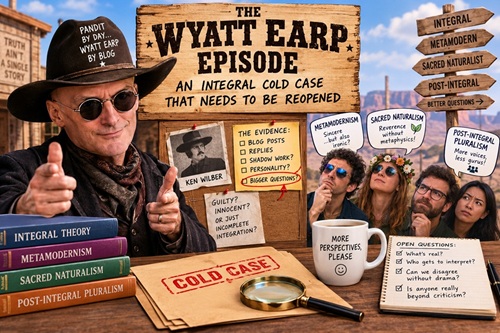 Introduction: The Case That Never Quite ClosedIn June 2006, Ken Wilber launched a series of blog posts that became known as the Wyatt Earp episode. The language was combative, the tone frequently derisive, and the ensuing controversy became a revealing moment in the history of the integral movement. Wilber's critics objected not simply to his colorful vocabulary, but to the way he responded to criticism, interpreted his opponents' motives, and invoked psychological concepts to frame the dispute. The episode was followed by replies, counter-replies, reflections on shadow work, and attempts to restore perspective. Yet the fundamental questions were never satisfactorily settled. What did the episode reveal about Wilber's relationship to criticism? What did it reveal about the integral community's relationship to its intellectual founder? And why did a movement that claimed to integrate multiple perspectives struggle so visibly with the possibility that its leading thinker might himself be in need of criticism? Nearly two decades later, the Wyatt Earp affair deserves to be reopened as an integral cold case. Not because revisiting old internet quarrels is inherently worthwhile, but because the controversy offers a revealing test of integral theory's claims about development, shadow, perspective-taking, and self-correction. The case also concerns the movements that have emerged alongside or beyond integral theory. Metamodernism, sacred naturalism, and other post-integral approaches offer different responses to the perceived limitations of conventional modernity, postmodern criticism, and Wilber's comprehensive spiritual framework. But have they resolved the problems exposed by the Wyatt Earp episode, or merely developed new vocabularies for negotiating them? The point is not to put Ken Wilber permanently in the dock. It is to examine whether integral and post-integral movements can apply their own standards to their most influential thinkers, their preferred worldviews, and their institutional cultures. 1. The Original Offense: Criticism Becomes a Psychological ProblemOne of the central difficulties in the Wyatt Earp episode was the tendency to interpret disagreement through the language of shadow projection. Shadow work can be useful. Critics can indeed be motivated by envy, resentment, wounded pride, ideological commitments, or projections onto admired teachers. Intellectual disagreement is rarely free of psychological entanglements. Anyone who has participated in a heated public dispute knows how easily arguments become entangled with questions of identity and status. But this insight cuts both ways. If criticism can reveal the critic's shadow, it can also reveal the critic's target. If opponents are projecting their disowned qualities onto Wilber, Wilber might equally be projecting his own disowned qualities onto them. The mere availability of a psychological interpretation does not establish its truth. The decisive question is whether shadow analysis is applied symmetrically. Are the psychological motives of the critic examined while those of the criticized authority remain presumptively innocent? Does the theory help clarify a disagreement, or does it become a convenient way of disqualifying unwelcome criticism without addressing its substance? A particularly troubling possibility arises when disagreement itself becomes evidence of the dissenter's limited development. The critic is no longer simply mistaken about a proposition; the critic is supposedly unable to see from a sufficiently comprehensive perspective. An ordinary intellectual dispute is thereby transformed into a diagnosis of developmental inadequacy. This is a dangerous maneuver because it can make a theory resistant to correction. The person who challenges the framework can always be explained by the framework. A mature account of shadow would begin with reciprocal suspicion. Perhaps the critic is projecting. Perhaps the authority is projecting. Perhaps both are. Perhaps neither psychological interpretation is necessary to explain the disagreement, which might instead concern evidence, logic, values, or incompatible assumptions. The Wyatt Earp episode remains instructive precisely because these possibilities deserve to be investigated rather than settled in advance. 2. The Pandit and the CowboyWilber has long occupied an unusual position in the integral movement. He is simultaneously a major theorist, a prolific interpreter of spiritual traditions, a developmental philosopher, and an authority whose writings have shaped the identities of many of his followers. This combination creates an inherent tension. The intellectual architect of a comprehensive theory can become the symbolic embodiment of that theory. Criticism of the person then feels like criticism of the entire intellectual enterprise. Wilber's self-presentation as a pandit, contrasted with the Wyatt Earp persona adopted during the controversy, brought this tension into sharp relief. The image of the spiritual intellectual and the image of the uncompromising gunslinger do not necessarily contradict each other. Wit, irreverence, and polemical aggression have their place in intellectual life. The problem arises when rhetorical aggression substitutes for argument or when the authority of the teacher is used to settle disputes that ought to be resolved through publicly examinable reasons. A theory that distinguishes developmental stages should be especially alert to this danger. Intellectual sophistication does not guarantee emotional maturity. A person may display extraordinary conceptual complexity in one domain while responding defensively in another. Development is uneven, and a person's reputation cannot substitute for an examination of their actual conduct. The lesson is not that a spiritual teacher must be a saint. It is that no claim to spiritual or developmental attainment should confer immunity from ordinary standards of accountability. If anything, the greater the authority, the greater the need for transparent self-correction. 3. The Asymmetry of Shadow WorkThe Wyatt Earp controversy raises a question that extends well beyond Wilber: Who gets to interpret whom? In a healthy dialogue, psychological interpretations remain hypotheses. They can be offered, challenged, revised, or abandoned. In an unhealthy dialogue, one participant assumes the role of diagnostician while treating the other's objections as further evidence of the diagnosis. The resulting asymmetry is particularly striking in an integral context. The theory offers sophisticated tools for examining human motivation, developmental limitations, and unconscious dynamics. Yet the possession of such tools does not automatically confer the wisdom to use them responsibly. Indeed, the more comprehensive a psychological vocabulary becomes, the more opportunities it offers for interpretive overreach. A critic can be accused of operating from an earlier developmental stage, failing to integrate a shadow, remaining attached to a partial perspective, or reacting from an unexamined egoic position. Any of these interpretations might occasionally be correct. None is self-validating. There must be a way to distinguish psychological insight from rhetorical immunization. One useful test is simple: Does the interpretation answer the substantive objection? If a critic identifies a factual error, the appropriate response is to examine the evidence. If the critic identifies a contradiction, the response should clarify the argument. If the critic questions a leader's behavior, the response should address the behavior. A psychological interpretation may enrich that examination, but it cannot replace it. The same standard applies to Wilber's critics. Calling Wilber defensive, narcissistic, or spiritually immature would not, by itself, establish anything about the truth of their criticisms. The argument must still be made. The cold case therefore concerns more than one man's rhetorical conduct. It concerns the conditions under which psychological language can illuminate disagreement without becoming a weapon against dissent. 4. The Integral Movement's Unfinished BusinessThe Wyatt Earp affair did not take place in a vacuum. The subsequent emergence of alternative integral forums suggests that the controversy contributed to a broader questioning of the movement's intellectual and social arrangements. This history matters because integral theory is not merely a collection of propositions. It also exists through institutions, conferences, publications, online communities, teaching relationships, and reputational networks. These social structures determine which questions receive attention, whose interpretations circulate, and what happens when influential figures are challenged. An intellectual movement can formally celebrate pluralism while informally rewarding conformity. It can praise perspective-taking while making certain perspectives socially costly to express. It can encourage shadow work while leaving the shadow of institutional loyalty insufficiently examined. None of these outcomes follows inevitably from integral theory. But neither does the theory automatically prevent them. The integral community's response to the Wyatt Earp episode should therefore be evaluated on two levels. The first concerns the arguments made by the participants. The second concerns the community's capacity to examine the controversy without reducing it to a morality play about a brilliant teacher and his psychologically troubled critics. Did the controversy produce durable procedures for handling internal disagreement? Did it strengthen independent critical forums? Did it encourage the public correction of mistakes? Did it make it easier for integral thinkers to challenge Wilber without first having to demonstrate their loyalty to the larger project? These are empirical questions, not questions that can be answered by citing AQAL diagrams or developmental theory. 5. The Integral Debate Analyzer: A New Opportunity, and a New TestThe Wyatt Earp affair has acquired fresh relevance through Integral Life's Integral Debate Analyzer, a framework intended to examine public disagreements in developmental terms. The analyzer's stated methodology emphasizes that its purpose is not simply to declare winners. It aims to examine how participants reason, what perspectives they can perceive, and how the interaction between them shapes the possibilities for dialogue. It also acknowledges that intellectual sophistication, factual correctness, and moral character are not interchangeable. These are useful qualifications. They also raise an obvious question: What happens when the framework is applied to a controversy involving Ken Wilber himself? The Wyatt Earp episode offers an unusually revealing test case because it involves competing interpretations of criticism, psychological projection, authority, and the quality of dialogue. A developmental analysis could help distinguish the participants' arguments from their rhetoric and explore how each side understood the other. But such an analysis would need to resist several temptations. First, it should not treat the vocabulary of developmental theory as proof that developmental judgments are accurate. Assigning a stage to a person is itself an interpretive act that requires justification. Second, it should not confuse a rhetorically sophisticated argument with a factually correct one. A participant may display considerable complexity while making a weak empirical claim. Conversely, an emotionally expressed objection may contain a valid point. Third, it should not allow the prestige of integral theory's founder to determine the interpretation. If the method is genuinely intended to illuminate disagreements rather than validate existing loyalties, Wilber must be open to the same critical examination as anyone else. Finally, the analysis should make room for institutional context. A dispute between a highly influential intellectual and a critic is not necessarily equivalent to a dispute between two participants with comparable reputations, audiences, and access to platforms. The most revealing application of the analyzer would therefore not be an attempt to prove that Wilber occupied a particular developmental stage in 2006. It would be an examination of the actual arguments, rhetorical moves, psychological interpretations, and power asymmetries in the exchange. The question is not whether Wilber can be assigned a developmental label. It is whether the analyzer can illuminate the controversy without allowing the framework to dictate its conclusion in advance. 6. What Integral Theory Must Explain About ItselfThe Wyatt Earp episode raises a broader problem for integral theory. A framework that aspires to integrate multiple perspectives must explain how it handles disagreement among people who already accept much of its worldview. It is relatively easy to invoke developmental stages when discussing people outside one's intellectual community. It is more difficult when the disagreement concerns the founder, the movement's identity, or the credibility of its central claims. The problem is not unique to integral theory. Marxist, psychoanalytic, religious, political, and other comprehensive worldviews have all developed ways of interpreting opposition through their own conceptual vocabularies. Such interpretations can sometimes be insightful. They become problematic when they remove the possibility of genuine disagreement. Integral theory's ambitions make this problem especially consequential. If every perspective is partial, then Wilber's perspective must be partial too. If development is uneven, then intellectual accomplishment cannot establish emotional or ethical superiority. If the observer's standpoint influences what is seen, then the observer must also examine the assumptions that structure their own vision. These propositions should apply to the integral theorist as much as to anyone else. There is also a distinction between a theory's conceptual inclusiveness and its practical openness. A system can contain categories for many perspectives while its adherents remain reluctant to hear perspectives that challenge the system's authority. The capacity to describe dissent is not the same as the capacity to accommodate it. The Wyatt Earp affair provides a concrete occasion to investigate this difference. 7. Metamodernism: Beyond Integral, or Another Comprehensive Story?Metamodernism offers one important comparison for reopening the case. Associated with attempts to move beyond the familiar opposition between modernist confidence and postmodern skepticism, metamodern thought often emphasizes oscillation: between hope and doubt, irony and sincerity, construction and deconstruction, commitment and awareness of the limits of commitment. This sensibility can provide a useful corrective to integral triumphalism. A metamodern thinker need not choose between treating Wilber as a visionary who has integrated the major truths of human knowledge and dismissing him as an obsolete guru whose work should be abandoned wholesale. It becomes possible to appreciate the ambition of integral theory while remaining skeptical about its grander claims. But metamodernism faces its own version of the Wyatt Earp problem. The language of oscillation can become a sophisticated way of avoiding decisions. A thinker can oscillate between sincere commitment and ironic distance without explaining what evidence would warrant either position. The ability to acknowledge contradictions does not necessarily resolve them. Nor does a willingness to embrace uncertainty guarantee that one has understood the facts. There is also the possibility of a new developmental self-image. Metamodernists can come to regard themselves as more flexible, self-aware, and psychologically sophisticated than the modernists and postmodernists they seek to transcend. The old hierarchy returns in a new guise: the integral theorist claims to include the earlier stages, while the metamodern theorist claims to move beyond integral's more rigid or spiritualized architecture. Who, then, gets to diagnose whom? If the Wyatt Earp affair teaches anything, it is that intellectual movements should be wary of converting their preferred style of consciousness into a certificate of superiority. Metamodernism must demonstrate its value through better arguments, more reliable inquiry, and more accountable dialogue—not simply through its ability to describe itself as beyond the limitations of its predecessors. A metamodern reassessment of the Wyatt Earp episode might encourage both sincerity and irony: take the substantive intellectual issues seriously, but refuse to treat the reputations and self-descriptions of the participants as sacred. It could acknowledge the human drama without confusing that drama with proof of anyone's philosophical correctness. That would be a genuine contribution. But it would remain a contribution to be demonstrated, not presumed. 8. Sacred Naturalism: Can We Keep Meaning Without the Metaphysical Insurance Policy?Sacred naturalism presents a different and equally revealing challenge. Rather than preserving a spiritual cosmology by expanding its metaphysical reach, sacred naturalists seek to recover reverence, wonder, ethical commitment, and existential meaning within a naturalistic understanding of the universe. The approach is relevant to the Wyatt Earp case because it questions a recurring assumption in integral spirituality: that a sufficiently comprehensive worldview should culminate in a spiritual interpretation of reality, whether expressed through Spirit, Eros, evolutionary purpose, or a hierarchy of contemplative realization. A sacred naturalist can appreciate the psychological and cultural importance of spiritual experiences without concluding that they reveal higher ontological realms. Nature can inspire awe without being the manifestation of a cosmic intention. Human development can produce extraordinary capacities without demonstrating that the universe itself is striving toward higher consciousness. This shift changes the terms of the debate. The issue is no longer which developmental interpretation of a spiritual worldview is most comprehensive. It becomes a question of what claims about reality are justified, what forms of meaning human beings can create or discover, and whether reverence requires metaphysical commitments beyond the evidence. Sacred naturalism also has its own cold cases to investigate. Does the language of sacredness clarify a naturalistic position, or does it quietly reintroduce the supernatural implications that naturalism was meant to leave behind? Can the movement distinguish poetic descriptions of nature from factual claims about cosmic purpose? Can it offer a compelling account of meaning without implying that the universe guarantees human significance? And can it criticize integral spirituality without reducing the appeal of spiritual experience to ignorance or psychological dysfunction? These questions matter because sacred naturalism should not merely become a new identity for people who have rejected integral metaphysics. It needs to make its own case for how scientific understanding, human values, aesthetic experience, and existential meaning fit together. The connection to Wyatt Earp is methodological rather than historical: both controversies ask whether a worldview can acknowledge the limits of its own interpretations. Integral spirituality must not treat naturalism as an inferior developmental perspective simply because it rejects cosmic Spirit. Sacred naturalism must not treat spiritual interpretations as intellectually worthless simply because their metaphysical claims are unsubstantiated. A rigorous conversation would distinguish the reality of human experiences from the explanations offered for them. The experience of awe may be genuine; the claim that it discloses a cosmic Eros remains a separate proposition requiring independent justification. Sacred naturalism thus provides a useful test of whether post-integral inquiry can preserve what is valuable in spiritual life while refusing to grant metaphysical claims a free pass. 9. Post-Integral Pluralism: Beyond Wilber's Authority Without Creating AnotherMetamodernism and sacred naturalism are not interchangeable movements, nor do all their proponents identify as post-integral. Nevertheless, both illustrate directions in which inquiry can move beyond the assumption that Wilber's synthesis must provide the organizing framework for every serious discussion of consciousness, culture, development, and meaning. Other post-integral approaches have explored participatory, pluralistic, relational, and context-sensitive alternatives. Their shared challenge is to move beyond integral theory without turning that movement into a new orthodoxy. The Wyatt Earp case is useful here because it exposes the danger of organizing intellectual life around a central authority. But simply removing the authority does not eliminate the underlying social dynamics. It is possible to reject Wilber while constructing a new intellectual identity around opposition to him. It is possible to criticize integral hierarchy while establishing a different hierarchy of supposedly more sophisticated perspectives. It is possible to denounce guru culture while creating new informal authorities whose claims receive insufficient scrutiny. Post-integralism is not automatically post-authoritarian. Metamodernism is not automatically beyond developmental self-congratulation. Sacred naturalism is not automatically free from dogmatism merely because it rejects supernatural metaphysics. A genuinely pluralistic approach would need to explain how competing claims are evaluated, how disagreements are resolved, and how intellectual communities prevent charismatic authority from substituting for evidence. It would also need to distinguish valid criticisms of Wilber's personal conduct from valid criticisms of integral theory, and both from the independent merits of alternative approaches. This distinction is essential. Wilber's conduct in a particular controversy does not establish that every component of AQAL is false. Conversely, whatever value AQAL may have does not vindicate his conduct or make his interpretations of critics correct. The same reasoning applies to post-integral alternatives. Their value must be established through their arguments and results, not through their distance from Wilber. 10. The Unresolved Questions on Both SidesThe integral and post-integral movements face different but related obligations if the Wyatt Earp episode is to become a genuine learning opportunity. For integral thinkers, the central questions concern the relationship between developmental theory and intellectual authority. Can a critic's argument be assessed without first being classified developmentally? Can shadow work be applied reciprocally? Can Wilber's contributions be appreciated without treating his judgments as privileged? Can integral institutions create conditions in which dissent does not carry an implicit developmental penalty? For metamodern thinkers, the challenge is to demonstrate that oscillation, reflexivity, and the combination of sincerity with irony produce better inquiry rather than a more fashionable intellectual identity. Can they take arguments seriously without turning uncertainty into an excuse for indecision? Can they recognize the limitations of both Wilber and his critics without making their own supposedly superior perspective immune to scrutiny? For sacred naturalists, the challenge is to develop a defensible naturalistic account of reverence, meaning, and human significance. Can they preserve the existential and ethical value of spiritual experience without endorsing unsupported claims about cosmic purpose? Can they acknowledge the psychological and cultural importance of religion without confusing that importance with the truth of religious metaphysics? For other post-integral thinkers, the questions concern the temptation to define intellectual independence primarily through opposition. Can they examine Wilber's arguments without reducing his entire legacy to a personality controversy? Can they acknowledge useful insights from integral theory while criticizing its limitations? Can they develop standards of evidence and dialogue that are more than reactions against the movement they left behind? All these approaches face a shared problem: the tendency to confuse intellectual affiliation with intellectual validity. A position does not become true because it is integral, metamodern, post-integral, or sacred naturalist. Neither developmental language nor anti-developmental language can replace careful reasoning. Neither a comprehensive framework nor a critique of comprehensive frameworks is immune to its own blind spots. The test of intellectual maturity is not whether a movement can explain its opponents. It is whether it can recognize when its opponents have identified something real. 11. How the Cold Case Should Be ReopenedA serious reassessment should begin with the complete surviving record of the June-July 2006 exchange. Wilber's original posts and follow-ups should be read alongside Frank Visser's three replies and the contemporary reactions from other integral thinkers. Later recollections can provide context, but they should not substitute for the original texts. The next step would be to separate different kinds of questions that have too often become entangled. What factual or interpretive claims were disputed? Which arguments were answered directly? Where did the exchange shift from propositions to judgments about motives? Where did psychological interpretation clarify the dispute, and where did it appear to displace substantive engagement? A third step would be to examine the consequences. Did the episode change the way integral communities handled criticism? Did alternative forums create more durable opportunities for internal disagreement? Which participants subsequently revised their views, and which questions remained unresolved? Finally, the episode could be analyzed using the Integral Debate Analyzer, provided that its results were treated as hypotheses rather than verdicts. The same evidential standards should apply to every participant. The analysis should be open to the possibility that Wilber made valid points, that his critics made valid points, that both sides committed errors, and that some questions cannot be settled by developmental interpretation at all. The investigation could then extend beyond integral theory itself. How would a metamodern analysis handle the tension between sincere commitment and ironic distance? How would a sacred-naturalist analysis distinguish psychological insight from metaphysical speculation? How would a pluralistic post-integral approach account for institutional authority and unequal access to public platforms? These comparisons would not require the different movements to agree on a single philosophy. They would require them to make their assumptions explicit and expose their methods to criticism. That would transform the episode from an occasion for retrospective score-settling into a practical examination of how intellectual communities learn. Conclusion: The Real Test of Integral DevelopmentThe Wyatt Earp episode is worth reopening because it brings an enduring tension in integral thought into focus. A movement may possess an elaborate theory of perspectives, development, and shadow while struggling to apply those concepts consistently when its own authority is challenged. The lesson is not that Ken Wilber should be judged by an impossibly high standard of personal perfection. Nor is it that his critics should be presumed innocent of projection, resentment, or intellectual error. The lesson is that no participant should be exempt from the ordinary demands of argument, evidence, reciprocity, and accountability. Integral theory must be judged not only by the range of perspectives it can describe but also by the way its adherents respond when a perspective threatens their own intellectual loyalties. Post-integral thought must meet the same challenge. Metamodernism must show that reflexivity is more than an elevated self-description. Sacred naturalism must show that a meaningful naturalistic worldview can be developed without smuggling unsupported metaphysical assumptions back into the picture. These movements need not converge on one final synthesis. Their differences may be productive. But productive disagreement requires more than the ability to classify one another's positions. It requires a willingness to expose one's own assumptions, distinguish interpretation from evidence, and acknowledge when a rival perspective has a legitimate point. The ultimate question is institutional and epistemological rather than merely personal. Can an intellectual movement build a culture in which its most influential figures can be challenged without the challenge being dismissed as a symptom of the challengers' limitations? Can movements that define themselves as post-integral avoid recreating the same dynamics under new banners? The Integral Debate Analyzer could provide a useful instrument for investigating these questions. But only if the analysis is genuinely open-ended, and only if the founder of integral theory receives no special exemption from the method's scrutiny. The Wyatt Earp case should be reopened, then, not to determine who won a blog quarrel in 2006, but to ask what integral and post-integral movements have learned from it since. A movement that claims to integrate every perspective must eventually learn to integrate the perspective that it, too, can be wrong.
Widget is loading comments...
|