|
TRANSLATE THIS ARTICLE
Integral World: Exploring Theories of Everything
An independent forum for a critical discussion of the integral philosophy of Ken Wilber
  Frank Visser, graduated as a psychologist of culture and religion, founded IntegralWorld in 1997. He worked as production manager for various publishing houses and as service manager for various internet companies and lives in Amsterdam. Books: Ken Wilber: Thought as Passion (SUNY, 2003), and The Corona Conspiracy: Combatting Disinformation about the Coronavirus (Kindle, 2020).
Check out my other conversations with ChatGPT
Integral Debate Analysis:
The Integral Debate Analysis Approach Beyond Winning and Losing The Integral Debate Analyzer 2.0 Everyone's Debates Except Wilber's? A Test of Ken Wilber's Own Framework Wyatt Earp as an Integral Cold Case The Integral Debate Analyzer Meets Wyatt EarpA Test of Ken Wilber's Own FrameworkFrank Visser / ChatGPT
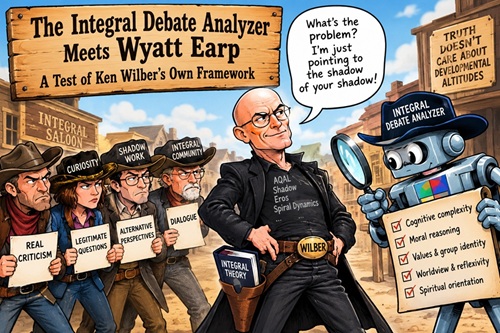 The 2006 Wyatt Earp episode is an unusually revealing test case for Integral Life's Debate Analyzer. It was not simply a disagreement between Ken Wilber and his critics. It was an internal conflict in which a prominent intellectual and spiritual authority responded to criticism with ridicule, then interpreted the resulting controversy through his own developmental and psychological framework. The central question is whether the Debate Analyzer can examine this episode without giving Wilber's own theoretical vocabulary an unfair advantage. The original controversy unfolded in June 2006. Wilber published a series of blog posts responding to critics in what he called a Wild West fashion. The follow-ups included reflections on shadow projection and the question “What Would Wyatt Do?” I responded with several critical essays, later collected in The Wild West Wilber Report. The episode also helped inspire the formation of Open Integral, a venue for alternative integral perspectives. I will apply the Analyzer's stated approach to the surviving record, treating this as a retrospective analytical exercise rather than claiming to have run an official Analyzer session. The distinction matters: the published methodology describes an assessment of developmental structures across cognitive, moral, values, worldview and, where relevant, spiritual dimensions. It explicitly says that factual correctness and developmental complexity are not the same thing. 1. What was actually being debated?The first mistake would be to reduce the Wyatt Earp affair to a simple clash between a mature integral thinker and less-developed critics. That would assume precisely what needs to be examined. Wilber's initial intervention was not merely a defense of particular theoretical claims. It also attacked the intellectual standing of his critics and drew a distinction between those who understood his work and those who did not. His subsequent posts introduced shadow projection as a way to interpret the reactions his intervention had provoked. Three disputes therefore became entangled. The first was intellectual: were Wilber's critics misrepresenting his theories, or were they identifying genuine weaknesses? The second was psychological: were their objections expressions of unconscious projections, or were they legitimate responses to Wilber's conduct? The third was institutional: who had the authority to decide what counted as an adequately integral criticism of Integral Theory itself? The third question is the most revealing. If Wilber's framework is used to evaluate his critics, can the same framework be used to evaluate Wilber? And can critics challenge the framework's assumptions without having their objections reclassified as evidence of their lower developmental position? These are questions about the rules of debate, not merely about the personalities involved. 2. The Analyzer's developmental dimensionsThe official Analyzer distinguishes several dimensions of meaning-making. Applying them to the Wyatt Earp episode requires examining observable argumentative behavior rather than pretending we can diagnose the participants' overall developmental stages from a collection of blog posts. Cognitive complexity - Could each side distinguish substantive criticism from personal hostility, coordinate multiple explanations for disagreement, and revise its interpretation in response to counterevidence? Moral reasoning - Did the participants apply standards of fairness, intellectual responsibility and accountability consistently, including to themselves? Values and group identity - Did participants prioritize open inquiry, or did loyalty to an intellectual community influence which criticisms they regarded as legitimate? Worldview and reflexivity - Could the participants examine the limitations of their own interpretive frameworks, or did they treat those frameworks as the unquestioned standards by which others should be judged? Spiritual orientation - Where spiritual authority was relevant, did claims to insight or realization lead to greater openness and accountability, or become a basis for dismissing dissent? These dimensions follow the Analyzer's published methodology, which cautions that development is uneven and that adversarial exchanges can bring out less constructive behavior than participants might display in other settings. The appropriate unit of analysis here is therefore the performance in this particular controversy, not a definitive ranking of Wilber, Visser or anyone else. 3. Wilber's cognitive performance: complexity versus closureWilber's strongest possible defense is that he had encountered criticism he regarded as superficial, repetitive or uninformed. An author who has spent decades developing a complex theoretical system is entitled to insist that critics represent his arguments accurately. Intellectual criticism is not exempt from standards of competence merely because it challenges an influential thinker. But that defense does not settle the question. The important issue is what happens when an author moves from rebutting an argument to discrediting the people making it. Wilber's response, as documented in the episode, mixed substantive disputes with personal ridicule. He then turned to shadow psychology to interpret some of the reactions. This introduced a difficulty: a critic could now be wrong about Wilber's theory, but the critic's anger could also be interpreted as evidence of an unresolved psychological problem. The possibility that the anger was a reasonable response to the manner of Wilber's intervention risked being obscured. From a cognitive-complexity perspective, this is a potential form of explanatory closure. A disagreement that could have several causes is interpreted through one favored explanatory lens. The more complex analysis would distinguish at least four possibilities:
These explanations can coexist, but none should be assumed in advance. Wilber's use of shadow theory was not inherently illegitimate. The problem arose to the extent that it was used to explain away objections rather than to investigate them symmetrically. 4. The shadow argument: a theory that turns back on its authorThe shadow issue is the psychological center of the episode. Wilber's suggestion that critics examine their projections is not intrinsically unreasonable. People do project motives onto others, especially during heated disputes. A critic may exaggerate an opponent's arrogance, overlook their own aggression, or interpret disagreement through accumulated resentment. Yet the same possibilities apply to the person being criticized. If anger can reveal a critic's unacknowledged shadow, Wilber's own anger and ridicule are also legitimate subjects for reflection. If critics might be projecting onto him, he might also be projecting onto them. If critics need to distinguish their emotional reactions from the validity of their arguments, Wilber needs to make the same distinction. This is where the Analyzer's construct-aware dimension becomes particularly useful. At its most reflexive, a framework can examine its own assumptions and the interests it serves. It can ask not only, “What is the critic failing to see?” but also, “What might my preferred explanation prevent me from seeing?” The crucial distinction is between using shadow work as an invitation to mutual self-examination and using it as a one-way instrument of disqualification. Wilber's subsequent posts about shadow work provided a conceptual vocabulary for self-reflection. But the existence of that vocabulary does not establish that the original controversy was itself handled reflectively. The relevant evidence is whether competing explanations were genuinely considered and whether the framework was applied equally to the author and his critics. A theory of projection should make its proponent more accountable to scrutiny, not less. 5. Moral reasoning: does intellectual altitude excuse bad conduct?The Analyzer explicitly distinguishes developmental complexity from moral character. A sophisticated thinker can behave badly; a less sophisticated thinker can make a morally sound objection. That distinction is indispensable here. Wilber's intellectual achievements do not settle whether his conduct during the Wyatt Earp affair was justified. Nor does his use of spiritual and developmental concepts automatically give his response greater moral legitimacy. A fair assessment asks whether the same standards apply to everyone. If ridicule undermines a critic's credibility, it should also count against an influential author. If critics have a duty to represent Wilber accurately, Wilber has a corresponding duty to represent their arguments accurately. If critics should examine their psychological motives, he should be willing to examine his own. This is not a demand that intellectuals remain perpetually calm or never respond sharply to unfair criticism. It is a demand that the standards of accountability remain reciprocal. The Analyzer's moral dimension should therefore examine the relationship between power and responsibility. Wilber was not simply another participant in an argument. He was the central figure in a movement whose members had invested considerable intellectual and personal commitment in his work. His responses consequently carried a different weight from those of an ordinary dissenter. The relevant question is not whether Wilber was a good or bad person. It is whether his conduct helped sustain the conditions for serious disagreement. 6. Values and group identity: the integral in-groupThe Wyatt Earp affair also exposed tensions within the integral community itself. Some participants supported Wilber's general position or regarded his intervention as a provocative challenge to critics who did not adequately understand his work. Others were disappointed by the tone of his response and questioned whether the subsequent psychological explanations adequately addressed the underlying objections. Contemporary commentary described a community becoming more divided rather than more united. One observer suggested that Wilber's posts had exposed divisions between those who felt included by his response and those who felt alienated by it. This is important because developmental movements can develop an identity around being developmentally advanced. Once that happens, criticism can acquire an additional meaning: it may be heard not merely as disagreement with an idea, but as evidence that the critic has not reached the level required to understand it. The resulting structure is self-reinforcing. Supporters who understand the master are recognized as insiders; dissenters who question the master risk being classified as outsiders. The framework that supposedly transcends conventional group identity can thus become a powerful marker of group identity itself. This does not mean that every integral supporter behaved this way, or that every critic was correct. It means that the group dynamics deserve independent scrutiny. The emergence of Open Integral after the controversy is a particularly revealing consequence. Its archive describes the project as an effort to develop alternative integral perspectives following the Wyatt Earp conflict. The irony is striking: a movement dedicated to integrating perspectives helped generate a separate forum for perspectives that its central authority had not adequately accommodated. 7. Worldview: when Integral Theory becomes the judge in its own caseThe most serious issue concerns the status of Integral Theory itself. Wilber's framework attempts to explain differences in consciousness, values and worldview through developmental stages. Such a framework can be useful for understanding why people reason differently. But it becomes problematic when its developmental categories are used to establish the legitimacy of the framework without independently addressing objections to it. Consider the difference between two responses to a critic. The first is: “Your interpretation of my theory is mistaken because you have overlooked these arguments.” The second is: “Your interpretation is mistaken because your developmental position prevents you from understanding my theory.” The first response offers a proposition that can be examined. The second may also contain a testable psychological hypothesis in principle, but it requires independent evidence. Otherwise, it risks becoming a circular defense: the theory is correct because the critic cannot understand it, and the critic cannot understand it because the theory says so. This is the very point at which the Analyzer should turn its attention to the framework's own assumptions. Its methodology distinguishes single-frame reasoning from the capacity to compare whole frameworks and examine the conditions under which different interpretations become possible. Applied consistently, that distinction raises a question for Wilber's critics as well. They should not assume that every developmental interpretation is merely an instrument of domination. A developmental account could illuminate real differences in reasoning. But its validity in a particular dispute must be established rather than presumed. The same standard applies to Integral Theory as a whole. It cannot receive immunity from criticism merely because it includes a sophisticated theory of criticism. 8. Frank Visser under the AnalyzerA symmetrical analysis must examine the critics, too. My own response to Wilber was not emotionally neutral. The episode took place within a long-running intellectual engagement with his work, and I was directly involved. My criticism of his conduct therefore cannot be treated as an entirely detached observation. The Analyzer would reasonably ask whether my responses distinguished Wilber's substantive arguments from his personal conduct, whether I represented his positions fairly, and whether my own interpretation of the controversy was open to revision. There is also a potential weakness in emphasizing the contrast between intellectual accountability and spiritual authority. If that contrast becomes too simple, it can understate Wilber's legitimate complaint that some criticism of his work might be poorly informed or motivated by hostility. A serious critique should not depend on proving that Wilber behaved badly. Even if he had responded graciously, his theoretical claims would still need to withstand scrutiny. Conversely, establishing that his conduct was objectionable would not automatically prove his critics' substantive arguments correct. My strongest position in this controversy is therefore not that Wilber was wrong because he was rude. It is that the quality of an argument and the conduct of its author are distinct questions, both deserving examination. That distinction also protects criticism from turning into a mirror image of the behavior it condemns. 9. The shared space: what kind of conversation did the episode create?The Analyzer's most interesting feature is its attention to the space between participants. A debate is not simply two individuals expressing their respective levels of development. It is an interaction that can either increase or decrease the possibilities for mutual understanding. The Wyatt Earp episode created conditions in which intellectual criticism, personal antagonism, questions of loyalty and claims about psychological development became entangled. Once disagreement was framed in terms of who understood Wilber and who was projecting shadow, it became harder to separate the evaluation of arguments from the evaluation of the people making them. This dynamic encouraged participants to take sides rather than jointly investigate the disputed issues. The creation of an alternative integral forum suggests that the conflict had consequences beyond the original exchange. The episode might have unfolded differently if the participants had agreed on several procedural rules: critics would quote and interpret Wilber's claims accurately; Wilber would answer the substance of criticism before discussing the critics' psychology; psychological explanations would remain hypotheses rather than verdicts; and all parties would acknowledge that their own interpretations could be mistaken. Such rules would not guarantee agreement. They would make disagreement more productive. The deeper lesson is that the quality of a debate cannot be measured solely by the complexity of the concepts its participants use. It also depends on whether those concepts help people understand one another or provide increasingly sophisticated ways to dismiss one another. 10. Would the Debate Analyzer expose Wilber's blind spots?The answer depends on how the tool is used. If it examines observable patterns of reasoning, distinguishes cognitive complexity from moral conduct, and treats developmental interpretations as provisional, it could illuminate the Wyatt Earp affair. It could identify the strengths of Wilber's theoretical ambitions while examining the ways his rhetoric narrowed the conversation. It could also identify weaknesses in his critics' reasoning without reducing their objections to personal pathology. But if the Analyzer were to treat Wilber's integral vocabulary as the privileged standard for interpreting the dispute, it could reproduce the very problem it is supposed to investigate. There is an important methodological limitation here. The official description explains the Analyzer's conceptual framework, but the available evidence does not establish how reliably its developmental judgments can be validated in a historical controversy such as this one. Its stage labels should therefore not be mistaken for objective psychological measurements or definitive findings about the people involved. I would not assign Wilber or Visser numerical developmental scores on the basis of these posts alone. Doing so would create a false impression of precision. Instead, the strongest application of the Analyzer is to examine specific behaviors: whether arguments are addressed, whether alternative explanations are considered, whether interpretations can be revised, whether standards are applied reciprocally, and whether participants can acknowledge the limitations of their own frameworks. These questions are more useful than simply asking who occupies the higher developmental altitude. Conclusion: the ultimate test is whether Integral Theory can criticize itselfThe 2006 Wyatt Earp affair offers an unusually sharp test of Integral Theory because it concerns not only what Wilber believed, but how he responded when his authority was challenged. His defenders may reasonably argue that he was responding to criticism he considered inadequate. His critics may reasonably argue that ridicule and one-sided appeals to shadow psychology undermined the possibility of constructive dialogue. Neither claim should be accepted without examining the actual exchanges. The decisive question is whether a framework designed to integrate perspectives can tolerate criticism of its own central authority without automatically interpreting that criticism through its own developmental hierarchy. The Integral Debate Analyzer could help answer that question, but only if it applies its principles symmetrically. Wilber's critics must be open to having their reasoning examined. Wilber must be subject to the same scrutiny. And the Analyzer itself must remain open to the possibility that its categories can illuminate a debate without fully explaining it. That leads to a final irony. A framework that claims to transcend narrow perspectives should be particularly capable of recognizing when its own perspective has become narrow. A theory of shadow should be especially willing to examine the shadow of its own proponents. And a movement that celebrates developmental growth should be able to acknowledge that intellectual achievement does not automatically produce humility, fairness or good judgment. The real test of Integral Theory is not whether it can explain why its critics are wrong. It is whether it can recognize when its critics have a point. And the real test of the Integral Debate Analyzer is whether it can reach that conclusion even when the person under examination is Ken Wilber himself.
Widget is loading comments...
|