|
TRANSLATE THIS ARTICLE
Integral World: Exploring Theories of Everything
An independent forum for a critical discussion of the integral philosophy of Ken Wilber
  Frank Visser, graduated as a psychologist of culture and religion, founded IntegralWorld in 1997. He worked as production manager for various publishing houses and as service manager for various internet companies and lives in Amsterdam. Books: Ken Wilber: Thought as Passion (SUNY, 2003), and The Corona Conspiracy: Combatting Disinformation about the Coronavirus (Kindle, 2020). Frank Visser, graduated as a psychologist of culture and religion, founded IntegralWorld in 1997. He worked as production manager for various publishing houses and as service manager for various internet companies and lives in Amsterdam. Books: Ken Wilber: Thought as Passion (SUNY, 2003), and The Corona Conspiracy: Combatting Disinformation about the Coronavirus (Kindle, 2020).
Check out my other conversations with ChatGPT Beyond Winning and LosingA Critical Evaluation of Corey DeVos's Debate AnalysisFrank Visser / ChatGPT
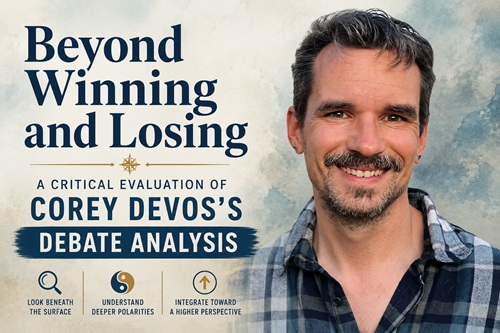 Corey DeVos's "Debate Analysis" project is one of the more creative recent attempts to apply Integral Theory to public intellectual disagreements. Rather than asking who won a debate, DeVos seeks to uncover the deeper structures underlying the conflict. His analyses attempt to reveal the values, concerns, and developmental dynamics that shape opposing viewpoints, and then identify a higher-order perspective capable of integrating both sides. This approach reflects one of the central ambitions of the integral tradition: to move beyond binary thinking and discover larger frameworks that can accommodate apparently conflicting truths. While this method offers valuable insights, it also raises important questions about truth, evidence, and the limits of metatheoretical analysis. The Core Method: Looking Beneath the SurfaceThe basic premise of Debate Analysis is that most public disagreements are not simply clashes over facts. Rather, they are expressions of deeper tensions between legitimate human concerns. Instead of focusing on arguments alone, DeVos asks what each participant is trying to protect, what deeper polarity drives the disagreement, and what broader framework might reconcile the competing perspectives. For example, in his analysis of debates between public intellectuals such as Sam Harris and Jordan Peterson, DeVos suggests that the participants are often defending different but equally important dimensions of human experience—truth versus meaning, certainty versus ambiguity, stability versus change. The task of analysis becomes one of identifying the deeper structure beneath the visible disagreement. This represents a significant departure from conventional debate commentary, which typically focuses on evidence, logic, rhetorical performance, or factual accuracy. The Strength of Charitable InterpretationOne of the strongest aspects of the approach is its commitment to intellectual charity. Rather than treating opponents as ignorant, irrational, or morally deficient, Debate Analysis assumes that each side is responding to genuine concerns. In an era of increasing polarization, this is a valuable corrective. Many contemporary debates deteriorate into caricature and tribalism. By asking what legitimate value a participant is defending, DeVos encourages a more nuanced understanding of ideological conflict. This method can also reveal dimensions of a disagreement that participants themselves may not fully recognize. Often people argue over specific issues while remaining largely unaware of the broader value systems motivating their positions. Mapping Values Rather Than ArgumentsA second strength lies in the method's ability to illuminate value conflicts. Many public controversies involve more than factual disagreements. Questions surrounding religion, political authority, social change, identity, or morality often involve competing priorities that cannot be resolved through evidence alone. Debate Analysis excels at identifying these deeper tensions. It highlights how disagreements frequently emerge not because one side lacks information but because different values are being prioritized. In this respect, the framework serves as a useful map of the psychological and cultural dimensions of public discourse. The Problem of TruthDespite these strengths, the approach faces a serious limitation: it often sidelines the question of who is actually right. Many debates are indeed conflicts between legitimate values. But many others involve factual errors, weak reasoning, unsupported claims, or demonstrably false assertions. In such cases, understanding why someone holds a position is not the same as evaluating whether the position is true. The danger is that the search for integration can create a false symmetry between arguments of unequal merit. If one participant's claims are well-supported and another's are not, framing the disagreement as a polarity requiring synthesis may obscure important distinctions. Understanding a viewpoint and validating a viewpoint are different tasks. Debate Analysis sometimes blurs that distinction. The Integral Temptation Toward SynthesisA recurring feature of DeVos's analyses is the discovery of a higher-order perspective that supposedly transcends the limitations of both sides. This reflects a core principle of Integral Theory: the idea that opposing perspectives often contain partial truths that can be integrated into a larger whole. While this can be illuminating, it also raises methodological concerns. After reading multiple analyses, one notices a recurring pattern. There is almost always a deeper polarity, a hidden variable, and a more comprehensive framework waiting to be discovered. The structure of the analysis appears remarkably consistent regardless of the topic. This creates the impression that synthesis is not always the conclusion of the inquiry but may instead be built into the method from the outset. The risk is that every disagreement becomes a candidate for integration, whether or not integration is actually warranted. The Problem of VerificationAnother weakness concerns the status of the interpretations themselves. How can we verify that a particular debate is fundamentally about "meaning versus truth," "autonomy versus belonging," or any other proposed polarity? These interpretations are often insightful and plausible, but they remain largely interpretive judgments. Unlike empirical claims, they are difficult to test. Alternative analysts could identify entirely different underlying structures and arrive at equally plausible conclusions. This problem is familiar throughout the integral tradition. The frameworks are often elegant and comprehensive, but their explanatory power sometimes exceeds their empirical grounding. When Abstraction Becomes a LiabilityDebate Analysis frequently moves discussions toward increasingly abstract levels of interpretation. While this can reveal important patterns, it can also create distance from the actual issues under discussion. Debates about policy, science, history, economics, or international conflict often require careful attention to evidence and practical consequences. At times, the move toward higher-order synthesis can feel detached from the concrete realities that generated the disagreement in the first place. Participants may be arguing about specific facts or decisions while the analysis relocates the conversation into a realm of values, structures, and developmental dynamics. The result can be intellectually stimulating but practically inconclusive. A Mirror of Integral TheoryPerhaps the most interesting aspect of Debate Analysis is that it serves as a microcosm of Integral Theory itself. Its strengths are the strengths of the integral approach: inclusiveness, contextual awareness, multidimensional thinking, and resistance to simplistic polarization. Its weaknesses are also familiar: a tendency toward excessive synthesis, an underemphasis on empirical adjudication, and a preference for interpretive elegance over rigorous validation. The framework is exceptionally good at revealing what people care about, what they fear, and what they seek to preserve. It is less effective at determining which claims are factually correct or empirically defensible. Conclusion: Interpretation Is Not AdjudicationCorey DeVos has developed a sophisticated and often insightful approach to understanding public disagreements. As a tool for mapping perspectives, identifying hidden values, and fostering intellectual empathy, Debate Analysis has considerable merit. Its limitations emerge when interpretation begins to substitute for evaluation. Understanding why people disagree does not necessarily tell us whether their claims are true. Revealing the values behind a position does not resolve questions of evidence. Discovering a higher-order synthesis does not automatically validate all perspectives involved. The method is therefore best understood not as a replacement for critical analysis but as a complement to it. It helps explain what debaters are protecting and why conflicts arise. What it cannot reliably determine is whether the positions being protected are justified. That distinction marks the boundary between integral sensemaking and the more traditional disciplines of logic, evidence, and critical inquiry.
Comment Form is loading comments...
|