|
TRANSLATE THIS ARTICLE
Integral World: Exploring Theories of Everything
An independent forum for a critical discussion of the integral philosophy of Ken Wilber
  Frank Visser, graduated as a psychologist of culture and religion, founded IntegralWorld in 1997. He worked as production manager for various publishing houses and as service manager for various internet companies and lives in Amsterdam. Books: Ken Wilber: Thought as Passion (SUNY, 2003), and The Corona Conspiracy: Combatting Disinformation about the Coronavirus (Kindle, 2020).
Check out my other conversations with ChatGPT
Integral Debate Analysis:
The Integral Debate Analysis Approach Beyond Winning and Losing The Integral Debate Analyzer 2.0 Everyone's Debates Except Wilber's? A Test of Ken Wilber's Own Framework Wyatt Earp as an Integral Cold Case The Integral Debate Analyzer 2.0Can an AI Really See How People Think?Frank Visser / ChatGPT
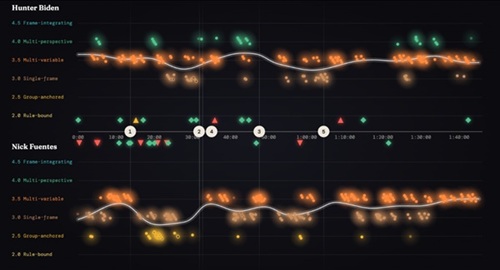 From developmental mapping to algorithmic authorityIntegral Life's revamped Debate Analyzer promises something more ambitious than a conventional analysis of political or philosophical disagreements. It aims to map how people reason, identify the developmental structures behind their arguments, reveal what each side is trying to protect, and discover the possibilities for synthesis that the participants themselves may have missed. Instead of simply asking who won a debate, it asks what kind of thinking each participant brought to it. The promotional announcement, titled “Development Isn't a Box. It's a Cloud,” (October 23, 2026) presents the latest version as a substantial upgrade. The system now analyzes debates passage by passage, assesses five developmental lines, and displays its judgments on an interactive map. Each passage becomes a data point that readers can supposedly inspect for themselves. An introductory briefing summarizes the debate, while an “Integrity Check” is intended to distinguish good-faith argument from smears and distortions. There is something genuinely worthwhile here. Public debates are rarely just contests over isolated facts. They involve competing values, different understandings of evidence, incompatible moral priorities, and assumptions about what constitutes a legitimate argument. A tool that helps readers recognize these differences could improve public discussion. But the Analyzer also raises a question that is particularly important for anyone familiar with Ken Wilber's Integral Theory: what justifies the developmental judgments that the system makes? It is one thing to use AI to summarize arguments, identify recurring themes, compare claims, and reconstruct opposing positions. It is another to assign those arguments developmental altitudes, infer the structures of meaning-making behind them, and present the results in a sophisticated visual framework that may make interpretive judgments look like objective measurements. My concern is not that such an exercise is necessarily worthless. It is that Integral Life risks turning a useful interpretive framework into an instrument of unwarranted epistemic authority. 1. The cloud metaphor: a useful correction, but not a scientific breakthroughThe announcement's most appealing idea is that development is better understood as a probability cloud than as a fixed box. Rather than assigning a person a single developmental stage, the Analyzer tracks a range of performances across a conversation. A participant may reason systematically about one issue, revert to rigid assumptions about another, and briefly display a more sophisticated capacity when circumstances permit. The tool distinguishes a person's apparent center of gravity from their lowest demonstrated performance and their highest demonstrated reach. This is a sensible correction to crude stage labeling. Human beings are not developmental specimens who carry a single, permanent stage number around with them. Our behavior depends on the subject matter, our expertise, our emotional state, the audience, the conversational setting, and the incentives of the exchange. Someone may be an excellent scientist and an inflexible political thinker, or a sophisticated philosopher and a remarkably poor judge of personal relationships. But there is a difference between acknowledging variability and demonstrating that a probability distribution of developmental capacities has actually been measured. What, precisely, is the cloud a probability distribution of? The probability that a person will demonstrate a particular structure of reasoning under specified conditions? The frequency with which an AI assigns particular developmental scores to passages? Or the analyst's uncertainty about which stage best describes an utterance? These are different things. A genuine probabilistic model would require a clearly defined target, a defensible procedure for estimating probabilities, and evidence that those probabilities are calibrated against relevant observations. A visualization of varying scores does not establish any of these. If the Analyzer identifies a person's “floor,” “center of gravity,” and “reach,” we need to know how these quantities are calculated. Are they simple summaries of AI-generated labels? Are the labels independently validated? Would another qualified assessor produce comparable results from the same transcript? And would repeated analyses of the same passage, using the same model and instructions, yield similar scores? The cloud metaphor may be a useful way of thinking about development. It is not, by itself, evidence that the underlying developmental measurements are reliable. The danger is subtle. A fixed label can look crude enough to invite skepticism. A dynamic, multidimensional visualization looks more sophisticated, and sophistication can be mistaken for accuracy. 2. Five developmental lines, one synthetic scaleThe Analyzer draws on several established traditions. Its cognitive line incorporates Michael Commons' Model of Hierarchical Complexity and Terri O'Fallon's STAGES model. Its moral line draws on Lawrence Kohlberg and Carol Gilligan; its values line on Clare Graves and Spiral Dynamics; its worldview line on Jean Gebser; and its optional spiritual line on James Fowler and M. Scott Peck. The resulting assessments are expressed through a common numerical scale, running from 1.5 to 5.0. This is ambitious intellectual synthesis. It is also where some of the most important questions begin. These traditions do not all measure the same thing. The complexity of a reasoning operation, the structure of moral justification, a person's motivational priorities, a worldview, and an orientation toward faith are not interchangeable psychological variables. They have different theoretical histories, methods of assessment, and standards of evidence. That different developmental theories identify patterns that can be compared does not automatically establish that their stages can be translated into a single common scale. Such a translation is itself a theoretical achievement requiring justification. Consider a speaker who presents a sophisticated argument for an authoritarian political system. The speaker might coordinate multiple variables, anticipate second-order consequences, and construct a consistent account of social order. Does that demonstrate advanced cognitive complexity? Possibly. Does it establish a correspondingly advanced moral orientation? Certainly not by itself. Does it reveal a particular worldview structure? Perhaps, but the answer depends on more than the speaker's political conclusion. The Analyzer recognizes that developmental lines can diverge. That is an important safeguard. Yet its common altitude system still invites readers to interpret the various numbers as positions within a unified developmental landscape. The danger is that a conceptual convenience becomes an implied empirical equivalence. The same concern applies to the synthesis of developmental thinkers into a shared framework. Independent origins are not proof of independent confirmation. If several theories are selected, interpreted, and aligned by a common integrative scheme, their apparent convergence may partly reflect the decisions made during that alignment. A rigorous defense of the Analyzer would therefore need to show not only that each source model has a research history, but also that the particular crosswalk between those models is defensible. What evidence supports the shared scale? Which mappings are well established, which are interpretive approximations, and which remain speculative? Without that distinction, a numerical score risks conveying more precision than the underlying synthesis warrants. 3. The content-structure firewall: a valuable principle with limitsThe Analyzer's central methodological claim is that it assesses the structure of an argument rather than the truth or falsity of its content. A speaker may be factually correct but structurally unsophisticated; another may be wrong while displaying greater complexity in how they reason. Rhetorical brilliance, academic credentials, and agreement with the evaluator are not supposed to determine developmental altitude. There is an important insight here. Correct conclusions do not always follow from good reasoning, and complex reasoning does not guarantee correct conclusions. Someone can reach a sound result through a crude argument, while another person can construct an elaborate, internally coherent defense of a false belief. But the distinction between content and structure is not as clean as the promotional language suggests. To assess reasoning structure, an analyst must interpret what a speaker means, identify the argument's premises, distinguish a genuine concession from a rhetorical maneuver, and decide whether the speaker has adequately represented the opposing position. These judgments depend on the substance of the debate. Imagine a climate scientist who repeatedly cites empirical findings and rejects an opponent's claims because they conflict with well-established evidence. An AI might describe the scientist as operating within a relatively narrow rational framework if the scientist declines to explore every alternative worldview. But the scientist might simply be applying appropriate evidential standards to a question for which some alternatives have little empirical support. Conversely, a conspiracy theorist might acknowledge multiple perspectives, discuss feedback loops, and weave disparate events into a grand systemic narrative. That may sound integrative. It does not make the resulting explanation intellectually superior. The distinction that matters is not merely between simple and complex reasoning. It is between reasoning that is appropriately responsive to evidence and reasoning that uses complexity to insulate itself from correction. The Analyzer's own methodology acknowledges that sophisticated vocabulary and elaborate frameworks can serve an unfalsifiable, identity-protective worldview. That is a good warning. But how reliably can an AI distinguish genuine structural complexity from the performance of complexity? And how does it avoid confusing an argument's openness to evidence with its willingness to entertain perspectives that have already failed evidential scrutiny? A sound assessment must consider both structure and content, even if it keeps them analytically distinct. Otherwise, an evaluator may reward a beautifully constructed argument without adequately examining whether it is true, relevant, or warranted. The content-structure distinction is useful as a diagnostic tool, but it cannot replace substantive criticism. 4. The problem of developmental altitudeThe Analyzer explicitly states that higher developmental stages do not necessarily make someone a better person. A relatively early-stage individual may be more compassionate, courageous, honest, or helpful than someone assessed at a higher altitude. Its methodology also warns that a person's performance in an adversarial debate should not be treated as a diagnosis of their overall development. These caveats are welcome. Yet they leave a fundamental question unresolved: what does a higher score actually entitle us to conclude? If the score concerns only the complexity of reasoning demonstrated in a particular passage, the claim can be relatively modest. We can discuss whether the speaker coordinates competing variables, examines assumptions, or recognizes limitations in a framework. But the moment those observations are organized into a developmental hierarchy, the interpretation becomes more ambitious. The hierarchy suggests not merely that one argument is more complex than another, but that the two performances occupy different positions in a developmental sequence. That may be justified in particular cases. It cannot simply be assumed. There are at least three separate claims here. First, the speaker has demonstrated a particular reasoning capacity. Second, that capacity corresponds to a theoretically defined developmental stage. Third, the stage reflects a relatively stable feature of the person's meaning-making under relevant circumstances. Each claim requires additional evidence beyond the previous one. A transcript can offer evidence for the first claim. It may support the second when the stage criteria are clear and independently defensible. The third is much harder to establish from a single exchange. The Analyzer's disclaimers recognize this problem, but the visual presentation of scores can still encourage readers to move unconsciously from one claim to the next. A passage receives a score; the score appears on a map; the map becomes a profile; and the profile begins to look like a portrait of the person. That is precisely the inference the methodology says it wants to avoid. There is also a normative problem. Even if developmental stages accurately captured certain patterns of reasoning, it would not follow that the most integrative form of reasoning is always the most appropriate for a given task. A simple, decisive answer can be superior to an elaborate synthesis when the evidence is decisive and action is urgent. A person who refuses to compromise on a well-supported factual claim need not be developmentally deficient merely because they do not find a midpoint between competing positions. Complexity is a capacity, not a universal substitute for judgment. 5. The AI problem: a map of judgments is not independent verificationThe new moment map (see header image) is arguably the most useful practical improvement. Instead of assigning an overall score based on a few selected quotations, the system analyzes the debate passage by passage. Readers can click on individual nodes and examine the material underlying particular assessments. The announcement presents this as a way to make the analysis more transparent and verifiable. That is a real improvement over an unexplained verdict. But inspectability and validity are not the same thing. Suppose an AI assigns a passage a cognitive altitude of 4.0. The reader can inspect the passage and the explanation accompanying that rating. Yet the explanation is itself another AI-generated interpretation. Unless the underlying criteria are sufficiently precise and independently validated, the reader is being invited to inspect one layer of judgment through another layer of judgment produced by the same general process. The system can be transparent about what it concluded without demonstrating that its conclusion is correct. This is especially important because the Analyzer evaluates subtle qualities: whether a speaker can examine their own framework, genuinely acknowledge the opposing position, recognize an underlying polarity, or reason at a level that transcends the assumptions of the debate. These are difficult interpretive tasks even for experienced human analysts. An AI may perform them impressively in one instance and inconsistently in another. The question is not whether language models can produce insightful interpretations. Clearly they can. The question is whether their developmental classifications are sufficiently reliable to support the stronger claims made for the resulting profiles. The methodology page itself concedes that the AI is not an oracle, that its judgments may be wrong, and that its assessments should be treated as hypotheses rather than verdicts. That is the correct attitude. But it should govern the presentation and use of the system, not merely appear as a disclaimer alongside authoritative-looking scores. What would strengthen the Analyzer considerably? A public evaluation in which independent human raters assess the same debate passages, disagreements are reported rather than concealed, and the AI's results are compared against those assessments. Repeated runs could establish how stable its ratings are. Carefully designed test cases could reveal whether the system systematically rewards particular rhetorical styles, ideological positions, or forms of vocabulary. Such testing would not eliminate interpretive judgment. It would help establish where the tool is dependable, where it is useful but uncertain, and where it should not be trusted. Until then, the moment map should be treated as an aid to interpretation, not as an instrument that measures developmental reality directly. 6. The danger of Integral confirmation biasThere is a more specifically Integral problem here. The Analyzer does not operate from a theory-neutral position. Its categories, developmental stages, and vocabulary are drawn substantially from the traditions that Integral Life already endorses. Its methodology explicitly incorporates Wilber's AQAL framework into the worldview line, while synthesizing several developmental models into a common altitude system. This does not automatically invalidate the tool. All interpretation begins somewhere. The relevant question is whether the framework can critically examine its own assumptions with the same rigor it applies to others. Consider how easy it would be for an Integral analyst to interpret a disagreement between a scientific naturalist and a spiritual philosopher. The naturalist might emphasize empirical evidence, causal mechanisms, and the limits of metaphysical speculation. The spiritual philosopher might emphasize lived experience, meaning, consciousness, and dimensions of reality that the naturalist's framework allegedly excludes. An Integral interpretation could frame this as a clash between developmental perspectives, perhaps suggesting that the naturalist is constrained by a rational worldview while the spiritual philosopher has access to a more inclusive or integrative perspective. But that interpretation would not establish that the spiritual philosopher's claims are true. Nor would it show that the naturalist's methodological restraint is a developmental limitation. The naturalist might simply be demanding evidence proportional to the claims being made. Indeed, the naturalist could be more open to revising their beliefs in response to evidence than the supposedly integrative thinker who incorporates every objection into an encompassing spiritual worldview. This is a familiar problem with comprehensive philosophical systems. They can reinterpret objections as evidence of the objector's limited perspective. The critic is not necessarily wrong; the critic is merely unable to see the larger picture. The framework thus gains a potential defense against criticism without having to answer it on its merits. The Analyzer's content-structure firewall is intended to prevent ideological agreement from determining developmental scores. That is an admirable ambition. But it needs to be demonstrated, not merely declared. Would the system assign comparable developmental ratings to structurally similar arguments when the speakers' conclusions are reversed? Would it assess a rigorous naturalist and a rigorous spiritual thinker according to the same standards of argumentation? Can it recognize when an ostensibly integrative worldview is less evidentially disciplined than a narrower one? These are not peripheral questions. They are tests of whether the Analyzer can apply its own standards to the Integral worldview that informs it. 7. The synthesis trap: not every disagreement conceals a higher truthOne of the Analyzer's most attractive features is its attempt to identify the partial truth on each side of a debate. It looks for underlying polarities, explains what each participant is protecting, and proposes a synthesis that might move the conversation beyond its original impasse. Its methodology distinguishes genuine integration from simply splitting the difference. This can be illuminating. Political disagreements often involve legitimate tensions between competing goods: liberty and security, individual autonomy and collective responsibility, institutional stability and reform. Understanding what each side is trying to protect can reveal common ground that partisan rhetoric obscures. But the language of polarity can also become a trap. Not every disagreement is a polarity in which both sides possess complementary truths. Some disagreements concern straightforward factual questions. Some involve one party making a well-supported claim and another making an unsupported one. Others concern values that cannot be reconciled without sacrificing something important. Consider a debate over whether a public figure made a particular statement. If a recording establishes that the statement was made, the relevant question is not how to integrate the speaker's worldview with that of someone who denies the recording. It is whether the denial survives contact with the evidence. Likewise, a debate over whether a medical treatment works cannot be adequately resolved by identifying the partial truth in both proponents' and opponents' positions. The evidence may support one conclusion much more strongly than the other. Even in political disputes, identifying the legitimate concern on each side does not mean that the proposed remedies deserve equal consideration. A concern about national security may be genuine while the policies advanced in its name are ineffective or unjust. A concern about equality may be legitimate while a particular intervention is poorly designed. The Analyzer's promise of fairness without false equivalence is therefore a good one. Its success depends on whether it can distinguish complementary values from competing factual claims, and genuine tensions from situations where one side is simply wrong. A synthesis should emerge from the analysis. It should not be a predetermined reward for finding a sufficiently sophisticated way to describe both sides. Sometimes the most integrative conclusion is that one side has the better argument, while the other has identified a legitimate concern that does not rescue its central claim. 8. The Integrity Check: a promising feature that needs its own standardsThe announcement's Integrity Check deserves particular attention. Integral Life says that the Analyzer should not automatically balance the scales when one participant argues in good faith and the other relies on smears or distortions. This is an important departure from the lazy assumption that fairness always requires equal criticism of opposing sides. A fair analysis should not invent weaknesses in a strong argument merely to create symmetry. Yet the Integrity Check introduces another evaluative task: deciding when a speaker is distorting the truth, arguing in bad faith, or engaging in smears. Some cases are straightforward. A quotation may be demonstrably fabricated, a statistic may be misrepresented, or a speaker may repeatedly attribute a position to an opponent that the opponent has explicitly rejected. Other cases are much less clear. A misleading claim may result from ignorance rather than deliberate deception. A politician may use selective evidence without making a literally false statement. An opponent may accurately identify a factual error while misrepresenting its significance. The distinction between an inaccurate statement and an intentionally dishonest argument matters, and an AI should not casually infer the latter from the former. The Analyzer would benefit from making its Integrity Check auditable in a specific way. When it identifies a distortion, it should show the relevant statement, the evidence against it, the precise nature of the discrepancy, and the degree of confidence warranted by that evidence. It should distinguish demonstrable falsehood from disputed interpretation and deliberate deception from an inference about intent. Otherwise, the Integrity Check could become the very thing it is designed to guard against: an authoritative-sounding judgment that one participant is intellectually legitimate while the other is not. The standard must be evidence, not developmental altitude. A supposedly advanced thinker can mislead, and a supposedly less developed thinker can tell the truth. 9. What would make the Analyzer genuinely useful?The Analyzer does not need to abandon developmental theory to become more rigorous. It needs to distinguish more clearly between the interpretive benefits of its framework and the empirical claims implied by its classifications. First, it should publish examples of how its ratings are validated. Independent assessors could evaluate the same passages without seeing the AI's conclusions, after which the results could be compared. Disagreements should be visible, particularly where the developmental categories are ambiguous. Second, the Analyzer should demonstrate its reliability across repeated analyses. If a passage receives substantially different scores under comparable conditions, users need to know. If ratings are stable, that is evidence worth presenting. Reliability would not prove validity, but without reasonable reliability, stronger claims would be difficult to defend. Third, the tool should separate observable features from developmental interpretations. “The speaker acknowledges two competing considerations but does not explain how they can be reconciled” is a relatively direct description of an argument. “The speaker operates at a particular developmental altitude” is a theoretical interpretation of that description. Both may be useful, but they should not be presented as if they were the same kind of finding. Fourth, the Analyzer should test itself against rival explanations. Does a speaker's apparent rigidity reflect developmental structure, limited subject knowledge, time pressure, a hostile interview format, or a rational refusal to concede an unsupported point? The methodology acknowledges the importance of context, but acknowledging alternative explanations is not the same as systematically distinguishing among them. Finally, the system should make room for substantive fact-checking that does not depend on its developmental map. Readers should be able to ask whether an argument is accurate, whether its evidence supports its conclusion, and whether its proposed synthesis actually resolves anything. Those questions should remain independent of whether the speakers appear to be operating at a relatively high or low developmental level. The result would be a more useful tool: one that combines interpretive breadth with epistemic restraint. Conclusion: an intriguing experiment, not a developmental X-rayIntegral Life's revamped Debate Analyzer is an interesting application of AI to a genuine problem. Public disagreements are frequently reduced to winners and losers, while the deeper assumptions, competing values, and failures of mutual understanding receive less attention. The Analyzer tries to make those underlying dynamics visible. Its passage-by-passage approach is an improvement over crude overall judgments. Its acknowledgment of uneven development is sensible. Its ambition to identify genuine distortions rather than force artificial balance is commendable. And its attempt to discover what each side is protecting could help readers understand disagreements more charitably without requiring them to abandon critical judgment. But its limitations are equally important. A developmental framework is not validated merely because it incorporates established theories. A common numerical scale does not prove that different developmental constructs are commensurable. An interactive visualization does not establish that the judgments displayed are reliable. And an AI's ability to produce an insightful interpretation does not establish that its developmental classifications correspond to measurable psychological structures. The most serious risk is not that the Analyzer will sometimes get a rating wrong. Every interpretive tool makes mistakes. It is that the elaborate architecture of developmental lines, numerical altitudes, moment maps, and synthetic conclusions may give contestable judgments an appearance of scientific authority. Integral Life itself acknowledges that these are hypotheses, not verdicts. That qualification should be taken seriously. For now, I would use the Analyzer as a generator of questions rather than a judge of developmental standing. What assumptions are the participants making? What evidence do they overlook? Which legitimate concerns are they failing to acknowledge? Where does a disagreement concern facts, and where does it concern values? What would change our minds? Those questions are worth asking whether or not the answers fit an Integral developmental map. Ultimately, the test of the Analyzer is not whether it can describe a debate in the language of higher-order integration. It is whether its interpretations help us understand the debate more accurately than we could without them. The Integral Debate Analyzer may be a promising map of how arguments unfold. It has yet to demonstrate that it can reliably measure the developmental altitude of the minds behind them. And that distinction matters. A map can illuminate the territory without being the territory itself. In Integral circles, we should be especially careful not to mistake a more elaborate map for a more accurate one.
Widget is loading comments...
|