|
TRANSLATE THIS ARTICLE
Integral World: Exploring Theories of Everything
An independent forum for a critical discussion of the integral philosophy of Ken Wilber
  Frank Visser, graduated as a psychologist of culture and religion, founded IntegralWorld in 1997. He worked as production manager for various publishing houses and as service manager for various internet companies and lives in Amsterdam. Books: Ken Wilber: Thought as Passion (SUNY, 2003), and The Corona Conspiracy: Combatting Disinformation about the Coronavirus (Kindle, 2020).
Check out my other conversations with ChatGPT
Geopolitics with a Wink:
Geopolitics for Dummies, Why Nations Behave Like People Putin's Jealousy: Ukraine as the Wife Who Dared to Leave How Trump Is Turning Geopolitics into a Global Reality Show Make America Grift Again: The Presidency According to Trump Coke or Pepsi? The American Two-Party System as Marketing Coke or Pepsi?Why the American Two-Party System Is More Than a Marketing ContestFrank Visser / ChatGPT
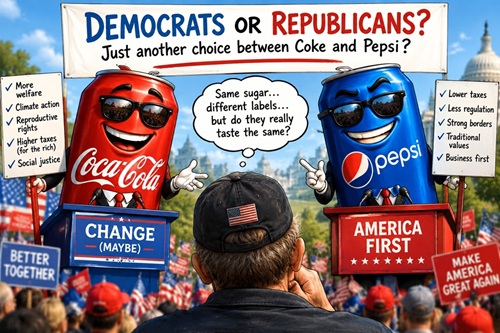 The comforting cynicism of the political spectatorThere is a certain sophistication in declaring that American politics is a sham. Democrats or Republicans? Coke or Pepsi? Blue cans or red cans? Different packaging, familiar ingredients, and the same corporations laughing all the way to the bank. The candidates perform their carefully rehearsed routines, television pundits argue over the latest outrage, campaign donors count their investments, and ordinary citizens are invited to believe that their vote might actually change something. For the politically disillusioned, the analogy is irresistible. It makes the skeptic feel as though he has seen through the whole charade. While millions of Americans are passionately arguing about abortion, immigration, taxation, climate change, guns, and the future of democracy, the enlightened observer sits back with a knowing smile. He understands that the real game is power, money, and elite self-interest. The rest is theater. There is certainly something to this diagnosis. American politics is saturated with money, corporate lobbying, electoral manipulation, media spectacle, and candidates who make promises they have little intention of keeping. Both parties operate within a political system that favors wealthy interests, rewards professional fundraising, and frequently puts the priorities of donors ahead of those of ordinary citizens. But the Coke-versus-Pepsi analogy takes a legitimate criticism and turns it into an intellectual shortcut. It confuses the fact that two parties share certain structural interests with the much stronger claim that their political consequences are essentially identical. They are not. And the difference matters enormously—not just to Americans, but to everyone who lives in a world whose security, economy, climate, and international institutions are deeply affected by decisions made in Washington. Two brands, two governing coalitionsCoca-Cola and Pepsi compete for customers, but neither proposes to reorganize the American constitutional system. Neither wants to rewrite immigration law, change the composition of the Supreme Court, restrict or expand reproductive rights, dismantle environmental protections, or redefine the powers of the presidency. Democrats and Republicans do all of these things, or at least attempt to. The parties are not simply rival marketing departments selling slightly different flavors of the same product. They are broad and internally divided coalitions of voters, politicians, activists, donors, religious groups, business interests, labor organizations, and ideological movements. Their members disagree among themselves, but their coalitions nevertheless produce distinct governing agendas. Consider the differences. Democrats generally favor a more active federal role in social welfare, greater protection for abortion rights, stronger climate policies, and broader civil-rights protections. Republicans generally favor lower taxes, fewer business regulations, stricter immigration enforcement, more conservative judicial appointments, and greater restrictions on abortion. These are broad tendencies rather than descriptions of every politician, but they are consequential differences. One can dislike both parties while still recognizing that their policies are not interchangeable. A Democratic administration and a Republican administration may both accommodate wealthy donors, preserve aspects of American military dominance, and compromise with corporate interests. Yet they can make very different decisions about healthcare subsidies, labor rights, environmental rules, judicial appointments, voting access, and the treatment of vulnerable minorities. To say that both parties are imperfect is reasonable. To say that their imperfections cancel out is arithmetic performed without numbers. The Supreme Court is not a soft drinkIf the Coke-versus-Pepsi analogy were merely a joke about campaign advertising, there would be little to object to. But its political implication is more serious: it suggests that the outcome of an election makes little difference to the lives of ordinary people. Consider the American Supreme Court. Presidents nominate justices, and the Senate confirms them. Those appointments can shape constitutional law for decades, long after the president who made them has left office. The reversal of Roe v. Wade in 2022, which ended the federal constitutional protection for abortion established by that 1973 decision, illustrates the point. Donald Trump's judicial appointments helped create the Supreme Court majority that overturned it. Republican-led states subsequently enacted or enforced abortion restrictions that would have been much harder to sustain under the previous constitutional framework. A Democratic president could not simply undo that development by signing an executive order. But Democratic administrations could nominate different judges, defend reproductive rights within the limits of federal authority, and support legislation protecting access to abortion. Those are not identical outcomes. They are different political possibilities with different consequences for millions of people. The same applies to environmental regulation, labor protections, voting rights, and the authority of federal agencies. One does not need to regard Democrats as heroes to recognize that elections can determine which policies are implemented, which rights are protected, and which institutions are strengthened or weakened. For someone whose reproductive freedom, healthcare, employment, or legal status is affected by such decisions, the difference between the two parties is not a matter of brand preference. It is a matter of lived reality. Imagine telling a woman in a state with a restrictive abortion ban that the distinction between Democratic and Republican governments is merely cosmetic. One suspects that the analogy would receive a less enthusiastic reception from her than from the comfortable political commentator who invented it. The difference between disappointing democracy and abandoning itThe Coke-and-Pepsi argument becomes even less persuasive when we consider the institutions of democracy itself. American democracy has never been a pristine system. Its history includes slavery, racial segregation, voter suppression, the disenfranchisement of women, and the disproportionate political influence of wealth. Both major parties have participated in this history, although their coalitions and positions have changed considerably over time. Nor have Democrats consistently behaved as champions of democracy. They have sometimes accommodated undemocratic practices, pursued self-serving electoral strategies, and defended institutional arrangements that benefit their own political interests. But acknowledging those failures does not eliminate the distinction between a party that respects electoral defeat and one whose leadership attempts to overturn it. After the 2020 presidential election, Trump refused to accept his defeat, promoted false claims of widespread electoral fraud, and sought to reverse the result. On January 6, 2021, a mob attacked the Capitol while Congress was certifying Joe Biden's victory. Trump subsequently returned to the presidency through the electoral process in 2024. These events do not establish that every Republican is an authoritarian, that every Democratic politician is a democrat in the deepest sense, or that the American political system is beyond repair. They do establish that questions about respect for elections and constitutional constraints cannot be dismissed as differences between two commercial brands. A political party's attitude toward the peaceful transfer of power is not a trivial policy preference. It concerns the conditions under which citizens can replace their rulers at all. If one party accepts electoral defeat and another faction seeks to make defeat politically or constitutionally impossible, the two positions are not equivalent simply because both parties solicit campaign contributions from wealthy individuals. Democracy is not guaranteed by the existence of two competing parties. It depends on what those parties do when the competition does not go their way. But what about the money?Here the skeptics have a much stronger argument. Both parties operate within an economic system in which wealthy donors, corporations, lobbyists, and organized interest groups enjoy considerable influence. Campaigns are expensive, politicians spend enormous amounts of time raising money, and the prospect of future employment can create incentives to remain on good terms with powerful interests. Democrats have often been reluctant to challenge concentrated wealth as aggressively as their rhetoric suggests. They have accepted corporate donations, accommodated financial interests, and failed to deliver on promises that energized their electoral coalitions. Republicans, meanwhile, have generally championed tax cuts and deregulation while presenting these policies as beneficial to the broader population. Both parties can be criticized for their dependence on money and for the distance between campaign promises and governing results. Yet even here, the conclusion that they are interchangeable does not follow. The degree of corporate regulation, the generosity of social programs, the taxation of high incomes, the protection of unions, and the enforcement of labor law are all matters on which governments make choices. Those choices can be limited by Congress, courts, economic conditions, lobbying, and bureaucratic resistance, but they are not imaginary. A Democratic administration may disappoint progressive voters by preserving much of the existing economic order. That does not mean its policies are necessarily equivalent to those of a Republican administration seeking more extensive tax cuts, reduced regulation, or weaker labor protections. The relevant question is not whether either party has achieved economic justice. Neither has. The question is whether their actions move society in the same direction, to the same extent, with the same consequences. Often they do not. A skeptic who wants stronger public healthcare, greater economic equality, or less corporate influence should be especially interested in identifying the political forces that obstruct those goals. Declaring the entire system a corporate conspiracy may sound radical, but it can obscure the very differences that matter when trying to change it. The false comfort of being above politicsThere is also a psychological attraction to political equivalence. Once someone declares both parties equally bad, that person no longer needs to examine difficult questions of degree, responsibility, or consequence. There is no need to determine which policies work better, which politicians tell more consequential lies, which institutions are under threat, or which compromises are defensible. The verdict has already been delivered: everybody is corrupt, everything is theater, and nothing meaningful can be done. This is not always cynicism born of ignorance. Sometimes it comes from years of disappointment, broken promises, and genuine observation of political hypocrisy. People who have watched politicians repeatedly fail to solve serious problems have understandable reasons to distrust them. But distrust can become a self-sealing ideology. Every failure confirms that the system is rotten; every improvement is dismissed as cosmetic; every difference between the parties is interpreted as public relations. Such an outlook is remarkably difficult to disprove because it makes no distinctions that evidence could challenge. It can also become a form of political self-indulgence. The skeptic enjoys the satisfaction of being too sophisticated to be fooled by either side, while other people bear the consequences of decisions made by whichever side wins. There is a difference between refusing to worship politicians and refusing to distinguish between them. The first is healthy democratic skepticism. The second is intellectual laziness dressed up as worldly wisdom. One can reject both parties' propaganda without rejecting the possibility of comparative judgment. Indeed, the more skeptical one is of political power, the more important such judgment becomes. American politics matters beyond AmericaFor Europeans, the Coke-versus-Pepsi analogy can be particularly tempting. From across the Atlantic, American political life often looks like an exhausting spectacle of partisan insults, theatrical congressional hearings, culture-war controversies, and presidential personalities that dominate every news cycle. Yet the United States is not simply another country arguing over domestic policy. Its decisions influence NATO, European security, international trade, sanctions, climate policy, technological development, and the balance of power between major states. A change in American leadership can affect whether European allies trust Washington's security commitments, whether Ukraine receives military assistance, how the United States approaches Russia, and whether international agreements receive sustained support. The consequences are not confined to foreign ministries. They can affect European defense budgets, energy markets, investment decisions, and the strategic calculations of governments far beyond Washington. This does not mean Democrats are invariably reliable allies or that Republican administrations invariably undermine international stability. Democratic administrations have made serious foreign-policy mistakes, pursued military interventions, and supported controversial uses of American power. Republican administrations have sometimes pursued pragmatic diplomacy and reached agreements that their critics did not expect. Nor is American foreign policy determined by party labels alone. Congress, military institutions, intelligence agencies, economic interests, public opinion, and international events all matter. But differences in alliances, military assistance, international cooperation, and attitudes toward multilateral institutions can have enormous consequences. For a European observer, therefore, the distinction between Democratic and Republican administrations is not merely a domestic American curiosity. It can help determine the strategic environment in which Europe must operate. If Washington's policy toward NATO becomes less predictable, Europeans cannot simply shrug and say that the Americans have switched from one flavor of soft drink to another. They must decide whether to spend more on defense, reduce strategic dependencies, strengthen European cooperation, or seek alternative diplomatic arrangements. Geopolitics has a particularly brutal way of punishing people who mistake their own cynicism for an adequate analysis of reality. The real problem is not that the parties are identicalThe strongest criticism of the American two-party system is not that Democrats and Republicans are indistinguishable. It is that the system offers voters a restricted and often unsatisfactory set of choices. The United States uses single-member congressional districts, a presidential Electoral College, and electoral rules that generally disadvantage smaller parties. These arrangements encourage two large coalitions to dominate national politics. Voters who prefer a social-democratic, libertarian, green, or other political program may find that neither major party adequately represents them. The result is a recurring dilemma: vote for the candidate closest to one's preferences, even when that candidate is disappointing, or support an alternative that better expresses one's convictions but has little chance of winning. This is a legitimate democratic problem. It can produce strategic voting, frustration, alienation, and a sense that citizens are perpetually choosing the lesser of two evils. The parties also have incentives to mobilize voters through fear of the alternative. Democrats warn that Republican victories threaten rights and democratic institutions; Republicans warn that Democratic victories threaten economic freedom, public safety, or traditional values. Sometimes these warnings are exaggerated. Sometimes they identify genuine risks. Often they combine both. When elections become existential battles, political leaders can avoid accountability for their own failures by pointing toward the supposedly catastrophic alternative. Voters are then encouraged to remain loyal not because their preferred party has governed well, but because the other party is said to be worse. This dynamic deserves criticism. A party should not receive an unlimited license to disappoint its supporters simply because its opponents are more objectionable. But recognizing this trap does not require pretending that the two alternatives are identical. It requires holding political parties accountable for what they actually do while acknowledging that the available choices may be inadequate. The goal should be to improve democratic representation, strengthen electoral competition, reduce the influence of money, and create more opportunities for citizens to influence policy—not to convert dissatisfaction into a blanket theory of political equivalence. The lesser evil is still a comparative judgmentThere is an understandable objection to lesser-evil voting: why should citizens continually settle for the less objectionable option rather than demand something better? They should demand something better. They should organize, criticize, campaign, support reform movements, challenge their own party leaders, and press for electoral changes that give alternative political movements a fairer chance. But political reform and electoral choice operate on different timescales. A voter deciding which candidate should govern for the next four years cannot make the immediate consequences disappear by declaring the available candidates inadequate. The choice still has to be made, even if abstention or a third-party vote is sometimes a defensible alternative. The crucial point is that a comparative judgment does not imply wholehearted endorsement. One can vote Democratic while criticizing Democratic economic policies, foreign-policy decisions, and dependence on wealthy donors. One can vote Republican while rejecting particular Republican social policies or objecting to the conduct of a Republican president. Political support need not be an act of tribal identification. In fact, the capacity to distinguish a conditional vote from an emotional allegiance is one of the marks of political maturity. The voter who says, "I prefer this candidate because the likely consequences are less harmful, but I will oppose the policies I disagree with," is making a more discriminating judgment than the voter who insists that both parties are equally bad before considering the evidence. The lesser evil may remain evil in important respects. But the differences between evils can be substantial, and their consequences can be very unequal. Conclusion: Stop tasting the cans and examine what is insideThe Coke-versus-Pepsi analogy survives because it captures something real about American politics: its commercialized campaigning, its professionalized political class, its wealthy patrons, its manufactured outrage, and its tendency to offer voters a choice between imperfect alternatives. But it becomes misleading when a critique of political marketing is transformed into a claim that electoral outcomes make no meaningful difference. Democrats and Republicans are not identical. They differ in their policy priorities, governing coalitions, judicial appointments, approaches to social welfare, environmental regulation, reproductive rights, immigration, and democratic institutions. Their differences are neither absolute nor uniform, and neither party deserves unconditional trust. But they are real enough to shape people's lives and influence the world beyond America's borders. The appropriate response is not to become a cheerleader for either party. It is to examine their records, compare their policies, investigate their claims, expose their failures, and judge their conduct by standards that apply equally to both. The same skepticism that reveals the influence of money should also reveal differences in what that money buys. The same suspicion that exposes political hypocrisy should also distinguish between different forms and degrees of hypocrisy. And the same distrust of concentrated power should make us attentive to whether political leaders respect the institutions that allow them to be removed from power. So, are Democrats and Republicans like Coke and Pepsi? Only if we imagine that a political system is nothing more than a supermarket shelf, that voting is nothing more than brand loyalty, and that the consequences of government are no more serious than a consumer's preference for a sweeter drink. A better analogy might be that of two competing airlines. Both may overcharge their customers, employ lobbyists, and advertise more comfort than they deliver. Both may leave passengers thoroughly dissatisfied. Yet if one airline is more likely to get you safely to your destination, the differences matter. And if one airline's captain announces that he alone owns the plane, refuses to acknowledge the navigation system, and threatens to throw the passengers who question him out of the emergency exits, it is no longer particularly sophisticated to remark that the other airline also has a poor customer-service department. Political skepticism should sharpen our distinctions, not erase them. The question is not whether either party deserves our blind faith. Neither does. The question is which party, under which circumstances, is more likely to produce outcomes we can defend—and what we should do when neither comes close enough. That is a much less comfortable question than whether we prefer Coke or Pepsi. It is also a far more useful one.
Widget is loading comments...
|