|
TRANSLATE THIS ARTICLE
Integral World: Exploring Theories of Everything
An independent forum for a critical discussion of the integral philosophy of Ken Wilber
  Frank Visser, graduated as a psychologist of culture and religion, founded IntegralWorld in 1997. He worked as production manager for various publishing houses and as service manager for various internet companies and lives in Amsterdam. Books: Ken Wilber: Thought as Passion (SUNY, 2003), and The Corona Conspiracy: Combatting Disinformation about the Coronavirus (Kindle, 2020).
Check out my other conversations with ChatGPT
Geopolitics with a Wink:
Geopolitics for Dummies, Why Nations Behave Like People Putin's Jealousy: Ukraine as the Wife Who Dared to Leave How Trump Is Turning Geopolitics into a Global Reality Show Make America Grift Again: The Presidency According to Trump Coke or Pepsi? The American Two-Party System as Marketing The Art of the Deal, the Science of the MessHow Donald Trump Is Turning Geopolitics into a Global Reality ShowFrank Visser / ChatGPT
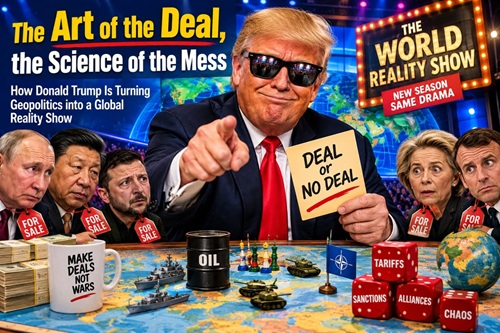 A World Leader Walks into a Poker GameImagine appointing a casino owner to run the international system, handing him the nuclear codes, giving him a social-media account, and telling him that every country on Earth is desperate to do business with him. Congratulations. You have just invented the Trump Doctrine. Its central principle is simple: everything is a deal, everybody is a potential sucker, and every negotiation is a chance to prove that Donald Trump is the greatest negotiator who has ever lived. The minor inconvenience that international relations involve history, ideology, military alliances, national interests, and people who occasionally refuse to be bullied is apparently a detail best left to lesser minds. Trump approaches geopolitics as though the world were a badly managed hotel in Atlantic City. NATO is an expensive franchise. Ukraine is a troublesome tenant. China is a rival casino operator. Russia is a potential business partner. Canada is an ungrateful neighbor who refuses to appreciate the value of a good real-estate deal. And the European Union? A committee of customers who have somehow acquired the delusion that they have rights. The result is a diplomatic landscape in which America's friends wonder whether they are still friends, America's enemies wonder whether they have accidentally become friends, and everybody else wonders whether the president has read the briefing—or merely the cover. The joke, of course, is that this is not merely a matter of bad manners. A president's words can affect military calculations, financial markets, trade relations, and the willingness of other governments to cooperate with Washington. In April 2026, Carnegie Endowment analysts described the resulting uncertainty for Europe as unstrategic ambiguity: the kind of confusion that undermines reassurance without necessarily deterring an adversary. The distinction between deliberate unpredictability and strategic incoherence matters rather a lot when the stakes include war and peace. The Great Friendship ExchangeTrump's most remarkable diplomatic innovation is his apparent ability to make allies feel like enemies while making enemies feel like prospective customers. Consider Vladimir Putin. Here is a Russian president who launched a full-scale invasion of Ukraine, a country whose independence and security have become central to European security. Yet Trump's approach has repeatedly emphasized personal engagement with Putin and the possibility of negotiating a grand settlement, while placing pressure on Ukraine to make concessions. There is nothing inherently wrong with talking to an adversary. Diplomacy without talking to adversaries would be like running a divorce court in which the judge refuses to let the spouses meet. The question is what the conversations accomplish, what leverage is being used, and what happens if the other side simply pockets the concessions. A summit is not a peace agreement. A handshake is not a security guarantee. And a dictator's smile is not a notarized declaration of good faith. Trump, however, seems attracted to the spectacular moment of personal rapport: the handshake, the flattering remark, the photograph in which two strongmen look as though they are about to announce a merger between their respective empires. The attraction is understandable. Being photographed as the man who can bring Putin to heel would be an extraordinary addition to the presidential trophy cabinet. But the Kremlin does not necessarily share Trump's preferred script. Putin has his own objectives, his own domestic political calculations, and his own ideas about the territorial future of Ukraine. He is not obliged to play the role of grateful supporting actor in Trump's international blockbuster. Indeed, the more Trump emphasizes his personal relationship with Putin, the more awkward it becomes if Russia continues pursuing its objectives regardless of American presidential charm. A dealmaker can persuade himself that he has established a special relationship. The other party can conclude that he has discovered a useful negotiating opportunity. These are not the same thing. NATO: The World's Most Expensive Friendship BraceletNow let us turn to America's allies, those peculiar creatures who have spent decades cooperating with Washington under the quaint assumption that a military alliance means something more than an annual subscription. NATO was established in 1949 around a straightforward proposition: an attack on one member could bring a collective response. Its credibility depends not only on weapons and budgets but also on the expectation that its members will stand together when threatened. Trump has long complained that European allies should contribute more to their own defense. That complaint is not automatically unreasonable. Europe has genuine defense-capability gaps, and American presidents have pressed European governments to shoulder more responsibility for decades. The problem is what happens when a legitimate argument about burden-sharing becomes a recurring spectacle of threats, insults, and uncertainty about whether the United States will honor its commitments. Imagine a neighborhood watch whose chief announces every Monday that he might abandon the neighborhood, every Tuesday that the residents are freeloaders, and every Wednesday that he would happily defend them if they bought his commemorative wristwatch. The residents might eventually spend more on security. They might also start wondering whether the chief is the person they should be protecting themselves from. Trump's treatment of NATO has repeatedly generated precisely this dilemma. European governments must invest in defense while also calculating how much they can continue to rely on Washington. Analysts at the European Council on Foreign Relations have described the administration's security policymaking as a continuous renegotiation, driven in part by competing factions seeking to deliver headline-grabbing victories. That is a peculiar way to run an alliance. The point of NATO is to make an adversary uncertain about whether aggression will succeed—not to make every allied government uncertain about whether America will show up. A deterrent works partly because the threat of retaliation is credible. If the guarantor spends every other week announcing that the guarantee is negotiable, the adversary may begin to wonder whether the guarantee is worth the paper on which it is printed. Trump might respond that this is simply how you get people to pay their bills. But a security alliance is not a delinquent account at a golf club. Its value lies precisely in the commitments that remain credible when honoring them becomes inconvenient. And so the allies pay more, plan more, and increasingly discuss alternatives. They may become militarily stronger as a result. They may also become less confident that the United States will remain their dependable partner. The great dealmaker risks discovering that he can collect higher membership fees while gradually destroying the reason people joined the club. The European Union: Fifty Shades of ConfusionEurope occupies a particularly uncomfortable position in Trump's geopolitical imagination. It is simultaneously a military dependent that should spend more, an economic competitor that should buy more American goods, a collection of insufficiently grateful allies, and a political nuisance that should stop disagreeing with Washington. The instructions are not always easy to reconcile. Europeans are told to become strategically independent, but they are also expected to coordinate their policies with the United States. They are encouraged to strengthen their defense industries, but Washington also wants to sell them American weapons. They are told that their security is their responsibility, while their ability to make independent decisions can provoke American threats of economic retaliation. It is a little like telling your adult children to stand on their own feet while demanding that they ask permission before buying shoes. The problem is not that America and Europe must always agree. They should not. Democracies can have legitimate differences over trade, technology, immigration, military intervention, and relations with China. Mature alliances require negotiation, not blind obedience. But negotiation works best when the participants understand what the other side wants and what commitments can be relied upon. When policy shifts repeatedly, governments have to spend precious time guessing Washington's next move instead of coordinating responses to common challenges. European leaders must therefore conduct two diplomatic exercises simultaneously. First, they must work out how to address Russia, China, and other international problems. Second, they must work out how to address the possibility that their most powerful ally might change its position before the next press conference. This is not an efficient division of labor. Trump may believe that keeping Europe off balance gives him leverage. But leverage has diminishing returns. Push an ally hard enough, and it may stop trying to please you and start preparing for a future in which your approval is no longer essential. The transatlantic relationship then becomes an exercise in strategic separation disguised as a series of successful negotiations. China: Congratulations, You Have Fired Your BackupChina presents an even more complicated problem. The United States has substantial economic, technological, military, and diplomatic advantages in its competition with Beijing. But some of those advantages become more useful when Washington coordinates with other advanced economies. Allies can help restrict access to sensitive technologies, diversify supply chains, address economic coercion, and reinforce regional security. They can also provide diplomatic legitimacy and reduce the risk that Washington will have to confront multiple challenges alone. In other words, allies are not merely mouths to feed. They are force multipliers. Trump's transactional approach risks treating these relationships as if their principal value were the concessions Washington can extract from them. Tariffs, threats, and demands for immediate compliance may produce bargaining leverage in particular circumstances. But they can also encourage partners to diversify their relationships, reduce their dependence on the United States, and pursue separate arrangements with Beijing. Chatham House analysts argued in May 2026 that Trump's treatment of allies had weakened Washington's negotiating position with Xi Jinping by reducing the cohesion of the coalition that could otherwise support American objectives. The irony is almost too perfect. If your objective is to compete with China, why make it harder for countries that share some of your concerns to cooperate with you? Imagine a football team preparing for a crucial match. The coach announces that the goalkeeper is overpaid, threatens to sell the defenders, insults the midfielders, and demands that the forwards pay for the stadium. Then he walks onto the pitch and complains that the opposing team has too many players. Perhaps the coach is negotiating a better salary structure. Perhaps he is expressing a deeply held philosophical commitment to chaos. Either way, the opposition will be delighted to observe the experiment. China, meanwhile, does not need to persuade every American ally to become pro-Chinese. It may benefit simply from watching those allies become less willing to follow Washington's lead. America can possess enormous power and still waste part of it by alienating the people who help make that power effective. The Deal of the Century, Every TuesdayThe deeper problem is Trump's apparent conception of success. In ordinary diplomacy, a successful agreement is judged by what it accomplishes: whether it reduces the risk of war, creates a durable peace, protects vital interests, improves economic conditions, or establishes rules that the participants will continue to respect. In Trump's personal political theater, success is often presented differently. It is the announcement, the headline, the dramatic meeting, the claim that nobody else could have achieved the result. The deal must be enormous. The victory must be historic. The other side must have conceded something spectacular. And Trump must be the indispensable genius who made it happen. The distinction is between the substance of an agreement and the performance of having made one. A diplomatic deal can be announced with great fanfare and still fail in implementation. It can produce a temporary pause without resolving the underlying conflict. It can give the parties an incentive to postpone a confrontation without eliminating the reasons for it. It can even reward an aggressor for creating a crisis in the first place. A leader concerned with long-term strategy must ask uncomfortable questions after the cameras leave. Does the agreement survive a change of government? Can it be enforced? Does it encourage future aggression? What concessions have been made, and what happens if the other side refuses to reciprocate? The great dealmaker, by contrast, may be tempted to regard the signed document as the final scene of the movie. But international agreements are not reality television finales. The credits do not roll when the leaders shake hands. The other side continues to pursue its interests the following morning. And when an agreement unravels, the same president who declared a historic triumph can announce that the previous negotiators were fools, the other side cheated, and a much bigger deal is now required. The plot repeats. The hero remains the same. Only the supporting cast changes. Foreign Policy by Presidential Mood RingA particularly striking feature of Trump's diplomacy is the degree to which public statements and personal encounters can dominate perceptions of American policy. One day a foreign leader is a great friend. The next day the same leader is ungrateful, weak, or impossible to deal with. One week a country is invited into a grand diplomatic initiative; the following week it is threatened with punitive tariffs. An adversary receives extravagant praise, while a longstanding ally is publicly humiliated. Some changes in diplomatic tone are perfectly sensible. Circumstances change, negotiations evolve, and leaders sometimes need to apply pressure. A president should not be required to follow a rigid script regardless of what happens. The trouble begins when other governments cannot distinguish a tactical maneuver from a durable change in policy. In business, uncertainty can sometimes be useful. A negotiator who keeps the other side guessing may gain an advantage over a specific transaction. In international security, uncertainty can become dangerous when it affects decisions about mobilization, deterrence, military assistance, or the interpretation of hostile intentions. An adversary might miscalculate. An ally might hesitate. A government might conclude that it cannot safely depend on American support and should make its own arrangements before the political weather changes again. That is why unpredictability is not automatically a strategic asset. It has to be connected to a purpose. A chess player may deliberately sacrifice a piece to create a winning position. That is strategy. A chess player who knocks the pieces onto the floor, declares that the opponent has been intimidated, and demands a trophy for innovative thinking is doing something else. The difference is not whether the behavior is conventional. It is whether it advances a coherent objective. The National Security Council Presents: Who's Got a Better Idea?Of course, no president personally manages every detail of foreign policy. Governments need professional diplomats, intelligence analysts, military planners, economic advisers, and institutions capable of testing assumptions before they become presidential announcements. These people are not decorative office furniture. Their job is to explain why an apparently attractive deal might be dangerous, why an adversary's offer might be misleading, and why a short-term political victory could create a long-term strategic problem. A functioning policymaking system should allow disagreement, compare options, identify risks, and establish a clear line of authority. It should also preserve enough institutional memory to prevent the government from treating every international crisis as though civilization began on the morning of the latest presidential post. Yet analysts have raised concerns about the weakening of established diplomatic processes under Trump. A February 2026 assessment by the European Council on Foreign Relations described a foreign-policy process shaped by competing factions and an emphasis on headline-grabbing wins rather than a consistently defined strategy. That matters because a government is not a private company in which the chief executive can improvise every major decision and expect the organization to absorb the consequences indefinitely. The world is full of actors who have their own plans. Putin has one. Xi has one. Iran's leadership has one. European governments have several, often disagreeing among themselves. Ukraine has existential interests that cannot simply be folded into somebody else's real-estate transaction. A president does not need to have every answer. But he does need a process that can help him distinguish a promising opening from a trap. Otherwise, the administration risks becoming a competition among advisers to determine who can present the most flattering version of the next grand bargain. The winning proposal is then the one most likely to appeal to the president's sense of historic importance—not necessarily the one most likely to work. It is the corporate boardroom from hell, except that the quarterly earnings report may include a war. America's Enemies Are Taking NotesThe beneficiaries of allied confusion need not be the countries that receive the warmest presidential compliments. They may simply be those that can exploit the resulting uncertainty. Russia can probe divisions between Washington and European capitals. China can deepen economic ties with countries that no longer feel confident about American reliability. Other powers can hedge, delay cooperation, or use American threats against allies as evidence that Washington's commitments are conditional. None of this means that every American policy reversal automatically benefits every adversary. International politics is complicated, and other governments face their own internal divisions, economic constraints, and strategic dilemmas. Nor does it mean that the United States has suddenly ceased to possess formidable advantages. The point is more modest, and more troubling: a country can weaken its strategic position without losing a single battle, simply by making its partners less willing to rely on it. Trust is not sentimental decoration in international affairs. It is an asset that takes years to accumulate and can be damaged surprisingly quickly. An ally that trusts Washington can coordinate plans, share sensitive intelligence, invest in compatible military systems, and accept risks on the expectation of reciprocal support. An ally that doubts Washington must spend more effort preparing for abandonment, negotiating alternatives, and protecting itself against the possibility that American policy will change. Every hour spent managing that uncertainty is an hour not spent addressing shared problems. And unlike a tariff, trust cannot be adjusted by presidential decree. You cannot announce a 25 percent surcharge on mistrust and expect everyone to become loyal by Friday. The Trump Doctrine: America First, Everybody Else GuessPerhaps Trump does have a coherent theory beneath the improvisation. His administration has pursued an unmistakably transactional approach, emphasizing national sovereignty, burden-sharing, bilateral bargaining, and the use of American economic and military power to extract concessions. It would be inaccurate to say that nothing connects these policies. But a collection of recurring preferences is not the same as a comprehensive strategy. A strategy must explain how immediate bargaining tactics serve long-term objectives. It must identify which interests are essential, which concessions are acceptable, which relationships are worth preserving, and which risks are worth taking. It must also explain how apparently contradictory policies fit together. If the United States wants Europe to become stronger, what kind of European strength serves American interests? If it wants to compete with China, how much damage to allied cooperation is acceptable? If it wants to end wars, what prevents a proposed settlement from rewarding aggression and inviting another war later? If it wants to preserve American primacy, why should other countries continue to organize their security around an America whose commitments are increasingly difficult to predict? These are not academic questions. They are the basic questions any serious foreign-policy strategy must answer. The Trumpian approach often seems to substitute a different test: Did the president get something? Did the other leader appear impressed? Can the result be presented as a victory? That test is politically convenient because it produces immediate, visible rewards. Strategic consequences, by contrast, are slower, less photogenic, and often impossible to attribute to a single leader. The president can claim credit for a handshake today. If the agreement fails three years later, the resulting damage may be blamed on the next administration, the previous administration, a foreign leader who supposedly cheated, or a deep state that failed to execute the genius plan. The dealmaker gets the photograph. Somebody else gets the bill. What Would a Serious Dealmaker Do?Ironically, a genuinely effective dealmaker would understand why alliances matter. A negotiator with reliable partners enters the room with more leverage. A negotiator whose commitments are trusted can make credible offers. A negotiator who understands the other side's interests can distinguish a sustainable agreement from a temporary performance. And a negotiator who thinks beyond the signing ceremony can design arrangements that survive the inevitable disappointments of international politics. The best businesspeople do not necessarily destroy every relationship in pursuit of a marginal concession. They understand reputation, repeat transactions, contractual reliability, and the cost of making everyone around them desperate to find another supplier. The same logic applies to geopolitics, although the stakes are incomparably higher. America's alliance network is not simply a collection of countries that owe Washington favors. It is a strategic structure built over generations. It gives the United States access, influence, intelligence, military cooperation, economic reach, and diplomatic weight that would be difficult to reproduce through bilateral pressure alone. That network has never been perfect. Allies disagree, free-ride, pursue their own interests, and sometimes frustrate American objectives. But the answer to those problems is not necessarily to treat every relationship as a shakedown. A stronger approach would distinguish between adversaries and allies without pretending that either category is permanent or absolute. It would bargain firmly while maintaining clear commitments. It would use diplomacy to reduce uncertainty where uncertainty is dangerous and preserve ambiguity only where it serves a defensible purpose. Above all, it would measure success by durable outcomes rather than the size of the announcement. This is not a plea for sentimental diplomacy or a return to some imaginary golden age of international harmony. It is a reminder that power works best when it is connected to purpose. A hammer is a useful tool. But if you use it to negotiate with the plumbing, you should not be surprised when the house floods. The Final Deal: A World That No Longer Knows What America WantsThe deepest irony of Trump's foreign policy is that the president's determination to demonstrate American strength may encourage other countries to prepare for an America that is less dependable. European governments may accelerate efforts to build independent defense capabilities. Asian allies may diversify their economic and security relationships. Countries that once coordinated closely with Washington may become more cautious about aligning themselves with American initiatives. Adversaries may look for opportunities to exploit those divisions. Some of these adjustments could produce benefits. Europe taking greater responsibility for its defense, for example, is not inherently a bad outcome. A more capable set of allies could strengthen the Western position if their capabilities are coordinated and their relationships remain robust. But there is a difference between encouraging allies to become stronger partners and making them fear that partnership itself has become a liability. The former builds collective power. The latter encourages everyone to look for an exit. And that is the danger of treating geopolitics as an endless succession of personal deals. A transaction can be completed and forgotten. A strategic relationship must be maintained, repaired, and renewed. Its value lies not only in what each side receives today but in what both sides can reasonably expect tomorrow. Trump wants to be remembered as the man who can make deals that nobody else could make. But the grandest deal of all would be to preserve the relationships that allow the United States to exercise its power effectively in the first place. Instead, his diplomatic style risks creating the geopolitical equivalent of a luxury hotel whose owner insults the guests, threatens to fire the staff, renegotiates the electricity contract every morning, and announces that the building has never been more successful. The chandelier is magnificent. The carpets are imported. The owner has personally approved the golden taps. And somewhere in the basement, the entire plumbing system is quietly coming apart. Welcome to the Trump world order: friends become suspects, foes become prospects, commitments become opening offers, and every international crisis is another opportunity for the greatest dealmaker in history to announce that he has won. The only question is what, exactly, the rest of the world is left holding when the deal is done.
Widget is loading comments...
|