|
TRANSLATE THIS ARTICLE
Integral World: Exploring Theories of Everything
An independent forum for a critical discussion of the integral philosophy of Ken Wilber
  Frank Visser, graduated as a psychologist of culture and religion, founded IntegralWorld in 1997. He worked as production manager for various publishing houses and as service manager for various internet companies and lives in Amsterdam. Books: Ken Wilber: Thought as Passion (SUNY, 2003), and The Corona Conspiracy: Combatting Disinformation about the Coronavirus (Kindle, 2020).
Check out my other conversations with ChatGPT
Geopolitics with a Wink:
Geopolitics for Dummies, Why Nations Behave Like People Putin's Jealousy: Ukraine as the Wife Who Dared to Leave How Trump Is Turning Geopolitics into a Global Reality Show Make America Grift Again: The Presidency According to Trump Coke or Pepsi? The American Two-Party System as Marketing Geopolitics for DummiesWhy Nations Behave Like People, Except With Armies, Oil, and Nuclear WeaponsFrank Visser / ChatGPT
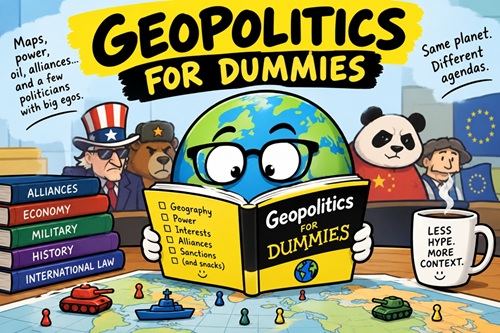 Geopolitics sounds like a subject best left to professors, diplomats, retired generals, and television commentators who can pronounce “multipolarity” without moving their lips. It involves maps, military alliances, economic sanctions, strategic resources, historical grievances, and the occasional leader who seems to have mistaken the world for his personal chessboard. But the basic idea is surprisingly simple: geopolitics is about how geography, power, and national interests shape relations between countries. It asks why nations cooperate, compete, threaten one another, start wars, make peace, and occasionally behave as if the entire planet were an oversized schoolyard. You don't need a PhD to understand it. You need a map, a memory longer than five minutes, and a healthy suspicion of anyone who claims that international politics is a struggle between the forces of absolute Good and absolute Evil. Let's begin. 1. The Golden Rule: Geography Doesn't NegotiateCountries cannot choose their neighbors. This is one of the most inconvenient facts in international relations. The United States enjoys two enormous oceans as natural defensive barriers, relatively friendly neighbors, vast agricultural resources, and access to both the Atlantic and Pacific. Russia, by contrast, occupies a gigantic territory with long, difficult-to-defend borders and a history of invasions from the west. China has a huge population, major industrial capacity, a long coastline, and a neighborhood filled with strategic complications. The Netherlands has excellent waterways, busy ports, and the practical wisdom of building dikes rather than invading Germany. Geography doesn't determine everything, but it establishes the playing field. A country with access to warm-water ports can trade more easily throughout the year. A landlocked country may depend on the goodwill of its neighbors to reach the sea. A state surrounded by potential enemies will worry about its borders in ways that an island nation protected by powerful allies might not. Consider Russia's obsession with strategic depth. Its historical experience of invasion has encouraged a preference for buffer zones between its core territory and potential adversaries. This helps explain Russian security thinking, although it does not justify every action taken in its name. Ukraine is an independent country, not a strip of disposable cushioning material for Russian geopolitical anxieties. Here is the first rule for beginners: geography helps explain why states worry about certain things. It does not automatically excuse what they do about them. 2. Countries Have Interests, Not Just FeelingsPolitical leaders frequently speak the language of values: democracy, freedom, sovereignty, justice, peace, and the defense of civilization. Sometimes they sincerely believe in these things. Sometimes they use them to mobilize voters. Sometimes the language of principle happens to coincide with a useful strategic opportunity. Usually, several motives operate simultaneously. The United States may support a democratic government because it values democracy, because the government is a strategic ally, because American businesses benefit, or because Washington wants to limit the influence of China or Russia. These motives are not mutually exclusive. Likewise, European countries may defend Ukrainian sovereignty because they believe international law matters and because they fear that rewarding territorial conquest could destabilize Europe. Principle and self-interest can point in the same direction. The mistake is assuming that one must cancel out the other. A useful question to ask whenever a government announces a noble objective is: What else does this government want, and what would it do if its interests conflicted with its stated principles? That question is not cynical. It is basic political literacy. The reverse mistake is equally common: assuming that every expression of principle is a cynical disguise for greed or domination. Governments sometimes accept real costs to defend principles, alliances, or institutions they consider important. Geopolitics is not the discovery that everyone is secretly evil. It is the study of how ideals, interests, fears, and opportunities interact. 3. The Security Dilemma: When Everyone Is Defensive and Nobody Feels SafeImagine that your neighbor installs a sophisticated alarm system. You become nervous. Why does he need such an elaborate system? Is he expecting trouble? Does he know something you don't? So you install security cameras. Your neighbor notices and buys a larger dog. You reinforce your fence. He installs floodlights. Eventually, both houses resemble maximum-security prisons, and neither homeowner sleeps particularly well. Welcome to the security dilemma. In international relations, one country's defensive measures can appear threatening to another. A state builds up its military because it fears attack. Its neighbor sees the buildup and responds with its own military expansion. The first state interprets that response as confirmation that it was right to be afraid. The result is an arms race in which both sides may claim to be acting defensively, even as the situation becomes more dangerous. NATO enlargement and Russia's reaction to it illustrate this dynamic, although they cannot be reduced to a single cause. Central and Eastern European countries sought NATO membership partly because they feared Russian domination. Russia's leaders interpreted NATO's expansion as a threat to Russian security and influence. Those opposing perceptions helped create a more confrontational environment. But there is an essential distinction: explaining Russia's perception of encirclement does not mean that Russia was entitled to invade Ukraine. Nor does the fact that NATO members described their alliance as defensive mean that Russian concerns were necessarily imaginary. Understanding a security dilemma requires taking perceptions seriously without treating every perception as accurate or every response as legitimate. The uncomfortable lesson is that fear can be politically consequential even when it is exaggerated, manipulated, or rooted in an outdated picture of the world. 4. Power Is More Than the Number of TanksMilitary power matters. But it is not the only kind of power, and it is not always the most effective. A country can influence others through economic strength, technological leadership, financial institutions, cultural prestige, energy supplies, intelligence networks, diplomacy, and control over strategically important infrastructure. The United States has benefited from the global role of the dollar and the centrality of American financial institutions. China has used its manufacturing capacity, trade relationships, and infrastructure investments to increase its international influence. The European Union exercises considerable regulatory power because companies around the world often find it worthwhile to meet European standards if they want access to European markets. This is power without necessarily firing a shot. Sanctions provide a particularly interesting example. A government may restrict another country's access to financial markets, advanced technology, or international trade. The objective is to impose costs and change behavior without resorting to direct military force. But sanctions are not magic spells. Their effectiveness depends on the target country's economic structure, alternative trading partners, political resilience, and the clarity of the demands being made. They may weaken a government, encourage adaptation, hurt ordinary citizens, or produce some combination of these outcomes. Military superiority has its own limitations. The United States possesses extraordinary military capabilities, yet its experiences in Vietnam, Iraq, and Afghanistan demonstrate that defeating an opponent militarily is not the same as constructing a stable political order. A country may win battles and lose the peace. The geopolitical beginner should therefore ask not merely, "Who has the strongest army?" but also, "Who can sustain the conflict, mobilize allies, absorb economic costs, and achieve a politically acceptable outcome?" 5. Great Powers Have Spheres of Influence. Smaller Countries Have Opinions.Great powers often believe that the political orientation of neighboring states is a matter of their own security. They prefer friendly governments nearby and dislike the prospect of hostile military alliances appearing close to their borders. The United States has historically resisted hostile powers establishing a military foothold in the Western Hemisphere. Russia has sought to preserve influence over neighboring former Soviet republics. China regards Taiwan as a core national issue and views American military involvement in the region with deep suspicion. There is a recurring temptation among great powers to divide the world into zones where they expect special privileges. But there is a problem with this picture: smaller countries are not chess pieces. Poland, Ukraine, Finland, Taiwan, and other states have their own histories, political preferences, security concerns, and ambitions. They do not necessarily share the geopolitical priorities of the larger powers that surround them. A great power may regard a neighboring country's independence as a strategic inconvenience. The smaller country may regard that same independence as the most important achievement in its national history. Both perspectives are politically real, but they are not morally equivalent in every respect. The right of a powerful state to feel insecure does not automatically override the sovereignty of a weaker one. This is one of the central tensions in geopolitics: the international system gives great powers disproportionate influence, while the principle of sovereign equality says that countries are entitled to determine their own political futures. Reality frequently violates the principle. That does not make the principle meaningless. 6. The Thucydides Trap: When the Rising Power Scares the Established PowerSuppose you are the manager of a successful company. You have dominated the market for decades. Then a competitor arrives, grows rapidly, acquires new technology, and begins attracting your customers. You might welcome the competition. You might improve your own products. Or you might start wondering whether the new company intends to replace you entirely. Now imagine that both companies possess nuclear weapons and that their executives command enormous military establishments. This is the background to the idea popularly known as the Thucydides Trap: the danger that a rising power and an established power may slide into conflict because the rise of one generates fear in the other. The ancient Greek historian Thucydides used the growth of Athenian power and the fear it generated in Sparta to explain the outbreak of the Peloponnesian War. The modern analogy is often applied to the relationship between China and the United States. China's economic and military rise challenges America's longstanding position in East Asia. Washington worries about Chinese regional dominance, technological dependence, and the security of allies such as Japan and South Korea. Beijing resents American military deployments, export restrictions, and efforts to limit Chinese influence. Neither country needs to desire a major war for a dangerous confrontation to emerge. Miscalculation, domestic political pressure, an accident at sea, or a crisis over Taiwan could escalate beyond the intentions of either side. However, the Thucydides Trap is not a law of nature. Rising powers do not invariably fight established powers. Economic interdependence, diplomacy, deterrence, domestic institutions, and sensible crisis management can all reduce the risk. The future is not predetermined by an ancient Greek historical analogy. If someone tells you that war between China and the United States is inevitable, remember that they have confused a warning about risk with a prediction of destiny. 7. International Law: Important, Imperfect, and Not Enforced by a World Police DepartmentDomestic societies generally possess police forces, courts, and governments with the authority to enforce laws. The international system has no equivalent world government with reliable control over every country. International law nevertheless exists. Treaties, customary law, international courts, diplomatic agreements, and institutions such as the United Nations establish rules that states are expected to follow. The prohibition on acquiring territory through the use of force is a particularly important principle. It helps protect countries against the idea that a stronger neighbor can simply redraw borders whenever it feels sufficiently powerful. The difficulty is enforcement. The UN Security Council includes five permanent members with veto power: China, France, Russia, the United Kingdom, and the United States. When one of these powers—or a close ally of one of them—is involved in a serious dispute, collective enforcement can become politically difficult. International law therefore operates in an uneven environment. Powerful states may violate rules, obstruct enforcement, or interpret legal principles selectively. Smaller states may find that the practical protection they receive depends partly on alliances and the willingness of others to help them. Does this mean international law is merely a sham? No. Even powerful states have reasons to value predictable rules, stable borders, functioning trade, and diplomatic legitimacy. Legal arguments can shape coalitions, influence public opinion, support sanctions, and impose reputational costs. States sometimes comply with rules even when immediate enforcement is unlikely. But law without reliable enforcement is vulnerable, especially when the interests of powerful states are at stake. The sensible position avoids two extremes. International law is neither a magical force that automatically prevents aggression nor an irrelevant decoration that can be discarded whenever a government finds it inconvenient. It is an imperfect system of rules operating in a world where power remains unequally distributed. 8. Propaganda: Every Country Has a Story About ItselfNo government describes its own foreign policy as a selfish grab for power. Governments tell stories. They defend the homeland, protect civilization, restore historical justice, rescue oppressed populations, maintain stability, or prevent an impending catastrophe. Their adversaries tell different stories. The same military deployment becomes aggression rather than deterrence. The same economic restriction becomes coercion rather than security policy. The same political movement becomes liberation in one account and subversion in another. Sometimes one account is substantially better supported by evidence than the other. Sometimes both contain selective truths. Sometimes the facts are deliberately distorted. The existence of competing narratives does not mean that all narratives are equally valid. Russia's full-scale invasion of Ukraine in February 2022 is a useful example. Russian officials offered security arguments and historical justifications for the invasion. Those arguments do not erase the fact that Russian forces crossed internationally recognized Ukrainian borders and launched a major war against a sovereign state. Explaining the Kremlin's stated motives is not the same as accepting its justification. The same standard should apply to Western governments, Chinese officials, and every other geopolitical actor. Claims about weapons, atrocities, treaty violations, territorial rights, and military intentions should be examined against evidence rather than accepted because they come from a favored side. A useful rule is to distinguish three questions: What happened? Why did the actors do it? Was what they did justified? These questions are related, but they are not interchangeable. Propaganda often works by answering all three at once, leaving the audience with the comfortable impression that its own side is innocent, its opponents are monstrous, and no further investigation is required. 9. Double Standards: The Geopolitical Gymnastics ChampionshipHere is a reliable way to identify political bias: observe what happens when a principle is applied to an ally and then to an adversary. If a country invokes sovereignty to condemn an enemy's invasion but dismisses the same principle when an ally occupies territory, something has gone wrong. If it condemns civilian casualties when caused by its opponents but minimizes comparable suffering caused by its own side, the moral standard is inconsistent. If international law is treated as binding when it produces a convenient verdict and dismissed as irrelevant when it does not, we are no longer dealing with a stable legal principle. We are dealing with selective allegiance. This problem affects governments, commentators, intellectuals, activists, and ordinary citizens. It is not confined to one ideological camp. There is, however, an important qualification. Applying the same principles does not require pretending that every conflict is identical. The history, legal circumstances, military objectives, and available evidence may differ substantially from case to case. Consistency means using the same standards of judgment, not automatically reaching identical conclusions. A serious analyst should be able to say, "My preferred government has violated a principle I normally defend." If that sentence is psychologically impossible to utter, geopolitical analysis has probably become an exercise in team loyalty. The goal is not to eliminate political commitments. It is to prevent them from deciding the facts in advance. 10. Why Small Countries MatterIt is tempting to imagine international politics as a private conversation among Washington, Beijing, Moscow, and perhaps a few other capitals. But smaller states can have influence far beyond their size. A strategically located country may control important shipping routes, provide access to military bases, possess valuable resources, or occupy a crucial position between competing powers. Countries that coordinate their policies can also increase their collective bargaining power. The Netherlands, for example, is a relatively small country, but its role in European trade, its membership in NATO and the European Union, and its advanced semiconductor-related technology sector give it international significance disproportionate to its population. Smaller countries also have agency through diplomacy, coalition-building, international law, and economic specialization. They can sometimes benefit from competition among larger powers, although they may also become vulnerable to pressure from all sides. The danger is that great-power analysis can make smaller countries disappear from the story. Their security concerns become secondary to the strategic calculations of their neighbors. Yet a world in which large states routinely determine the fate of small ones without regard for their populations is not merely unpleasant for the smaller states. It is also a world in which the security of every country ultimately depends on its ability to dominate someone else. That is hardly a stable foundation for international peace. 11. Energy, Trade, and the Weaponization of InterdependenceFor decades, many policymakers assumed that economic interdependence would make major wars increasingly irrational. Countries that trade extensively with one another have a great deal to lose from conflict. There is truth in this argument. Trade can create constituencies for peace, raise the cost of war, and provide incentives for cooperation. But interdependence can also create vulnerabilities. A country dependent on imported energy may fear an interruption of supplies. A country dependent on foreign semiconductor production may worry that a political dispute will disrupt access to critical technology. A country that relies heavily on another for export markets may hesitate to criticize its policies. The response has been a growing emphasis on economic security: diversifying suppliers, protecting sensitive technologies, building strategic reserves, and reducing dependence on potentially hostile states. The United States has restricted China's access to certain advanced technologies. Europe has sought to reduce vulnerabilities in energy and critical supply chains. China has pursued greater technological self-reliance. These measures can increase resilience, but they can also raise costs, weaken cooperation, and encourage retaliatory restrictions. There is a difference between sensible diversification and the fantasy that a modern industrial economy can become completely self-sufficient. Global production networks are too complex for that to be a realistic general objective. The geopolitical challenge is to decide which dependencies are genuinely dangerous, which are mutually beneficial, and which risks can be managed through institutions and agreements. The country that imports nothing may be strategically independent. It may also be extremely poor. 12. Nuclear Weapons: The Ultimate Argument Against Winning Too MuchNuclear weapons have transformed the meaning of military victory. In a conventional war, a country may be able to defeat its opponent, occupy territory, or destroy its armed forces. In a nuclear war between major powers, the destruction could be so catastrophic that even the nominal victor would inherit a devastated world. This is the logic of nuclear deterrence. If both sides can inflict unacceptable damage on the other, neither should expect to escape the consequences of a major nuclear exchange. The result has sometimes been described as mutually assured destruction, an acronym that captures the bleak logic rather well. Deterrence can discourage direct attacks, but it does not eliminate danger. Nuclear states can miscalculate, misunderstand signals, suffer technical failures, or find themselves in crises where leaders believe that backing down would threaten their survival or political position. Nuclear weapons also complicate conventional warfare. A nuclear-armed state may believe that its arsenal reduces the risk of an adversary intervening directly in a conflict. That possibility creates incentives for limited aggression under the shadow of nuclear deterrence. Meanwhile, other countries may conclude that possessing nuclear weapons is the safest way to prevent external coercion. Thus, weapons intended to prevent war can also help sustain dangerous confrontations. The lesson is not that nuclear deterrence has never worked. It is that preventing catastrophe is not the same as creating security. A system can remain stable for decades while carrying risks that no responsible person would willingly choose. 13. The Multipolar World: More Players, More ComplicationsThe international system is often described as unipolar, bipolar, or multipolar. A unipolar system has one overwhelmingly dominant power. A bipolar system is organized primarily around two major powers. A multipolar system has several influential centers of power. The Cold War was largely bipolar, with the United States and the Soviet Union leading rival blocs. After the Soviet Union collapsed, the United States enjoyed a period of exceptional global predominance. Today, China's rise, Russia's military role, the growing influence of India, and the collective economic weight of the European Union complicate any simple picture of American dominance. But multipolarity does not automatically mean greater fairness or peace. A world with several powerful actors may offer countries more diplomatic options and reduce dependence on a single hegemon. It may also produce shifting alliances, competitive arms buildups, and more opportunities for regional conflicts. Nor does a country become an equal great power simply by declaring that it rejects American dominance. Power must be assessed through economic capacity, technological sophistication, military capabilities, institutional resilience, alliances, and the ability to sustain commitments. Multipolarity is a description of the distribution of power, not a moral achievement. Whether it produces a more stable world depends on how the major powers behave, how institutions adapt, and whether states can manage competition without turning every disagreement into a test of national prestige. 14. The Most Dangerous Word in Geopolitics: InevitablyHistory is full of claims that a particular conflict had to happen. War was inevitable because of geography. War was inevitable because of ideology. War was inevitable because one civilization was rising while another was declining. War was inevitable because one side could not tolerate humiliation. Such explanations often contain useful insights. But the word "inevitable" can conceal a great deal of lazy thinking. Wars are shaped by structural pressures, but also by decisions. Leaders choose whether to negotiate, mobilize troops, issue ultimatums, accept compromises, escalate confrontations, or misrepresent their intentions. Domestic politics, accidents, personalities, and institutional constraints all influence the outcome. A conflict may become increasingly likely without becoming unavoidable. This distinction matters because it preserves the possibility of prevention. If war is simply the mechanical result of historical forces, diplomacy is theater and political responsibility becomes difficult to locate. If human decisions help produce war, different decisions may sometimes prevent it. The opposite error is to assume that every conflict can be solved through goodwill and dialogue. Some governments have territorial ambitions, some disputes involve incompatible demands, and some leaders believe that force offers better rewards than compromise. Realistic diplomacy must recognize both the possibilities and the limits of negotiation. The mature geopolitical outlook combines structural analysis with an understanding of human agency. It recognizes constraints without turning them into excuses. 15. A Beginner's Checklist for Reading the NewsWhen the next international crisis appears on your screen, resist the temptation to decide immediately which civilization is saving the world and which is preparing to destroy it. Start with the geography. Where is the conflict occurring? What borders, ports, sea lanes, resources, or neighboring states matter? Then examine the interests. What does each government want, and what does it fear? Which objectives are publicly stated, and which are supported by observable behavior? Next, assess the power balance. What military, economic, technological, and diplomatic resources does each side possess? What are its vulnerabilities? Which allies might become involved? Look at the history, but avoid the trap of treating ancient grievances as automatic explanations for modern decisions. Historical memories matter because political actors use them, but history does not dictate a single response. Examine the law. What rules apply? What evidence supports allegations of violations? Are the same standards being used for allies and adversaries? Finally, consider alternative explanations. Could an apparently aggressive move be intended as deterrence? Could a declared defensive measure also provide offensive advantages? Could a government be pursuing domestic political goals alongside its foreign-policy objectives? Do not assume that every explanation is equally plausible. Compare the evidence, distinguish established facts from speculation, and update your conclusions when new information appears. Most importantly, remember that governments are not single-minded organisms. Different ministries, military institutions, intelligence agencies, political factions, and business interests may disagree about what the national interest requires. A country's foreign policy is often less like a grand chess game played by one omniscient strategist and more like a committee meeting in which several people have maps, conflicting instructions, and access to very expensive weapons. That is one reason prediction is so difficult. Conclusion: Geopolitics Without the Geopolitical MystiqueGeopolitics is not an occult science practiced by men in dark suits who move colored pins across maps. It is an attempt to understand how states navigate a world of unequal power, competing interests, geographic constraints, historical memories, economic dependencies, and uncertain intentions. It teaches us why nations seek alliances, why military buildups can produce insecurity, why economic connections can become instruments of coercion, why international law matters even when enforcement is inconsistent, and why great powers often struggle to accept limits on their influence. It also teaches us something more uncomfortable: the distinction between understanding a country's behavior and approving of it. Russia's security concerns can be studied without endorsing its invasion of Ukraine. American strategic interests can be recognized without assuming that every American policy is wise or lawful. China's desire for influence can be understood without treating its ambitions as inevitable or its neighbors' fears as irrelevant. The same analytical standards should apply to everyone, while the conclusions should reflect the actual evidence and circumstances. If there is one lesson worth remembering, it is this: Explain behavior by examining interests, fears, capabilities, and circumstances. Judge behavior by examining evidence, consequences, and principles. Never confuse the two. And when a commentator assures you that his preferred country is motivated entirely by virtue while its enemies are motivated entirely by malice, you can safely suspect that you are not listening to geopolitics. You are listening to public relations with a military budget. Welcome to the subject. You are now qualified to be skeptical of television generals, suspicious of historical inevitability, and mildly irritating at dinner parties. Just don't invade the neighbors. There are rules, after all.
Widget is loading comments...
|