|
TRANSLATE THIS ARTICLE
Integral World: Exploring Theories of Everything
An independent forum for a critical discussion of the integral philosophy of Ken Wilber
  Frank Visser, graduated as a psychologist of culture and religion, founded IntegralWorld in 1997. He worked as production manager for various publishing houses and as service manager for various internet companies and lives in Amsterdam. Books: Ken Wilber: Thought as Passion (SUNY, 2003), and The Corona Conspiracy: Combatting Disinformation about the Coronavirus (Kindle, 2020).
Check out my other conversations with ChatGPT
Geopolitics with a Wink:
Geopolitics for Dummies, Why Nations Behave Like People Putin's Jealousy: Ukraine as the Wife Who Dared to Leave How Trump Is Turning Geopolitics into a Global Reality Show Make America Grift Again: The Presidency According to Trump Coke or Pepsi? The American Two-Party System as Marketing Make America Grift AgainThe Presidency According to Donald TrumpHow to break your promises, lose an election you won't admit losing, demand a Nobel Peace Prize, and still believe you deserve a bigger trophy.Frank Visser / ChatGPT
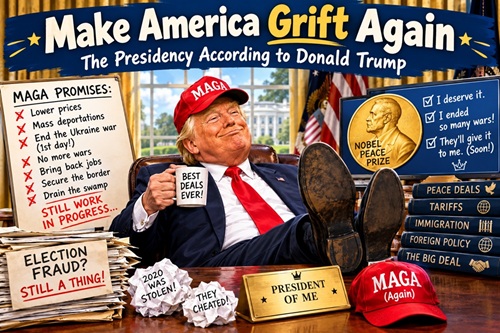
The Oval Office as a Mirror with Gold TrimMost presidents enter the White House with some understanding that the job involves governing a country. They inherit institutions, confront problems, negotiate with adversaries, reassure allies, and occasionally discover that reality has failed to read their campaign literature. Donald Trump has a rather different conception of the American presidency. To him, the presidency is a combination of reality television, a luxury real-estate development, a personal grievance department, and an awards ceremony at which he is perpetually convinced that somebody has stolen his rightful first prize. The country is not so much a republic to be governed as a gigantic audience to be entertained, intimidated, or persuaded to buy whatever he is selling this week. Government policy becomes a promotional slogan. Diplomacy becomes a property negotiation. The Justice Department becomes an object of personal fascination. And the Nobel Peace Prize becomes the political equivalent of a participation trophy that he insists everyone else has received unfairly. The genius of this arrangement, if one can call it genius, is that almost any outcome can be advertised as a triumph. A diplomatic agreement is a historic victory. A diplomatic failure is proof that the other side was unreasonable. An economic problem is somebody else's fault. A personal setback is persecution. And an unfulfilled promise is simply a promise that has not yet been properly explained by the president's communications team. Welcome to Trumpian governance, where the brand is always magnificent, the numbers are always fantastic, and the buck stops everywhere except at Donald Trump's desk. 1. MAGA: The Greatest Hits of Unkept PromisesMake America Great Again was a wonderfully economical political slogan. Four words, one baseball cap, and an entire universe of expectations. America would become richer, safer, stronger, more respected, and presumably so magnificent that other countries would spontaneously line up to pay tariffs as a gesture of gratitude. Trump's 2024 campaign offered something for practically everybody. Workers would get manufacturing jobs back. Consumers would enjoy cheaper energy and groceries. The border would be secured. Illegal immigration would be crushed. Government waste would be eliminated. And wars would end so quickly that the Pentagon might have to cancel some of its subscriptions. Trump even promised to end Russia's war against Ukraine on his first day back in office. Apparently, Vladimir Putin had simply been waiting for a phone call from a New York real-estate developer with a talent for televised self-promotion. Reality, unfortunately, did not cooperate. By 2026, the promise-tracking record had accumulated a familiar mixture of partial achievements, legal setbacks, stalled initiatives, and outright failures. His mass-deportation ambitions ran into practical constraints; his effort to end birthright citizenship faced a Supreme Court setback; and his tariff agenda encountered judicial resistance. His pledge to bring gasoline below $2 a gallon was hardly helped by the war with Iran, which sent prices sharply higher. One can, of course, argue about individual policies. Some promises were pursued vigorously; others were implemented in modified form. A fair assessment should distinguish between what Trump actually did, what he attempted, and what he merely announced with the confidence of a man unveiling a new hotel. But the central absurdity is that Trump sells political success as a permanent condition rather than a measurable outcome. If prices rise, he can blame his predecessor, the Federal Reserve, foreign countries, greedy corporations, or the media. If tariffs hurt American consumers, the pain becomes evidence that his policies are working. If a court blocks him, the judge becomes an enemy of the people. If a diplomatic initiative collapses, the agreement was either a terrible deal inherited from somebody else or a magnificent deal that the other side failed to appreciate. This is not accountability. It is an elaborate system for ensuring that the president is never wrong. MAGA, in this interpretation, does not mean that America will become great. It means that Donald Trump will always be able to say that he made it great, regardless of what the supermarket receipt says. And that is a very different product. 2. The Art of the Deal, the Science of the ExcuseTrump's business mythology rests on the idea that every problem can be solved by negotiating harder, demanding more, and making the other person believe that you are holding all the cards. This works reasonably well in certain television formats. It is less reliable in international affairs, where other countries have their own interests, governments, military capabilities, domestic politics, and inconvenient memories. A country is not a distressed casino that can be purchased below market value after its owner has been insulted sufficiently. Trump's preferred diplomatic technique seems to involve alternating between extravagant praise and public humiliation. One day a foreign leader is a wonderful friend with whom he shares a special relationship. The next day the same leader is an ungrateful fool who has failed to show proper respect. Allies discover that longstanding commitments can suddenly become bargaining chips, while adversaries discover that flattery, a ceremonial handshake, and a few carefully chosen compliments might buy them another round of presidential goodwill. The result is an international environment in which everyone must guess which version of Trump will appear at the next meeting. Will it be the peacemaker? The tariff enthusiast? The territorial expansionist? The dealmaker? The man who threatens to abandon an ally? Or the man who announces that he has always been that ally's greatest friend? Foreign ministries must find this exhausting. Imagine having to maintain a strategic relationship with a superpower whose foreign policy occasionally resembles a reality show in which the host changes the rules halfway through the competition. And yet Trump continues to present himself as the ultimate negotiator. Every encounter becomes a contest of personal dominance. Every concession is advertised as a victory. Every reversal is reframed as strategic flexibility. The problem is that a deal is not good merely because the president says it is good. It is good if it produces durable, beneficial results. A real estate developer can sometimes walk away from a bad contract. A president cannot walk away from geography, history, economic interdependence, or the consequences of destabilizing an alliance system built over generations. America First can become America Alone if its execution is sufficiently incompetent. 3. The Election Fraud Delusion: A Democracy with a Permanent Do-OverTrump's relationship with elections reveals something more troubling than his enthusiasm for self-promotion. He won the 2016 presidential election. He lost the 2020 election to Joe Biden. He then spent years insisting that the second result was fraudulent, despite recounts, audits, court proceedings, and investigations failing to establish the widespread fraud necessary to overturn the outcome. The distinction matters. Election irregularities can occur. Individual cases of fraud can occur. Election systems can have vulnerabilities. Democracies must investigate credible evidence of wrongdoing. But none of that establishes Trump's grand theory that an election he lost was secretly stolen on a scale sufficient to change the result. The extraordinary thing is that the theory survives the absence of the evidence it requires. In 2026, Trump was still promoting the 2020 fraud narrative, even after the release of documents he claimed would provide decisive proof. An Associated Press review found that the material did not substantiate his central allegations of widespread voter manipulation. Here we encounter a peculiar feature of Trump's political psychology: an election is legitimate when it confirms his greatness and suspicious when it does not. Imagine a football manager who declares that every victory proves his tactical genius while every defeat demonstrates that the referee, the scoreboard manufacturer, the opposing team, and the laws of physics are conspiring against him. Eventually, the league might suggest that the manager learn to read the scoreboard. Trump instead demands that the scoreboard be investigated. His refusal to accept defeat is not merely a personal eccentricity. It undermines the principle that makes democratic government possible: political power is temporary, elections are binding, and losers must eventually surrender office. Without that principle, democracy becomes a competition in which the winner governs only until the loser invents a sufficiently elaborate conspiracy theory. And there is an even more cynical possibility. By continually alleging fraud before elections, a politician can prepare his followers to distrust any future result that goes against him. Defeat then becomes not a verdict from voters but proof of enemy interference. The leader never has to reconsider his message, his policies, or his competence. This is an extraordinarily convenient arrangement for a man who regards criticism as an insult and contradiction as a form of treason. The tragedy is that millions of citizens can be drawn into a political fantasy in which their own democratic system is trustworthy only when their preferred candidate wins. The country is then divided not merely over what government should do, but over whether reality itself is permitted to deliver an unwelcome result. 4. The Nobel Peace Prize: Please Hold the ApplauseIf the election fraud saga reveals Trump's difficulty accepting defeat, his pursuit of the Nobel Peace Prize reveals his difficulty understanding recognition. For most people, the Nobel Peace Prize is an award bestowed by an independent committee after it evaluates contributions to peace. For Trump, it has increasingly resembled a customer-service complaint that has somehow escalated to the international level. He wants the prize. He says he deserves the prize. He points to conflicts in which he claims to have played a decisive role. He complains that his accomplishments are not adequately appreciated. And when another person receives the award, the injustice apparently becomes even more intolerable. In October 2026, Trump publicly argued that he should receive the prize while acknowledging doubts about whether the Nobel Committee would award it to him. He cited his claimed role in resolving multiple conflicts, although some parties disputed his contribution and fighting had resumed in several regions. His promise to end the war in Ukraine on his first day back in office had also gone unfulfilled. The irony is almost too perfect. A president who has made his personal greatness the organizing principle of his political identity wants an award that is supposed to recognize contributions to peace. Peace, in this worldview, is not quite the absence of war, the prevention of suffering, or the construction of durable political settlements. It is a personal achievement that ought to be acknowledged with a medal, a ceremony, and preferably a flattering announcement on television. The Nobel Committee's refusal to cooperate with this fantasy is presumably one of the great diplomatic disappointments of our age. One can almost imagine the internal monologue: I have done more for peace than anybody. Everybody says so. People come up to me with tears in their eyes. And now these people in Norway won't give me a prize? What kind of system is this? The answer, Mr. President, is a system in which the recipient does not appoint the judges. That is the point of an independent award. It is not a loyalty bonus, a presidential performance review, or a gift bestowed on the person who asks most insistently. And the Nobel Peace Prize cannot be treated like a trophy purchased for a hotel lobby. It is not enough to claim that you ended wars. One must examine whether conflicts actually ended, whether agreements endured, and whether the parties themselves recognize the settlement. A ceasefire is not necessarily a peace treaty. A handshake is not a security guarantee. An announcement is not an outcome. And a medal handed over by a grateful political ally does not magically make its new possessor a Nobel laureate. The Nobel Committee has made clear that the prize cannot be transferred to another person. Trump's fixation on the award thus becomes a miniature of his entire presidency: the relentless pursuit of external validation by a man who treats recognition as an entitlement. The world is not obliged to give you a medal because you keep telling it how wonderful you are. 5. The Presidency as a Personal Awards ShowWhat unites Trump's broken promises, election fraud allegations, and Nobel ambitions is not simply inconsistency. It is a conception of political office in which the institution exists to affirm the individual who occupies it. In a conventional understanding of the presidency, the office is larger than the officeholder. The president serves a constitutional system, represents citizens who did not vote for him, and must accept that public authority comes with obligations as well as privileges. Trump seems far more interested in the reverse proposition: the office is an extension of himself. The presidency becomes another Trump property, with his name on the entrance and his personal reputation at stake in every transaction. The government is expected to demonstrate loyalty. Institutions that resist him are enemies. Officials who praise him are patriots. Officials who criticize him are incompetent, corrupt, or disloyal. Even the physical environment can become part of the branding operation. The White House, a public institution associated with the continuity of American government, is increasingly treated as a stage on which the president can dramatize his own historical importance. The distinction between the public interest and personal interest becomes dangerously blurred. This does not mean every Trump policy is necessarily wrong, or that every opponent of his administration is necessarily right. A serious assessment must examine specific decisions and their consequences. But it does mean that his governing style invites a fundamental question: when national interests conflict with Trump's personal image, which one takes priority? His repeated insistence that he was cheated out of the 2020 election suggests an answer. So does his anger at perceived insufficient gratitude from allies, and his extraordinary preoccupation with an international prize that would certify his own historical greatness. The presidency is supposed to be a public trust. Trump often behaves as if it were a lifetime achievement award. 6. MAGA as a Customer-Satisfaction ProblemThere is a final irony here. Trump's political strength has always rested partly on the claim that he is a successful businessman who understands what ordinary people want. His supporters wanted lower living costs, secure borders, less bureaucratic interference, and a foreign policy that avoided expensive, open-ended wars. They wanted a president who would put their interests ahead of those of distant elites. Those are legitimate political demands. Many Americans have good reasons to feel frustrated with their political institutions, and dismissing them as dupes would be both lazy and counterproductive. But a movement that promises to judge government by results must eventually confront the results. If groceries remain expensive, voters are entitled to ask why. If a war that was supposed to end continues, voters are entitled to ask what happened. If tariffs raise costs for domestic businesses and consumers, voters are entitled to ask whether the promised benefits justify the damage. If a leader spends more energy discussing his personal grievances than solving public problems, voters are entitled to wonder whose interests are being served. The difficulty for MAGA is that the movement has invested so heavily in Trump's personal image that criticizing the product can feel like betraying the salesman. This is the political equivalent of a customer defending a malfunctioning appliance because the salesman was so charismatic. The refrigerator does not cool the food, but the salesman promised it was the greatest refrigerator ever manufactured. Perhaps the food is not really spoiled. Perhaps the kitchen is too cold. Perhaps previous refrigerators were even worse. Eventually, however, somebody has to throw away the milk. Trump's gift is to transform dissatisfaction into loyalty. The more the world challenges his claims, the more his supporters can interpret the challenge as evidence that the establishment fears him. The more institutions resist his demands, the more he can present himself as a heroic outsider battling a corrupt system. This creates a self-reinforcing political drama in which failure can become a source of renewed support rather than a reason for reconsideration. But it also leaves the country vulnerable to a dangerous substitution: the emotional satisfaction of believing in a strong leader replaces the practical benefits that leadership is supposed to deliver. A nation cannot eat slogans, heat its homes with press conferences, or secure its future with applause. 7. The Great Deal: One Man, One Mirror, No RefundsPerhaps the most revealing image of Trump's presidency is not a campaign rally, a diplomatic summit, or a speech from the Oval Office. It is a man standing in front of a mirror, explaining to himself that he is the most successful president in history while the mirror, unfortunately, refuses to issue a written endorsement. Everything becomes personal. The economy is a reflection of his greatness. The military is a reflection of his strength. Diplomacy is a reflection of his negotiating genius. Elections are legitimate when they validate his popularity. Awards are meaningful when they recognize his importance. The presidency is no longer merely a mechanism for governing the country. It becomes the world's largest stage for the performance of Donald Trump. And this is where the comedy becomes damning. The United States possesses extraordinary resources: universities, scientific institutions, businesses, diplomatic networks, military capabilities, and a constitutional system designed to distribute power rather than concentrate it in one person's hands. Its success depends on institutions and citizens whose work extends far beyond any president's personality. Yet Trump's conception of leadership repeatedly reduces this complex national enterprise to the question of whether Donald Trump is winning. The result is a politics of permanent self-congratulation. The promises are magnificent, the explanations are elastic, the enemies are everywhere, and the awards are always overdue. If the president claims victory, victory must be celebrated. If the evidence contradicts him, the evidence must be attacked. If voters reject him, the election must be questioned. If the Nobel Committee declines to honor him, the committee must explain itself. Somewhere in this circus, the actual business of governing is expected to take place. One almost feels sorry for the civil servants trying to run the country while the chief executive is busy auditioning for the role of Greatest Man Who Ever Lived. Almost. Conclusion: Making America Great Again, One Excuse at a TimeTrump's presidency poses a question that extends beyond one man or one party: what happens when a democratic leader comes to regard the country as an instrument of personal validation? The danger is not merely that promises will be broken. Every administration encounters constraints, makes mistakes, and fails to deliver everything it promised. The deeper danger is a leader who refuses to distinguish between personal humiliation and national adversity, between criticism and betrayal, between a political defeat and a stolen election, or between a diplomatic accomplishment and a trophy he believes the world owes him. A president who cannot admit failure cannot reliably learn from it. A president who treats independent institutions as enemies cannot easily be held accountable. And a president who sees every international relationship as a contest of personal dominance may sacrifice long-term national interests for the short-term pleasure of appearing victorious. MAGA promised to restore American greatness. But greatness is not measured by the number of times a president calls himself great. It is measured by the quality of a nation's institutions, the security and prosperity of its citizens, the credibility of its commitments, and its willingness to submit political power to democratic rules. The Nobel Peace Prize would not settle that question. Neither would another election victory, another triumphant rally, or another golden plaque bearing the president's name. What Trump seems to want is something more extravagant: a world in which reality itself acknowledges his superiority. Unfortunately, reality has never been particularly good at following instructions. And so the show continues. The promises are renewed, the grievances are rehearsed, the enemies are denounced, and the Nobel Prize remains somewhere beyond reach. Perhaps the ultimate Trumpian achievement would be to win the Nobel Prize for Peace while simultaneously demanding that the committee investigate why it took so long to recognize his genius. Now that would be a deal. One hundred percent Trump. Zero percent refund.
Widget is loading comments...
|