|
TRANSLATE THIS ARTICLE
Integral World: Exploring Theories of Everything
An independent forum for a critical discussion of the integral philosophy of Ken Wilber
  Frank Visser, graduated as a psychologist of culture and religion, founded IntegralWorld in 1997. He worked as production manager for various publishing houses and as service manager for various internet companies and lives in Amsterdam. Books: Ken Wilber: Thought as Passion (SUNY, 2003), and The Corona Conspiracy: Combatting Disinformation about the Coronavirus (Kindle, 2020).
Check out my other conversations with ChatGPT
Geopolitics with a Wink:
Geopolitics for Dummies, Why Nations Behave Like People Putin's Jealousy: Ukraine as the Wife Who Dared to Leave How Trump Is Turning Geopolitics into a Global Reality Show Make America Grift Again: The Presidency According to Trump Coke or Pepsi? The American Two-Party System as Marketing Putin's JealousyUkraine as the Wife Who Dared to LeaveThe Geopolitics of a Possessive HusbandFrank Visser / ChatGPT
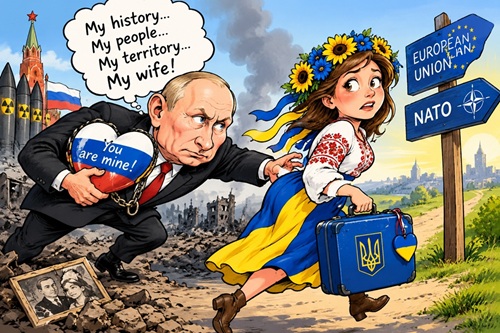 Imagine a husband who cannot accept that his wife is a person in her own right. He regards her not as an independent human being, but as an extension of himself: someone whose identity, loyalties, friendships, and future must remain under his control. For years, he insists that they belong together, that their shared history makes separation unthinkable, and that her desire for independence is an act of betrayal. When she finally decides to leave, he does not wish her well. He threatens her, stalks her, destroys her possessions, and eventually tries to kill her. Now imagine that this husband commands one of the world's largest armies, possesses a vast nuclear arsenal, and can wrap his possessiveness in the language of history, national destiny, and civilizational unity. The metaphor becomes chillingly recognizable. Vladimir Putin's war against Ukraine can be understood, in part, as the geopolitical equivalent of an abusive husband punishing a wife who dares to walk away. Of course, countries are not spouses, and international politics cannot be reduced to domestic psychology. Russia's invasion has military, strategic, historical, and ideological dimensions that require serious analysis. Nor can we diagnose Putin's private psychology from a distance. But as a moral and political analogy, the jealous-husband metaphor illuminates something essential about the logic of domination: the transformation of a former relationship into a supposed entitlement to control another party's future. “If I Cannot Have You, Nobody Can”The possessive husband's fundamental mistake is to confuse intimacy with ownership. Because he once shared a home with his wife, he believes he retains a right to determine where she lives. Because they have a common past, he claims authority over her present. Because she has chosen another future, he interprets her independence as an injury inflicted upon him. Putin's treatment of Ukraine follows a disturbingly similar pattern. Ukraine and Russia share centuries of entangled history, cultural connections, family ties, religious traditions, and linguistic overlaps. But a shared history does not confer permanent political ownership. Ukrainians are not obligated to surrender their sovereignty because Russian rulers regard their country as part of a historical inheritance. Putin has repeatedly challenged the legitimacy of Ukraine's independent national existence, presenting Russians and Ukrainians as essentially one people and portraying Ukraine's Western orientation as a threat to Russia. In his historical essay of 2021 and his speech preceding the full-scale invasion in February 2022, he advanced arguments that questioned the historical foundations of Ukrainian statehood. The jealous husband makes a comparable argument: You cannot really be separate from me. Your independence is artificial. Someone has turned you against me. Notice the crucial reversal. The supposedly betrayed party becomes the aggressor, while the partner seeking independence is accused of causing the conflict. The wife's decision to leave becomes the husband's justification for violence. Ukraine's attempt to choose its own political future becomes, in the Kremlin's narrative, evidence of hostile Western manipulation. This is the logic of coercive control: independence is reinterpreted as provocation, disagreement as disloyalty, and separation as an intolerable act of aggression. The slogan that captures this mentality is brutally simple: if you refuse to belong to me, you must pay for your refusal. The Wife Is Not Allowed to Choose Her FriendsThe analogy becomes even more revealing when we consider Ukraine's desire to develop closer relations with the European Union and, potentially, join NATO. A controlling husband may insist that his wife has no right to associate with people he dislikes. He calls her friends dangerous, their influence corrupting, and her independence a security threat to the household. He claims that he is merely protecting the relationship, when what he really wants is to preserve his monopoly over her choices. Putin's opposition to Ukraine's Western integration has often been presented in precisely this kind of language. NATO expansion, Western influence, and the possibility of Ukraine becoming more securely integrated into European institutions have been invoked as explanations for Russia's hostility. These concerns belong in any serious discussion of European security. But explaining a ruler's security perceptions is not the same as granting him a right to dictate the foreign policy of a neighboring sovereign state. Ukraine's relationship with the West is not simply a private affair between Kyiv and Washington or Brussels. It is a matter of Ukrainian political agency. Ukrainians have their own historical experiences, political divisions, aspirations, and fears. They are not merely pieces on a Russian chessboard. The abusive husband, however, regards his wife's friendships as evidence that she has been corrupted. He cannot entertain the possibility that she might genuinely prefer another way of life. If she disagrees with him, someone must have manipulated her. If she wants to leave, someone must have seduced her. If she resists, someone must be directing her resistance. This is a remarkably convenient worldview. It absolves the controlling party of any responsibility for the relationship's breakdown. Perhaps Ukraine turned toward Europe partly because it feared Russian domination. Perhaps Russian coercion itself helped make Ukrainian independence more urgent. Perhaps the more aggressively Moscow tried to keep Ukraine within its orbit, the more determined Ukrainians became to escape it. In an abusive relationship, the attempt to prevent abandonment can become the very force that makes reconciliation impossible. The Punishment of IndependenceThe analogy becomes more than rhetorical when we turn to the actual violence. Russia annexed Crimea in 2014 and supported armed separatism in eastern Ukraine. On February 24, 2022, Putin launched a full-scale invasion, initiating a war that has brought enormous destruction, mass displacement, civilian suffering, and countless deaths. Russian forces have occupied Ukrainian territory, and the United Nations and international investigators have documented serious violations of international humanitarian law in the conflict. What does the jealous husband do when threats no longer work? He escalates. He wants to demonstrate that leaving him will be more painful than staying. The punishment becomes a message to the victim: Look what you made me do. Putin's public justifications have repeatedly portrayed Russia as responding to Western aggression, protecting Russian speakers, or confronting an existential threat. Such claims do not erase Russia's responsibility for choosing to invade Ukraine. A state may have genuine security concerns without acquiring a license to conquer its neighbor. The abusive husband's rhetoric operates through a similar moral inversion. He insists that his violence is defensive, that his victim provoked him, and that his actions are ultimately intended to restore peace. He may even claim to be acting for her own good. But a person who bombs the house of someone determined to live independently cannot plausibly present the destruction as proof of love. The comparison is especially disturbing because the violence is not merely directed at Ukraine's government or armed forces. It has devastated the lives of ordinary Ukrainians: families separated, homes destroyed, cities battered, children displaced, and civilians forced to live under the constant threat of attack. The analogy to domestic abuse should never trivialize these experiences. Rather, it helps expose the moral obscenity of treating another people's freedom as an offense punishable through collective suffering. In this sense, the war resembles a murderous version of the message If I cannot control your life, I will make your life unbearable. Nostalgia Is Not a Marriage ContractPutin's historical vision is central to understanding the possessive dimension of his politics. The collapse of the Soviet Union was famously described by him as a major geopolitical catastrophe. His subsequent rhetoric has often emphasized Russia's lost status, historical unity, and the injustice of the post-Soviet settlement. The analogy with a jealous former partner is hard to miss. He cannot accept that a relationship has ended because he remains emotionally and ideologically invested in what it once was. But history is not a marriage contract that binds future generations indefinitely. The Soviet Union was a political entity composed of republics that became independent states when it dissolved in 1991. Ukraine's independence was affirmed by a nationwide referendum in December of that year, in which an overwhelming majority of participating voters supported independence. This was not simply a Western conspiracy or a diplomatic misunderstanding. It was an expression of Ukrainian political choice. Russia subsequently recognized Ukraine's independence and territorial integrity through international agreements and diplomatic commitments. Whatever grievances Moscow later developed, they did not create a legal entitlement to reverse that independence by force. A husband may remember the early years of a marriage with genuine affection. He may feel that the separation has robbed him of something precious. He may even believe that the relationship was better for both parties than either can achieve alone. None of this gives him ownership over his former partner. The same principle applies to nations. A former imperial relationship does not confer permanent authority over those who once lived within an empire. Nor does cultural closeness cancel political autonomy. There is something profoundly revealing about a great power that interprets the independence of its neighbors as a humiliation. It suggests that its sense of greatness depends not only on its own achievements, but also on the inability of nearby peoples to choose their own destinies. That is not security. It is insecurity inflated into an imperial doctrine. The Nuclear HusbandThere is, however, a crucial difference between the domestic analogy and geopolitical reality: Putin possesses the means to threaten the entire world. An abusive husband may threaten to destroy his former partner's life. A nuclear-armed leader can make the consequences of confrontation potentially catastrophic far beyond the immediate relationship. Russia's nuclear arsenal gives Putin's threats a significance that no domestic analogy can fully capture. Nuclear deterrence complicates the response of Ukraine's supporters. Western governments have sought to help Ukraine defend itself while avoiding a direct NATO-Russia war. Putin's nuclear rhetoric has been one element of the coercive environment in which these decisions are made. The result is a grotesque asymmetry. Ukraine is expected to exercise restraint in defending itself partly because its aggressor possesses weapons capable of threatening civilization on a much larger scale. Imagine a violent husband holding a weapon of mass destruction and telling the neighbors that any attempt to protect his wife will endanger the entire street. His threat is not merely an expression of anger. It becomes a means of controlling everyone who might intervene. The analogy does not mean that every Western policy decision is correct, or that the risks of escalation should be dismissed. Nuclear war would be an unimaginable catastrophe. Prudence is essential. But there is a danger in allowing the threat of extreme violence to become a permanent veto on the victim's right to resist. If possessing the largest weapon means that a state may determine the political future of its neighbors, then nuclear power becomes an instrument of imperial blackmail. The challenge for Ukraine's supporters is to deter further aggression, protect Ukrainian sovereignty, and pursue a just and sustainable peace without triggering a wider war. That is an extraordinarily difficult task. The difficulty, however, does not transform the invasion into a legitimate exercise of Russian self-defense. What About NATO? The Husband's Defense AttorneyAny provocative analogy deserves to be tested against its limitations. Putin's defenders often argue that Russia was provoked by NATO enlargement, Western interference, or the possibility of Ukraine joining a hostile military alliance. Some Western commentators have likewise argued that Washington underestimated Russian security concerns and failed to appreciate how Moscow would respond to the changing European security environment. These arguments should not be dismissed merely because they are inconvenient. Great-power competition, military deployments, alliance politics, and security dilemmas are real. Western policy can be criticized on its own merits, and the history of NATO enlargement remains a legitimate subject of debate. But the jealous-husband analogy exposes a basic distinction between explaining conduct and excusing it. Suppose a husband fears that his wife is becoming close to people who dislike him. He believes they may encourage her to leave. He might have reasons for distrusting them. Perhaps they really do dislike him. Perhaps some of their advice is self-interested. Perhaps they underestimate the consequences of the separation. Does any of this give him the right to imprison his wife? The answer is no. Likewise, even if Russian leaders sincerely believed that NATO enlargement threatened Russian interests, they still had diplomatic options. They could negotiate, propose arms-control arrangements, seek reciprocal security guarantees, and compete for influence through economic and political means. They could not legitimately invade Ukraine simply because they feared the direction its citizens might choose. There is also an important distinction between Ukraine's aspirations and NATO's decisions. Ukraine did not become a NATO member before the 2022 invasion. Its future relationship with the alliance was contested and uncertain. The invasion therefore cannot be explained simply as a military response to an accomplished Ukrainian accession. Moreover, Ukraine's own security calculations were shaped by Russia's conduct, including the seizure of Crimea in 2014. Russian aggression helped make Western security arrangements more attractive to Ukrainians. Finland and Sweden's subsequent decisions to join NATO likewise demonstrated how Russia's invasion could produce the opposite of its intended strategic effect. The controlling husband discovers that the more fiercely he tries to prevent separation, the more compelling separation becomes. His mistake is not necessarily that every fear he has is imaginary. It is that he treats his fears as a superior claim to another person's freedom. The Wife Has a Voice of Her OwnThere is a further danger in this metaphor: Ukraine must not become merely a passive female victim in a story about Putin's psychology. Ukrainians are not simply the objects of a quarrel between Russia and the West. They are political agents with their own views, disagreements, institutions, and aspirations. Their resistance cannot be understood solely as a reaction to Putin, any more than their national identity can be reduced to opposition to Russia. The metaphor should illuminate domination, not erase Ukrainian agency. Ukraine's population is diverse. Its citizens have differed over language, regional identity, relations with Russia, and the country's preferred political orientation. Those differences do not invalidate Ukrainian statehood. Nor does speaking Russian make someone less Ukrainian or automatically more loyal to Moscow. A possessive worldview struggles to recognize such complexity. It divides the world into loyalists and traitors, authentic members of the family and those who have been corrupted by outsiders. Putin's rhetoric has frequently drawn upon a conception of historical and cultural unity that makes Ukrainian independence appear unnatural or provisional. Yet the decisive question is not whether Russians and Ukrainians share a civilization, a history, or even overlapping identities. They plainly do. The question is whether those connections entitle one nation to rule another. They do not. The wife in our analogy is not obliged to prove that her new friends are perfect, that her future will be easy, or that every decision she makes is wise. Her right to leave does not depend on the infallibility of her judgment. Likewise, Ukraine does not have to demonstrate that every Western government is benevolent, every European institution is effective, or every Ukrainian political decision is correct before it can claim the right to exist as an independent state. Sovereignty is not a prize awarded to countries that make no mistakes. It is a fundamental principle of international order. Can There Be Peace with a Possessive Husband?The metaphor leads to an uncomfortable question: what would reconciliation mean? In an ordinary marriage, the end of an abusive relationship may require separation, legal protection, and the recognition that reconciliation is neither obligatory nor necessarily safe. Appeals to the couple's shared past cannot substitute for the victim's security. International politics is more complicated. Russia and Ukraine are neighbors. They share borders, economic connections, environmental concerns, and a long history that will not disappear when the fighting stops. Some form of future coexistence is unavoidable. But coexistence is not the same as restored intimacy, and peace is not the same as submission. A sustainable settlement would have to address Ukraine's security, the territorial consequences of Russia's invasion, the rights and safety of affected populations, and the difficult question of how to prevent renewed aggression. Any negotiated outcome would also have to confront the realities of military power and the political choices available to the parties. There is no simple diplomatic formula that resolves all these issues. What the abusive-husband analogy rules out is the fantasy that peace can be secured merely by persuading Ukraine to behave more obediently. If the underlying demand remains that Ukraine must never exercise meaningful independence from Moscow, then a ceasefire may simply become an interval before the next attempt at coercion. A peace imposed through fear might stop the shooting temporarily while leaving the fundamental conflict unresolved. It could reward aggression, encourage further demands, or create the conditions for another war. Conversely, a peace that ignores Russia's legitimate security interests or fails to establish workable arrangements for coexistence could prove unstable as well. The objective should not be to humiliate Russia or to turn every Russian citizen into an enemy. Nor should it be to restore Putin's imperial self-image at Ukraine's expense. It should be to establish a settlement in which Ukraine's existence and political autonomy are not permanently subject to Russian permission. A former partner may grieve the loss of a relationship. A nation may grieve the dissolution of an empire. But neither grief creates a right to violence. The Real HumiliationPerhaps the deepest irony is that Putin's war has damaged the very relationship it purportedly sought to preserve. A country that might once have maintained complicated, sometimes affectionate, sometimes resentful ties with Russia has been subjected to invasion, occupation, bombardment, and enormous human suffering. The resulting hostility cannot simply be attributed to Western propaganda. It is also a predictable consequence of what Russia has done. If the purpose was to keep Ukraine close to Russia, the invasion has instead deepened the rupture. If the purpose was to prevent NATO from becoming more attractive, the war has encouraged NATO's expansion. If the purpose was to demonstrate Russian greatness, the spectacle of a powerful state trying to subdue a neighboring country has also exposed the limits of its political imagination. The jealous husband ends up destroying the possibility of the relationship he claims to cherish. This is the tragedy of possessive power. It cannot distinguish love from ownership, loyalty from obedience, or peace from the absence of resistance. It seeks to preserve a relationship by eliminating the freedom that would make the relationship meaningful. At the national level, the consequences are incomparably larger. People die, cities are destroyed, families are displaced, and generations inherit trauma. The metaphor is useful precisely because it strips away the grandiose language of destiny and exposes the elementary moral structure underneath: one party claims the right to control another and uses violence when that right is denied. Conclusion: Ukraine Is Not Putin's PropertyVladimir Putin is not literally a jealous husband, and Russia is not literally a household. The analogy cannot explain every strategic calculation, historical grievance, or institutional interest involved in the war. But it captures a central feature of Putin's relationship with Ukrainian independence: the refusal to accept that a neighboring people can have a political future not determined by Moscow. The possessive husband says, We have a history together, therefore you belong to me. The imperial ruler says, We have a history together, therefore your sovereignty is conditional. The husband threatens punishment if his partner leaves. The ruler threatens war if a neighboring country chooses a different geopolitical orientation. Both transform a claim of attachment into a claim of authority. Both portray resistance as betrayal. Both can insist that their coercion is defensive, even as they inflict the very suffering that makes reconciliation less likely. But history is not ownership, proximity is not subordination, and cultural kinship is not a political chain. Ukraine may make mistakes. Its Western partners may make mistakes. NATO policy can be debated, and Russia's security concerns can be examined. None of these considerations alters the essential principle: Ukrainians are entitled to determine their own country's future without being invaded for exercising that right. A peace that depends on Ukraine's permanent obedience would not resolve the underlying problem. It would merely institutionalize the logic of coercive control. The final lesson of the metaphor is therefore not that Putin should learn to be a more considerate husband. It is that Ukraine is not his wife, his possession, or his inheritance. A nation is not an unfaithful spouse. Independence is not adultery. And an invasion is not an act of wounded love. It is an exercise of power against people who have the right to live without it.
Widget is loading comments...
|